I do not have a diabetic cat

Status
Not open for further replies.
Sorry, Larry, but no; it shows error variance.
You'll seldom find a Pearson correlation of 1.0, which is perfect.
You need to acquire test data to get the distribution for both the home meter and the lab meter.
To review it visually, you plot on a graph to see where the pairs of tests display; this is not a statistical test, however.
You have to determine if each measurement tool shows the glucose as normally distributed or not, then determine if the Pearson correlation coefficient is the correct statistic to use (parametric) or some other statistic (non-parametric).
In measurement science, there is always error in measurement. For well standardized tools, such as distance, this is usually quite small. We already know that home human glucometers, testing human blood, are allowed to read anywhere within 20% of what a lab would get. Lab equipment has much narrower allowances than that.

BTW - I have over 25 years of experience in statistics and measurement science.
 
Well the conservation center is out but the other keeper is interested and may be able to get a zoo on board if she can get a grant for a real study.

In the mean time I'll use the .7 from the one comparison test since it's all I got. When things warm up then I can take Aurora in and test her(maybe drag Pua along too) and slowly compile comparison tests as I can.

So I started Pua a SpreadSheet with one test this morning on there so far of 208 but was actually at +9 since supplement since it was late and probably around 4 hours since last eating.
 
Last edited:
Okay got the ketodia sticks. The whole read at exactly so many seconds thing threw me a bit but think she was moderate keytones and 250-500 glucose but she had also tested very high that morning with the meter and it turns out when she broke into the fridge she had had some of the weigh I had drained when making their cheese, which is about the worst thing she could do for her glucose. That item has been moved to the fridge she can't get at now.

Maybe anteaters are a bit better at dealing with keytones for some reason. She had those two bouts of what might have been ketoacidosis on her walks but recovered with some rest and drinking lots of water but seems a regular pet would have likely been in hospital for awhile. Doesn't make it okay though and will see how she tests when she hasn't been eating forbidden food.
 
We generally encourage increased water consumption in cats showing moderate or higher ketones, to help flush them out. Maybe add a little bit of water to one of the things she eats.
Ketones can turn into an acidosis, but if anteaters normally deal with an acidic diet (formic acid in ants, right?), that may be why they can tolerate it better than cats.

You might set up a spreadsheet of any paired tests you get, separate from her routine monitoring. that way, it'll be easier to do an analysis.
Use the columns I mentioned earlier. I can help with the statistical analysis.
 
I can try adding more water bowls. Pua has an obsession with visiting and drinking out of every water source there is. Maybe related to a survival instinct to know where they all are in case things start drying up. I don't know though. Aurora refuses to even drink water and relies on the water in her soup food.

Don't like that she still had a high number this morning. She started out lower on the first so don't think it's just the new conversion method. The only other thing I changed in that time frame was using the sour cheese instead of buttermilk, it should have less sugar but maybe I'm not doing something right. I can try buttermilk and see if the numbers go back down.

And yeah getting more comparisons will require a better tracking method like the graph.
 
Last night's pee was still moderate keytones but glucose read 1000. She just pees once a day when she gets up. I'm gonna try adding back the more chia seeds. I tried removing them due to the carbs as mentioned but she had trended down before when I added them.
 
I think it may be time to talk with the vet about trying a bit of insulin; those numbers are really high.
 
Yeah I'm not liking those numbers. I want to try running the strip through her pee stream to be sure it's not being effected by my method. She pees on a fresh pee pad and I dab it on that. She did not cooperate last night though.

I was just thinking being able to give her insulin would be nice. My vet would like to run her through some insulin testing first to see if she actually has low levels or is just resistant but that probably wont be feasible. It's also a scary thought to not be sure I can home test properly as she has been in low 100s sometimes the once verified by lab tests.

Making some changes to her supplements and see if we can get a change back down but we may be forced to do insulin despite the dangers. Maybe start her on a tiny dose just once a day and work up.
 
Starting with a tiny dose is important. Check locally for what is available and what the concentrations are.
Humulin/Novolin NPH may be available and do have diluents available, plus it should be inexpensive.
 
Novalin is a slower acting one right? I think a slower acting one once a day would be the best to start since they literally sleep all day most days without getting up to eat, drink or even pee. I would fear insulin during the day could send her into clinical torpor from going too low.

I added her labs but one row is showing colors. What did I do wrong?
 
No, Novolin/Humulin (same insulin, different brands) NPH (means neutral protein Hagedorn), lasts about 6-8 hours in cats. In dogs, which have a slower metabolism, it lasts about 12 hours. Since anteaters have a really slow metabolism, it seems logical than NPH type insulin might work well. Or maybe even Regular insulin, which in cats, may last 4-5 hours max (those speedy, revved up kitties!)
Its something to discuss with a vet.
 
Last edited:
Saw the vet today got blood from Pua and Aurora for comparisons. Vet is really reluctant about insulin since we have no history of using it in anteaters to make her comfortable with doing it. Said animals can live along time with high glucose but a drop could kill her fast and that I should continue to try diet changes or natural means. I'm just not sure what else I can do since her companion is so picky about her food and Pua takes some of that. I switched to lower fat meat in the diet and Aurora went on hunger strike. I had to switch to around half old and half new recipe and then she decide it was food after all. Pua's keytones did come down to 15 on her last test though.

I'll see about making a chart once I have the lab values but Aurora was 29 freestyle, 25 alpha cat setting and 34 dog setting. Using the .70 conversion for freestyle her lab should be around 41, which would be typical of her, though she has always been not eating when tested in the past so I had expected higher this time, guess not. If I convert based on the difference in dog meter to lab on Pua's old test it'd be 36 we could expect the lab but I doubt that.

Pua was 170 freestyle, 195 cat meter and 233 dog meter. So using FS difference should be 242.8 lab or using the old dog difference could be 253 lab.

I'm just curious to see which will wind up being closer but I know all tests combined will be used once we have a few for the data but choosing one meter over the other. So if FS is closer after conversion using the old number then it makes sense to stick with that for future compiling, I think, even though the alpha was closer non-converted. Also we used the vets alphatrack which was gray but mine's pink. I'm out of alpha strips so didn't bring it. We used the vet's alpha meter last time too though.
 
They do make a diluent for the NPH insulins, I believe. That would permit the adjustment of the concentration to one the vet might feel was safe to test.
NPH is normally a U-100, or 100 units per mL. Dilution could get it down to any concentration desired.
 
That could help. She also was eager to see glucose tests for other anteaters, besides the zoo value chart we have, so will see if my friend can do hers soon. If they test low 40's like Aurora then it will help prove Pua is way to high and not just kinda high like her numbers might be for other species.

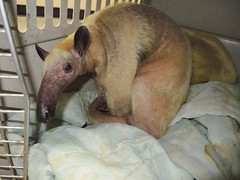
Here's Aurora being grumpy at the vet prior to blood draw
Grumpy Aurora by TamanduaGirl, on Flickr

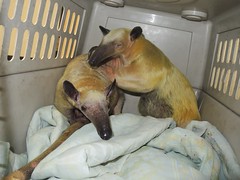
Pua clinging to Aurora after her blood draw
Pua clinging to Aurora by TamanduaGirl, on Flickr

Couple peas in their pod ready to go home
Two peas in a pod by TamanduaGirl, on Flickr
 
Okay got a sheet made up with their meter and lab tests. I'm scratching my head at Aurora's results. If she were a cat she'd be dead, right? Maybe she's a zombie anteater. She's fine mostly. She has some fur issues, taurine and botin helps her a lot there. Could be hypothyroid but no way to test for that in them yet. Lowest tested zoo tamanduas were 33 glucose, so not that much lower but probably lower than average. Aurora has noramaly been 40's but was always not well and not eating when tested before.

Edit: after looking closer at Aurora's blood values it points to addison's rather than thyroid. She's been my problem child health wise since rescued.
 
Last edited:
Okay I'm having math fail and know you can help. I thought Pua's old compare test was a 30% difference but I went to math them out now and it looks like 5% difference. I wanted to try and line graph it, even though I only have the three comparisons(my friends vet can't seem to draw blood from her's it is a difficult things, my vet is great at it though), so far just to get some rough idea of the sliding scale.

So percent differences:
lab: 107 meter: 99 (7%?)
lab: 234 Meter: 170 (27%)
Lab: 29 Meter: 28 (-3.5%?) Negative used just so I know which direction the difference goes.

Are these right? If so I don't know how I got 30% before if not I must have forgotten all my schooling or something. I was wondering as I got 155 meter today and at 30% difference that would be still a bit high but if the 107 vs 99 difference is really 5% the the difference changes faster than I thought and that is likely a really good number somewhere in between.
 
Last edited:
Okay I checked with Google and I'm doing it right now it seems. So made the chart. So using the chart today's 155 would be about 190(Wish I could add lines to the chart to make it easier to check) instead og 221 using the .70 conversion. I know you told me that all along but I thought it was a smaller difference due to somehow messing up the original difference. Really need some more mid range comparison values to be sure of better accuracy though but seems more accurate for when I get lower numbers like today.

https://docs.google.com/spreadsheet...PFC9_8HaVRipR2cTs4behkBlg/edit#gid=1056993474
 
Chances are the differences are going to be different at different BG levels. The variance between an alpha trak and a human meter in cats can't be calculated by a flat percentage as the variance changes depending on whether the numbers are higher or lower, I think the variance is higher in higher numbers. That even applies between different human meters, eg the freestyle light meter reads significantly lower than most meters in higher numbers but with lower numbers the variance is less - percentage wise.

Such cute photos, looks like neither of them were talking to you by the time they were coming home and just presenting bottoms, in fact that tail stuck straight out the back looks like a big up yours!

So difficult trying to figure out the best thing to do when you're a pioneer, I feel for you.
 
It'll depend on the direction of your math - do you want to know the percent the human meter is compared to the lab, or the percent the lab is compared to the human meter? I'll assume the former.
meter/lab*100, rounded to 1 decimal: human meter runs lower than lab

-27.4% @ 170
-7.5% @ 99
-3.4% @ 28


Don't forget that all home glucometers can have a 20% variance per FDA regs (I think they are in the process of changing this to 15%). That means that the real reading can be + or - 20% of what you see so the variance in numbers depends on how low or high the bg is. A 100 can really be anywhere from 80 or 120. And a 400 can be between 320 or 480. (This doesn't even touch on the fact that there is even an accepted percent variance for lab testing, too.)

What this means for your tests is that the first and last are really the same number because of the variance of accuracy:
lab: 107 meter: 99 (meter variance: 79.2 - 118.8)
lab: 234 Meter: 170 (meter variance: 137-204)
lab: 29 Meter: 28 (meter variance: 21.4 - 33.6)

So my reading is that the lab and the home glucometer are reading the same, except for the second test. Once you get more numbers you can tell if that one test is just an anomaly.
 
Vyktors Mum, thank you. They are curled up in balls with their heads underneath so you are actually seeing their upper backs but I'd say the sentiment is about the same. And Yeah BJM had said all along I needed to graph it but I don't really have enough comparison tests yet and thought both the upper tests were in the 70% difference range so thought a formula would work for upper numbers but I finally saw my mistake so that was wrong.

I thought I needed the % difference to do the graph but I went with a simpler graph instead so I can find her home test number on the graph then go strait up and that "should" be roughly the lab number assuming the current curve is right but it could be it more suddenly rises at some point or could be like Maggie said and an anomaly on the one, will need more tests to be sure. For now it would look like her reading of 155 would be roughly 190 lab(actual level).

I've tested the meter on the control fluid a lot and it seems to be pretty steady in it's readings, like not getting a random high or low, the one time it was swinging more I changed the battery and it went back to normal but it's possible. Maybe should double check when I get a random higher or lower number though to be sure. I think over all even though it can be 20% difference from actual level it's likely always close to the same amount different. I guess the question would be if someone using the same brand and style of meter would be much different than mine? As that was the plan to try and get others to do comparisons with the same meter, only not literally my meter. But if mine is say 20% and others could be 15% or 10% using the same type meter that would complicate the results a bit but then that is also the goal to get enough results so anyone could use that meter on a tamandua and know what the results mean but necessitates even more results due to that possible variance.

But it does make sense too that if the difference is within he possible variance it could be considered basically an accurate reading. But it does seem the percent difference goes higher with each higher test but there's not enough to know for sure yet.

Oh I did find out that if I don't get enough blood and squeeze a bit more out to finish filling the strip it can falsely read high so I don't do that now. I just need a new strip if it fails the first try.
 
I think over all even though it can be 20% difference from actual level it's likely always close to the same amount different. I guess the question would be if someone using the same brand and style of meter would be much different than mine? As that was the plan to try and get others to do comparisons with the same meter, only not literally my meter. But if mine is say 20% and others could be 15% or 10% using the same type meter that would complicate the results a bit but then that is also the goal to get enough results so anyone could use that meter on a tamandua and know what the results mean but necessitates even more results due to that possible variance.
I believe the variance is each individual meter, not necessarily by brand. But I'm not sure. And no, the variance is a percentage, not a number. It varies according to reading. The lower the bg reading, the smaller the amount of variance. The higher the reading, the larger the amount of variance.

As BG numbers vary almost minute to minute and all tests have an accuracy variance, there are really no hard and fast numbers in treating diabetes. Just an approximate (but close) number that tells if she is too low, too high, if it's safe to give insulin. We look to patterns and trends.

I understand you are trying to come up with a scale just for Tamanduras, as we have for cats using a human meter. The examples you have so far looks like the your Pua's readings with a human meter is very similar to the lab test and might not need to be adjusted. But as you said, more data is needed to be sure.
 
example of the 20% meter variance
a test of 50 means the result is likely somewhere between a test of 40-60, a span of 20
a test of 500 means the result is likely somewhere between a test of 400-600, a span of 200
 
I understand that but what I meant is the control fluid is not changing how much glucose is in it and the meter reads about the same each time on it so not jumping around by 20%, or I thought it didn't but checking the records the highest vs the lowest is a 15% difference. Was thinking of the wrong meter it was the alpha track that got almost the same number each time, literally just a point of two difference but it was further off from lab so made more sense to use the freestyle. So what I was saying is if it was like my other one whatever amount it's off would be static but that others might be different amount off but since it does jump around that's not valid. I see what you mean now and I just got lucky with a meter that doesn't vary in the alpha, I guess. But with it not varying on tests it had me thinking the variance is just how much it can vary from lab not how much it can vary when used repeatedly on the same sample or control fluid.

Okay so if I were to unadjust her numbers she's doing pretty good though would like to see her under 180 more often. It's been mostly under 250 non-adjusted but hoovering near 180 half the time. Still the little info I have seems to show it may be lower than lab more as it gets higher so really need some more info.

She's gone up the last few days because the recent batch of food doesn't have silkworm in it due to running out because of shipping delays. I tried adding some more ants and fiber so will see if that helps tonight. High last night was 242 unadjusted (doesn't look as ugly that way but still not great).
 
Last edited:
The +/- 20 is for the whole system of meters and strips. If you always use the same meter then you will experience less variation on test to tesif you tested blood with the same blood level.
The test strips themselves are part of the overall +/- 20. Test trips are coded in order to reduce the contribution to the +/- 20% if you always use the same lot of test strips there will be less variation in BG value of you use blood with the same BG value.
 
That makes sense.

Well seems there really are magical properties to silkworms that lower blood glucose. Guess I will be ordering them in bulk next time and feeding more of them. I upped the fiber and ants last night but her level was even worse today. The only change that correlates with the increase was no more silkworm pupae.

And this verifies it's real: http://medicine-hygiene.idnwhois.org/article-13881.html

How weird and frustrating as it will probably be a week or so as all my orders were delayed due to Chinese New Year, it's almost a 2 week holiday!
 
Whenever you report the numbers, do so unadjusted. Track them vs lab numbers on a separate plain page of your spreadsheet for developing norms and reference values.
Keep the date with them and sort them in ascending order based on both of the meters as you add them in - you may get some tests where a number on your meter gets 2 different numbers from the lab. This is normal due to the error allowed in home meters. It will help you see the range of variation along the continuum.
 
Status
Not open for further replies.
Back
Top