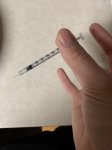
I know, I know, I know. This forum is for helping our furry friends, but this caregiver could use some help. My kitty, 11 years old, was diagnosed about a month ago. Since then, I’ve not been able to give him a single injection, I’m paralyzed with fear. I take him to a local vet daily where he gets one injection which is just slightly better than none. The vets and their staff are great, and have encouraged me as I try to work though this. Still, I awake every morning by 2 AM and start worrying, dreading injection time. I’m eating very little and can’t concentrate on anything. I have a tremor which makes matters worse as the more I worry the worse the tremor gets which makes injections even harder. I try to think happy thoughts, that the injections don’t hurt him, they will help him. I think of bad thoughts, what will happen to my dear kitty if I can’t do this. Nothing helps, I’m completely, totally irrational. IRRATIONAL. My own doc has prescribed an anti-anxiety med but thus far it’s not helping. I’ve thought about seeking psychiatric help but that takes time and I don’t know if my furbaby has the time. Please advise if you can!
I see you take your kitty once a day for to your vet daily for one injection of insulin. Cats need insulin every 12 hours. I assume you are doing the night time injections?
Are you testing his BG at home , do you have a meter?
Here is something one of our members wrote up about testing
If you are not testing your kitties BG both AM and PM you won't know if the number is safe to give insulin, plus we tests a couple times a day during each 12 hour cycle
God forbid he goes hypo
If you live in the US I can suggest what human meter to buy.
Our numbers are based on human meters
As far as giving insulin you are not hurting him.
If you have to give him a treat while you attempt to test that's fine.any freeze dried treat or a piece of boiled chicken
Testing I found this written by one of our members
Here's something I wrote up for others for testing...maybe it'll help you too! (substitute "her" for "him")
It can be really helpful to establish a routine with testing. Pick one spot that you want your "testing spot" to be (I like the kitchen counter because it's got good light and it's at a good height....it also already blocked 2 escape routes due to the wall and the backsplash) It can be anywhere though...a rug on the floor, a table, a particular spot on the couch...wherever is good for you.
Take him there as many times a day as you can and just give his ears a quick rub and then he gets a yummy (low carb) treat. Most cats aren't objecting so much with the poking..it's the fooling with their ears they don't like, but once they're desensitized to it and learn to associate a certain place with the treats, they usually start to come when they're called! Or even when they hear us opening the test kit!
You also have to remember...you're not poking him to hurt him...you're testing him to keep him safe and understand what's going on inside his body. There's just nothing better than truly understanding what's going on inside your kitty's body and with this disease, the more knowledge you have, the more power you have against it. The edges of the ears have very few pain receptors, so it really doesn't hurt them.
Also, if you're nervous and tense, it's going to make your kitty nervous and tense too. As silly as it might seem, try singing! It forces you to use a different part of your brain!
It's also important to make sure his ear is warm. A small sock filled with a little rice and microwaved or a small pill bottle filled with warm water (check temp against your wrist like you would a baby bottle) works well
For new kitties, using a heavier gauge lancet is also really helpful. A 25-28 gauge lancet pokes a bigger "hole" than a 31-33 gauge lancet does, so look for "Alternate Site testing" lancets that are usually a lower number
Finding the right "treat" will be a great help too! Freeze dried chicken, bonito flakes, little pieces of baked chicken...whatever low carb treat you can find that he really enjoys will help him to associate the testing with the treat! China's Achilles heel was baked chicken, so I'd bake a piece, chop it into bite sized pieces, put some in the refrigerator and freeze the rest to use as needed. It didn't take long for her to come any time I picked up the meter!
Testing
Always aim for the sweet spot warm the ears up first, you can put rice in a sock and put it in the microwave, test it on the inside of your wrist to be sure it's not to hot, like you would test a babies bottle. You can fill a pill bottle with warm water and roll it on the ears also.Just keep rubbing the ears with your fingers to warm them up
6. As the ears get used to bleeding and grow more capilares, it gets easier to get the amount of blood you need on the first try. If he won’t stand still, you can get the blood onto a clean finger nail and test from there.
When you do get some blood you can try milking the ear.
Get you finger and gently push up toward the blood , more will appear
You will put the cotton round behind his ear in case you poke your finger, after you are done testing you will fold the cotton round over his ear to stop the bleeding , press gently for about 20 seconds until it stops
Get 26 or 28 gauge lancets
A lot of us use the lancets to test freehand
I find it better to see where I'm aiming
You can also put a thin layer of vaseline on the ear ,to help the blood bead up
Here is a video one of our members did
VIDEO:
How to test your cat's blood sugar
Here is a link ,tap on the blue link and tell us about your kitty
Just tap on your name and then tap signature add the information and hit save
Here is a link
helping us to help you link. If you noticed, our members have some basic information about their cat's in their signature. This helps us to not pester you by asking the same questions (your cat's name, insulin type, date of diagnosis, etc.) repeatedly. We also have a link to our spreadsheet in our signature. We are very numbers driven. The spreadsheet is a record of your cat's progress. By linking it in your signature, we can follow along and provide feedback should you need the help.
- Add info we need to help you:
- Caregiver & kitty's name
- DX: Date
- Name of Insulin (do not include dose or frequency)
- Name of your meter
- Diet: "LC wet" or "dry food" or "combo"
- Dosing: TR or SLGS or Custom (if applicable)
- DKA or other recent health issue (if applicable)
- Acro, IAA, or Cushings (if applicable)
- Spreadsheet link. Please put the signature link on the bottom line of your signature information, on its own, so it is easy to find.
- Please do not put any information about your location in the signature for security reasons. If you wish to add your country location, please add it to your profile.
Be sure to click the 'Save Changes' button at the bottom. If you need help urgently it is important we know these things at a glance. We don’t want to waste valuable time finding out information.



 This makes me soooo happy!
 .
.