Michi&Charlie
Member Since 2026
Hello again Lovelies,
We've been struggling over here with Charlie's sugars and I'm not quite sure where we are going wrong. I just spent the last little bit entering all his data into his spreadsheet. We use a notebook to log since I'm not home everyday (four day long shifts out of town) and my hubby, Matthew, and I are basically taking shifts with Charlie. Charlie is slowly adjusting to testing, but it's been a bit of a rollercoaster. He also just finished treatment for an upper respiratory infection and was on both cortisone/antibiotic eye drops and an oral antibiotic which we recently finished. Now that the infection has cleared up, I'm hoping we will see some more stability but I'm not 100% sure how much of an effect that had. I know in humans, that sort of thing can cause drastic shifts in blood sugars, so maybe?
One of our major hurdles that we've encountered is our vet is not the most helpful individual I've ever met and doesn't seem very knowledgeable. When I ask why to any instruction, I get repeated instructions with no explanations and I think that he has decided I'm "difficult". He's not wrong, lots of people find me "difficult" but it doesn't mean that in this case I'm wrong either. I absolutely plan to go to another clinic next time, but we are severally short on the funds right now to do so. The vet we have been seeing has been emailing back and forth with me but his instructions don't seem correct to me. From day one, he has repeatedly instructed me to only feed Charlie twice daily. Every 12 hours when he gets his shot, and that's all. That's despite the fact that Charlie was severally underweight at his appt on Feb 21, (3.4 kg and he's a very large framed, lanky cat- he's a loooong boy). He even commented on him being too thin for his size and that it was indicative that he's probably been unwell for a while (honestly, I should have taken him in years ago. I was terrified that they would just tell me "he is old" and tell me to put him down. I've been kicking myself since he was diagnosed for not taking him in when he first started to lose his appetite.) It's also despite the fact that Charlie has been free fed his entire 19 years of life, has never been a cat that gorges and never over weight. I can't recall what he weighed at his healthiest, but he was very muscular, athletic and never chunky fella.
Since starting the insulin, Charlie is ravenous. Every four hours around the clock he is crying and yowling for food. He comes over to me and his stomach is audibly growling. He's not gorging, he's not eating because he's bored. He's legitimately hungry. He doesn't rush through the meal but usually cleans his plate, or takes a break and goes back to it later and finishes then. So, I've been pretty well feeding him a small amount of food whenever he really persistently asks for it. Sometimes at night I can ignore him and he'll settle without eating for a little bit, but then when he next asks he's VERY adamant that he needs to eat "RIGHT NOW, MAMA!". We've cut out almost all treats, with the exception of some freeze dried treats, and he gets one of those Delectable tube treats once a day. With the exception of the odd treat (to get him through to his next feeding if he's being super demanding but it seems to close to his previous feeding), we feed him a small serving of either Fancy Feast pate, Almo Nature (the low carb varieties), Tiki Cat or raw cat food.
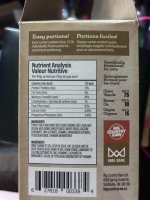
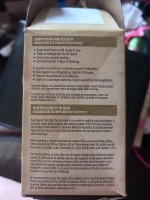
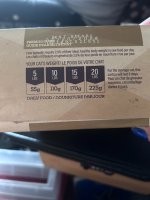
I switched to a couple of different raw foods and have noticed something odd, that maybe means that I don't quite understand the nutritional side as well as I thought I did. One of the new raw foods is not a complete food but a supplement, that consists of 100% beef organ meat. We use it sparingly as a treat, he loves it, and it doesn't seem to cause any sudden or drastic changes to his BGL. However, the other new one I picked out, seems to cause him to end up high, but I don't understand why. It says on the package that it's 1% carbs, and the ingredients seem ok to me. The only possibility I see is that it lists barley and wheat grasses as the 7th and 8th on the list. I've attached pics of the package. His previous raw food that I used to feed him sometimes has a bunch of fruits and vegetables in there so I purposely didn't buy that one again. I thought this one would be a better choice, and he freaking LOVES the stuff, but it seems like every time I give it to him he has a high reading later. I's super confused because it seems like a significant high for what I thought was still a low carb food despite the grasses, so now I'm not sure I understand any of it.
I can't stick to one food or brand because Charlie absolutely refuses. He used to be that cat that ate the same kibble and cans for a decade then one day he just stopped. Now if I give him the same thing two days in a row he looks at me like "Are you kidding me, Mama?". He's an elderly fella and I try to give him variety for enrichment as well, he doesn't have a lot of excitement in his days anymore (though he did have some very strong opinions over the new to the neighbourhood, adolescent ginger kitty who showed up outside the bedroom window the other night at 3 am). I don't think restricting him to two meals per day, 12 hours apart is reasonable at all and I refuse to follow the vet's instruction. I think the vet genuinely thinks this disease is just too difficult to manage any other way and I refuse to buy into it. I've been rewarded with a very happy kitty who's putting on weight, has more energy, is back to being playful and looks like he feels better, but his sugars are all over the place. I can spot when his sugars are high even before I double check with a poke because he starts to get a tiny bit unsteady/wobbly or just slightly ... off. I can tell when the insulin starts to drop his sugar because he perks up and can hold his tail nice and high and trots around like a much younger cat. I'm willing to do whatever I have to do to give him the best golden years of his life I can. I don't care if it's going to be more difficult if it means that he's happy and comfortable. No doctor would tell a human diabetic to only eat two meals a day just because otherwise it makes it harder to manage, they would teach the person how to manage it better in order to have a better life.
Any help would be GREATLY appreciated. I tried to include as many details as I could in the remarks on the spreadsheet.
~Michi&Charlie
We've been struggling over here with Charlie's sugars and I'm not quite sure where we are going wrong. I just spent the last little bit entering all his data into his spreadsheet. We use a notebook to log since I'm not home everyday (four day long shifts out of town) and my hubby, Matthew, and I are basically taking shifts with Charlie. Charlie is slowly adjusting to testing, but it's been a bit of a rollercoaster. He also just finished treatment for an upper respiratory infection and was on both cortisone/antibiotic eye drops and an oral antibiotic which we recently finished. Now that the infection has cleared up, I'm hoping we will see some more stability but I'm not 100% sure how much of an effect that had. I know in humans, that sort of thing can cause drastic shifts in blood sugars, so maybe?
One of our major hurdles that we've encountered is our vet is not the most helpful individual I've ever met and doesn't seem very knowledgeable. When I ask why to any instruction, I get repeated instructions with no explanations and I think that he has decided I'm "difficult". He's not wrong, lots of people find me "difficult" but it doesn't mean that in this case I'm wrong either.
I absolutely plan to go to another clinic next time, but we are severally short on the funds right now to do so. The vet we have been seeing has been emailing back and forth with me but his instructions don't seem correct to me. From day one, he has repeatedly instructed me to only feed Charlie twice daily. Every 12 hours when he gets his shot, and that's all. That's despite the fact that Charlie was severally underweight at his appt on Feb 21, (3.4 kg and he's a very large framed, lanky cat- he's a loooong boy). He even commented on him being too thin for his size and that it was indicative that he's probably been unwell for a while (honestly, I should have taken him in years ago. I was terrified that they would just tell me "he is old" and tell me to put him down. I've been kicking myself since he was diagnosed for not taking him in when he first started to lose his appetite.) It's also despite the fact that Charlie has been free fed his entire 19 years of life, has never been a cat that gorges and never over weight. I can't recall what he weighed at his healthiest, but he was very muscular, athletic and never chunky fella.Since starting the insulin, Charlie is ravenous. Every four hours around the clock he is crying and yowling for food. He comes over to me and his stomach is audibly growling. He's not gorging, he's not eating because he's bored. He's legitimately hungry. He doesn't rush through the meal but usually cleans his plate, or takes a break and goes back to it later and finishes then. So, I've been pretty well feeding him a small amount of food whenever he really persistently asks for it. Sometimes at night I can ignore him and he'll settle without eating for a little bit, but then when he next asks he's VERY adamant that he needs to eat "RIGHT NOW, MAMA!". We've cut out almost all treats, with the exception of some freeze dried treats, and he gets one of those Delectable tube treats once a day. With the exception of the odd treat (to get him through to his next feeding if he's being super demanding but it seems to close to his previous feeding), we feed him a small serving of either Fancy Feast pate, Almo Nature (the low carb varieties), Tiki Cat or raw cat food.
I switched to a couple of different raw foods and have noticed something odd, that maybe means that I don't quite understand the nutritional side as well as I thought I did. One of the new raw foods is not a complete food but a supplement, that consists of 100% beef organ meat. We use it sparingly as a treat, he loves it, and it doesn't seem to cause any sudden or drastic changes to his BGL. However, the other new one I picked out, seems to cause him to end up high, but I don't understand why. It says on the package that it's 1% carbs, and the ingredients seem ok to me. The only possibility I see is that it lists barley and wheat grasses as the 7th and 8th on the list. I've attached pics of the package. His previous raw food that I used to feed him sometimes has a bunch of fruits and vegetables in there so I purposely didn't buy that one again. I thought this one would be a better choice, and he freaking LOVES the stuff, but it seems like every time I give it to him he has a high reading later. I's super confused because it seems like a significant high for what I thought was still a low carb food despite the grasses, so now I'm not sure I understand any of it.
I can't stick to one food or brand because Charlie absolutely refuses. He used to be that cat that ate the same kibble and cans for a decade then one day he just stopped. Now if I give him the same thing two days in a row he looks at me like "Are you kidding me, Mama?". He's an elderly fella and I try to give him variety for enrichment as well, he doesn't have a lot of excitement in his days anymore (though he did have some very strong opinions over the new to the neighbourhood, adolescent ginger kitty who showed up outside the bedroom window the other night at 3 am). I don't think restricting him to two meals per day, 12 hours apart is reasonable at all and I refuse to follow the vet's instruction. I think the vet genuinely thinks this disease is just too difficult to manage any other way and I refuse to buy into it. I've been rewarded with a very happy kitty who's putting on weight, has more energy, is back to being playful and looks like he feels better, but his sugars are all over the place. I can spot when his sugars are high even before I double check with a poke because he starts to get a tiny bit unsteady/wobbly or just slightly ... off. I can tell when the insulin starts to drop his sugar because he perks up and can hold his tail nice and high and trots around like a much younger cat. I'm willing to do whatever I have to do to give him the best golden years of his life I can. I don't care if it's going to be more difficult if it means that he's happy and comfortable. No doctor would tell a human diabetic to only eat two meals a day just because otherwise it makes it harder to manage, they would teach the person how to manage it better in order to have a better life.
Any help would be GREATLY appreciated. I tried to include as many details as I could in the remarks on the spreadsheet.
~Michi&Charlie