Teri & Disco NoFurNo (GA)
Member Since 2019
Yesterday 2/6: http://www.felinediabetes.com/FDMB/...-5-314-7-355-pmps-332-1-5-291-6-5-270.225303/
Hoping for something more than lemons today!
Hoping for something more
than lemons today! than lemons today!


Sue can you clarify for me (don't mean to hijack the thread)? I thought if you see green that you hold the dose for 10 cycles?Since you're following TR and haven't seen a green in 6 cycles, it's time for an increase. Looks like 3 u is the next increment for Disco.
Sue can you clarify for me (don't mean to hijack the thread)? I thought if you see green that you hold the dose for 10 cycles?
I just edited my post at the same time you posted. I got the quote from under the TR guidelines.No, on TR you can increase after 6 cycles since seeing a green...I think maybe you're thinking of SLGS - where indeed you do hold the dose longer - it's less aggressive than TR and slower to increase....
I just edited my post at the same time you posted. I got the quote from under the TR guidelines.
Makes sense. Thanks for the clarification.I tend to be as aggressive as TR will allow - increasing every 6 cycles if Luci is showing me a lot of yellow and pink...I'm looking pretty much at 2/4 - 2/7 - I'd be getting an increase ready if it were me.
All questions are good questionsMakes sense. Thanks for the clarification.
It just takes time to get to know your cat and what makes sense for you - when I'm feeling better I'll be increasing Luci's dose - although at this stage of the game remission is unlikely for her - but I do like to see her in lower numbers for her general well being.
Thank you for your guidance, the days go by and I get a little muddled and I really appreciate the clarification. I will increase him tonight as I’ll be around most of the weekend.All questions are good questions
Thank you for your guidance, the days go by and I get a little muddled and I really appreciate the clarification. I will increase him tonight as I’ll be around most of the weekend.
I have a question and maybe I’m just pessimistic but I’m not sure if he will go into remission because he has some pancreas damage from his inflammatory bowel disease and one of his G.I. profile tests is always elevated. His labs from October are on his spreadsheet but I will look back and see what his previous tests were because we ran different panels where I used to work.
Previous labs attached, done in August 2019 (he had labs run every 6 months)
She loves me for it (I think!)...sometimes I'm not so sure...but LOL - she's worth it!
I couldn't really read what the attached labs said - you may want to put that into your SS - under a new tab that you can name 'Labs'. I'm no expert either - but there are people on the forum who are more educated about those things and if it's there could be useful in the future for review.
In the meantime, don't give up on hoping for remission - kitties have the amazing ability to heal their pancreas' unlike us hoomans - once ours is damaged it is forever damaged - felines have the ability to re-grow new pancreatic cells! Also, I've accepted that although Luci may never go into remission - she's pretty healthy and happy and I still have her with me after two years - ok, so she needs medicine twice a day to stay alive and healthy - so do many other people and animals - it's ok...we have an understanding and she's a member of the family - so deserves our help to survive - I hope someone does that for me someday too
Thank you for your kind words and support! I added the last 3 lab panels Disco had run from the clinic I worked at in Virginia into his spreadsheet. Thx for recommending I do that. I've always felt that Disco loves me the most of the 3 kitties I have now, he purrs non-stop and demands loving and now that he has diabetes, that love has grown. I'm so glad he doesn't hide from me as I test him so often, but almost the opposite--he comes around when he hears the test strip container pop open--of course, treats are involved, LOL
Oh my gosh I’m in such an anxiety state I posted this on 2/7 and it really is 2/8Hi Teri, Can you update your spreadsheet?
Updated and the 77 is tonight Sat 2/8, not yesterday—my errorHi Teri, Can you update your spreadsheet?
Thx for including the TR sticky, too. It looks like i should shoot but im about to retest him nowThat's OK. No worries. 77 is a good number. Update your spreadsheet. I'll tag @Wendy&Neko @Sienne and Gabby (GA) and @Chris & China (GA) as I'm pretty sure one of them has access to fix the thread.
Yes to all the aboveAre you able to monitor tonight? Plenty of strips? MC and HC food? Syrup on hand?
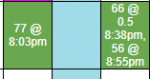
66 at 8:38pm, was 77at 8:03pmTest again in 15-20 min after you PMPS to see if Disco is coming up. On Feb. 3 you skipped a low number and Disco ended up going really high that night.
After a day testing every 2 hrs, Disco’s PMPS is 77, so he’s going low in the evening just to trick me this cycle! Is this right—not feed him and test again in 30 minutes? If he is lower in 30 min, is that when I feed 2 tsp HC gravy or do I feed LC thrn unless he’s below 50. I will read over my notes again but I wanted to get this posted so I could get an answer so hopefully somebody will see this and help me.
***Note—i meant to post this on Sat 2/8 not Fri 2/7***
I just changed the title and the date on this thread Hope that doesn’t confuse too many peopleOk. Great.
I think you can still change the title of this thread so you can catch a more experienced person to help out. In this title change the date to 2/8 and your pmps number and state that you are stalling.
66 at 8:38pm, was 77at 8:03pm
Stalling and I can test every 20 minutes somehow half an hour went by when I just re-tested him but I’ll do it every 20 minutes now I promiseNo food. Stall and test and see if he is headed higher. He is probably breaking a bounce and so heading lower fast. Feed only if he drops below 50. Test every 20 minutes so you can catch him rising and shoot then.
8:15pm, its now 8:48pmSorry. Just saw this. When was his shot due?
I will stay up with him and I can be home all day tomorrowHow long can you stall for? It will affect your shoot time tomorrow. How comfortable are you with shooting a lower number that what you've seen before?
I'll tag a few more people for you.
@Christie & Maverick
@Sue and Luci
@MrWorfMen's Mom
@Bron and Sheba (GA)
Update his SS so other members can see his numbers without having to read the whole thread. Will give you something to do in between tests to take your mind off his numbers!
NoAny history of ketones for Disco?
Updated spreadsheet, he still dropping he’s 56 now at 8:55pm
I am so anxious I’m shivering, trying to read and absorb everythingWow! He is on a tear!
Some general rules when stalling (ECID):
- 50s or higher – don’t feed. The number will bump up on its own soon due to the insulin wearing off.
- 40s or lower – you have a couple of choices.
- When 40s occur at the end of the cycle, it can be beneficial to withhold food and test in 15-20 minutes to determine if kitty is on the rise or hasn’t reached nadir yet.
- If they are hanging in the 40s for a while, or if they are still dropping, it is ok to feed a tsp or two of LC and retest. This is very tricky. You want to avoid feeding too much while you’re waiting for them to go over 50, because you don’t want to artificially inflate the number with food.
- Example: if kitty is 43 and you feed a whole meal, or feed some HC, and the number bumps up to 52, is that the cat’s natural end-of-cycle rise, or is it food spike? What if it is food spike? Then if you shoot the 52, when the food wears off he might drop back to the 40’s (and when insulin kicks in a couple of hours later, you might have a problem). If the 52 is the cat’s natural rise, then he will probably keep rising for the next few hours until insulin kicks in. If you can’t tell whether the number is food spike or natural rise, it’s safest to wait. Your data will help you here. Study the spreadsheet. How much food spike does the cat usually get? How many hours after the shot does the insulin’s onset usually occur in this cat? At what number is the cat likely to be when onset occurs? If the cat does drop, how easy/hard is it to regain control of the numbers? How carb sensitive is he?
- Test often (every 15-20 minutes, or at most every 30 minutes). You want to catch the rise the minute it starts. With most of our cats, once they start to rise they will really zoom. You want to get the insulin in as soon as possible, because it will be another 2-3 hours before the insulin kicks in and you don’t want to let the cycle get too far ahead of you.
Yes ReliOn PrimeYou are using a human meter, right?
Disco is still in safe numbers. Is he acting normal?I am so anxious I’m shivering, trying to read and absorb everything
Yes ReliOn Prime
YesAre you able to stall longer to see if he will rise on his own without food? Stalling longer will affect your shoot time for the next few days.
test in 15 min from 8:55Updated spreadsheet, he still dropping he’s 56 now at 8:55pm