

? Gizmo's Dosing Thread - Can anyone help finding the right insulin dose when vet won't advise me?

Gizmodo

Member Since 2026
Hi all

2nd time poster (now that I have finally had the time to read and absorb how to use the spreadsheet and some of the other threads, however it had been an extremely stressful and busy time so I apologise I have likely missed things).

I believe my spreadsheet for Gizmo's readings should be linked in my signature, and there's some more background info in my profile perhaps?

For additional context to try to explain my spreadsheet...
My vet has prescribed 3u BD, this has not been reviewed since I believe the 14th June? Maybe earlier than that. I sent a curve based off 3 units on the 29th June where his AMPS was 446 and his "nadir" was 292 at +12hours when I was due to give his PM dose. I gave the dose as prescribed and monitored through the night, and his nadir was 194 at roughly +4h before rising back up to 428 by AMPS. My vet didn't reply to this. However this was around the time that it was really hot and I was giving more wet food and less dry food. I started to notice the difference in his readings and continued to titrate the food over a few weeks and also switch to lower carbohydrate wet food as well. I reduced his insulin dose to 2u during this process because I wasn't able to monitor his nadirs very well and my vet has always drilled into me the risk of a hypo compared to the risk of hyperglycaemia and has been fine with Gizmo having readings above 400 consistently. These readings were all done on an Alphatrack3. However I switched to a human meter for cheaper strips so I could afford to test more during this period of food titration.

I started to run into further problems with his insulin dose after a few weeks of titrating the food and getting the point where he was on just wet food. He'd never had any symptoms of a hypo when I'd been home and his pre-shot levels were generally the same. However he started to have much lower readings at his pre-shot doses which a Reddit User directed my to the SLGS dosing protocol which talks about what to do if levels are lower. Although they were above 200, it was still in the 200-250 range which I just wasn't used to Gizmo being in and I was worrying about giving the full 2u at those points, so I followed the advice to give a lower than usual dose and typically the next couple of cycles the pre-shot level would be okay. However it started to happen more often and with pre-shot readings in the 100-200 range, so I dropped him from 2u to 1.75u on the 15th July.

However after a few doses of 1.75u, he had a mild (asymptomatic) borderline hypo around 68 so I reduced him further to 1.5u until I could do a full curve. This was on 18th July and he went down to 47 at +9h, so various people on Reddit told me the dose was too high whereas other people told me the dose was too low and 47 was fine. Bearing in mind my vet had told me not to go below 216 on a pet specific meter, I was nervous about the conflicting advice. I reduced the dose to 1u and messaged my vet to show them the curve on 1.5u. The vet didn't reply to that, so I chased them 2 days later with another curve on 1u where his nadir was 135 on a human (not terrible, but much below their recommendation) and he also had raised ketones of 23.4mg/dl.

The vet advised me that they couldn't advise on his insulin dose as his readings were from a human meter which was more than 90mg/dl different than a pet meter. So whilst he is technically prescribed 3u BD still, I am in no-mans-land trying to work out if the dose I am giving him is too high and causing bouncing and risking hypos, or too low and risking DKA. His ketones have thankfully reduced back to 3.6mg/dl.

I had a spare libre left from the last time they tried to fit one (during his initial transition on to insulin) so I decided to try that again instead of buying more alphatrack strips. It took 3 attempts and I had to buy an additional 2 libres so it ended up being very expensive, but we got the libre on and it has been on since wednesday evening. The libre data is showing some very interesting trends with his blood glucose, it's almost like he has a regular 24-48h cycle where his insulin dips low for the first shot, then jumps up again, then holds much steadier for the next cycle, then dips and peaks again, then holds. Is this because of bouncing?

I had more confidence to increase his dose back up to 1.5u now that he has a libre to alarm if he's hypoing, and he hasn't had any hypos since then, but there have been two cycles where his sugars don't start to increase back up to a good pre-shot level until around 14 hours.

I have still been taking pre-shot levels on my handheld meter as I know the libres aren't 100% accurate and are better for just representing the trend, but I wasn't sure what data to input onto the spreadsheet because I'm also trying to give the poor boy's ears a break from all of the pricking. However I have also been trying to do some random checks to try to prove to my vets that my human meter can represent the trend just as well as the Alphatrack, especially if they're happy to use libre readings. I've entered the readings from the handheld on a separate line to the libre readings on the spreadsheet, so you can discount either as needed. I'm also going to attempt to attach the libre graphs so you can see the trend I'm trying to explain.

TLDR;
1) Do you think the dose I'm giving is too low, too high, or okay to continue with?
2a) What should I do about late nadirs/low pre-shot readings? People give me lots of different advice - they say don't change the dose around too much and give sliding-scale insulin, however some people tell me to shoot when it's ~150-200 and some people say not to shoot under 200, some people say hold the dose for 7 days before adjusting, others say you can adjust after 5-6 cycles. I'm trying to ensure that he still gets some insulin, but on the days that I'm not going to be home because I have work, I don't know how much to give.
2b) his blood glucose usually spikes when I give him food, even though it's low carb content. the insulin onset is usually around +1.5-2.5h, so even if his reading is only ~150-180, would it be okay to give him food and insulin knowing the food will likely kick in much quicker than the insulin? he then gets more food from the autofeeder at +3h ish, but that's less guaranteed because the wet autofeeders are new and I'm not confident that he would definitely eat his food vs his sister might eat it vs he might eat both portions.
3) how should I track libre data on the spreadsheet, or should I not include this at all? Okay I actually found the useful thread on this now, I hadn’t found it before as it was titled continuous glucose monitors
 

Attachments

  • IMG_8943.jpeg
    IMG_8943.jpeg
    121.7 KB · Views: 2
  • IMG_8944.jpeg
    IMG_8944.jpeg
    144.4 KB · Views: 2
  • IMG_8945.jpeg
    IMG_8945.jpeg
    144.1 KB · Views: 2
  • IMG_8946.jpeg
    IMG_8946.jpeg
    147.8 KB · Views: 2
  • IMG_8947.jpeg
    IMG_8947.jpeg
    133.3 KB · Views: 2
Last edited:
am in no-mans-land trying to work out if the dose I am giving him is too high and causing bouncing and risking hypos, or too low and risking DKA. His ketones have thankfully reduced back to 3.6mg/dl.
Hi. I am reading through your thread. You are getting way too much conflicting advice. But I want to say that bounces are not caused by too high of a dose necessarily. A bounce is where the cat's body reacts to lower numbers that he is not used to being in anymore... since becoming diabetic. It's a protective mechanism where the cat's central nervous system perceives either a steep drop in blood glucose or simply the cat being in lower numbers - and releases adrenaline, cortisol, glucagons and growth hormone, all of which create insulin resistance and can keep numbers high for up to six cycles (the bounce). Bounces don't have to last that long, but in some cats they will. Over time, many cats will start to clear the bounces more quickly. When the bounce does clear, the BG numbers will come back down and give us an accurate picture of what a dose is doing for your kitty. I have seen cats bounce from BG in the 200s very frequently, and sometimes even higher numbers if the cat is used to being in all red or black numbers (400s or 500s.)
 
vet advised me that they couldn't advise on his insulin dose as his readings were from a human meter which was more than 90mg/dl different than a pet meter.
This is an unverified statement. There is no substantiated proven and quantified exact difference between the pet meter and the AT meter. The AT will read higher than a human glucometer but I have never seen a 90 point difference! Now I have seem a 90 point differential between the Libre sensors (a human device) and a human glucometer, but that’s a different story.

I do understand your difficulty with regard to the vet though. It sounds like your vet had been overdosing your cat with those high doses. Higher doses should never be a starting point, but should be worked up to gradually (speaking as someone whose cat had a dose of over 44 units at one point!)
 
especially if they're happy to use libre readings.
That’s kind of dumb, don’t you think, since a Libre is a HUMAN device not calibrated for pets! Like, how can you accept a Libre when you can’t accept a human glucometer!! Vets have used human meter for decades. The pet specific meters have only more recently been on the scene.
 
However after a few doses of 1.75u, he had a mild (asymptomatic) borderline hypo around 68
A 68 on a human meter or a 68 on an Alpha Trak?

68 on an Alpha Trak isn’t really borderline hypo, but it’s the point where we will take action to make sure the BG won’t drop lower (and we will take a dose reduction.)

68 on a human glucometer is not anywhere not close to hypo. The number we don’t want the cat to drop below while on insulin is 50 on a human glucometer, and action should be taken to keep the cat from dropping below 50. That action can be just feeding a little LC food, which is often enough to stabilize BG. Only if the cat drops below 50 (human meter) or 68 (Alpha Trak) will we begin medium carb or high carb.)
 
I would not have advised skipping insulin today. I would have advised shooting 1 unit and then monitoring so we could gather data to see if it was enough, too much, or too little.

Your head must be absolutely spinning with all the different advice you have been getting!
 
Were the green readings on the night of 7/31 Libre readings?

Are all of the blanks I see on the spreadsheet skipped shots (and no tests?). No… are those two lines— one for Libre and one for human meter? This is really confusing (not your fault as you are trying to figure out how best to represent these numbers.) I think what has worked best for me with other members is — if you are using primarily Libre readings, just enter those and then put in the human meter readings in the same cell below the Libre reading but with either an asterisk or an H next to the number. The problem then is that you have to manually color code each cell… but it can be done.

Now, if you are using primarily the human meter, you can do the opposite by putting an L next to the Libre reading.

It makes a difference how your spreadsheet is formatted though… in other words, when you set up your spreadsheet, did you choose the format for human glucometers or the format for Alpha Trak meters?
 
Last edited:
The Libre readings will be okay for anything above 100. After that, especially if it comes down to a decision about whether the cat has earned a reduction (which in the beginning would be if kitty drops below 90, but later can be modified with data and experience) I would like to see a human glucometer reading to verify the BG reading. The Libres track fairly well with the human glucometers in numbers above 100, but in the lower numbers, the Libres can really steer you wrong by telling you the BG is very low and it may well be quite a bit higher. I have seen this a lot.
 
I do not see any evidence of Gizmo being overdosed on 1.5 units. He did have those two green readings the other night, but thpse were Libre readings from what I can tell and I don’t trust them. However, if you want to, you can drop his dose back to 1.25 units. His ketones are fairly high though, aren’t they (still over 3 on your blood ketone meter?). If that is the case, I would probably hold his dose at 1.5 units at this time and try to shoot that dose as consistently as possible.
 
This is an unverified statement. There is no substantiated proven and quantified exact difference between the pet meter and the AT meter. The AT will read higher than a human glucometer but I have never seen a 90 point difference! Now I have seem a 90 point differential between the Libre sensors (a human device) and a human glucometer, but that’s a different story.

I do understand your difficulty with regard to the vet though. It sounds like your vet had been overdosing your cat with those high doses. Higher doses should never be a starting point, but should be worked up to gradually (speaking as someone whose cat had a dose of over 44 units at one point!)
So he was started on 0.5u BD in march and worked up to 3u BD with increases every 2-3 weeks until he hit 3u BD in May and has been on that prescribed dose since then.

The issue was that I started reducing the carbohydrate in his food which lowered his insulin requirement. I tried to do this gradually over the course of ~3 weeks but it has been tricky ever since. But his sugars have at least reached <200 since then. They had only ever dipped as low as 250 before I started titrating up wet food and down carbs.

Also, my human meter did record a difference of 252 (human) and 360 (AT3) when I checked side by side numbers with the last couple of strips. I read this can be quite normal for it to be a ~25-40% difference and the 40% is more likely with the higher numbers?

However I chose a human meter that is verified for use in human diabetics. It is prescribed through NHS formularies so I don’t think it’s a dodgey meter necessarily?
 
Dod he take Bexacat or Senvelgo before starting insulin? Has he ever been hospitalized for a DKA?
Yes I had put this information on my profile. He was hospitalised shortly after diagnosis with raised ketones and respiratory issues so the vet thought DKA but the blood test showed no acidosis. So he was kept in on an insulin infusion and fluids to get his ketones down and monitor his breathing - turned out to possibly be an asthma attack. But he’s not on treatment for asthma.

So technically no he never had DKA, but he had raised enough ketones (not sure what level) that he had to be admitted for 36 hours to get them down. That was in Feb 2025.

After that they started him on Senvelgo. He was on that for nearly a year and had excellent fructosamine tests, never had urinary ketones (I didn’t have the blood monitor at that point), and had no other complications. However he wasn’t regaining the weight he had lost prior to his diagnosis and after about 6 months he started to lose more weight, pretty gradually, but became underweight and they thought he might be in remission (they did other blood tests to rule out other things) so we tested him off senvelgo but he wasn’t definitely still diabetic so he was started on insulin infusion March 2026
 
A 68 on a human meter or a 68 on an Alpha Trak?

68 on an Alpha Trak isn’t really borderline hypo, but it’s the point where we will take action to make sure the BG won’t drop lower (and we will take a dose reduction.)

68 on a human glucometer is not anywhere not close to hypo. The number we don’t want the cat to drop below while on insulin is 50 on a human glucometer, and action should be taken to keep the cat from dropping below 50. That action can be just feeding a little LC food, which is often enough to stabilize BG. Only if the cat drops below 50 (human meter) or 68 (Alpha Trak) will we begin medium carb or high carb.)
So the 68 was a human meter and I didn’t really know how to describe it because I’m aware it’s not a hypo technically unless it’s under 50 on a human meter. I didn’t give full hypo treatment but as it was 1am and I was desperate to go to sleep but wouldn’t be able to monitor I just gave him a little bit of low carb dry food (like 10g, it’s 1g of carb total) and then programmed his feeder to give him another 10g of food a couple hours later just in case
 
Were the green readings on the night of 7/31 Libre readings?

Are all of the blanks I see on the spreadsheet skipped shots (and no tests?). No… are those two lines— one for Libre and one for human meter? This is really confusing (not your fault as you are trying to figure out how best to represent these numbers.) I think what has worked best for me with other members is — if you are using primarily Libre readings, just enter those and then put in the human meter readings in the same cell below the Libre reading but with either an asterisk or an H next to the number. The problem then is that you have to manually color code each cell… but it can be done.

Now, if you are using primarily the human meter, you can do the opposite by putting an L next to the Libre reading.

It makes a difference how your spreadsheet is formatted though… in other words, when you set up your spreadsheet, did you choose the format for human glucometers or the format for Alpha Trak meters?
Hi, all the readings on the spreadsheet are either for a human meter or a Libre meter. I did two separate lines with the same date and put the Libre vs handheld meter in the remarks section. I can try to look at reformatting later but life is hectic at the moment and I go on holiday tomorrow so not sure when I’ll have time to do that.

The green readings from 7/31 were Libre yes.
 
The Libre readings will be okay for anything above 100. After that, especially if it comes down to a decision about whether the cat has earned a reduction (which in the beginning would be if kitty drops below 90, but later can be modified with data and experience) I would like to see a human glucometer reading to verify the BG reading. The Libres track fairly well with the human glucometers in numbers above 100, but in the lower numbers, the Libres can really steer you wrong by telling you the BG is very low and it may well be quite a bit higher. I have seen this a lot.
So last night I had my first Libre false alarm where it woke me up at 3am to say he was 68, by the time I went downstairs to get the handheld meter he was 59, but then by the time I got back upstairs and had the meter ready he was back up to 83. And then was over 100 on the Libre by the time I finished testing.

The human meter read 110 at 3am so I went back to sleep.
 
I do not see any evidence of Gizmo being overdosed on 1.5 units. He did have those two green readings the other night, but thpse were Libre readings from what I can tell and I don’t trust them. However, if you want to, you can drop his dose back to 1.25 units. His ketones are fairly high though, aren’t they (still over 3 on your blood ketone meter?). If that is the case, I would probably hold his dose at 1.5 units at this time and try to shoot that dose as consistently as possible.
I will check his ketones again this evening.

My main concern with his insulin dose is that even though his nadirs aren’t dropping too low, it’s his preshot numbers that are sometimes a problem. With a few consistent cycles of 1.5u he gets to a point where his +12h numbers are 125-175 and I don’t know whether to give his shot.

However with the libre data I have started to see that his sugars very quickly rise when it’s nearly time for food anyway? E.g I woke up at 6am and his Libre read ~125. He would normally get his shot around first thing, and he had his evening dose as 18:30 last night. I stalled and left him till 06:30, he was still 133 on the Libre so I checked with the handheld human meter and he was 130.

Then I started replying to these messages and by 07:00 he was up to 239 on the Libre (180 on the handheld meter). And because of the trend and knowing his new insulin dose doesn’t onset until +2-3h I gave him food and the shot. But I only gave 1.25u. Was that the right thing to do? His Libre is currently erroring so I can’t see what it’s up to after another 30 minutes but I’ll try to check before I leave (I’m already super late for work now sigh) EDIT: yep, he’s up to 342 by 07:50 which is 45 minutes after eating low carb wet food.

Essentially, his nadirs aren’t too low, but he seems to stay lower or level until 12-14h some days and then rocket up in the course of 60 minutes. Which wouldn’t be an issue if I had flexibility with his shot time but I often can’t delay it too much because of work.
 
Last edited:
So the 68 was a human meter and I didn’t really know how to describe it because I’m aware it’s not a hypo technically unless it’s under 50 on a human meter.
True not a hypo, but low enough to go ahead and reduce the dose by .25 units.

You absolutely have been doing the right thing by monitoring carefully and reducing the insulin dose as needed while doing the food transition. You have helped Gizmo tremendously by doing the food transition. Well done!
 
My main concern with his insulin dose is that even though his nadirs aren’t dropping too low, it’s his preshot numbers that are sometimes a problem. With a few consistent cycles of 1.5u he gets to a point where his +12h numbers are 125-175 and I don’t know whether to give his shot.
This is actually good and is what is supposed to happen (but doesn’t always happen for some cats who have a real smile shaped curve.). It’s progress. You have to learn how to shoot lower numbers, but gradually. I can see how much of a problem it is when you have to leave for work.
 
This is actually good and is what is supposed to happen (but doesn’t always happen for some cats who have a real smile shaped curve.). It’s progress. You have to learn how to shoot lower numbers, but gradually. I can see how much of a problem it is when you have to leave for work.
Unfortunately his numbers are bad tonight, which is my concern with shooting when he’s less than ~300.

He went way way down fast despite eating most of his food at dinner time, and I moved his +3h meal forward to be at +2.5h, again he ate most of it and I gave him a few treats as well.

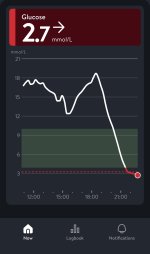
But by +3.5h he had dipped to borderline hypo territory. Down to 47 by +4hr. I did check as well on my AlphaTrak meter because the vet gave me a few in case of emergency strips and they read 119. So I didn’t immediately treat the 47 whilst I posted to ask for advice, but gave a bit more wet food. But then he dipped even further to 41, then 34 so I’ve given honey + slightly higher carb wet food. Still monitoring at the moment but it’s going to be a long night I think
 

Attachments

  • IMG_8956.jpeg
    IMG_8956.jpeg
    134.1 KB · Views: 3
Keep testing every 20 minutes until he’s at least over 50-70 range. Give very small amounts of food (HC of course) and testing every 20. If below 50 on your human meter then give karo onto the gums/in the buccal pocket.
 
If you fill him up with food things will become more difficult to manage. Only give a teaspoon of HC at a time.

As his numbers rise, you can extend the time between tests.
 
There’s nothing in the units cell for tonight. How much did you shoot? Whatever it was — reduce by another .25 units for the new dose going forward.
I gave 1.5u tonight after giving 1.25u this morning because of the slightly lower AMPS. But I was trying to follow the advice to adjust dose based off nadirs not off pre-shot levels. And his nadirs had generally been okay with 1.5u, I didn’t quite trust the Libre data where he’d hit green zone overnight because he often lies on his sensor. E.g last night when it was a false alarm.

I will reduce the dose back to 1.25u tomorrow though. Slightly frustrating that when he was consistently on 1.25u his nadirs were mostly yellow/barely blue. But after a few days on 1.5u it’s time for another hypo.
 
When you get a chance… and I know you’re dealing with beautiful Gozmo’s low numbers right now… please tell me how many carbs (percentage on a dry matter basis) are in the food you are feeding Gizmo. Do you have some differing carb percentages to try? Some cats will do much better on low carb food that isn’t the lowest of the low— up to ten percent.
 
I gave 1.5u tonight after giving 1.25u this morning because of the slightly lower AMPS. But I was trying to follow the advice to adjust dose based off nadirs not off pre-shot levels. And his nadirs had generally been okay with 1.5u, I
I stated to reduce to 1.25 units going forward. That means to reduce to 1.25 units and hold the dose for 7days and then reevaluate numbers to see if dose adjustments are necessary. Maybe either you didn’t see this or I did not make this clear if so, I am sorry
 
Yes, of course we take nadirs into consideration always …. but when we reduce a dose at this point, following the SLGS dosing protocol, we would reduce the dose by .25 units because of the green number that you verified was actually with a human meter and not a pet meter– – so we reduce the dose by .25 units and hold the dose for seven days regardless of how high the numbers may go. Of course, we always take reductions when they are earned… so if he were to fall below 90 during that seven day period…. another reduction of .25 units would be earned.
 
I will reduce the dose back to 1.25u tomorrow though. Slightly frustrating that when he was consistently on 1.25u his nadirs were mostly yellow/barely blue. But after a few days on 1.5u it’s time for another hypo
Yes. For safety, we need to reduce and be very patient with him (not my strong suit). When dealing with diving kitties, I have found using differing carb percentages — higher end low carb food up to ten percent and even medium carb food — the early portion of the cycle can help a lot to smooth things out.
 
I do not see any evidence of Gizmo being overdosed on 1.5 units. He did have those two green readings the other night, but thpse were Libre readings from what I can tell and I don’t trust them. However, if you want to, you can drop his dose back to 1.25 units. His ketones are fairly high though, aren’t they (still over 3 on your blood ketone meter?). If that is the case, I would probably hold his dose at 1.5 units at this time and try to shoot that dose as consistently as possible.
I stated to reduce to 1.25 units going forward. That means to reduce to 1.25 units and hold the dose for 7days and then reevaluate numbers to see if dose adjustments are necessary. Maybe either you didn’t see this or I did not make this clear if so, I am sorry
I based my 1.5u dosing this evening off your earlier reply suggesting you didn’t see any evidence that 1.5u was too high, and that I could reduce if I wanted but you would probably try to hold at 1.5u because of his ketones.

You also referenced a dose reduction regarding the 68 reading on my handheld (human) monitor, but that was historical data from the 16th July and I had been giving 1.75u at that point so 1.5u was already a 0.25u reduction from that?
 
I based my 1.5u dosing this evening off your earlier reply suggesting you didn’t see any evidence that 1.5u was too high, and that I could reduce if I wanted but you would probably try to hold at 1.5u because of his ketones.

You also referenced a dose reduction regarding the 68 reading on my handheld (human) monitor, but that was historical data from the 16th July and I had been giving 1.75u at that point so 1.5u was already a 0.25u reduction from that?
Okay. Wait a minute. Let me review everything. Regardless, he should have a dose reduction based on tonight’s dive.
 
True not a hypo, but low enough to go ahead and reduce the dose by .25 units.
See this reply from earlier today. I am so sorry if you didn’t see this or if it was misunderstood! You said the 68 was a human meter reading and I was glad you confirmed that. Then I said he had earned a reduction (by going below 90) and to reduce to 1.25 units as the new dose.

See post #16 above.

I feel like we have miscommunicated somewhere, and I am so sorry that we have.
 
See this reply from earlier today. I am so sorry if you didn’t see this or if it was misunderstood! You said the 68 was a human meter reading and I was glad you confirmed that. Then I said he had earned a reduction (by going below 90) and to reduce to 1.25 units as the new dose.

See post #16 above.

I feel like we have miscommunicated somewhere, and I am so sorry that we have.
Yes I saw this message (albeit 90 minutes after I had already given 1.5u tonight), but I am still confused because the 68 reading was from the 16th July when I gave 1.75u, so I had already reduced by 0.25u since then.

After the 68, I dropped from 1.75u down to 1.5u and had another reading of 47 which I contacted my vet about. I dropped to 1u and held that for a few days but then somebody (Reddit) told me I had reduced by too much by going down 0.5u so I tried 1.25u. I held that for ~6 days but the lowest nadir was 128 so somebody advised to increase by 0.25u again. Since I got the Libre on I tried 1.5u again because I’d have a much better chance at monitoring for hypos. I’d also made some changes to his feeding schedule to include a portion of wet food at +3h try to buffer his insulin slightly.

But it was around this point that I made the spreadsheet and posted to here. Since I’d been turned around in circles by so many different opinions. So I’d made a bit of a hash of it in recent weeks just because I’d had to stray so far so suddenly from the vet’s recommendation and then they were refusing to advise me even when I was sending full curves showing hypos.

Don’t worry about the miscommunication, it was my decision to give 1.5u - you hadn’t even replied with post #16 yet by the point I was giving his evening dose of insulin. And at the end of the day, you don’t know a dose is too high until you get a result too low. Gizmo has had terrible BG control for months, and likely will continue that way.
 
I saw this message (albeit 90 minutes after I had already given 1.5u tonight), but I am still confused because the 68 reading wa
Yes. We are at least five hours apart in time zones. I am not surprised you saw that message long after I sent it.

And yes.. i was wondering about that particular 68, but your Gizmo had already dropped below 90 again since then (like on July 31) even though you had reduced. So I was looking at the overall picture. I am also confused by having two lines for one day with different BG readings on them.


And at the end of the day, you don’t know a dose is too high until you get a result too low.
That’s not really how we work here as we follow established dosing protocols. But it is true that sometimes cats will drop low and definitely will get our attention.

I would say that you have been taking advice from too many different places. It’s not necessarily true that Gizmo will have terrible BG control in the future. Don’t give up. He may be more challenging than some cats, but it doesn’t mean that things can’t get better. :bighug:
 
Oh by the way, when my cat was first diagnosed, I spent months spinning my wheels with bad advice from a Facebook group. I finally came here in desperation and found help for my boy who had a high dose condition — and I had been told so many wrong things by that Facebook group — things that actually led to my cat’s DKA and hospitalization for one week. It can happen. I am not saying it’s the same for you… I am just sharing some of my own story.
 
Back
Top