
Carb Calculator App?

Status
Not open for further replies.

Mandy S

Member Since 2020
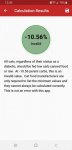
I downloaded an App that someone posted on the fb page called Carb Calc. Does anyone use it? It asks for ash % but most of the things I'm seeing don't have that listed.

I've put in a few foods and I get this message with varying negative numbers depending on the food.

I thought if this worked well I could have my husband download it and use it at the store when he's picking up cat food after work while we figure out what she will eat. The Petsmart is a block away from him so it's convenient.
 

Attachments

  • 116273828_3353058854756418_3193610368395605537_n.jpg
    116273828_3353058854756418_3193610368395605537_n.jpg
    25.2 KB · Views: 239
I downloaded an App that someone posted on the fb page called Carb Calc. Does anyone use it? It asks for ash % but most of the things I'm seeing don't have that listed.
I've put in a few foods and I get this message with varying negative numbers depending on the food.
Hi Mandy, my understanding is that the 'carb calc' calculator only calculates the carb content of a food as dry matter content. (So, it imagines that all the water is removed from the food, and the protein, fat, carbs, etc are evaluated by percentages of weight).
But here we use a slightly different method to calculate carb content; we compare by the 'percentage of calories' that come from carbs, and this is more accurate than just looking at the dry matter by weight.
There is a list of US foods compiled by Dr Lisa Pierson (where she's very kindly done lots of calculations), which I'll post the link to below.

There is also an online calculator that can be used to calculate the percentage of calories from carbs, but....the difficult thing with US foods is actually getting the right data to do the calculation with... US pet food labels only give very general 'maximum or minimum' values for protein, fat, etc, but they don't tell us what is currently in the food (this is one of the reasons we can get wonky calculation results...) ...To get the current data it's usually necessary to contact the manufacturer and ask for it. Very occasionally, especially with the more premium (pricey!) foods the data may be on the manufacturer's website.

Here is the link to Dr Pierson's food list:
https://catinfo.org/docs/CatFoodProteinFatCarbPhosphorusChart.pdf

And if you can get the current data for a food you're interested in you can use this online calculator to work out the percentage of cals from carbs:
https://secure.balanceit.com/tools/_gaconverter/index.php?

Eliz
 
Thank you, I'm glad I asked. :)

I looked on the food list, but some of the foods I want to try aren't listed...I think they've come out since that list was made maybe? Idk. I have to pick stuff with just one protein and some of those aren't listed.
I'll try that calculator.
 
https://weruva.com/product/chicken-duck-turkey-take-a-chance/

So I entered the info into the calculator linked above and it said 14.9% ME Carbs. Guessing 2.5% on ash.
But on the page if you click on detailed analysis, it says carbs are only 5.2% carbs.
Maybe I did it wrong?
Hi Mandy, that page just gives the 'guaranteed analysis' of possible min/max values for protein, fat, etc. But if you scroll down down the page in the link below you will see a section where the food data is shown as 'As Fed Percentage'. That is the info that you need (and it also lists ash content.) I used the calculator I linked to further up the thread and the food comes out as around 5.14% calories from carbs.
https://weruva.com/nutrition-landing/bff-play-ni/

.
 
What do you put in the calculator if you don't know ash content?
Guessing 2.5% on ash.
Well..... ....I think the creator of the 'carb calc' calculator suggests 2.5% if there is no figure for ash. That's not a bad figure, but this is of course just a general estimate, and the actual figure may be different, so maybe just bear that in mind when doing a calculation... (A similar situation arises calculating carb content of some dry foods where no moisture content is listed. In that case an 'average' moisture % suggested just for the purpose of the calculation is 10%. But...it could be as low as 6% or as high as maybe 12%. So, sometimes I do different calculations using a number of possible moisture percentages, to see how that changes things... :rolleyes:)

Just as an illustration of how ash values can vary you can take a quick look at the 'ash' column on the food list that I maintain for UK foods. If you scan across to the far right of this chart, the penultimate column is the ash content in the cat food. If you scroll down that you'll see that ash content is 'often' in the low 2's. But can vary from around 0.7 to 5....
https://docs.google.com/spreadsheets/d/1J5JpMe6TDXrHq_aTl9hUtHy6Gs9oRBqlz4nPGKxtySA/pubhtml
 
Hi Mandy, that page just gives the 'guaranteed analysis' of possible min/max values for protein, fat, etc. But if you scroll down down the page in the link below you will see a section where the food data is shown as 'As Fed Percentage'. That is the info that you need (and it also lists ash content.) I used the calculator I linked to further up the thread and the food comes out as around 5.14% calories from carbs.
https://weruva.com/nutrition-landing/bff-play-ni/

.

Thank you! I didn't even see that there was a different chart below that one. :/
I'm also glad that the food is okay for her to eat because she really likes it and hasn't eaten this well in 3 months.
 
Well..... ....I think the creator of the 'carb calc' calculator suggests 2.5% if there is no figure for ash. That's not a bad figure, but this is of course just a general estimate, and the actual figure may be different, so maybe just bear that in mind when doing a calculation... (A similar situation arises calculating carb content of some dry foods where no moisture content is listed. In that case an 'average' moisture % suggested just for the purpose of the calculation is 10%. But...it could be as low as 6% or as high as maybe 12%. So, sometimes I do different calculations using a number of possible moisture percentages, to see how that changes things... :rolleyes:)

Just as an illustration of how ash values can vary you can take a quick look at the 'ash' column on the food list that I maintain for UK foods. If you scan across to the far right of this chart, the penultimate column is the ash content in the cat food. If you scroll down that you'll see that ash content is 'often' in the low 2's. But can vary from around 0.7 to 5....
https://docs.google.com/spreadsheets/d/1J5JpMe6TDXrHq_aTl9hUtHy6Gs9oRBqlz4nPGKxtySA/pubhtml


I understand what you're saying at a base level. lol I need to practice and hopefully will get a better grasp on this as we go along.
 
Okay, I'm confused, and I'm so sorry. :/

There is a post on the fb page talking about calculating carbs and they are saying to NOT use the "as fed" numbers. Honestly half the stuff on their makes my head spin.
 
There is a post on the fb page talking about calculating carbs and they are saying to NOT use the "as fed" numbers. Honestly half the stuff on their makes my head spin.
Hi Mandy, there is quite a bit of conflicting info at times on the FB page (Feline Diabetes FB group). :confused: ...But the way that carbs are calculated there 'should' be exactly the same as it is here... The 'Feline Diabetes' page is the FB presence of FDMB, and so 'should' give the same info. But, because it's FB....well....that's not always the case.... I see people post all kinds of stuff about carb content; some good, some bad, and some just confusing. And I often try to ease the confusion (but it's like trying to hold back the tide....)
The policy of both groups is to compare by the 'percentage of calories from carbs'. This is the most useful way of comparing carb values. But there are other ways of comparing carb values. Some people compare by the percentage of carbs by weight, (wet or dry); some compare by calories from carbs per 100g or ounce, etc...

A complicating factor in calculating carb values of US foods is that the data is usually given as a 'guaranteed analysis', but unfortunately that just shows the range of minimum and maximum values for protein, fat, moisture, etc. It doesn't tell us what is 'actually' in the product. And if we want to calculate the percentage of cals from carbs then we do need to know - as near as is possible - the current values. This may be given as 'as fed' data. Data given as 'typical analysis' is also fine (this is how the data is usually given in Europe). It doesn't matter if the data is given as wet or dry matter values because water has no calories. Once we know how much of that food is comprised of protein, fat, and carbs (the sources of calories), we can then work out the total calories of the food, and the percentage of calories that come from protein, fat, and carbs.

BTW, lots of people get confused about carb values, even people who've been dealing with feline diabetes for years... It's a topic that does just confuse people, endlessly. And it can totally fry your brain if you let it... Been there, haha! :rolleyes:

Eliz
 
Last edited:
...Regarding 'dry matter' or 'wet matter' when calculating the percentage of calories from carbs, maybe this helps to explain why it doesn't matter which you start out with...

Let's say I'm feeding a dry kibble food that has 30% of calories from carbs. If I crush it up and add water to that, and smoosh it around a bit and make it into a sort of pate texture, it still has 30% of calories coming from carbs, because the only thing that's changed is that I've added water to a dry food that has 30% cals from carbs. The water has no calories so adding it doesn't affect the calorific distribution that comes from protein, fat, and carbs.

Conversely, let's assume that I have a wet food that is 4% calories from carbs. I spread that in a baking tray and dry it out in the oven, and then I break it up into little cat treats (don't even try to imagine the smell, I did actually try this once... :eek:) Those treats still have 4% calories from carbs, because all I've done is take the water out of a food that has 4% calories from carbs. The water has no calories so removing it doesn't affect the calorific distribution...

So, you can use wet or dry matter data to do carb calculations with.
If using wet matter for a calculation the moisture/water element will be removed early on as part of the calculation anyway, because we only need to deal with the parts of the food that have calories; protein, fat, and carbs. So, whether starting out with wet or dry matter, we'll actually be using the same ratio of protein, fat, and carbs, to do the calculation with; the distribution of those elements will be the same...

I hope this makes sense. But do tell me if it doesn't!
 
Last edited:
A complicating factor in calculating carb values of US foods is that the data is usually given as a 'guaranteed analysis' [...] It doesn't tell us what is 'actually' in the product.
I do worry if a post-Brexit US-UK trade deal goes ahead that, in addition to changes for human food, labelling regulations for pet foods will become more aligned with those currently used in the US. Changes to UK food labelling standards is a biggie for the US trade negotiators (it's in the United States' published objectives for an FTA).


Mogs
.
 
Hi Mandy, there is quite a bit of conflicting info at times on the FB page (Feline Diabetes FB group). :confused: ...But the way that carbs are calculated there 'should' be exactly the same as it is here... The 'Feline Diabetes' page is the FB presence of FDMB, and so 'should' give the same info. But, because it's FB....well....that's not always the case.... I see people post all kinds of stuff about carb content; some good, some bad, and some just confusing. And I often try to ease the confusion (but it's like trying to hold back the tide....)
The policy of both groups is to compare by the 'percentage of calories from carbs'. This is the most useful way of comparing carb values. But there are other ways of comparing carb values. Some people compare by the percentage of carbs by weight, (wet or dry); some compare by calories from carbs per 100g or ounce, etc...

A complicating factor in calculating carb values of US foods is that the data is usually given as a 'guaranteed analysis', but unfortunately that just shows the range of minimum and maximum values for protein, fat, moisture, etc. It doesn't tell us what is 'actually' in the product. And if we want to calculate the percentage of cals from carbs then we do need to know - as near as is possible - the current values. This may be given as 'as fed' data. Data given as 'typical analysis' is also fine (this is how the data is usually given in Europe). It doesn't matter if the data is given as wet or dry matter values because water has no calories. Once we know how much of that food is comprised of protein, fat, and carbs (the sources of calories), we can then work out the total calories of the food, and the percentage of calories that come from protein, fat, and carbs.

BTW, lots of people get confused about carb values, even people who've been dealing with feline diabetes for years... It's a topic that does just confuse people, endlessly. And it can totally fry your brain if you let it... Been there, haha! :rolleyes:

Eliz
Well said
 
I do worry if a post-Brexit US-UK trade deal goes ahead that, in addition to changes for human food, labelling regulations for pet foods will become more aligned with those currently used in the US. Changes to UK food labelling standards is a biggie for the US trade negotiators (it's in the United States' published objectives for an FTA).
I totally hear you, Mogs... ....:(....
 
...Regarding 'dry matter' or 'wet matter' when calculating the percentage of calories from carbs, maybe this helps to explain why it doesn't matter which you start out with...

Let's say I'm feeding a dry kibble food that has 30% of calories from carbs. If I crush it up and add water to that, and smoosh it around a bit and make it into a sort of pate texture, it still has 30% of calories coming from carbs, because the only thing that's changed is that I've added water to a dry food that has 30% cals from carbs. The water has no calories so adding it doesn't affect the calorific distribution that comes from protein, fat, and carbs.

Conversely, let's assume that I have a wet food that is 4% calories from carbs. I spread that in a baking tray and dry it out in the oven, and then I break it up into little cat treats (don't even try to imagine the smell, I did actually try this once... :eek:) Those treats still have 4% calories from carbs, because all I've done is take the water out of a food that has 4% calories from carbs. The water has no calories so removing it doesn't affect the calorific distribution...

So, you can use wet or dry matter data to do carb calculations with.
If using wet matter for a calculation the moisture/water element will be removed early on as part of the calculation anyway, because we only need to deal with the parts of the food that have calories; protein, fat, and carbs. So, whether starting out with wet or dry matter, we'll actually be using the same ratio of protein, fat, and carbs, to do the calculation with; the distribution of those elements will be the same...

I hope this makes sense. But do tell me if it doesn't!


What you're saying about the water content not changing things makes sense. :) So when I'm looking at a food, I can put the dry matter info into the caclculator?

um...I can imagine the smell of baking cat food. yuck. lol
 
I don't know if anyone here has used it, but I found this useful-looking calculator by Googling:

http://fnae.org/carbcalorie.html

If you put in all the numbers, you get calories per 100g for each nutrient and total calories per 100g, so you just divide the carbs figure by the total.

Note: for dry food, I added up the given percentages and assumed the remainder (around 10%) was water.
 
Status
Not open for further replies.
Back
Top