I'm severely struggling with getting his blood AMPS , I've been doing the warm compress and trying to milk the ear but I'm failing every time. My poor baby was pricked so much this morning I tried at least 8 times I'm at the point of crying because I can't get this down.
Hi, please don't be hard on yourself. This stuff can take a wee while to learn, for both human and kitty. And I do totally and absolutely promise you that it 'does' get easier...
I'm now on my second diabetic kitty, and both kitties have provided their own individual challenges. But in both cases it was a matter of finding out what worked for that individual cat.
What follows is some miscellaneous ramblings based on the previous comments in the thread and my own experience with my kitties... Take whatever is useful, ignore the rest...

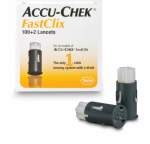
Regarding whether to use the lancing device ('clicky thing') or to use a lancet freehand, this is entirely a matter of what
you find easiest to do.
I tried both methods and came to absolutely love my lancing devices (I know that many others have an entirely opposite experience). My close vision isn't great, so the fact that I could just 'press and click' a device against the edge of my kitties' ears has been brilliant for me. I'm not even able to aim particularly well for much of the time. I just aim in the general direction of where I 'think' is the best spot; then press and click and hope for the best. This rather haphazard sounding technique has served me extremely well for just over 13 years now.
I got my cats used to the sound of the lancing device by using it rather like a 'training clicker'. At times when I wasn't testing I'd click the lancing device a couple of times and then give the kitty a treat. The sound of the lancing device soon came to be like the sound of a tin opener...
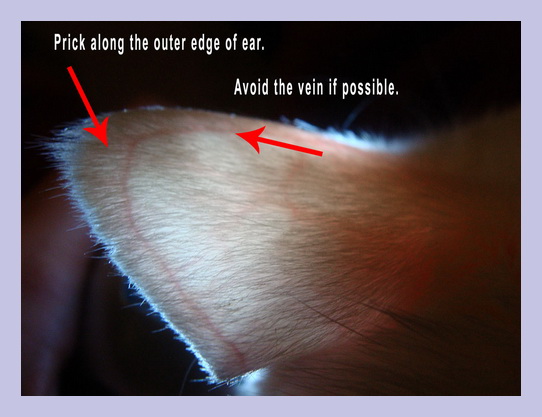
It is well worth trying different spots up and down the edge of the ear to see what works best. It's also common that one ear bleeds more easily than the other. My first diabetic, Bertie, tended to bleed best about half way down the outer edge of his right ear. My current girl tends to bleed best close to the tip of her right ear, on either side.
A mistake I made early on was not to put pressure on the underside of the ear (opposite to where I was pricking). This meant that I sometimes pushed the edge of the ear away rather than pricking it. The lancet needs something to 'resist'.
Both my diabetics have/had really dark ears. Bertie was black, and Bonbon is a dark tortie. In the early weeks of testing a super thin smear of Vaseline on the outer edge of their ears helped the blood to 'bead up' and stopped it disappearing into the fur. This also 'seemed' to help with healing. In both cases, the ears seemed to get a bit pink in the first few weeks, but then that stopped. It is as if the ears toughen up a bit somehow. In spite of that the ears do also start to bleed more easily. This is apparently because the ears produce more blood vessels in response to those tiny weeny pin prick 'injuries' (the growing of new blood vessels is called 'angiogenesis').
Here are some testing tips that I wrote out for someone else a while back and occasionally re-post just in case there is anything that might help. Sorry for posting this somewhat impersonal info. And please do shout out if you need clarification or further help.
Eliz
-----
HOMETESTING TIPS & TRICKS
1. WARM EARS. Probably THE most important thing. Warm ears bleed very much more easily than cold ones. You can warm an ear by massaging it, or by holding something warm against it; ie a pill bottle filled with warm water, or a ‘rice sock’ briefly warmed in the microwave.
2. MASSAGING immediately below the ear prick, with finger and thumb, can ‘milk’ more blood out. I almost always do this, if only for a second or two.
3. VASELINE. A teensy weensy smear of Vaseline on the outer edge of the ear will enable the blood to ‘bead up’ and stops it disappearing into the fur. This also makes it easier to see the blood droplet if the kitty has dark ears.
4. RESISTANCE. The lancet needs something to ‘resist’ otherwise it can push the ear away rather than pricking it effectively. Some folks use a piece of cotton wool or folded tissue. I use one of my fingers, but sometimes do accidentally take a blood sample from myself that way.
5. TWO EAR PRICKS close together can often produce enough blood for a test when one ear prick might not.
6. SCOOPING THE BLOOD DROP ONTO YOUR FINGERNAIL. Doing this is a game-changer for some people. If you can get that drop of blood on your finger or thumb nail you can then let the kitty go and finish the test without her/him.
7. TREATS. It is important to reward the kitty for each attempted test, whether the test was ‘successful’ or not. Cats very soon learn to associate tests with treats. And some will soon come running for their tests. A ‘treat’ is usually a food reward of some kind, but some folks reward their kitties with a cuddle or a grooming session. I actually crumble a few treats for my cat and test him while he’s hoovering up the crumbs.
Remember to reward yourself too. Chocolate is good…
8. GET COMFORTABLE. If you are physically comfortable you’ll be more relaxed, and also less likely to try to rush the process. Some people like to test their cats on a counter top or a desk, maybe next to a desk lamp. Some people prefer to hold their cats on their laps when they test. Some folks incorporate testing into a grooming session. You’ll find what works best for you. And once you get used to home testing you’ll quite possibly be able to do it anywhere, and maybe even while the kitty is asleep.
9. RELAX. Cats pick up on our moods. The more relaxed and ‘matter of fact’ we are, the more relaxed and confident the kitty is likely to be. Some people chat or sing to their cats while they test him. Try it. It might help you too.
10. PATIENCE. Be kind to yourself. You’re learning something new. (And you’re learning something wonderful!)













 Thank you for the warning


