When you first start giving your cat insulin, you have no idea how low a particular dose of insulin will take your cat.
So, at the beginning, before you have learned to home test, before you have learned how YOUR cat will react, we suggest you keep the threshold for giving a shot, your decision point, at a higher BG number.
And that you keep the dose lower at the beginning, lower than many vets recommend as a starting dose.
We sometimes call that threshold a "shoot/no shoot" number but it is really a "stop and think what to do" number.
So, for people new to the message board, that threshold is set to 200 for a minimum. That threshold can be higher if you use a pet meter, or another insulin like NPH or Vetsulin.
The threshold, the decision point, the "stop and think BG number" can and should be lowered as you gain experience.
Experience with testing, with your cat's reaction to insulin.
Once you become more experienced, that initial threshold will be lowered.
With Lantus, once you gain experience and move to the ISG (insulin support group), the threshold for lantus is 150.
For some of the other insulins, such as the Prozinc you are using, the threshold is lowered as we see how your cat is doing.
It kind of depends on what the nadirs are, what the duration of the insulin is for your cat, what the onset is for your cat, how well you have managed the change to a better food, if you have a timed feeder or are able to leave food out for your cat to eat while you are away at work.
ECID Every Cat is Different. "Know thy Cat" will help to guide you. You will always know more about your cat then we can ever learn.
We use our best judgement in trying to guide you.
Mid-cycle BG tests in combination with the pre-shot tests and other notes on the SS help us to guide you.
Since Sirius was already down in the middle blue ranges, the 3U you were giving looked like way too much.
Your bottle of Prozinc was ruined, you could not get anymore until after the weekend and then your vet didn't have the Prozinc in stock so you had to find the insulin elsewhere.
First dose once you got insulin was 0.5U. Not much test data, that first dose brought Sirius down into the green number ranges. Still not much test data over the next 5 cycles, but Sirius was still in the mid-blue number range. But it looked like 0.5U could be too much. Not enough test data to say either way.
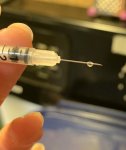
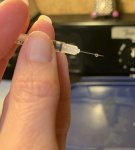
Over the next few cycles, you were getting a little more test data, still low but obvious that Sirius needed a tiny bit of insulin. How tiny could you learn to dose? Had you practice, practice with those drop doses. You started drop dosing a couple of days ago.
1 drop did not seem to be budging the numbers much lower.
So suggested you increase to 2 drops.
You should try to stay at that dose for 3 cycles, to see if it drops the BG levels for Sirius more.
Unless, he drops really low, under 60-80 or so. You pick the low or nadir BG number that makes you feel comfortable.
Set it higher if you like, than the suggested number.
If Sirius drops below the nadir you have set, then you should reduce the dose. A drop.
With Prozinc you are looking for about a 50% drop between the pre-shot tests and the nadir.
You do not want much more of a drop than 50% between those 2 tests.
If you do have > 50% drop, between pre-shot and nadir, either steer the cycle with food or drop the dose by a "skinny" or very tiny amount.
Sirius is already on a very tiny amount of insulin, so there is not much of a lower dose you can give him. No way to "skinny" the dose for him unless you can measure even tinier drops.
Prozinc is an in-and-out insulin. Effects not extending much beyond 12 hours, if that.
Wears off, is all used up by his body around the middle of the cycle.
Then the BG numbers keep rising.
Many cats on Prozinc, have a steep rise between +11 and pre-shot.
But you don't know that unless you get that +11 test.
If you can get a +11 on a regular basis, that will tell you if the test you get at pre-shot is a rising or falling BG.
More reassuring to see that the number is rising, between +11 and pre-shot test.
Gives you more confidence in giving him some insulin.
Regular tests in the night time cycle are important too.
One before you go to bed is always a good idea.
Not sure if I have answered your question or not.
At least I hope you have a better understanding of what is going on and why we have made the recommendations we have.