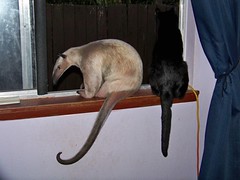
I do not have a diabetic cat

Status
Not open for further replies.

TamanduaGirl

Member Since 2014
Wait don't throw me off the board yet. I have a diabetic anteater and the diabetic dog forum owner suggested this might be the place to get help since dogs are type 1 and cats or more often type 2. And no this isn't a prank this is us https://www.facebook.com/pages/Pua-Tamandua/107868115902036

Looking at steps 3 and 4 on here https://www.facebook.com/pages/Pua-Tamandua/107868115902036 does that mean I should consider Pua's blood sugar controlled if it is <300 to 100+?

She is currently getting <110 lowest daily value and mid 200's lik3 237-220 highest after meal value. We are achieving this with herbal supplements with the vets blessing because we are both a bit apprehensive of using medications or insulin on her since we would be flying blind with no cases of precedent to rely on and getting blood samples from her is a difficult and stressful event. I thought she needed to be lower but if we pretend for a minute she's a cat this range is considered okay?

I am using an alphatrack with freestyle strip in it set at 24. I burned through a ton of strips to figure out what setting and combo got the most accurate readings for her. Before that I thought we had her reasonably controlled due to falsely low readings. Then she started having massive blood sugar spikes due to the exercise of going on walks/hikes. She looked poisoned which is what I thought happened the first time. Figured they sprayed the park grass with something. Disorientation, shaky movements, lethargy, puking, fear. The first time our regular vet was in surgery and the stand in couldn't manage to get blood to test sugar. Do you think her numbers are low enough to make taking her for hikes safe again?
 
Well I'm game for a challenge!
If you can get fresh urine samples, you might also use KetoDiaStix to test for ketones and glucose in the urine. It isn't as precise as blood testing, however ketones can be a danger sign. They form as a by-product of fat breakdown; too many may indicate diabetic ketoacidosis (DKA), a potentially fatal complication of diabetes.

Ideally, you want to shift food away from carbohydrates, towards protein and fats. What are you feeding? It might be a matter of adjusting proportions of food types.

Also, if you are meal feeding, it may help to break it up into mini-meals so that the glucose comes in at lower amounts more frequently, rather that spiking with meals. I have the impression that an anteater eats slowly, so this may be a non-issue.
 
Firstly - WOW!

Can't say that I know anything about anteaters, e.g. what there normal blood glucose range should be, proper diet etc. so I don't know if you can follow the 'cat' treatment or guidelines.

In relation to exercise - in cats, humans and dogs at least - exercise would cause the blood glucose level to reduce not to spike. Low blood glucose COULD be responsible for the symptoms you've noted. Don't know how knowledgeable your vet is about anteaters I would be consulting a specialist if your vet's just a regular 'GP'
 
Thank you, PumpkinsMom

BJM, I was just about to order the KetoSticks but the KetoDiaStix make more sense, thanks. She generally holds her pee all day then pees huge when she first gets up so testing that should be doable. DKA is a worry with her symptoms with the hikes but the first time I did rush her to the vet but since we live an hour away she was pretty much all better when we got there and was totally after being there a bit. The second time wasn't as intense and knew she recovered on her own the first time so let her rest but took her BG on the meter after she had rested some it was upper 300's but that was before I knew the meter was reading low so it was surely much higher.

The diet is 3 cups ground beef 1 cup dried ants or silkworm pupae, 1 cup beef heart, 1 cup wheat bran, 1/3 cup spinach or fresh thyme(or 1tsp dried). 1 cup ground chia seeds, 2 tbls nutritional yeast.


She gets blue cheese and soaked chia seeds for treats and to mix her supplements in. She will steal a bit of Aurora(other anteater)'s soup(same food but Pua eats hers semi-solid). I drizzle a couple spoonfuls of yogurt on top of that because Aurora will literally starve herself to death if I don't. I know some people say that without meaning it but it's 100% true. The yogurt is plain but eating a good amount of it sends Pua's sugar sky high(well 400+ on the old meter system) but she really just gets a tiny bit this way so that's pretty much the extent of her carbs and unavoidable.

Anteaters get little to no sugars and fats in the wild so maybe lowering the fat content in the beef could help but most things say fat is good, but maybe for anteaters? She will get ants as treats again once we can get our hands on the kind she is willing to eat.

They are basically free fed. I put their food out at night when they get up then they eat all night on and off since they are nocturnal. Aurora will only eat her soup when it's cold though so I'll change her bowl usually at least once a night. The diet would be 3tbls of chia seeds but I upped it to up the fiber, plus Pua loves them. Pua lost weight over the summer but she was also not getting sugary treeats any more(like plain yogurt, not like I was giving her candy or anything) plus the modified diet and her weight has now stabilized and is a good weight she was a bit tubby before.

Vytors Mum, The species tested glucose levels are mean 72 low 33 high 175 These aren't exactly established norms but averages from zoo tamanduas that were tested but as close as we can get right now. Aurora has always tested low 40's at the vet but she has been tested so far just when off food. I hope to get her tested while well and eating in the spring once it warms up. I haven't tried any home testing on her since she is a rescue with title trust and lots of fear as it is and it's not needed for her just wanted for info reasons.

My vet is not an expert but they are rare enough none exists. There is a vet about 4 hours from here that sees quite a few due to the Conservation center being near him but he hasn't dealt with diabetes in them so there's no point in making the trip with her. There is/was a group doing a study in diabetes in tamandua but they have failed to return any messages or offer any help and haven't published any findings yet.


My vet was confused by her glucose going up from exercise too. Exercise should decrease BG but even in people it can sometimes raise it, it seems it's really rare and she's just unlucky. Due to either not enough insulin or insulin resistance the glucose doesn't get to the cells in enough quantity so the cells continue sending out signals that they need glucose since they are using it fast from exercise, even with high levels in the blood since it's not getting to the cells in enough quantity so the glucose keeps being released and so keeps climbing. Human sites recommend checking BG at intervals during exercise but that's not doable for her. Maybe checking before hand and if it's low enough even if it spikes up wont go as high.

Edit: another thing that points to the episodes being high BG is when I had her out in the summer she did fine when I made sure to give her supplements shortly before but then when it happened again I had just been giving them at night. What she was getting has been adjusted since finding out she was higher than I thought based on the home tests and I have changed to giving them 3 times a day to get the results we are seeing now. Twice was still well over 300 on the highs. Will look into something else possibly being wrong with her though if it keeps happening and her BG is well controlled.
 
Last edited:
I found an article (about humans) that might be helpful for you at http://www.livestrong.com/article/57559-high-blood-sugar-after-exercise/#page=1 it talks about the levels you need to be below for safely exercising - you should be able to get a general idea from the urine sticks even if you can't test every time before you go and it also talks about doing less intense exercise if it's raising your bg - i.e. Maybe she should do shorter regular walks rather than long hikes.

In relation to the fat in her diet - if it's not a natural part of an anteaters diet (and I dont imagine that ants have much fat on them) I would try to reduce it as much as possible. My theory for optimum health for all creatures is to make the diet as natural as possible.

I really wish I had better answers for you. She's very lucky to have someone like you looking out for her welfare.
 
Wow this is really interesting.
I just happen to have a bag of Chia seeds and went to look up the carb %. It says 5g carb per tablespoon. You said you were giving 1 Cup.
If this is just to add fiber, I would start looking for other resources.

for cats, many here use pumpkin.
And you might look for yogurt with less sugar in it. There are so many different ones available now.
I know the one I prefer for myself has more sugar in it than the other brands.

I agree with the others that you want to find a diet as close to their natural diet as possible.
I hope you are able to get those ants soon.
Seems like that might be something to stock up on.
 
I don't want to be a buzz-kill and especially not on Christmas, but we are not "equipped" here to offer advice on a diabetic anteater.

As a wildlife biologist, I have to say that diabetes in a wild species is not normal. Second, we do not know how the metabolism of an anteater works in comparison to a cat. Third, we don't know a normal glucose level.

Wild animals have very specific dietary needs and we, in the FDMB, do not have that knowledge.

My suggestion would be to contact some zoo vets. I do wish you the best and hope you have a Merry Christmas.
 
Last edited:
OK you don't have a cat, you have an anteater - First that's way cool. Welcome to the group! We are all going to learn here and while yes we are cat centric, we certainly can offer you ideas and provide information that work for our cats that may be able to be modified/applied to an anteater.

And our (ok my rule is) gotta see lots of pics of your family and stories about their antics! (no pun intended). Since none of us have any experience with anteaters. Although the more I think about it, there is one member (not sure if she is still on here or just on FB). that works at a zoo and may have experience/exposure to anteaters. I will alert her on FB and ask her to come here to see if she can help.

Now for some observations and thoughts.

1) Many of us have found that using the freestyle lite meters with butterfly strips, gives incorrect readings with out cats. Additionally, meters with TRU in the name also give false readings. These meters are typically the "store brand" sold in Walgreen's, CVS, etc.

That being said, using an alphatrak with freestyle strips, you may find that you are not getting accurate readings.

Many purchase the Relion brand (confirm, micro, prime) from Walmart. If that is not an option, I found that Bayer Contour is an excellent meter and only requires a small blood sample.

2) You mention that you are feeding yogurt. Most yogurt has sugar in it, even plain version. Using any with the artifical or alternative sweeteners is not good cause of the chemical makeup of it. What I believe you want is the cultures and probiotics that is in yogurt.

You could try some other products, one that comes to mind is something that we sprinkle on cat's food called Forti Flora - made by Purina. Not sure if an anteater would like this, but might be worth checking out.

3) Not sure what the carb content of bran is, but thinking because it's a grain food, it may be higher in carbs than you want to use. Looking for an alternative may also help.

4) How do you blood test on an anteater? We test our cat's ear, what body part are you testing? You mentioned that you have problems testing, can you describe your procedure and maybe we can help with other ideas.

For example, we give treats, either food or in Maui's case a nice brushing after testing. what does your anteater like? we also find over time that the cat's are trained to come or know when testing time is and some even will sit in their "spot" and meow waiting for their test/treat.
 
Like Marje, I am very reticent to give advice. What may be a perfectly reasonable diet for a cat -- a species that is an obligate carnivore -- may cause nutritional deficiencies in an anteater. I haven't a clue how an anteater metabolizes insulin. Does your anteater require one shot a day? Two? We don't even know what insulin would be best recommended and we see lots of cats coming here on insulin that is really not well suited for cats so who knows what's appropriate for an anteater.

The Columbus zoo is the largest in the country. It's also connected to Ohio State's vet school. They may be a place to start. Alternatively, Cornell has one of the best vet schools in the country. Either of those places may be able to best advise you. We can try to offer support and help you to sort out the information you're getting but I would hate to make a recommendation that might end up doing harm.
 
Likewise, I have absolutely know knowledge on anteaters so I'm not comfortable advising you, but I do want to say that your dedication to your sweet girl is inspirational! She is adorable! I hope you are able to figure out what is going on with her, and if you don't mind keeping us updated, I think we'd all love to know how she is doing!
 
I'm wondering if plain Greek yogurt might have fewer carbs in it. Something to look up.

Definitely search around zoos or wild life preserves for exotic species vets; look for those who deal with similar animals. (er, what are in the same family as anteaters?)
 
What an interesting situation. I agree that we really aren't equipped to help you, unfortunately. I'd hate for us to give you advice based upon what we know about diabetic cats and have it be wrong for anteaters. I think contacting a zoo is a great idea.

I'm wondering what the basis is for her diet - in the wild they wouldn't be eating bran or yogurt. For any animal, diabetic or not, the diet should be as close to what they would eat in the wild as possible.

Good luck to you. I hope you can find a source for accurate information.
 
The friend I mentioned is talking with her zoo friends - who I think is with the Columbus zoo actually to see what they know about this and how they can help you - will see if we can get you to connect directly with them. In the meantime, while we mainly only know about cats - we can provide you general information and what we do with our cats - whether that can transfer to an anteater, I don't know, but basic information may be helpful...hopefully the zoo people can help better! Paws crossed.
 
Can you get grubs or mealworms, or fresh ants? Apparantly, anteaters are carnivors, with a slowish metabolism. Discuss with your vet the use in NPH insulin, which in dogs (slower metabolism than cats), can last for 12 hours per shot. If you were to consider it, you would want to use a tiny dose, such as 0.25 to 0.5 units
 
Thank you all. So much to reply too.

First off the big concern seems to be diet. I worked hard to get that as close to wild as I could though on the surface it doesn't look like it. Yes their diet is much different than a cat. They need only trace amounts of retinol for example or they get a type of MBD of the spine where as cats need a lot of it. Their phos:ca ratio is about inverse from what you would find in most species. If you just fed them local ants and termites it would not be a balanced diet since they would not be the same values as the wild species they would be eating. I formulated the diet recipe(which I posted and doesn't include the yogurt) to meet the nutritional values found in their wild diet as much as possible. She is 9.5 now and I had her spine x-rayed a couple years ago and it was beautiful. Many places started using the diet since or a close variation of it and had much more success than they once had. They slow their metabolism while sleeping and need lots of vitamin K in their diet because they do not recycle it like most animals. Despite the major differences the basic rules of diabetes would be the same, like lowering carbs and it helps to discus with people who understand the condition even if not the actual patient.

I do beleive most of the source of her condition was an illness when younger that caused internal bleeding and effected her liver and probably other organs but there was obvious signs of her liver being affected. I know I didn't help with some of the treats she was allowed but didn't think of them as being high sugar at the time. The issue with the yogurt isn't anything added it's the left over lactose. Though Greek yogurt should be lower in sugars since it is drained a bit and the lactose is in the weigh I haven't found the store brands of Greek yogurt to actually be any lower in sugar than regular. One thing I had been doing was using goat cheese cultures but on cows milk and making cheese. Age 24hrs or more then strain for 24hrs. Then I blended it with some water to make it a better consistancy to be poured on top of Aurora's soup. This removes most of the weigh so should remove most of the sugar and is still sour milk tasting enough to make Aurora happy enough to eat her food. Recently I had just used yogurt though as I didn't see any BG benefits when doing that. I will go back to doing that though as it should be less stress on her system at the least by having less lactose. One other benefit was Pua didn't like it much so left Aurora's food alone more so she also got less of the cheese than she does the yogurt since she was less inclined to steal though still did sometimes.

@Vyktors Mum that article goes into detail more on what is going on with exercise than I had seen before. Will have to work on the less more often. I would do weekly hikes before and she likes to go go go till exhausted. I can hold her back so she doesn't run as hard too.

I can try using lower fat meat. It does raise the phos in the ratio doing that but others have chosen to do so with the diet and had no issues yet. Plus with her age it's not a real issue unless the ratio is thrown way off or the retinol went too high(that can cause major damage in just a month).

@rhiannon and shadow That does seem like a lot of carbs. I added them for mineral content mostly but then upped them for fiber too. The wheat bran is the main fiber source. The wild diet is super high in fiber but it's insoluble since it's from exoskeletons.

@Hillary & Maui (GA) I wasn't getting accurate reading with the freestyle or alpatrack. What I did was take 3 different control fluids and tested each meter with each type of strip and fluid combo. None seemed accurate as far as her blood goes. So I took the freestyle strip in the alphatrack meter(because it can be coded and FS can't) and coded it down till it was different enough from the base reading on each fluid to account for the difference initially seen when we tested the drawn blood at the vet with the meters compared to lab. This seems to have worked as the numbers were more what was expected and a test at the same time of day as one taken at the vet gave about the same number though different day and blood. 107 lab tested at vet and 109 at home. I'll try the meter as coded next time we have her to the vet to draw but it seems to be working for her.

The yogurt is given for flavor as Aurora will not eat without it added at least a little bit on top. The best compromise I could come up with was soft sour tasting cheese instead like described above. Milk free alternatives still have comparable sugar as sugar needs to be added to have something to ferment with the cultures. It's possible she may react less strongly to one of the other sugars than lactose though. I don't think probiotics on their own have any real flavor.

Wheat bran was about the highest fiber food I could find to add but looking now it does have a good deal of carbs. I thought of it as mostly fiber. I'm used to looking at the protein annd mineral content ect but will need to get used to looking at carbs too.

It's not that much of a problem to test at home. I poke her feet and wait a moment them can get some blood out. Their skin is pretty thick. I meant it's difficult to get veterinary blood samples. It can only be drawn from the vein in the underside of the tail. It takes at least two of us to hold her as the vet draws blood. This greatly inhibits the ability for more invasive tests where they might want to keep her for a bit and draw more than once over a period of time. Pua got a bit depressed when I did a curve on her awhile back but generally she tolerates some spot testing well. They poke each others feet with their claws for fun so I believe she takes it as me playing too rough more than my being malicious and yes a treat does help a lot.

@Sienne and Gabby That is why we were trying to avoid having to go with medications or insulin. It is really uncharted territory. Sometimes with such a rare animal you are forced to have your pet be the guinea pig, like when we used an appetite stimulant on Aurora. There was no record of it's use in anteaters but it worked great and now other anteaters can benefit from the knowledge. It kind of sucks to be first though.

@BJM just anteaters. Sloths and Armadillos share the same super order as anteaters but that's as close as it gets. They are that unique.

I use http://www.nal.usda.gov/fnic/foodcomp/search/ a lot for finding nutrient info.

Living with Anteaters is us ;) Glad it looks useful though. I need to update that though I see it's not the most up to date version of the care sheet I have.

A lot of good studies can be found in the Edentata newsletters http://www.xenarthrans.org/

I could use mealworms if mashed up. She found them hard to eat given whole as a treat. I use dried silkworm pupae a lot since their nutrient content is very similar to ants. She loves soft bodied grubs when I can find them.

 
Last edited:
Had a thought - instead of wheat brain, you might see if you could use plain psyllium powder for fiber. It should be a lot lower in carbohydrate. We use it with our diabetic cats if they have issues with constipation OR diarrhea, as it basically holds water in and provides bulk. If you decide to test this, check the respective fiber content in the bran, then I would swap out slowly, maybe 10-20% per day or two so you have time to observe the impact on her and correct course as needed.

Another thought is chitin, found in the exoskeletons of arthropods ... like ants. Sourcing that might be difficult, but I did find listings on Google.

After reading how their mouths work, I understand about the meal worms. Using a blender to get them to a paste then adding to the sour milk/yogurt might make the consistency such she could eat it.
 
Welcome! I think having anteaters as pets fascinating! Can I ask how that came about? Also, how much does she weigh? So many questions!

It sounds like you are very knowledgable about Pua's dietary needs. The trick will be lowering the carbs while you keep all the necessary values in range. You also may have to take shorter walks if exercise is causing trouble.

The keto-diastix may help a lot. Since you are unsure of the accuracy of your glucose meter on an anteater, the urine test will allow you to see when Pua is spilling glucose into her urine. So if your meter says seems to say the number is ok, but glucose is still showing up in the urine, you will know that the meter is wrong.

PS: To those who are worried about Pua not being a cat, we have had at one non-cat diabetic members in the past. I seem to remember a diabetic ferret. So though we might not know anything specific about anteaters, we might be able to help out with general ideas, like cutting carbs. Even with cats, we acknowledge that we aren't vets and that every cat is different. Pua is just a bit more different!
 
I'm wondering if you can't start an ant farm.... like you need more work. But that way you might be able to get the right ants.
I guess I would be hunting out as much of the "natural " diet as I could and stockpiling.

just like people who have lizards as pets, they often also have the food in another tank so they don't have to run find it at a store.
my dd had crickets for a while and now has cockroaches ( superyuck)
I sure wish you success.
 
One thing you will find here is a lot of information. Be it diet, insulin, whatever. It's here.

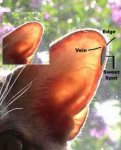
We typically test cat's ears. Does an anteater have ears? Can you test them if the paw becomes a problem or too challenging? In cats, they have fewer nerve endings in the ear, which makes it an easy place to test. We test the ear edge (AKA the sweet spot).
 

Attachments

  • sweetspot.JPG
    sweetspot.JPG
    19 KB · Views: 148
I just checked Psyllium Husk and it shows as having 1.3g of carbs per 1.5g of husk which would actually be the worst ratio as most fiber supplements seem to be half carbs. I think wheat bran will have to do for now. It is less than half carbs. I had looked into Chitin before but at the time it was only available if ordering in huge quantities. There are now sellers on Alibaba offering to sell in smaller amounts so I'll see what they can offer.

Interestingly one of her supplements is Chitosan which is Chitin with one molecule removed but I'd not give that in large quantities since a molecule can change a lot. I would need to consult a chemist.

Ant "farms" are really just ant cages. It's not really feasible to raise ants. Cockroaches are a possibility, they genetically are much like termites, though I'm not sure I could raise them in enough quantity. The one issue still with insects is the gut-loading concept. What they eat can greatly effect their nutrient make up. So captive ants even of the same species could still be much different nutritionally from the wild ants so would require experimenting and testing to find out what the ants need to be fed as well. More insects in the diet is good in general though.

I had been ordering ants off of Aliexpress but that seller became unrelable and along with losing shipments we got the wrong ants last time which they hate but I have been mixing into their food with acceptance instead of feed on their own. So I placed an order with a seller on Alibaba recently but not gotten a shipping number yet but I suppose Christmas break is a thing there too so will be patient for awhile.

Oh I did try wild farming termites before with the forestry's blessing but it didn't work out. I only got termites too tiny to do anything with. I couldn't collect them out of the farms without obliterating them.

Pua is about 15 pounds right now. I just weighed Aurora and she's 17 but she is unusually large for a girl 17-19 is more male size. I had worked with exotic animals and the more I learned about Tamandua the more I loved them. They are a huge challenge though.

Their ears are kind of leathery. It's a no go on even trying with Pua though as her edges are scarred. First she had a staff infection of the ears when we first got her then her illness(streptecocal toxic shock) that caused internal bleeding also caused petecial hemorrhaging. This caused her skin to peel when she was getting better as the skin had died from the bleeding and this included her ears. She even lost the "tip" of one ear.

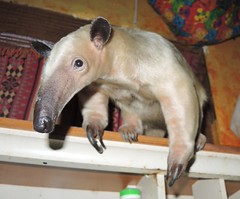
I see you are awake by TamanduaGirl, on Flickr

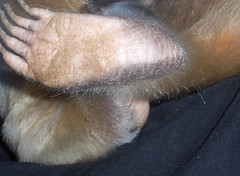
PS her foot though this is an old photo. They are smoother now.
Pua foot by TamanduaGirl, on Flickr
 
Last edited:
do anteaters eat roaches? do they like them?

I know my daughter's lizard doesn't keep up with eating them fast enough. ( different needs)
if Pua like them, you might be able to keep up with a couple of small aquariums of them.

She tells me hers are different than the kind that pester humans.
They are bred on purpose to be a good food source for whatever eats them.
 
Last edited:
Some folks test on the paw pads of their cats. I do not know if that would work for you.
 
as long as she lets you take blood from the foot, that is all that matters.

You really have done your homework and know what's best for them. Who knew there were differences in ants and termites and you could actually mail order ants.:eek:

Do anteaters get along with dogs and cats?
 
She found some wood termites out back once and loved them. I haven't tried any feeder roaches yet but they seem worth a shot.

BJM Yes I've been testing on her feet. I did it on the pad of her hand once but then when I tried repeating that the blood kept running between the grooves of her skin instead of welling up. I guess I got lucky and poked a smooth spot the first time.

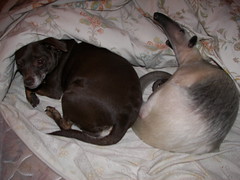
It depends on the dogs and the anteaters but yes. (hyzzie dog and Pua)
Caught sleeping together by TamanduaGirl, on Flickr

Generally when the anteaters are down running around they will ignore the dogs. Pua isn't fond of the fact the new dog Beaker sleeps in my bed but is getting bolder about coming onto the bed with him there.

Pua was terrified of the cat when she first got here but wild felines are one of their predators. She learned the cat wasn't a threat though. She was an old mellow cat. She and the young cat Jake get on fine. He loved her when he was younger but they don't spend much time together any more. The only thing is he will tease them sometimes when outside and jump over or near them which startles them. They don't like fast movements since sight is their weakest sense.

Pua and her shadow by TamanduaGirl, on Flickr
 
Thanks so much for posting the pix she is about the cutest thing I've ever seen :):):)

p.s. ssshhh don't tell anyone but there's lots of cockroaches and termites around my place, and I'd be very glad to baby sit if you wanted to ship her over ;)
 
BJM Yes I've been testing on her feet. I did it on the pad of her hand once but then when I tried repeating that the blood kept running between the grooves of her skin instead of welling up. I guess I got lucky and poked a smooth spot the first time.

I don't know if it would help you, but some of us spread a very thin layer of vaseline on the area we are going to test to help the blood bead up and keep it from running into fur.
 
Thanks guys.

Been distracted with my more problematic anteater Aurora. She has developed a couple infected tail wounds. I have no real idea how she managed it but this is a critical situation in a prehensile tailed animal.

The Vaseline sounds like it might work long as it gets down into the skin grooves.
 
Thank you. Aurora sees the vet tomorrow. Been bandaging it and giving baytril in the mean time.

So I had said I was giving yogurt but I was actually giving buttermilk most recently but though it was similar enough not to draw the distinction. I ran out and yesterday was crazy so I did give a bit of yogurt. She tested at 322 this morning which is the highest I've seen in a long time. So I got buttermilk for now but will start with making the cheese tomorrow instead. Buttermilk is not much lower in sugar and carbs than the yogurt though it is some so I'm not sure why yogurt seems to be the worst thing Pua can ingest for her BG.
 
I admit, I've been lurking your thread because...come on! Anteater? So interesting! :woot: How was the vet visit yesterday?

One other thing I was thinking about is instead of the buttermilk or yogurt, what about parmesan cheese? That's something else that works pretty well with cats because of its stinkiness and you don't have to use too much of it so it has a negligible impact on BGs (at least for cats).
 
Aurora was very grumpy about the whole thing. Had to play country music in the car or she'd cry and she growled at me when I stopped on a Pearl Jam song. The vet said it looks like I have it under control. It's looking really good today.

Could see if there's any interest in parmesan. Aurora is super picky but you never know they have odd tastes. She loves her yogurt/buttermilk sour cheese/sour cream sort of things. She used to love blue cheese, most do there is an ant where they live in the wild that smells and tastes like blue cheese, but after an illness she had she now only likes it sometimes. She likes some types of ants but seems to have trouble actually eating them most of the time for some reason. She's an odd duck.

Blue cheese is a good treat for Pua since it is low in carbs and pretty much all traces of lactose are gone due to it being aged so long though fat is a bit of an issue with it. Pua LOVES her soaked chia seeds as treats. I may need to rethink that having learned about the carbs in them. Though they come out still fully formed much of the carbs are likely in the outer slimy(once soaked) coating so she would be getting that. They are less sugar than her old treat choices though. She also loves to suck the seeds out of small tomatoes. I usually let her have one a day. I figure most of the carbs are in the fruit rather than the seeds but I could not find a run down on them separately to be sure.

Also I blend the cheeses with water or grape seed oil to make it a better consistency so that also cuts down on the percent of carbs in the final whole product consumed though water doesn't affect the count on a dry matter basis.
 
So long as I'm here I had noticed the cat difference for home meters. Someone mentioned a chart but I don't remember what thread but I found a thing that says home meters test 30-40% lower for cats compared to what a lab test would say. Now it all makes sense. Here's my handy chart from when I tried to figure it out before.


So some explanations of my notes the Pua column is directly from Pua's blood the others are the control fluids the contour is mega expired as they gave me that meter for free at the pharmacy then I see it expired in '09, gee thanks. Never could get enough blood from her to use that meter anyway.

So the values to the left are meter and strip combos. The Alpha meter / AT strip is set at dog code the one that ends fs was set at cat code.

So seeing that the freestyle meter with FS strip was 32 points below lab I set out to get a configuration that was about 32 points above what the control fluids tested at on the FS/fs combo. And Alpha/fs at 24 was close as I could get.

I see now that was wrong and I should have been aiming for the percent difference of 70. So should have used code 23. I tried this gain with the new strip I just got and she should be 22.5 but that setting does not exist so 23 is still closest.

I suppose I could save myself the trouble and just use the freestyle and do the math each time of upping it 70% Though I'll need a new battery for it. Was getting wild numbers tonight till I put the alpha battery in it then it got consistent numbers again. It needs some battery warning light so you know the accuracy is gonna go down.

Geez I always do things the hard way first. FS/fs and so the math it is from now on.
 
See my signature link Glucometer Notes.

We do not adjust the test numbers to get pet-meter values; we use cat-specific numbers to use human meters.
 
Thanks. Yeah that's what I will have to do, and was trying to here, though I still mathed wrong. It's 30% difference for her 75 on human meter to 107 lab, right? The 75 is 70% of 107 but the difference is the 3o, doh. Geez I really suck at this.
 
Pet estimate = human meter / .65
pet estimate * .65 = human meter estimate
The .65 is the halfway point for 30-40%.
Then there is the +/- 30% meter variance, which is why we don't bother converting - it winds up with a range of numbers that are useless for making decisions.
 
Okay that helps but I was trying to get something to use to figure home values based on the lab value since we didn't now how the pet or human meters compare for an anteaters otherwise. Lab value the day we tested the meters on the same blood was 107 so taking 107* .70=74.9 and the FS metter that day was 75.

So to get a home value on the FS meter I would take the value divided by .70 then right? So like in the chart I have a test of the Fs that was 192 so 192/.70=274 So that formula should get me at least a rough idea on account of the variability of the meters. This one using the fluids when the batter is good normally stays within about 10 points though.

Previously I tried to recode the meter to make up for the difference but it doesn't work out well enough.
 
PS the alpha meter that day was 99 so if I was trying to get pet meter number it would be much different from cat. 99 pet to 107 lab to 75 human. (edit roughly .76 to get pet meter value on human meter but would be pointless in my case)
 
Last edited:
What you'll need to do is collect numerous pairs of tests on the same blood drop and put them in a table.
Then snag me; I do statistics for a living.
It'll be easiest if you set up a table as
date, time, human meter test, lab test, any notes

Also, the relationship between the 2 types of test may vary with how large the number is. Small numbers may be a smaller percent difference than large numbers.
 
Thank you. That could take a long time since the lab test is an ordeal an the only test we know is accurate. I could try asking the conservation center if they could test all of their tamandua with lab and FS meter. That would be a huge favor if they actually did but it sure would be valuable to keepers of the species.
 
If you provided the meter and strips, and maybe spent a day helping them do it, they might be willing to work with you. It would enable them to use less expensive testing for routine checking.
 
Yes it would be a great little study to do. I just sent them a note asking if they do annual blood tests as if they do it wouldn't be that much more of hassle to do the meter testing at the same time so explained the idea. I also CCed the idea to another anteater friend who had been looking for a study idea though she only has 2 of her own. Maybe we could all come together and work it out.
 
There you go - a nice little study on a possible cost-saving approach to monitoring the anteaters, possibly publishable in an exotic species veterinary journal.
 
9-14-2014

I just did two tests with my original AlphaTrak and my human Easy Gluco Plus meter. Both comparisons used same drop of blood from two different cats


Dulce OTJ
AT = 72

Easy Gluco Plus = 54
The AT is 133% of the EGP value

Badgar
AT = 377
Easy Gluco Plus = 331

The AT is only 113% of the EGP value
 
@Larry and Kitties - it may be different in anteaters, hence the need for some major data collection.

And to get a proper, statistical relationship determined, you need hundreds of paired samples, not just 1.
 
Status
Not open for further replies.
Back
Top