

Managing food access can be one of the hardest parts of caring for a diabetic cat, especially in multi-cat households. Different diets, consistent meals, grazing behavior, and food stealing can all collide quickly. Microchip cat feeders exist to solve one specific problem: only the correct cat gets access to the food. This article breaks down how they work, when they make sense for diabetic cats, and what caregivers on the Feline Diabetes Message Board (FDMB) consistently report after long-term use.
What a Microchip Cat Feeder Actually Does
A microchip feeder reads your cat’s implanted ID microchip (or an included RFID collar tag) and opens only for that cat. When the registered cat walks away, the lid closes. Other pets cannot access the food. Most models are not a timed feeder. They do not dispense meals on a schedule. It is an access-control feeder. That distinction matters for diabetes management.
For diabetic cats who are often fed low carbohydrate food throughout the day, controlled access is often important when dealing with a multi-cat household.
Why Food Access Matters for Diabetic Cats
Diabetic cats often require consistency when it comes to feeding. Sudden food deprivation may contribute to blood glucose swings. At the same time, uncontrolled access by other pets can lead to:
- The diabetic cat missing meals
- Non-diabetic cats eating low-carb food
- Overeating that can complicate glucose regulation
- Constant caregiver stress and monitoring
Microchip feeders can also be useful when one cat requires food mixed with medications, supplements, or other additives that should not be consumed by other pets.
Microchip feeders typically only address one variable: which cat can eat the food. For many households, that single fix can simplify feeding routines.
The Most Commonly Recommended Feeders From The Forum
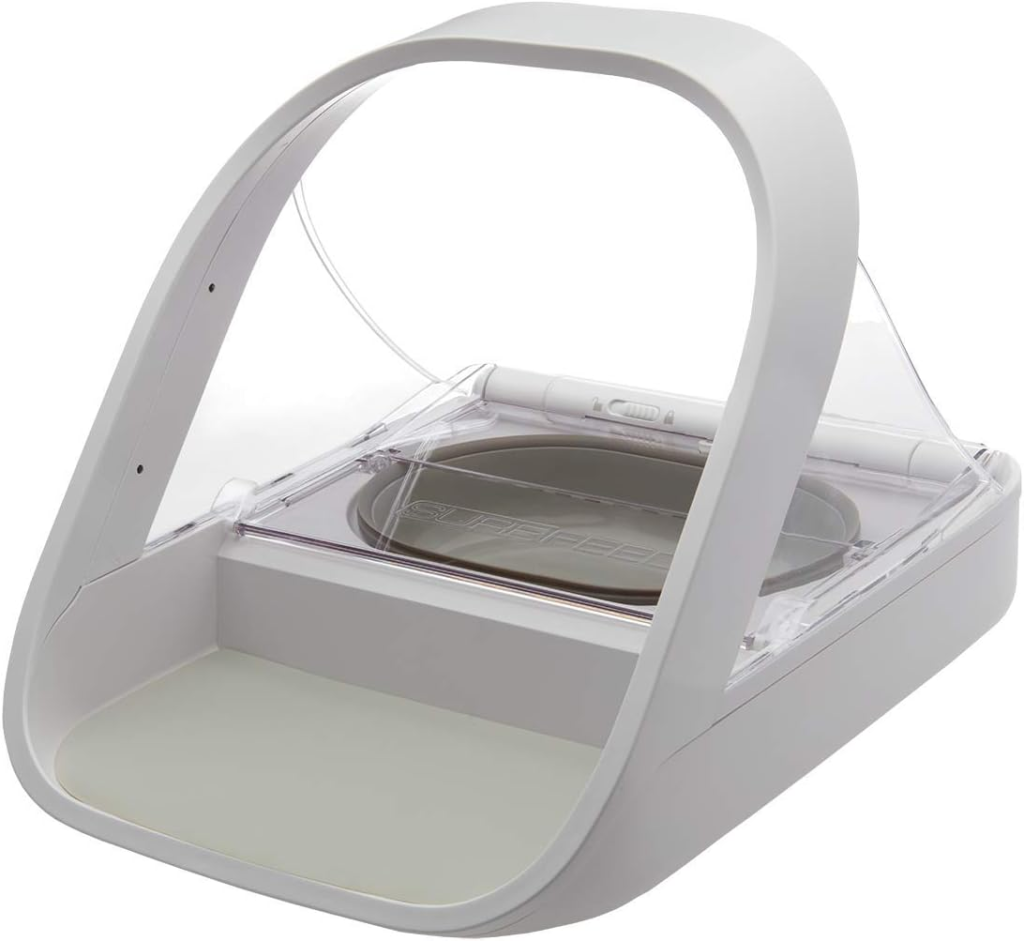
- Sure Petcare SureFeed Microchip Pet Feeder
Price: $199.00
Amazon: SureFeed, Chewy: SureFeed
This model is recommended often by caregivers on the Feline Diabetes Message Board (FDMB). It works with implanted microchips or included RFID collar tags, supports wet or dry food, and runs on batteries rather than a power cord.
What Caregivers Report With the SureFeed Feeder:
Reliability appears to be the top reason people use this feeder. Once programmed, the feeder reliably opens only for the registered cat. In multi-cat homes, this stops food theft and removes the need for constant supervision. For diabetic cats, this alone often stabilizes feeding routines.
Training is usually short but not instant. Many cats adapt within a few days. Timid cats may need the lid movement slowed or staged training. Food-motivated cats generally learn quickly. A small minority never tolerate the motion or sound.
Many caregivers report that wet food stays fresher. The closing lid reduces drying and odor, which helps diabetic cats who eat slowly or return to food multiple times per cycle. Worth noting that there is no cooling functionality with this feeder.
Battery operation is both a benefit and a downside. No cord allows flexible placement, but batteries need replacement every few months. Caregivers recommend changing batteries proactively to avoid missed meals.
Build quality is adequate but not premium. The plastic bowl is the most common complaint. Many caregivers wish for stainless steel for hygiene and easier cleaning. Third-party stainless inserts exist and are frequently purchased.
It does not solve bullying on its own in all cases. A determined dominant cat can still hover or push another cat away. In those cases, feeders may need to be placed in separate rooms or paired with physical barriers.
Long-term sentiment is positive. Many caregivers report using the same feeder for years and consider it one of the few pet products that effectively addresses a persistent problem.
- Petlibro One RFID Smart Feeder
Price: $149.99

Petlibro: One RFID Feeder
The Petlibro RFID Feeder for dry food offers a solid compromise between intelligent access control and budget-friendly pricing. Like microchip-based systems, this feeder uses RFID tags to identify which cat can open the lid, preventing food stealing and enforcing diet boundaries in multi-cat homes. It’s designed specifically for dry food and excels in simplicity: no complex programming, touchscreen menus, or power cords. Caregivers report that the dry food hopper keeps kibble fresh and accessible, and training cats to accept the feeder is usually quick because the mechanism is quiet and straightforward. The trade-offs are clear – it does not accept wet food, and it requires collars with RFID tags rather than scanning implanted microchips – but for households focused on dry-food portion control and separation, it delivers reliable access management at a lower price point.
In general, dry food isn’t usually recommended for diabetic cats due to carbohydrate content and hydration concerns. See our other article: What to Feed a Diabetic Cat – A High-Level Overview.
Microchip Feeder vs Timed Feeder for Diabetic Cats
The practical difference between microchip feeders and timed feeders becomes most noticeable in multi-cat households. Timed feeders control when food is available, which can work well when there is only one cat or when all cats eat the same food without interference. In homes with multiple cats, timing alone often fails because the wrong cat eats the food, one cat eats multiple portions, or a timid cat is displaced during the feeding window. Microchip feeders instead control which cat can access the food, reducing food stealing and guarding as variables. For diabetic cats that eat small meals, return to food multiple times per cycle, or need flexibility around insulin action, controlled access may be more practical than rigid timing.
Some caregivers combine both approaches by using a microchip feeder within a timed feeding setup, but that added complexity is only useful in specific situations. For example, some caregivers have built their own feeding box setup with a RFID access door and a timed feeding solution inside.

For caregivers looking for a timed wet food solution, the Petlibro Polar is commonly recommended. Here’s an article on that feeder: A Review of Petlibro’s Polar Wet Food Automatic Feeder.
When a Microchip Feeder Is Worth It
A microchip feeder is usually worth the cost if:
- You have multiple cats with different diets
- One cat steals food or guards bowls
- Your diabetic cat eats slowly or grazes
- You are constantly policing meals
- Food access is contributing to inconsistent glucose readings
It is usually not worth it if:
- You have only one cat
- All cats eat the same food
- Your diabetic cat eats scheduled meals cleanly
- Budget is tight and feeding issues are minor
Bottom Line
Microchip cat feeders do not treat or manage diabetes, but they can reduce feeding interference in some situations. In multi-cat homes, making sure the intended cat eats correctly can reduce day-to-day caregiver stress and remove common feeding disruptions. When those variables are reduced, feeding routines often become more consistent, which may make diabetes management easier for some cats. Individual responses vary, and no feeder can control or eliminate blood glucose fluctuations on its own.
They are relatively expensive, not a universal solution, and unnecessary in households without food-access issues. When food stealing, guarding, or diet separation is a persistent problem, they are one of the few products designed specifically to address that issue.
For many caregivers facing those challenges, considering a microchip feeder may be a reasonable option to consider.
Community Discussion: