When is a cat considered officially OTJ?

Status
Not open for further replies.

RenaRF

Member Since 2011
Henry hasn't had insulin since 4/17 (backstory here). His spreadsheet is linked in my signature. You can see he's been blue for the past six days, but he has some blue "spikes" I'm not super thrilled about. He's eating the Merrick low carb foods at regular intervals day and night (I am using a timed feeder for overnight feedings and for daytime when I'm out at meetings).

Are his recent numbers low enough for him to be considered officially OTJ? And just FYI - when he was getting insulin, he was getting .5U Lantus once daily and it would cause HUGE drops in BG. He was diagnosed with a BG of over 600. The first date on the spreadsheet is the first date he came to live with me (long story, but his person was going to take him to a shelter when she got the diagnosis).

Thanks!
Rena & Henry
(and Bella, Rufus, Feats & Meatball)
 
We consider OTJ when they are between 40-130 for 14 days.

He is a little high still however. What flavors of merrick are you feeding? You might want to choose flavors that are slightly Lower in carbs to see if that helps. But even if it doesn't he is looking good and I wouldn't shoot at these numbers.
 
The normal "rule" for OTJ is 2 weeks without insulin, which Henry fits. But you are right that he is not down into double digits (the "greens"), where one would expect an OTJ cat to be.

You are doing the right things to support OTJ status--good low-carb food, frequent and nighttime feedings.

My Maxwell was a "high normal" OTJ kitty for the time he had left between going off insulin and dying from pancreatic-origin cancer (about 1.5 years). But I kept an eye on his BG levels, watched for clinical symptoms of diabetes, and made sure he had small frequent meals of low-carb wet food available. He was very content those 1.5 years.

Now that your questions makes me stop and think, one thing that makes sense to me now about Maxie was that he had a very high fPLI test result. (In fact, his was the highest result reported to that date on the FDMB.) The fPLI is the cat-specific test for pancreatitis and at the time (2005), that test was uncommon and it required that one ship the blood to a vet school lab in TX for testing. But given Maxie never had any pancreatitis symptoms, the vet and I never did anything with that information. The vet seemed to write it off as interesting but not relevant.

If Henry were with me, I think I would do two things at this point, besides what you already are so capably doing.

First, I would get the fPLI test. For curiosity if nothing else. These days, the test is done through IDEXX and even though it is not inexpensive (maybe $150), it's not as expensive as it used to be. The results of a fPLI test could give you some glimpse into what Henry's medical future might hold.

Second, I would ask my vet to give me a good evaluation of Henry's need for a dental procedure. A low-level dental infection caused by gingivitis, broken or decayed teeth, resorption lesions, or other dental problems often cause increased BG levels. Henry was (I believe) on ABx when he was with the vet/boarding facility, and it may be that those ABx knocked down some level of infection, allowing his BGs to improve. But perhaps a smouldering infection is keeping his BGs in the high normal level. Even if he only has plaque, it might be a good idea to have him in for a dental cleaning. It certainly can't hurt his BGs (although the overnight fasting might make him grumpy). There is a good article about what to look for in a dental procedure on the Diabetes in Pets Wikia here.
 
Venita and Ennis93 said:
First, I would get the fPLI test. For curiosity if nothing else. These days, the test is done through IDEXX and even though it is not inexpensive (maybe $150), it's not as expensive as it used to be. The results of a fPLI test could give you some glimpse into what Henry's medical future might hold.

Second, I would ask my vet to give me a good evaluation of Henry's need for a dental procedure. A low-level dental infection caused by gingivitis, broken or decayed teeth, resorption lesions, or other dental problems often cause increased BG levels. Henry was (I believe) on ABx when he was with the vet/boarding facility, and it may be that those ABx knocked down some level of infection, allowing his BGs to improve. But perhaps a smouldering infection is keeping his BGs in the high normal level. Even if he only has plaque, it might be a good idea to have him in for a dental cleaning. It certainly can't hurt his BGs (although the overnight fasting might make him grumpy). There is a good article about what to look for in a dental procedure on the Diabetes in Pets Wikia here.

Venita, I agree 100%. Clide had pancreatitis twice during his time with me. Thankfully, it was pretty mild, but I am familiar with the fPL1, and I do think it's a really good idea to ask for that given that I really need the vet to draw blood as well just for a basic screening. I will also, obviously, have the vet check his mouth. His breath is not rank, but it ain't great either, and I suspect he's going to need a dental. If he does need one, I'll take him to the veterinary dental specialist I used for Clide as well. At least I have my specialists covered. ;)

Thanks - I think I'll make the appointment for Monday. I had moved his appointment out (he had one originally for a week ago) because I wanted to give about a month between his initial diagnosis and his recheck to see what his blood levels are doing, and Monday is pretty much right in that sweet spot.
 
The only other suggestion I would have would be to try a microdose (0.1) of insulin after the checkup and verifying no infection present. Try the lower carb low carb foods idea first though to see if that will drop his numbers into the pretty green zone.
 
Deb & Wink said:
The only other suggestion I would have would be to try a microdose (0.1) of insulin...

Deb, do you have a link to show Rena how to draw and measure a drop of insulin?
 
if this were my cat, I would be giving insulin. As already mentioned, a cat is considered in remission if they can ideally stay under 100 (in the greens) without insulin. It does not appear that you ever had a green number and I am curious as to why you stopped giving insulin. If you were only giving .5 unit - that is not a huge dose and one that you can safely administer and test.

My thoughts are that this cat needs insulin still and while he is trying to not need it, a little bit will certainly help and you will probably start seeing green numbers quickly.

take a look at Maui's chart and you will see that she got small amount of insulin in the green numbers and i can safely say that 4 years later she is still in remission.
 
There is this link to Steve Rapaport pictures of the various microdoses http://steverapaport.com/jock/SyringeFineGradations/ The pictures are a little out of focus so I do not like them as much.

There are some good pictures here but still not the ones I want. This post also is good because it talks about the consistency of the dosing and has some different pictures.
http://felinediabetes.com/FDMB/viewtopic.php?f=10&t=34424#p360982

I know there are better pictures around. Let me find the link. Here they are!!! They were in the Lantus ISG, Tight Regulation Sticky called "STICKY: LANTUS & LEVEMIR - NEW TO THE GROUP? PLEASE READ..", about 6 pages down.

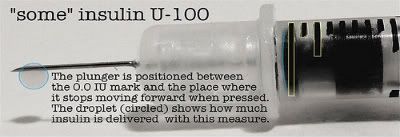
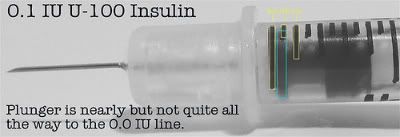
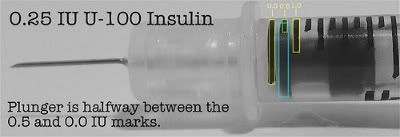
Pictorial guide using a U-100 syringe marked with half units:

someinsulin-1.jpg

01unit-1.jpg

025unit-1.jpg


Fine dose gradations from Steve and Jock:
0.5U = exactly half a unit
0.4U = skinny 0.5 touching the line
0.3U = skinny 0.5 with daylight under the line
0.2U = fat zero with daylight over the line
0.1U = fat zero touching the line

You really, really, really need to have the syringes with the 1/2 unit markings when you do this. It is good to practice with an empty syringe and some colored water to check your dosing. Then maybe with a fine tipped black marker, draw in a line at the spot on your 'practice syringe/reference syringe' for future reference. Draw up an insulin dose and compare to the mark on your 'reference syringe'.

Does that make sense to you Rena?

I had Wink on an OTJ trial beginning of February 2013 and when he bounced into those blues, I put him back on a microdose of insulin to help support his pancreas for a bit longer. He went officially OTJ March 12th after his second OTJ trial and keeping all in the green numbers.
 
I hope Henry feels better! Do they know what's going on yet? If he's on Clavamox, it sounds like an infection of some sort. :YMHUG:

Venita and Ennis93 said:
Deb & Wink said:
The only other suggestion I would have would be to try a microdose (0.1) of insulin...

Deb, do you have a link to show Rena how to draw and measure a drop of insulin?

Here's another great link for micro-dosing as well.
 
The reason for all of this drama is a skin infection. I noticed what seemed like very mild chin acne a week and a half ago - but by Wednesday, one of the areas looked scary. Like he had a lump just below the right corner of his mouth. Having recently lost my sweet Clide to OSCC, I am paranoid about ANY appearance that is not normal. So off to the vet we went. Vet thinks it's bacterial or fungal. Took a scraping, sent it out for a culture (results not back yet). Didn't think it was cancerous. The whole bottom of his chin is kind of crusty/icky. And they found another area on his right butt cheek! So he prescribed Clavamox and a Novalsan rinse (topical).

I took him home and life was good. Numbers had been great (spreadsheet is up to date). Gave him the first Clavamox at 8am Thursday am, fed him, and then left for meetings an hour from my home. Got a call from my husband at 1pm. He said Henry had been throwing up. I got home by 2:30, and he had vomited like 6 times. Took his BG and it was 325!!! It had been like 93 that morning. He vomited another three times once I got home - liquid. And the last (10th) time, he vomited A LOT of blood. This was about 5pm. I put him in the carrier and ran out the door to our vet ER.

They gave him fluids, subQ anti nausea and subQ antacid. They prescribed a topical antibiotic and anti-inflammatory - the generic form of bactroban. And yes, it has a steroid in it and we discussed that but decided that because I home test, we would give it a shot and not risk another oral antibiotic. They also sent me home with sulcrafate - the kind without sugar that I have to crush and mix with water and then syringe. I was to withhold water until about 11pm provided he didn't vomit, and I did that (and he didn't vomit). He used the kitty box at 11ish last night and there was definitely blood in his stool and it was diarrhea. :( ER vet was called, agreed that it could be just blood from the stomach from the earlier incident and to watch him (it wasn't bright blood - like fresh; it was maroonish). I was to withhold food until the following am to give his GI system a break, and if he didn't vomit overnight, feed this AM and I did that.

I tested him this am (101), gave the sulcrafate, put the ointment on, put an ecollar on him (which he hates) and then fed him half his normal amount. He ate that willingly and I gave him the other half a bit later. Tested him at 2pm and he was 99. Fed him a little more and he ate and ate well (Henry eats FAST). 8pm BG was 90. But he hasn't finished all of his dinner and he clearly has diarrhea (although no blood), so he's not back up to snuff yet.

All from stinking Clavamox. Poor Henry.
 
Status
Not open for further replies.
Back
Top