What's the target number? (Can't regulate)

Status
Not open for further replies.

Hammerhead

Member Since 2014
My baby sweethead Hammerhead is getting a little older (15?) and I've amiss how to regulate him.

Summary info:
- Purina DM, half can at 8 am and 4 pm.
- Humalin N - Vet said (two years ago) 1-2 units per meal.
- Saline (Ringer), ≈50ml with each meal.
- At the vet two weeks ago the ringer was prescribed after 1) he didn't #2 for 2 days 2) he had some growth (infection) on his gum; blood test found a UTI and a single antibiotic was given to address both. Infection gone quickly, who knows his current state on the UTI .. He certainly has no problem urinating and he defecates once a day overnight.

But as I've found him at times getting weak (and assuming the number was low what else can I do but feed him ... and sometimes when I do he won't eat the DM and because I think it's am emergency I feed him cat treats (regular old cat treats... which I now learned today are no good and tossed them this morning and went and got freeze dried chicken)

Today:
8:30 am, 53 bgl; legs completely limp; half can food, ate all; very hungry; walking in minutes; gave him 1.5u
9:30 a, 87 sugar; walking with difficulty
11:30, 40, gave him 1/8 can food with a few of the new freeze dried treats; barely walking
2 pm, 125, walking well!
4 pm, 240, weak again!; dinner- 1/2 can plus 1 unit (didn't do 1.5 because I had to leave for a few hours)
7 pm, 135, weak!!
8 pm, 100, so I've fed him 1/4 can (what other option might there be?)

So I note from 11:30 to 2 pm the number was rising and 4-7 pm it's falling. ... is that pertinent?

Sometimes I just think it's better to feed him 4x a day!

Is it possible the Humalin is too old? ... with only 1-2 u a day my present bottle has lasted 6-8? months?, and is at the very bottom... no problem tossing.

I work at home and can do a little extra work to get this right. Hammerhead is a pretty resilient cat otherwise.

Thank you experts.
 
Are you using a human glucometer or a pet-specific meter (like the AlphaTrak) to test Hammerhead's glucose? If you are using a human glucose meter, you don't want the insulin to take the kitty's numbers below 50. If you are using the AlphaTrak, you don't not want the insulin to take the kitty's numbers below 68. I see that Hammerhead's numbers fell below 50 today. That tells us that the dose you are giving him is too much. He may be experiencing episodic weakness because he is having hypoglycemic attacks.
 
Poor Hammerhead! :sad:

I'm only a novice so I can't offer you any advice but the experienced members here will be able to.

Given Hammerhead's clinical signs, I'd be inclined to recommend you highlight your thread on the board so that experienced members will know you need help fairly quickly. To do this, go back to your opening post and click the edit button. Then select one of the post icons (e.g. the 'star' icon or 'question mark' icon) to attract more attention to this thread. Then submit your post again. If it starts looking like an emergency (and hopefully it won't!), you can change the opening post icon to 911 to let members know you need help in a hurry.
 
Okay, I'm back. I had to grab a chart. This chart was created by one of our members here (BJM) and gives you a general breakdown of the numbers:

We suggest using an inexpensive human glucometer. One many of us use is the WalMart Relion Confirm, or Confirm Micro, which is also sold at American Diabetes Wholesale as as the Arkray USA Glucocard 01 or 01 Mini (samemanufacturer - Arkray USA). It uses a tiny blood droplet and the cost is significantly lower for test strips (like $0.36 each). In Canada or other countries, you'll need to look for one you can afford, and easily obtain test strips to use.

[Glucose reference ranges are unsubstantiated and have been removed by Moderator]


* * * * * * * * * * * * * * *

Examples of using the chart:

Ex. You are a new insulin user and you test your cat before giving insulin. The test is 300. It probably is safe to give insulin.

Ex. You are an established user of Lantus, following the Tight Regulation protocol. You've tested around +5 to +7 to spot the nadir. It is 200 mg/dL. You probably need to increase the dose, following the instructions for the protocol.

Ex. Your cat is acting funny. The eyes are a bit dilated. You are concerned and test the glucose. The number is 35 mg/dL. ACK! The cat may be in a hypoglycemic state. You quickly follow the HYPO protocol linked in the glucose reference values chart. (which we really, really, suggest you print out and post on your refrigerator.)

Okay, so let's start with the home testing. It's great that you are getting these readings in. It's really, really important not to give a shot when your kitty is at 53 like he was this morning, though. That is at the low end of the normal range. What is happening, I think, is that you are giving your cat too much insulin. The insulin then brings him down too low, and his liver tries to protect him by releasing extra glucose to get his numbers back up. That may be why you're seeing some of those big swings in numbers.

A couple of other thoughts I had. First, it's actually easier on the kitty's pancreas if you will feed several small meals a day instead of a couple of larger meals. How is Hammerhead's weight? A lot of diabetic cats actually need extra calories until they get regulated. Their bodies can't properly process the energy in the food, so they need to eat more of it to compensate.

Humulin is actually not one of the best insulins for cats. Humulin causes sharp drops and wears off quickly - this, too, might be causing the big swings you're seeing. Lantus, Levemir, and Prozinc are some of the best insulins for cats. They last much longer and are much gentler on the kitty. You might want to consider asking your vet about switching to one of these insulins.

An infection can often raise a cat's glucose numbers. Once the infection is treated, the glucose numbers can come down and the insulin dose may need to be reduced as a result.

Please make sure you have high-carb canned food or Karo syrup available in case of a hypoglycemic episode. Maple syrup and honey will work, too. Here's some information on recognizing the signs of hypoglycemia: http://www.felinediabetes.com/FDMB/viewtopic.php?f=28&t=15887

I'm going to stop there and ask what questions you have. I know you have to have a ton of them. I'm also hoping some other users can offer some suggestions and advice.

I'm glad you found this site!
Shelly
 
Hi and Welcome,

I definitely think your kitty needs less insulin. This morning, his number was way below 200 (our usual target for a no shoot number for new diabetics) so he shouldn't have gotten insulin. The low numbers today were definitely in hypo territory. Be aware he may go up quite a bit tonight. Cats "bounce". When their body perceives a lower than usual number, it releases extra glucose which sends the blood glucose numbers up. I would still lower the dose, even if his number is high tonight.

As you are home testing (Fantastic way to keep him safe!), if he were mine, I would reduce the dose to one unit and start testing before each shot and midcycle to see how low the insulin is taking him. That will help you figure out if he needs more or less insulin. For the pre shot, if he is under 200 but above 150-180, you can stall. Wait 20 minutes and retest, without feeding. If he is over 200, then you can safely shoot, but maybe reduce the dose a smidge.

Just for reference: We generally consider a cat regulated if they are in the mid 200s at preshot and in double digits at nadir but not below 40, which is approaching hypo territory. A cat OFF INSULIN ranges from 40-120 and if in that range for 2 weeks without insulin, we consider a cat in remission or OTJ (off the juice)

I would think his symptoms have to do with the hypo today, but I am wondering what antibiotic the vet prescribed. There are some issues with Covenia which you might consider if he has any of the symptoms and they persist. Note that all cats do not have these problems:

Covenia per Dr. Lisa: quick note on the long-acting antibiotic called Convenia. Because this drug stays in the body for a very long time (up to ~60 days) it is one of the newest antibiotics to be terribly overused/abused. Veterinarians and lay people are seeing it as a quick and easy fix to their problems because they don't have to give it once or twice daily like with other antibiotics. It is typically given by injection once every 2 weeks. However, keep in mind that if an adverse reaction occurs, you cannot retrieve the drug from the body.

Convenia can cause severe anemia. There is a report on VIN (Veterinary Information Network) from a general practitioner who dealt with two cats that died within 10 days of receiving Convenia. They were otherwise healthy cats and had normal red blood cell
 
Oh my... this is an outpouring of love !

Thank you!

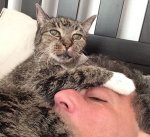
Introducing Hammerhead...


Hammerhead isn't new to treatment ... it's been years.

I am using AlphaTrak and I certainly don't recall the vet saying don't give under 200.

"We generally consider a cat regulated if they are in the mid 200s at preshot and in double digits at nadir but not below 40."

(Not what I recall the vet said ... I have been doing for a 100-200 range.)

Shot was Cefovecin (Convenia) <25lb/ml. At this point I think the harm is me and not the anti-biotic.

*I'll also note that Hammerhead, when he can walk, is often dizzy... or disoriented ... I would swear he's blind or deaf sometimes... he's stop coming when called and unless his food is right under his nose he can't find anything ... treats that are inches away.

So clearly I need to re-regulate the dosage.

Is it a good idea to try 4x1/4 can a day instead of a half-can twice a day? ... my thinking is that is doesn't always finish the half can but sure would the 1/4 can and if more frequent, with a few days curve monitoring, and NOT giving him anything below 200, how about half a unit from 200-300?, and 1U from 300-400? (I'm reading some info that sounds conflicting so I'm trying to garner a safe average). And if I'm 4x1/4, with humalin, as it's short-acting, then that would also be consistent? (longer active insulin for longer periods without eating). Time and time again I see he's getting weak mid-day and night so again, does this reasonably point to 4x a day? (or even more than one can for now?... 4 x 1/3rd can or 1/2 can? ...)

Also, semi-different topic, I noted in my OP that I give him IV fluid... it was very hard to find a supplier for the IV but a reliable and very affordable source is Walgreens Infusion Services ... near me in Plymouth Meeting, PA.

http://healthcare.walgreens.com/healthc ... n_services
 

Attachments

  • IMG_1266.jpg
    IMG_1266.jpg
    50.2 KB · Views: 423
What a cutie! :-D

I am using AlphaTrak and I certainly don't recall the vet saying don't give under 200.

"We generally consider a cat regulated if they are in the mid 200s at preshot and in double digits at nadir but not below 40."

(Not what I recall the vet said ... I have been doing for a 100-200 range.)

Thanks for letting us know that you're using the AlphaTrak. In that case, you don't want Hammerhead's numbers to fall below 68. That 40 you saw today was definitely hypo territory. Hammerhead was also in hypo territory when you gave him insulin with that 53 pre-shot number this morning. nailbite_smile

I just provided a copy of BJ's chart to kind of give you an overview of the range of numbers; I didn't mean to confuse you! ohmygod_smile When people are new here, we try to play it safe and tell them not to shoot low numbers (like under 200) until they can collect more data. [Many people who use Lantus will actually give insulin when their kitties are in lower numbers - but Lantus works in a completely different way than Humulin does.] We have a saying here - "Better too high for a day than too low for a moment." That's why we try to be more conservative until we can get some data to show how kitty reacts to insulin.

I would personally try feeding more often - four meals a day might help a lot. Often, people just have to experiment with a feeding schedule to see what works best. Some people feed four meals a day, some six meals, some even more than that. The more frequent meals will definitely help ease some of the burden on his pancreas.

As for the dose - I've asked someone who has more experience with Humulin to come by and offer some suggestions about a good dose for Hammerhead since this dose is too high for him. We want to make sure you get the best advice from the most experienced users!

Shelly
 
If he were mine, I'd drop the dose To .5 and get some data. If, after a few cycles, he is running in high 300s and 300s, then increase by .25 and hold that dose awhile. If his numbers are in that regulated range, then I'd hold the dose for a few days to see if the wet low carb diet and infection clearing brings the numbers down.

IMHO, Better to start low and slowly raise the dose as the testing indicates, especially as you may have an infection keeping the numbers high for a few more cycles.
 
What are the chances you could switch to ProZinc or BCP PZI? They are a bit more expensive than Humulin and last closer to 12 hours per shot.

The difficulty standing and walking could very well be hypoglycemia. Have you tested at times he's like that? With the dose you are giving, it is very possible he may have suffered some permanent damage from hypoglycemic attacks. Another possibility is he has diabetic neuropathy; this is treated with methyl-B-12, a specific form of the cobalamin vitamin.

Humulin lasts about 6-8 hours in the cat. Good regulation can take shooting 3 times a day at roughly 8 hour increments.

Because of how fast and hard it hits, it is important the cat has eaten about 30 minutes before giving the insulin. Feeding after about +4 hours after the shot may result in fast rising glucose levels due to the Humulin wearing off - only testing will show how long it lasts in your cat.

Please don't give insulin below about 230 mg/dL on an AlphaTrak (about 150 mg/dL on a human glucometer) unless you have test data arout +3 to +4 hours after shots which show your cat is not going too low (below 50 mg/dL on a human glucometer; about 76 on an AlphaTrak)
 
"it is important the cat has eaten about 30 minutes before giving the insulin"

Vet never said that.

"Good regulation can take shooting 3 times a day at roughly 8 hour increments."

Without eating? ... vet said never without a meal. (Which I'm not thinking she said just to try and simplify things.)

I could be mad at the Vet but it's more my fault than theirs unfortunately.

When his levels are good... is that unique for him?... he walks ok.

Thank you everyone.
 
Right now, it looks like the insulin is working better for him than it does for most cats. I'd continue testing, shooting small amounts if the numbers warrant and see how it goes. In most cats, it only lasts about 8 hours but maybe he will be one of the lucky ones. The reason for him to eat ahead of the shot is that it tends to hit hard and fast and can drop them pretty fast. You want food in his stomach to counteract that.

Vets usually receive one workshop on diabetes with their nutritional section done by Purina. And then in their practice, they may see a diabetic cat every few months. We live and breathe FD and see a couple of new FD cats daily. We have a protocol of slow acting, long lasting insulin plus wet low carb food and testing that has been successful for over 15 years. Maybe your vet will be willing to learn something from you!
 
Challenges with work and other obligations (and Hammerhead doing better) have kept me off the board for a week I see! ... where does the time go!

He is better on some fronts ... I've found after a few days of charting that his behavior is typically pretty good when he's in the 350-450 range. So in the am I've found him to be max, 500 sometimes, and then I give him food and 0.75U.

But he never eats it all (half can) and sometimes not even a quarter. This didn't worry me...I fed him a few tablespoons every four hours or so but now I'm not sure about IV ringer fluid - how much and when (each meal? once, twice a day? 100ml?)...and if he should get miralax with every meal.

He's been pooping once a day, but that stopped a day ago. Plenty of uninary output. I've given him 100ml fluid this am and now, dinner, a few tablespoons of food mixed with water, and 100ml IV. He's a bit hungry and starting to have trouble walking (cause it's not alot of food)...but I'm concerned too much food is bad! ... he won't be able to push it out! ... and too little and his body won't say 'go'!

But I can't see how he's dehydrated. He's not uncomfortable and I've been walking him around ... he follows me, he's hungry.

Now my biggest concern is another vet trip if he doesn't poop again... how long might it be and what can I do to feel him below and get an idea of things!

Poop Hammer!
 
Good to get an update on Hammerhead.

I'd be very much inclined to take him back to the vet, and very much inclined to get his B12 levels checked because deficiency can contribute to weakness (including gut motlity problems). Is Hammerhead showing any signs of nausea (odd lip licking when he eats something, licking the food but not eating it, sniffing it but walking away)? If he's nauseated it can cause inappetence. He needs to have food on board with his insulin.

Hopefully more experienced members will be able to give you some advice. I'm only a novice.
 
Feline Constipation will educate you on more than you ever thought you needed to know about how the feline GI tract should function and how to intervene when it does not.

If the vet determines he is not blocked (ie, it won't move) Miralax or generic equivalent, 1/8 to 1/4 teaspoon, may be added to a meal, along with an extra tablespoon of water, to help keep moisture in the feces so they do not become rock hard. Don't start this unless you are sure things can still move; it could be disastrous (the GI tract can tear).
 
Status
Not open for further replies.
Back
Top