Went hypo. -Dose decr - hi nadirs- to hyperglycemic

Status
Not open for further replies.

Wendy 17 and Merlin

Member Since 2020
Merlin behaved normally tonight, not giving any indications of anything unusual happening. PMPS was 503 on a Vet meter (Henry Schein GlucoGauge). My Relion was dead when I tried to get a reading due to needing new batteries. It would have read as approx. =/>300. I had Relion working again a bit later.

I decided to do as Panic suggested yesterday and take some additional readings. I am so glad I was urged to do so. Otherwise I would have missed the hypo episode.

Although he had been eating frequently and enough since the last shot (PMPS), Merlin was hypo at +3 h (48 Relion Prime, Vet meter 28) without showing any signs or symptoms of being hypo. I treated him with honey and food and rechecked at +4 (83) and +6 (146). No ketones.

What should I do next when the usual dose is due? No insulin or reduced dose? Is a permanent dose reduction indicated? How much?

@Panic
 
How far until shot time? Yes a permanent dose reduction of 0.25u.

Next time you get a number, ANY number below 50 you have to stay with them and keep testing every 15-20 minutes until they're at least over 70 and can stay over that without food intervention for 2 hours. Merlin could have easily dropped again after the honey wore off.

I'm very glad you tested, as you can see the cat doesn't always show hypo symptoms.
 
Thank you for the quick response!
AMPS is in 2 hrs (8am PT). If he reads over 200 by then, should I give the reduced dose (0.4U reduced to 0.25U) or skip?

With Merlin needing such a small dose, does that mean he is near remission?
 
? Went hypo. What to do next?--Too low again next day
After going hypo in the early morning hours Fri 10-9-20, I did not shoot the AM dose at 8 am. BG for AMPS was 225. At +8 hr, it was 311. PMPS at 8pm was 278. I gave the newly reduced dose of 0.25U instead of the previous 0.4 U.

All seemed fine. At +5 hr, I got another unexpected low reading (57) that could easily have been lower a little bit earlier.

Merlin did lip smacking at +5 hr. I fed him hi carb kibbles. He regurgitated them a few min later . This frequent regurgitating has gone on for over 6 weeks.

I gave him 2 mg Zofran and fed hi cal canned. BG improved to 177 at +6.5 hr.

Questions:
  1. Why does he go hypo even on a prior skipped dose and then on a following new half dose?
  2. This going hypo could have happened daily for a long time since I did not test mid cycle.
  3. Could this be the reason that fructosamine had worsened after a month on PZI?
  4. What needs to be done to make the curve less deep at nadir?
  5. Is the frequent nausea related to low BG?
  6. What should I do at the upcoming AM shot (in 3 hrs)? And the PM shot at 8 pm?
 
Away from my computer atm but will comment when I get back shortly. We're going to drop the dose to 0.10u okay?
 
Some thoughts for you.

57 isn't hypo numbers ... below 50 is the "take action" number and even if a cat drops below that, it is not considered a true hypo unless they are symptomatic. I haven't heard of lip smacking as a symptom though it might be, perhaps someone can clarify that for me. Now Merlin DID drop lower last night though (which is good because he earned a reduction again! hooray!).

Are you feeding throughout the day/night? Snack at +2, +4, +5, every couple hours or so? That will help steer the drop.
Merlin had a noticeable drop at +2. A +2 is indicative of how the cycle will go. Next time you see a noticeable drop at +2, get another test in an hour (or sooner if needed).

Why does he go hypo even on a prior skipped dose and then on a following new half dose?
Some cats run down the dosing scale. Diabetes is a moving target. 0.4 is too much, so is 0.25. You're probably getting pancreatic activity which is working alongside the insulin and dropping him more, so we lower the dose accordingly.

Could this be the reason that fructosamine had worsened after a month on PZI?
I never look at fructosamines past using them for diagnosing diabetes. Ignore them, there's no real-time accuracy with them.

What needs to be done to make the curve less deep at nadir?
See above. Feed small snacks to "steer" the drop.

Is the frequent nausea related to low BG?
If he is not eating, or eating and throwing it up, that would cause the insulin to have nothing to work with, so possible. @Nan & Amber (GA) do you have any info on this?

What should I do at the upcoming AM shot (in 3 hrs)?
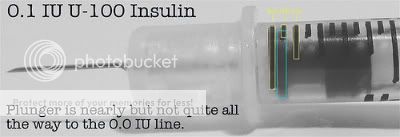
0.10 units if he is high enough for insulin. Below 150 skip, between 150-200 either skip or feed and check in a couple hours and dose based on that number. This will throw off your schedule though.

Take a syringe and practice with water before giving 0.10u. It'll be a very very small amount. This picture is for U-100 syringes but it will be the same spot on U-40s.
01unit-1.jpg
 
A guide for you:

Numbers between 50-70
  • This is an intervention range. Feed 1-2 tsp of low-carb food and retest in 20-30 minutes.
    • If dropping, offer a little more low-carb food and repeat process
    • If holding, no more food but retest in 30 minutes to be sure they are no longer dropping
    • If rising, no more food and take a break. Retest in an hour to make sure they don’t dip back down again
Ensure that kitty stays over 70 without food intervention for at least 2 hours.

Numbers below 50
  • This is considered the “take action” number. If the blood sugar is permitted to go lower, the cat is in danger of experiencing a hypoglycemic event.
    • Retest immediately to determine the reading is accurate
    • Rub Karo/maple syrup or honey on gums (this is a TEMPORARY fix)
    • Feed high-carb food and recheck blood glucose in 15 minutes
Repeat as necessary, testing every 15-20 minutes until numbers are over 50 - then use the 50-70 range guide. Every time you have to feed mid/high-carb food, the 2 hour clock starts over.

Do you have gravy food at all? High-carb dry works as well but it's better to use gravy because dry takes a while to leave the system after.
 
If he is not eating, or eating and throwing it up, that would cause the insulin to have nothing to work with, so possible. @Nan & Amber (GA) do you have any info on this?

Not really-- the above makes sense. On the other side, feeling lousy (as with nausea) can bump the numbers up, as can some of the frequent root causes of nausea (such as pancreatitis). So it's hard to draw any direct consistent relationship betwen BG and nausea.

Speaking of nausea, that's what the lip-licking indicates, I think.
 
Speaking of nausea, that's what the lip-licking indicates, I think.
'Yawny' lip licking is commonly a symptom of nausea. (Think of the faces humans make when they have tasted something disgusting.)

Is the frequent nausea related to low BG?
It's one possibility (though I've no way to say for certain). When some cats experience a significant drop down to lower numbers - either in the hypo range or even safe numbers at the lower end of the normal reference range - it can sometimes trigger GI upsets (nausea, diarrhoea).

Can't comment on PZI, but I have come across reports that Lantus sometimes causes digestive upsets in human diabetics.


Mogs
.
 
  • Thank you for the great info. It helps so much to get some understanding!
  • Merlin gets food whenever he asks for it or should get some per schedule (spoon-feeding if needed). He eats every 2-3 hours.
  • What are some favorite high-calorie foods? I have some Hill's z/d on hand that I used. You are right, to work faster, wet food would be preferable to dry.
  • Yes, lip-smacking (swallowing saliva) indicates nausea. Vomiting usually follows soon thereafter.
  • Merlin's pancreas is very inflamed due to the abscess and bacterial cyst that surgery was unable to remove. There seems to be some insulin production left.
AMPS this morning was 232. I gave 0.1 U PZI
 
Wish we knew what was bothering his tummy since the meds don't seem to be helping. :( He does seem to be high enough for insulin but with his poor appetite + low numbers indicating pancreatic activity I'm not sure what to suggest.
 
Thanks for responding. I agree. His pancreas is probably the cause for feeling badly. He might be better tomorrow. Every single day, I do not know what to expect. He has that many ups and downs. I think I will skip the PM shot. I cannot stay up and watch him for the next hours. Never went to sleep last night.
 
I don't think you're doing anything wrong. Not sure it's time yet to switch to a different insulin, you may just have to wait out Merlin's tendency to bounce. I suspect that's what happened this morning-- he was in blues last night, possibly he went lower, and then zoomed up in reaction this morning.

Let's see what the Prozinc/PZI people have to say about this, though!
 
It looks like he was just clearing a bounce from last night. Do you already know what a bounce is or need a Bouncing 101?

You could switch to Lantus ... but it may be tricky because then you will be dealing with a depot. The way depot insulin works is it stores insulin in the body and releases it slowly ... and one cycle affects the next. So say you had Merlin on a depot insulin with 0.10 units. If his pre-shot was low and you decided to skip, you still would have to monitor because the depot may come into play and continue to lower the BG even without a new dose of insulin. Make sense?

I think you should post on the Lantus forum and ask if they think you should try switching over, they would probably have a better idea on whether you should switch or stick with it.
 
If you are having problems using the U40 syringes to measure the U40 Prozinc insulin, you can try several things.

1. Use U100, 3/10 cc syringes with 1/2 unit markings on the barrel. Use the conversion chart (multiple the U40 dose by 2.5 to get the amount to measure and draw up in the U100 syringe) Keep recording the dose on the SS as the U40 dose amount.
2. Use calipers to measure the dose. Insulin syringes don't always have the markings in exactly the same spot on the barrel of the syringe. Calipers can help with measuring a more consistent accurate dose. See the FAQ's forum for the thread on using calipers.
3. Make a reference syringe. Take a syringe, draw up some colored water or juice, and compare that "reference syringe" amount to the amount you have drawn up in your syringe with the insulin in it.
4. Practice drop dosing.
 
Elizabeth, I needed the Bouncing 101 info and explanation!! Thank you. Diabetes is so complex. The info I need to know is huge. What can I do to avoid the bounce?
Merlin is getting worse on me faster than my efforts to help him. He is losing weight, looks drawn. He is shaky on his hind legs all the time now. Is it painful? He is getting weekly B12 shots.
Deb, I used both U-100 and U-40 syringes. I need to measure 0.1 Unit. That is less than a mm on the barrel. I will use your suggestions. Thanks.
 
Bouncing 101:

Bouncing is a phenomenon that occurs when the body experiences (or at least thinks it does) hypoglycemia. Luckily the body uses bouncing as a defense mechanism against this where it attempts to compensate the low blood sugar by dumping excess glucose in an attempt to raise blood sugar back to “normal” numbers. Unfortunately, “normal” is a relative term according to the body. For a diabetic whose body has been untreated for so long that it considered very high numbers to be the new normal, lower numbers can often make the body overreact in attempt to save itself, even if it’s not in danger.​

A cat who has been suffering from diabetes for some time may at the point of diagnosis have a new “normal” of 400. When insulin is introduced and brings it down, even to 200 (still diabetic levels), the body thinks it is in danger, dumps excess glucose, and thus the blood sugar skyrockets up to the 400-600s. After enough time has passed, the body will eventually realize that 200 isn’t such a bad number, and bouncing will happen less often. Note some cats are extremely bounce-prone and a switch to Lantus/Levemir is needed.​

There are three main causes of bouncing: when blood sugar drops too low (hypoglycemia), drops lower than the body is used too, or by dropping too much too quickly. Typically if a cat drops more than 50% of their blood sugar a bounce is likely to happen, or if they drop 100 points within an hour.​

While bouncing can be considered as a safety net in the instances of hypoglycemia, it can look very confusing on paper.
As for preventing bouncing, the only way to discourage it from happening is steering the drop throughout the day with food - but you won't always stop it, and it CAN be a good thing. If you haven't already I suggest asking the Lantus people if they think Merlin will be able to smooth out on Lantus. Then we can look into getting you a pen vial.
 
Hi Wendy,

He is shaky on his hind legs all the time now. Is it painful? He is getting weekly B12 shots.
I wonder whether the B12 injections might be 250mcg cyanocobalamin? If yes, it's not as good for the nervous system as B12 methylcobalamin. Normally for uncomplicated diabetics with neuropathy quite a high daily dose of methylcobalamin is given (see Zobaline formulation) but with Merlin's multiple issues I'd suggest discussing any change to his supplementation and also dosage thereof with your vet before switching/adding to Merlin's regimen.

Other things to look at are potassium and phosphorus levels as both of these can cause similar problems if they're out of whack.

I hope this info helps you both.


Mogs
.
 
Elizabeth, great info on bouncing. I have not yet had time to ask the Lantus forum. Merlin gets wet food any time he asks for it, he gets as much as he wants to eat, even gets spoon-fed several times a day if he does not eat on his own. He gets food every 2-4 hrs around the clock. He gets picky and wants a lot of variety. The standard is home-made chicken breast. Various canned in addition. When he first got sick in Ap 2019 with IBD and pancreatitis, the vet ordered hydrolyzed protein dry food (Royal Canin), which he got exclusively for about 10 mo. He likes it, but it is high in carbs. When blood sugar rose, I put him back on wet food since Feb 2020. During the last few mo, when he has no appetite and even objects to spoon-feeding, he gets a few kibbles as last resort to get some food into him.
His food is not well absorbed. Stool is formed, but soft and very pale in color (taupe [grayish] and yellow color), lacking bile. Surgeon put a stent into his bile duct to help with bile flow. Hx of triaditis. For his pancreatic abscess/cyst, he was on high-dose, multiple antibiotics for ca. 14 mo, which caused severe long-term diarrhea and dysbiosis. He does not have a normal intestinal flora. Probiotics did not help. Diabetes causes him to lose weight as well, correct?
Overall, he has come a long way. He was so close to death so many times. He is a bit more stable now, but not at all safe. He still has a 6 cm pancreatic cyst that reformed within 2 days of surgery trying to remove it.

Mogs, actually I do not know which kind of B12 he is getting. The vet gave me a vial that does not give details. His K and P levels are normal (in mid range). I give him small amounts of potassium citrate daily. His urine is very acidic (ca. 5.5 frequently).
I thought that his shaky hind legs are due to diabetic neuropathy. How soon would neuropathy appear? It is also true that he has lost a lost of muscle mass and is very weak from his prolonged illness. The long-term drugs he got may also have caused damage.
 
How soon would neuropathy appear?
I honestly don't know the answer to that, Wendy. All I know is that if it's very pronounced it can take a few months of good regulation and B12 methylcobalamin supplementation for the clinical signs to disappear. Maybe start a new thread specifically asking about things (plural!) that may cause hind leg weakness? Other members may have experiences to share that might be helpful to the two of you.


Mogs
.
 
Status
Not open for further replies.
Back
Top