Trying to Home Test

Status
Not open for further replies.

LestatsDad

Member Since 2018
Hi all,

In order to avoid another hypoglycemic episode, I finally got a test meter. After reading through posts/suggestions here, and talking with my Vet, I went with the Relion Prime.

I tried to test for the first time last night, and well, it was a definite exercise in futility for me. While I believe the ear is the preferred spot, I've seen the techs at my vet use the paw/pad, so I figured that would be easier to get. But Lestat put up such a fuss and fight, I eventually figured that he must be feeling good (as he gets very docile when not feeling well). So no test was taken.

So - a number of questions...
1) When picking up the meter and associated stuff, I didn't see/get a control solution. Is there a control solution for Relion that I should get?
2) Ear or pad - any preference, or as long as you can get the drop of blood, is it all the same?
3) The Relion Lancer (because I am not confident enough to free-hand it) comes with both a depth meter and an Alternative Site Cap. If using the pad, is one better than the other?
4) My belief (from times at the vet) is there is a specific spot in the ear to hit where the veins/capillaries run. Is this true, or can you get any spot so long as it is near the capillaries?

Many Thanks!
 
1) When picking up the meter and associated stuff, I didn't see/get a control solution. Is there a control solution for Relion that I should get?
You have to use control solution that was manufactured for the Relion Prime. Like test strips, control solutions are not interchangeable.
2) Ear or pad - any preference, or as long as you can get the drop of blood, is it all the same?
It should not really make a difference. However, for humans, BG measured in the finger tips in more in line with real BG compared with BGs taken from places like arm and thigh. That is arm or thigh BGs may lag timewise finger BGs. Thus, in actuality pads BG may respond faster than ears.
3) The Relion Lancer (because I am not confident enough to free-hand it) comes with both a depth meter and an Alternative Site Cap. If using the pad, is one better than the other?
I use the lancet pens. I have found out that some lanced pens are a lot better than others. Many hear use the lanced free hand. I tried that when I started but my cat pulled away when the lanced was in the ear and the ear ripped a little. There was blood everywhere.
4) My belief (from times at the vet) is there is a specific spot in the ear to hit where the veins/capillaries run. Is this true, or can you get any spot so long as it is near the capillaries?
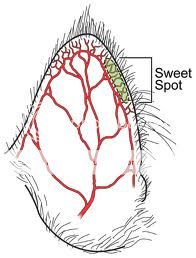
YOu really want to poke between the marginal ear vin and the outer edge of the ear.
 
Here's a picture showing where you want to be aiming (the "sweet spot"):

earpokey_zpsc6584fc3.jpg


It can be hard getting blood in the beginning (after a while, the ears "learn to bleed" by growing new capillaries in response to the pokes). You want to start with the bigger sized lancets (26 or 28 gauge-- smaller numbers = bigger lancets), often labeled "for alternate sites".

For paw pad testing, you definitely need the bigger lancets (and an agreeable cat! not all will allow it, as you seem to have discovered :cat:)
 
Adding: if you do hit one of the larger blood vessels, at least you will definitely get enough blood! The problem is that it is more painful for the cat, and also easily leads to bruising. In general, to keep the ear from bruising, you want to apply a little pressure (with a tissue or cotton pad) right after you've gotten the reading, until the bleeding stops. A little dab of antibiotic ointment is a good idea, too (if doing lots of tests during a day, I only applied ointment at the end of the day, or else things got pretty messy.)
 
Have you watched @JanetNJ video on home testing? It really helped me in the beginning & the link is in her signature. Maybe someone has already mentioned this... but I can’t imagine trying to prick a paw. This spot on the ear doesn’t have as many nerve endings so they don’t feel it as much. Hope this helps, also massaging the ear until it’s really warm will help. Good luck & so glad that you’re doing the right thing for Lestat! A hypo is scary bad!
 
Hi, it's hard at the begining, you both have to get used to testing so keep trying, I find Babu and my cyvies ( they kind of unwillingly volutiered when I started learning) tolerate or do not mind so much on the ear but boy they hated the paw, I've heard some people do just fine on the paw so I guess you could try both and see which one he allows.

I also hand hold the lancet because the lacet device makes a click that startles them and they don't like it

Here are some tips some of us use:

- Pick a location where you are confortable so that he learns that's the testing place
- Always give him a reward (low carb) afterwards even if you couldn't get a sample so that he associates the testing with a good thing
- Sometimes it helps to start taking him to that location and just rub his ears so that he gets used to you handling his ears
- Some found it useful to wrap him in a towel burrito (taco) style so that he is inmovilized ( Babu after a whiledid not need the towel but just being put on top of it made him be still)
- Warm the ear before prick it that will help more blood to come out, some use a sock with rice in it that they warm in the microwave for a few seconds, I use a small wet pice of cloth that I also warm in the microwave and put in bag ( the same kind of bag his rewards are kept so as soon as he hears the bag he knows and kind of likes the idea)

This is the link to Janet's video is really good

 
Adding: if you do hit one of the larger blood vessels, at least you will definitely get enough blood! The problem is that it is more painful for the cat, and also easily leads to bruising. In general, to keep the ear from bruising, you want to apply a little pressure (with a tissue or cotton pad) right after you've gotten the reading, until the bleeding stops. A little dab of antibiotic ointment is a good idea, too (if doing lots of tests during a day, I only applied ointment at the end of the day, or else things got pretty messy.)

I use neosporin also at night or plain vaseline during the day mainly because Babu has a lot of hair in his ear and if I don't the blood gets absorbed by the hair
 
Thanks - I have seen the video from Janet (and a few others on Youtube). I probably just need lots of practice. I tried the ear tonight, but still no blood. I tried all the tricks - Warming the ear, a comfortable place, lancer at the deepest setting, cotton on the other side of the ear... but no dice.

Hopefully I'll eventually get it. I can say Lestat was a bit more amenable to me trying the ear than his paw.
 
Thanks - I have seen the video from Janet (and a few others on Youtube). I probably just need lots of practice. I tried the ear tonight, but still no blood. I tried all the tricks - Warming the ear, a comfortable place, lancer at the deepest setting, cotton on the other side of the ear... but no dice.

Hopefully I'll eventually get it. I can say Lestat was a bit more amenable to me trying the ear than his paw.
Skip the landing device and free hand poke so you can be more accurate. If you are using the lancets that came with it, that's your problem. They are too thin. You want to go to Walmart and pick up a box of 26 or 28 gauge lancets. The smaller the number the thicker the Lancet. The ones that come with your meter are 31 gauge I believe. Good for humans but not for cats.
 
Thanks - I have seen the video from Janet (and a few others on Youtube). I probably just need lots of practice. I tried the ear tonight, but still no blood. I tried all the tricks - Warming the ear, a comfortable place, lancer at the deepest setting, cotton on the other side of the ear... but no dice.

Hopefully I'll eventually get it. I can say Lestat was a bit more amenable to me trying the ear than his paw.

Trying to get the sweet spot with the lancet device is hard try it freehand I think is easier to see exactly where you are pocking
 
Hi all,

In order to avoid another hypoglycemic episode, I finally got a test meter. After reading through posts/suggestions here, and talking with my Vet, I went with the Relion Prime.

I tried to test for the first time last night, and well, it was a definite exercise in futility for me. While I believe the ear is the preferred spot, I've seen the techs at my vet use the paw/pad, so I figured that would be easier to get. But Lestat put up such a fuss and fight, I eventually figured that he must be feeling good (as he gets very docile when not feeling well). So no test was taken.

So - a number of questions...
1) When picking up the meter and associated stuff, I didn't see/get a control solution. Is there a control solution for Relion that I should get?
2) Ear or pad - any preference, or as long as you can get the drop of blood, is it all the same?
3) The Relion Lancer (because I am not confident enough to free-hand it) comes with both a depth meter and an Alternative Site Cap. If using the pad, is one better than the other?
4) My belief (from times at the vet) is there is a specific spot in the ear to hit where the veins/capillaries run. Is this true, or can you get any spot so long as it is near the capillaries?

Many Thanks!
Hi there, did you ever find out where you can get the control solution for your Relion Glucose meter? And if we even need to use the control solution to calibrate? Thanks!
 
You can get the control solution by calling Relion. The number is in the booklet that came with the meter.
 
Status
Not open for further replies.
Back
Top