Paw testing - can I use the smaller (digital) pads?

Status
Not open for further replies.

ErikAndHarvey

Member Since 2015
Every post or video I've seen mentions drawing blood from the plantar pad on the back paws, but I haven't seen anything mentioning - for or against - using the digital pads.

I've still yet to get a good blood test from Harvey, as he's been very intolerant of it so far and I've personally done a poor job of keeping at it, but now that I'm switching him from dry food to canned, I want to make sure I adjust his insulin dosage properly and this means buckling down and solving the blood test problem.

He hates having his ears held, but tolerates his rear paws. However, I have a hard time getting good samples from his plantar pads because they're thick and calloused. His digital pads, though, are thin and also a light color with visible veins, which should theoretically make for a much easier prick.

Is it okay to use these for blood testing? Is it more painful for the cat? Does anyone have experience in this matter?
 
I've only used Tonka's hind pads, which is what his vet suggested, but I could swear that I saw someone posting in response to another pad sample query a little while ago that they used all four pads on their cat. I can't recall which posting it was in though and am not computer-savvy enough to know how to search the forum on key words, so I can't be certain of this. If you go through various posts on paw testing from the past couple weeks, you might find it in there. I think that there was a note that you have to be sure to clean their front feet that much better before (and probably after) testing, since they dig around in the litter box with them.
 
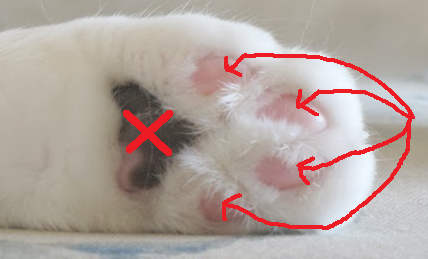
Jordi, I'm not referring to the front/back paws, but the individual pads on the back paws. Not the palms, but the fingers, if that makes sense?
d4gbvvU.png
 
I am going to start doing home monitoring soon and this is all new to me so is this the best place to get blood?
 
Jordi, I'm not referring to the front/back paws, but the individual pads on the back paws. Not the palms, but the fingers, if that makes sense?
d4gbvvU.png

Oh, I see what you're meaning. I'm not sure how well that would work. With Tonka, I have to squeeze his pads a fair bit to get the blood out, and those smaller pads are quite tiny. Maybe if you used the heated rice sock trick. But I don't think it's generally recommended. Have you tried a lancet device with a larger opening, or freehanding it? They make some device covers for people using "alternate testing sites" like the arm etc., or for people with calouses, with a larger opening, which allows the lancet to go in a bit deeper. That might work better if calouses on his pads are the issue. Possibly a larger gauge lancet too.
 
I had some trouble getting enough blood from Moby's paws when I started testing. We did do the rice sock for bloodflow and that definitely helps. Someone suggested neosporin or antibacterial ointment before using the lancet, as that helps the blood to bead on the skin, and that has worked like a dream. Typically, I'll do two quick pokes close by one another and then milk the paw a bit to get a blood bead big enough.

I never tried testing his finger pads... If you are using a lancet device, I use mine on "6" and I can get enough blood about 75% of the time on the first try now.
 
My lancet has been nothing but useless. Harvey is still very resistant to blood testing and he doesn't even seem to notice the device, so I've been trying it freehand.

I'm going to continue trying for the ears for a little while, but if that doesn't work I'll give the digital pads a try and let you know how it goes.
 
You may be using too thin a lancet. The higher the number of gauge the thinner the lancet. If you're trying something in the 30s it's probably too thin, at least to start with. Most people find a 28 gauge satisfactory but some have started even thicker at 26
 
Status
Not open for further replies.
Back
Top