Newly Diagnosed & New here with several questions

Status
Not open for further replies.

gabriele

Member Since 2013
Hi - my name is gabriele and my cat Casper (13 yo) was diagnosed last week. He had been loosing weight, drinking a lot of water, etc. He spent the past 4 days at the vets where they were trying to stabilize his sugars, apparently it spikes very high in the morning and then low at night.

My daughter is going to vet tech school and she works in his office p/t which is a big advantage to me. WHen I got his diagnosis I hit the internet and found this board plus tons of info (thank you everyone!)

Casper is home for the weekend because he would have been the only animal there and Catie (DD) would be going there to take care of him, which is why the vet allowed him a weekend pass. (He still has a catheter in.)

My question - she brought home all the supplies from work, including their glucometer, AlphaTeck(?), it's purple. His chart shows that they were giving him dry & wet food (d/m), insulin, syringes, plus some other stuff she might need.

This afternoon we bought the Relion meter and lances from Walmart (they went to the store, I refuse to go into that place) and they only had one type of Relion meter "Prime" and one size lance - 30ga.

We tried to do a comparison test, and of course no blood from his ear (she was doing a jugular draw at work), so she used her own blood. The Relion was 82 and the AlphaTeck was 164. Anyone know what type of difference there will be between the two? We will be doing a test tonight at the time it's supposed to be - probably with a jugular draw. She's just trying to look at the numbers so I'll know too.

Now for food - we just spent a bunch of money on 9-lives since it was on sale (we have 2 other cats, 12 & 13 yo). Using the food chart, most of them are less than 10% (avg. 4-5%) carbs, so I'm not going to go buying different food at this time. (They all used to get canned at night plus free eating of Science Diet senior.) I'm hoping this should be OK for the next few weeks.

When Casper came home, I offered him some food and since he wasn't eating well at the vets, he readily ate 1/2 can.

Should he have food available all the time? He's lost about 4-5 pounds and weighs a little over 6 pounds, and looks skinny. They had food & water in his cage there. Right now he's in his favorite place - our master bathroom, with a litter box & water plus food. I have been going in there frequently today to pick him up and cuddle him. He is purring in my arms during this time.

Oh - he's on 2ml of vetsulin, twice a day.

Also the vet is thinking he may have thryoid problems too.

I think that covers most of it right now. My main concern is the difference between the meters. (And I suspect I'll need to get larger lances.)

Thanks for having this board and all the information!

-gabriele
 
The alphaTrak meter does read higher than the human meters. But for our purposes we do consider that, especially in the lower ranges, when someone posts a low number and says they are using it. The ReliOn works fine as we are considering patterns and trends. It takes less blood and both it and the strips are much less expensive. So most people here use human meters. And yes, 25-27 gauge lancets work better at first. You sometimes can compensate for the smaller size by a quick double poke to make a bigger hole.

We are not crazy about Vetsulin. It tends to be a harsher insulin than the milder, longer lasting ones like Lantus, Levemir or ProZinc. It is possible to regulate with it, but takes more monitoring and doesn't work for every cat. Cats are more likely to drop at the beginning of the cycle rather than 5-7 hours in, and it tends to last less than the 12 hour cycle. But since you can test, you will be able to see how it works for your cat.

Keep reading and let us know how we can help.
 
The difference in using a pet-specific meter vs a human meter (aside from the very high cost of the former) is mostly a matter of scale (though not exactly 1:1). Think of it as reading temperature in Celsius vs Fahrenheit. Both are correct. If you have the reference values for each, you can interpret them.

Here are some glucose reference ranges used for decision making using glucometers. Human glucometer numbers are given first. Numbers in parentheses are for non-US meters. Numbers in curly braces are estimates for an AlphaTrak.

< 40 mg/dL (2.2 mmol/L) {< 70 mg/dL for an AlphaTrak}
- Treat as if HYPO if on insulin
- At nadir (lowest point between shots) in a long term diabetic (more than a year), may earn a reduction.

< 50 mg/dL (2.8 mmol/L) {< 80 mg/dL for an AlphaTrak}
- If before nadir, steer with food, ie, give modest amounts of medium carb food to keep from going below 50 (2.8).
- At nadir, often indicates dose reduction is earned.

50 - 130 mg/dL (2.8 - 7.2 mmol/L) {80 - 160 mg/dL for an AlphaTrak}
- On insulin - great control when following a tight regulation protocol.
- Off insulin - normal numbers.
(May even go as low as the upper 30s (1.7 mmol/L){60s for an AlphaTrak}; if not on insulin, this can be safe.

= 150 mg/dL (8.3 mmol/L) {> 180 mg/dL for an AlphaTrak}
- no shot limit for ProZinc, PZI, or other non-depot insulins

> 150 mg/dL (8.3 mmol/L) {> 180 mg/dL for an AlphaTrak}
- At nadir, indicates a dose increase may be needed when following a tight regulation protocol.

200 mg/dL (11.1 mmol/L) {230 mg/dL for an AlphaTrak}
- no shot level for beginners; may slowly reduce to 150 mg/dL (8.3 mmol/L) {180 mg/dL} for long-acting insulins (Lantus, Levemir, and ProZinc) as data collection shows it is safe

180 - 280 mg/dL (10 - 15.6 mmol/L) {may be 210 - 310 mg/dL for an AlphaTrak}- Any time - The renal threshold (depending on data source and cat's renal function) where glucose spills into the urine.
- Test for ketones, glucose is too high.

>= 280 mg/dL (15.6 mmol/L) {may be >=310 mg/dL for an AlphaTrak}, if for most of the cycle between shots
- Uncontrolled diabetes and thus at risk for diabetic ketoacidosis and hepatic lipidosis
- Follow your insulin protocol for dose adjustments
- Test for ketones; if more than a trace level of ketones, go to vet ASAP.
 
Thank you for all the help. I just found the chart (before I got to my response) of the reference ranges between the human vs animal glucometers. I've printed it off to keep.

When Casper goes back tomorrow, I'll mention the insulin information. The bottle of vetulin that we have, has his name on it of course, so my guess is that's what he'll be coming home with. If so can I change brands after this is used up? Or is it best to see if I could get one of the others that you suggested.

We haven't tested Casper yet this morning but will be shortly. I was searching for food quantities. Casper ate 1-1/2 cans of food since he came home yesterday afternoon. They contained 3 carbs in 1 can and the 1/2 can had 4 carbs. If he eats 2 cans a day, (he's really underweight) for example, would I look at adding those numbers together and that's the total percent for the day? Also, is it best to give him food several times a day, for example 1/2 can, 4x a day? (These are the 5.5 oz cans.)

This forum has so much information, so I'm betting that these questions were answered somewhere here - just haven't found them yet.

Thanks!
 
When you talk to the vet about changing insulin, if he prescribes either Lantus or Levemir, ask for the prescriptions for the pens instead of vials. The initial cost for the pens is higher than the vial. However, with a vial, you will not be able to use all of the insulin before it becomes ineffective. So you will end up throwing a lot of it away. With the pens, because it is packaged in smaller containers, you should be able to use almost every drop before it becomes ineffective. There are 5 pens in the package and depending on your dose, should be enough insulin to last almost a year.
 
Note: the can labels give the guaranteed analysis, not the as fed or dry matter basis. The math needs to be done on the latter to be correct. If you are persistent, sometimes you can get the as fed data from the manufacturer.

There is a list already compiled by Dr Pierson, of the percent of calories (not weight) from carbohydrates on her website Cat Info

For cats and dogs, there are:
3.5 calories per gram of protein
8.5 calories per gram of fat
3.5 calories per gram of carbohydrate

Once you have the weight of each component in grams, you multiply by the calories per gram.

Then you divide each component by the sum the total calories and express as a percent.
 
I am using the list from Dr. Pierson to determine what to feed Casper. I've had on hand the lower carb ones, so that's what he's getting.

His BG number this morning was 414, and I gave him his 2 units while he ate. I wasn't told to test again, but just every 12 hours. The meter I used for this test was the Relion. (My daughter is really sick, so wasn't able to come over.) Last night was 306 on this meter.

I'm lucky Casper was very patient with me because it took me many pokes this morning to get a successful reading (not to mention some heated discussions with the "DH" on what "I" was doing wrong!). I am contemplating doing another BG check in about 45 minutes which would be a +4 reading according to the SS. (Thank you for the SS.)

I don't have anything to test for keytones - and haven't read up on that (yet). He has been sleeping for the most part, but that's always been "norm" for him. When I go check up on him, he gets up and comes over, so I pick him up and cuddle him and he just purrs. He has eaten almost 1/2 can of his morning food.

So this is where we stand right now. Is there an "average" time (I know, every cat is different) that it will take to get him to proper numbers? I'm not a panicking-type person, just need information, or places to go get correct/reliable information.

Thanks so much!
 
There is no average, unfortunately. We like to say ECID - every cat is different :mrgreen: With Vetsulin, the usual pattern is a drop around 4-5 hours after the shot and then a pretty steady rise up. You may be one of the lucky ones whose cat responds better and has a longer flatter cycle. Your testing will give you this info pretty quickly.

I am assuming he had some ketones because he stayed at the vet. Maybe I am incorrect. Ketone testing is very important if he had high ketones before. It is a good idea with any diabetic cat to catch them early if they happen. Here is some info:

http://www.felinediabetes.com/ketones.htm
 
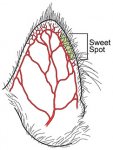
Warming the ear or rubbing it to get the blood flowing makes it easier to get blood. Using larger size lancets, 26-28 gauge, often labeled "for alternate site testing" makes it easier to get blood. Aim for the "sweet spot". It takes time to get good at testing.

Here are some testing tips to help you out.
 

Attachments

  • sweet spot diagram.jpg
    sweet spot diagram.jpg
    42.8 KB · Views: 523
Welcome to the board!

Is he getting that science dry at night? Any dry can spike their numbers and keep them there for over 24 hours. Less than 1 tsp of that does it to my cats.

I free feed mine many meals through the day to help support the pancreas. In terms of quantity of food, while Casper is unregulated he will need more food so I would give him as much low carb wet as he wants and weigh him every couple of weeks and adjust accordingly.

I usually recommend 3-4 tests a day

- always before the shot - this is mandatory as you don't want to shoot when too low. As a newbie this too low number is 200 but is reduced over time once you have the data to know if its safe.
- mid cycle - 5-7 hours after morning shot depending on your schedule. This is to see how low he is going. The low point "nadir" is what you base dose changes on since you don't want him dropping too low (under 50).
- before bed (2-3hours after Pm shot) to get an idea of what his overnight plans are. If this number is less than the pre shot test number you may want to set the alarm for a test a few hours later as this implies an active cycle.

Wendy
 
Update on Casper - he's been home for almost a week. I've been testing 3-4 times a day. His BG goes from the 550s to +600 in the morning to anything between 60-240 at +6 during the day and then at +12 he's back up to the 550s to+600. A couple of nights ago I tested at+3 and he was at 54. It's really crazy to me.

He's on vetsulin, 2.5 units, 2x per day. He will be going back to the vet in 2 weeks for a check up.

Do I test more frequently - such at +3, in addition to the +6 or not? Do I test during the night? If so, then wouldn't his eating effect the numbers? The cats had always been free eaters. I keep Casper in the bathroom at night, so my other cats can eat the dry food (I know, I know - but we're weaning them off.)

He gained 1 pound which is good since he's really underweight. (He's now at 8 pounds). You can still see his back bones and hip bones but not as badly. I've been feeding him Fancy Feasts - about 2 cans a day. And I've been charting it. (Can someone please send me the link to that spreadsheet - I can't find it any more and need to download it. Sorry about that.)

I had bought several cans of the low carb Little Friskies - but discovered that they all have rice in them. Is that something new since Dr. Lisa did the cat food info list or was it included in the %s.

Thanks!
 
Here are the directions for the spreadsheet. It's a little tricky so if you need help, just ask.

http://www.felinediabetes.com/FDMB/viewtopic.php?f=6&t=18207

Casper is definitely bouncing. Each of those low numbers cause his liver to "panic" and release extra glucose, which means he bounces up into those really high numbers. But the Vetsulin also seems to be reacting really harshly with his system.

If he were mine, I'd lower the dose. Those low numbers are dangerously low. Maybe a little less insulin will mean more normal midcycle numbers and less bouncing. And yes, I'd ask for one of the three milder insulins asap.
 
Thank you!

Do I wait for his visit in a couple of weeks, or contact the vet and ask for a prescription now? The vetsulin is what they had at the vets.
 
Maybe call the vet tomorrow, tell them how much your kitty is bouncing and ask for one of the milder, longer lasting insulins. If the practice only uses Vetsulin, they are way behind the times and maybe it is time to find a new vet? If they are willing to consider another insulin, we can give you information on the other insulins - vet studies that show they work better than Vetsulin, which is an insulin that works best for dogs.

But first, I'd reduce the dose and see if he stays in safer ranges.
 
Forgot - thanks for the link. I just print out the pages now - I have old excel, and it doesn't like .xclx stuff. Haven't gotten to download Open Office yet.
 
I think I'll reduce the dosage a little tomorrow.

My daughter is a p/t vet tech there, while going to school (to be a vet tech), so we haven't even gotten the bill for his week + stay there. (She's supposed to get a discount - anything helps!)

She goes to work on Tuesday and I'll mention to her about his bounces and see about getting Lantus prescribed. And, I'll ask her if he uses other insulins there.

Thanks so much!
 
The Friskies ate style foods do have a little rice in them, but Dr. Lisa Pierson took that information into account when she did up the food chart we all use. Most of those Friskies pate style foods are in the 8-10% carb range and are ok for a diabetic cat. I don't feed the Mixed Grill flavor to my foster cat Wink, because that flavor is 11% carbs.

Of course, you may find that your cat is more carb sensitive and the higher carbs of the Friskies, 8-10% are a bit too much for your cat. ECID.

Wow on those wild swings (500+ point drops) in the BG'S! :shock: :o :shock: Yes, I agree with Sue that one of the longer duration, and gentler insulins like Lantus would help even out those swings. Those swings and the fact the Vetsulin does not seem to be working for the full 12 hour cycle are 2 big reasons why we suggest other insulins for cats.
 
Status
Not open for further replies.
Back
Top