Newly diagnosed kitty and mommy stressed out

Status
Not open for further replies.

Tininha

Member Since 2014
Hello everyone!

Three weeks ago or so I noticed my male cat Juno of 12 yr old drinking more water and urinating more than usual. His hair coat in the back was very greasy and he was loosing a little bit of weight. He was still eating, playing and being active for his age. Last Wednesday, February 5th, I took him to the vet. He's not a very cooperative cat and he usually needs to be sedated when he needs to be examined by the vet. They did an X-ray, took a blood sample, and urine. Everything was fine besides the high glucose levels in the blood and urine. His blood glucose values were 27.5 mmol/l (496mg/dl). To be sure it was diabetes, the doctors wanted to make the fructosamine test, but Juno was so stressed out that they couldn't make a proper analysis from that blood sample. They said he needed to stay there overnight to take another blood sample. On Thursday, February 6th, I went to pick him up to the clinic and they took another blood sample from him for the fructosamine test, but his stress levels were again so high that once more the blood was not good for analysis. The vets told me to go there again on Monday, February 10th, to take another blood sample to the test, but before going to give him 2 pills to sedate him.

During the weekend he got much worse, lost quite a bit of weight, he was very lethargic and stopped eating. I was freaking out with these people!! I called the clinic totally in despair 3 times during the weekend and told them Juno got much worse since he went to the clinic and what he needed was an insulin shot asap, not making more tests! On Sunday, I bought Keto-Diastix to test for ketones and he was in level 2. On Monday morning, February 10th, I had a seriously talk with the vet, and told him that Juno was dying and at this point the priority was to medicate him asap! They finally gave me the insulin and since that day I have been monitoring him at home (Juno couldn't stay at the clinic because of his stress levels). I am giving him Levemir insulin 2 units twice a day and doing home blood glucose testing (before each insulin shot and between the two shots). He has been eating all his life Royal Canin dry food and if I knew what I know right now I would never have given such a food... I changed his diet to Ziwi Peak canned food and he loves it. It's a bit pricey, but he's needing it at this point in time.

He is slowly getting better, but it's still early to tell how he's going to react to the insulin. He has started eating, he's finally reacting when I call him, and he even bite me in my hand today morning, but his hind legs are still very weak. I feel quite scared dealing with this illness. I had no clue about the seriousness of diabetes. It's a enormous responsability and I'm worried I'll do something wrong. Giving shots, checking blood sugar, checking food and everything should be done consistently over time.

Sorry about the long post, but I felt I needed to explain how this last week has been. It has been such a nightmare...

I have a few questions and I'm hoping you can answer to them. Juno likes to eat small meals throughout the day. Is this a problem? I am not able to make him to follow the rule of only two big meals per day. How much should he eat (he weights around 5kgs) before I can give him an insulin shot? Should I still give him an insulin shot if his glucose values are in the normal range? Last night I skipped an insulin shot because his values were 6.4 mmol/l (115mg/dl). I'm freaking out about the possibility of him having an hypoglicemia episode...

One more thing. He has had asthma for a few years, but he only had very occasional episodes of asthma attacks (such as once a month or so). Since he came from the vet clinic last Thursday that he has had 8 asthma attacks. I think he has a bit of mucus on his lungs. Today I told the vet about the asthma attacks, but the vet said they didn't find out anything on his lungs in the X-ray. He said that might be because his immune system is very weak due to diabetes. Do you have any thoughts about this?

I'm so stressed out and not able to sleep thinking that he may have an hypoglicemia shock or he may not control diabetes.

I have been reading lots and lots of articles about feline diabetes since last weekend, but I am overwhelmed by so much new information... All the help is more than welcome. Thank you!
 
Cristina,

Hello and welcome to the board. Read through your post and it sound like you are doing everything right. You have him on insulin, are checking his BG levels and monitoring him for ketones.
You also have him switched to canned food which is recommended. As for the weakness in hind legs that is neuropathy from the diabetes. I think you can give him Zobaline for that.
As for the asthma attacks, you might have them check his blood pressure next time he go to the vet. I had a cat that was a big cat(22lbs) used to cough(a lot) and the vet said he had asthma. Well turned out it was not that after all but heart problems and had to be on medicine for high blood pressure.
Best of luck to you.

Terri
 
Fantastic job, Mom! You truly saved Juno's life and have him on the road back to being a healthy kitty. At least your vet gave you a good insulin!

I have a few questions and I'm hoping you can answer to them. Juno likes to eat small meals throughout the day. Is this a problem? I am not able to make him to follow the rule of only two big meals per day. How much should he eat (he weights around 5kgs) before I can give him an insulin shot? Should I still give him an insulin shot if his glucose values are in the normal range? Last night I skipped an insulin shot because his values were 6.4 mmol/l (115mg/dl). I'm freaking out about the possibility of him having an hypoglicemia episode…

Yes, many people feed several smaller meals during the day thinking that it helps support the pancreas. Some people freeze the food (silicone muffin pan works great. then pop out and put in a baggie to freeze) and let it thaw while they snack. I have to admit this never worked for my Oliver. He dragged it around the house, all over the rugs, eating the pieces that flaked off.) I have better luck with an automatic feeder. I love my PetSafe 5. You can set it for 5 different feedings, it is very hard to break into (others are not as difficult) and you can set it to close up 2 hours before the test so it is not food influenced.

Because he is on Levemir which is mild and long lasting, he doesn't have to eat a certain amount before you give him a shot. It is good for him to have something in his tummy.

Yes, we suggest that new diabetics not shoot under 200 at first. When you get a lower number, you can wait 20 minutes without feeding, and retest. Then if he has risen enough, perhaps give a little less insulin.

We have a great tool - a color coded spreadsheet - that you can keep your numbers on. That way if you want advice, we will be able to see his numbers and doses at a glance. Ask if you need help:

http://www.felinediabetes.com/FDMB/viewtopic.php?f=6&t=18207

Since you skipped, he may be high at the next pre shot (24 hours since the last shot), so post to get some help if you are wondering how much to give him.
 
Thank goodness you are testing glucose and ketones! You may find the following helpful in interpreting the glucose tests. At the bottom are instructions for how to use the following reference ranges.

Comparing a human glucometer to a pet-specific glucometer is like reading temperature in Celsius vs Fahrenheit. Both are correct. You just need to know the reference ranges to interpret what the numbers mean.

[Glucose reference ranges are unsubstantiated and have been removed by Moderator]


* * * * * * * * * * * * * * *​
How to use the glucose reference values chart:

When you get a test, look for the number on the chart that either equals, or contains, the test value you have. Read the information. As needed, make a decision and act.

Ex. You are a new insulin user and you test your cat before giving insulin. The test is 300. It probably is safe to give insulin.

Ex. You are an established user of Lantus, following the Tight Regulation protocol. You've tested around +5 to +7 to spot the nadir. It is 200 mg/dL. You probably need to increase the dose, following the instructions for the protocol.

Ex. Your cat is acting funny. The eyes are a bit dilated. You are concerned and test the glucose. The number is 35 mg/dL. ACK! The cat may be in a hypoglycemic state. You quickly follow the HYPO protocol linked in the glucose reference values chart. (which we really, really, suggest you print out and post on your refrigerator.)
 
Welcome Cristina and extra sweet Juno!!

Just a few things I wanted to add. First of all, relax and breathe! You're in the best place you could be with a diabetic cat! The people here have 10's of thousands of hours (if not more) of experience dealing with diabetes at home. Here's A message from your cat. I hope you enjoy it.

We were all scared, confused and overwhelmed when we first came here. The diagnosis is a scary one, but you CAN treat Juno at home and do an excellent job of it, saving both the stress and cost of frequent trips to the vet. It sounds like Juno will like that!!

It's GREAT that you're already home testing!! Your best defense against a hypoglycemic episode is testing!! If you'd get a spreadsheet set up so we can see your test results, we'll be able to help you make decisions on increases (or decreases!) Here's How to set up your spreadsheet

Levemir is an excellent insulin, so you're already doing great to have that! My one concern is that 2 units is a pretty high dose to start with. We recommend starting at .5 or 1 unit every 12 hours to start with, and doing as much testing as possible to see how each cat reacts to both the insulin and food. Levimir is a "depot" insulin, which means you give the same dose every 12hours for at least 5-7 days to start with while you're "filling the depot" before you'll see how Juno really does on that dose. With depot insulins, only part of each shot goes to work quickly...the rest is stored and released slowly, so out of each shot, some will work on that cycle, where the rest will go "to the depot"...Once the depot is full and releasing the correct dose, you'll see how that particular dose works for Juno.

If you have been home testing, could you either post the numbers you've gotten here or on the spreadsheet?

Ziwi Peak is a good food, but I understand it's pricey. There are much cheaper foods you could feed that are readily available in most places, like Fancy Feast classics or Friskies pate's.

Keep asking questions, and we'll all be here to help you in any way we can. This sugardance can seem overwhelming at times, but soon it'll just be part of your daily routine, and the relationship between you and Juno will become closer than you could even imagine!
 
Thanks everyone for the help and support.

I am also thinking the dose might be a bit too high. Until now I skipped two shots, because the BG reading was low. Of course, Juno's BG levels were again a bit high when I gave him the next shot. The vet told me not to skip insulin shots since it's not good, unless the values are below 60mg/dl. I still think if they are within the normal range I should skip the shot, and that was what I did twice. Before I found this forum I was reading for some advice from this webpage http://www.sugarpet.net/mycurves.html.

The vet advice was to give him the insulin shot and read his BG levels one hour after each shot and read also at least once in between the shots. I did that in the first two days, but then I freaked out on Tuesday, February 12th, after giving him the shot, since his BG levels went down to 86mg/dl. It's a good value, but I was not expecting to decrease so fast and I had given to him the insulin shot of 2 units... Since that day I started testing the BG always BEFORE the shot, unless it has been almost 24 hours since the last shot.

Here is Juno's BG levels readings. What do you think it's a good starting point? 2 units/twice a day, 1 unit/twice a day or 2 units/once a day? It appears to me that 2 units/twice a day is a bit high for him.

Thank you again. I really appreciate your help.
 

Attachments

Yes, maybe 2 unit was too high of a starting dose. It is hard to tell since there is no even preshot number for the 12th and 14th. For the time being I would keep the dose at 1 unit twice daily.
 
Twice a day dosing generally works best as cats have a rapid metabolism and most insulins won't last more than about 12 hours.

Syringes with half unit marks allow you more precision in measurement. His best dose might be somewhere between 1 and 2 units. Most 3/10 mL syringes mark half units and we routinely estimate 0.25 unit increments. Magnifiers really help with that - hand, stand, visor, or clip-on. I'm partial to the Carson Clip and Flip, available through our shopping partner Amazon.
 
Sorry Cristina, but I don't have Excel on my computer so I can't open your spreadsheet.

We'd really appreciate it if you'd use the spreadsheet I told you about earlier. It's set up so that each cell will "color code" automatically depending on the BG result, and it makes it much easier to see the "waves of action", or "patterns" we look for with Levemir

Without seeing your spreadsheet, I'd say if you're having to skip shots, you're giving too much insulin. We hear this often when people first come here and have been doing what their vet suggested. I'd go back down to 1 unit every 12 hours for now. Levemir works best with a consistent dose, given every 12 hours, so we need to find a dose that you can give twice/day without having to skip shots.
 
I'm using Levemir FlexPen and it doesn't have half unit marks. I have to give him either 1 or 2 units. What do you think of giving 1 unit + 2 units a day?

Thank you once again.
 
You can get regular insulin syringes and use the pen just like you would use a vial. The "dial a dose" on the pens isn't accurate enough for our kitties. Humans (that those are designed for) take much larger doses, so if it's "off" a little, it's no big deal, but when as little as 1 drop difference can make a BIG difference in our kitties, it's very important to use regular insulin syringes instead of the "dial a dose" on the pens.

Here's a video on how to do it with the Lantus Solostar Pen...the Flex-pen works in the same way
[youtube]u4KtK_skpmQ[/youtube]

If you have a WalMart handy, just go buy the 3/10mL, 31 gauge, 8mm length insulin syringes with half unit markings. They're about $13.00 for a box of 100
 
Hi Chris,

For some reason the first excel spreadsheet I uploaded lost its original format. Please check out instead the second excel spreadsheat "Juno_Monitoring_New.xlsx".

Thanks!
 
Sorry, it's not the format that's my problem. I don't have Excel on this computer and can't afford to pay for it.

The spreadsheet we use is really great, and doesn't require any special program. It's a Google spreadsheet. The best thing about it is that as you put in your test results, it automatically color codes them. This is important because later on in this journey, it's not necessarily the numbers that we look at. It's the patterns, or "waves of action" that are most important.

If you look at China's spreadsheet (and pretty much anyone else here, we all have them in our signatures) you'll see what I mean. We don't look so much at the actual numbers after awhile, but how the insulin is working over several cycles, and learning the color codes for each set of numbers makes this really easy.
 
Now I see what you mean :). I will have a look at them later.

I just tested Juno's BG levels and they are too high (425 mg/dl). In the morning I gave him only 1 unit and now he has the highest values of all week. These ups and downs are driving me crazy... Perhaps 1 unit twice a day is not enough. Do you think I can give him 2 units in the second shot? What do you think?
 
Google will import an xls format spreadsheet into its own format.

Just log in to your account and Click on the underlined arrow next to Create.
 
No, do not give 2 units!

We do increases and reductions in .25 unit increments only (which is another reason you need to get regular insulin syringes instead of using the "dial a dose")

Even 1 DROP of insulin can make a big difference one way or the other for some cats.

Without being able to see your test results, there's just no way to know what's going on with Juno yet, but even if I could see them, there's no way I'd ever suggest you increase by a whole unit!

It's possible that Juno went lower than his body is used to now and his liver released hormones and sugars to bring it back up. This is called bouncing. It's possible he does need more insulin, but again, without seeing where he's been, that's a total guess, and we never guess when it comes to insulin. Our number one rule is to be safe.

Please just hold the 1 unit for now, at least until you can get some insulin syringes so you can measure doses in between 1 and 2, and because Juno has already had problems with DKA, make sure you're checking for ketones in his urine as often as possible.
 
Ideally, you want to give the same dose every 12 hours, so stick with 1 unit.

Unless the lowest level goes below 50 mg/dL, do not reduce. Going below 50 mg/dL on a human glucometer is an automatic reduction of 0.25 units.

Wait 3 full days before re-evaluating the dose for an increase.

Also, you should be able to make a copy of this spreadsheet which will land in your own Google account. That is the one to put in your signature and edit. you can only look at the one I've posted.
 
Thank you!

No, you don't want to go to 2 units because the protocol we use that's so successful requires consistent dosing. You have gone from 2 to 1 to skipping and back. Each time you start a new dose, you have to start counting cycles.

Here's info from the protocol:
"General" Guidelines:
Hold the initial starting dose for 5 - 7 days (10 - 14 consecutive cycles) unless the numbers tell you otherwise. Kitties experiencing high flat curves or prone to ketones may want to increase the starting dose after 3 days (6 consecutive cycles).
Each subsequent dose is held for a minimum of 3 days (6 consecutive cycles) unless kitty earns a reduction (See: Reducing the dose...).
Adjustments to dose are based on nadirs with only some consideration given to preshot numbers.

Increasing the dose:
Hold the dose for 3 - 5 days (6 - 10 consecutive cycles) if nadirs are less than 200 before increasing the dose by 0.25 unit.
if your cat is new to numbers under 200, it is recommended to hold the dose for at least 8-10 cycles before increasing.
when your cat starts to see nadirs under 100, hold the dose for at least 10 cycles before increasing.
After 3 days (6 consecutive cycles)... if nadirs are greater than 200, but less than 300 increase the dose by 0.25 unit.
After 3 days (6 consecutive cycles)... if nadirs are greater than 300 increase the dose by 0.5 unit.

Reducing the dose:
If kitty drops below 40 (long term diabetic) or 50 (newly diagnosed diabetic) reduce the dose by 0.25 unit. If kitty has a history of not holding reductions well or if reductions are close together... sneak the dose down by shaving the dose rather than reducing by a full quarter unit. See additional notes in the next paragraph about drops into the 20s and 30s. Alternatively, at each newly reduced dose... try to make sure kitty maintains numbers in the normal range for seven days before reducing the dose further.


Because Juno has already had one episode of DKA, we do want to watch him carefully, as well as possibly increasing him sooner than most, but for now, just hold the 1 unit, check for ketones as often as possible, and try to be patient. We all truly do understand how scary it can be to see those higher numbers, but they're safer than numbers that are too low. We have a saying here.."Better too high for a day, than too low for a moment". High numbers take time to do their damage. Low numbers can kill quickly.
 
Hello and welcome from someone else who uses Levemir. It's likely that the only insulin syringes you can buy in Denmark are the BD syringes - that's all we have available in Canada. And unfortunately at a higher price per box than what Chris mentioned is available in a US Walmart. I get the BD Ultrafine II syringes - they have the half unit markings.

Another fun fact about Levemir is that the nadir is often later in the cycle. My Neko occasionally has her nadir at the preshot test or blood test we do just before the injections. As a Levemir user, you will have to get used to lower preshots than Lantus users, but first you need to collect enough data on Juno and how he reacts to Levemir. I second the others that starting with the lower dose and shooting that consistently for several days will help tell you what to do next regarding dosing.
 
Thank you so much for your feedback. I followed your advice and gave to Juno only 1 unit yesterday night and today morning. His BG increased quite a bit, and he started drinking again more water. Today I gave him the shot 4 hours ago and his BG right now is 196mg/dl.

Yesterday I tested for ketones and he was free of ketones. He has been eating, but sleeping a lot. I am afraid that the values get again so high that he goes back how he was last weekend. I thought he couldn't make it... I will see for a couple of days how his body reacts with 1 unit twice a day.

I agree that I should get one regular syringe, and give him slightly more than 1 unit. My problem is that I never gave an injection before and the FlexPen is very convenient. Before using the regular syringe I should talk with the vet so that he can teach me how to use it. Since the vet prescribed Juno 2 units/twice a day he's probably not going to be happy with that, but my furbaby's life is in first place.

I have another question. Can I give him the next shot in 11 hours or should I wait for the 12 hours? Because of my work, I need to start giving him the shots a little bit earlier.

PS: You can now check Juno's spreadsheet in my signature. I finally understood how it works. Thank you for the help BJM :)).
 
Hi Cristina,

It looks like you are doing very well with Juno. I can't help you too much with Levemir as I have never used it, but if Juno's preshot number at +11 hours is high enough to require insulin, then I would think it would be OK.

With regards to food, since you are in EU, you are surrounded by brilliant catfood manufacturers. Ziwipeak is a great food, but it is very expensive & is only in 3 flavours. My cats got bored of it quickly.

Other brands you could try which are cheaper, but just as good are:

Bozita (in cans or tetrapak in jelly)
Grau (the grain-free varieties)
Catz Finefood
GranataPet
Macs
Ropocat
Leonardo
Smilla
Christopherus
Om Nom Nom

You can order online from:
http://www.fuettern-mit-spass.de/katzenfutter/nassfutter/
http://www.zooplus.dk/shop/kat/kattefoder_vaadfoder
http://www.floyds-pfotenshop.de/Katzenfutter-und-mehr/Nassfutter:::144_4.html

So glad that Juno has no ketones!

Juliet
 
Hi again Cristina!!

Great to hear you're holding the 1 unit dose. The fact that Juno went down almost 200 points in 4 hours is a good sign! The more tests you can get in, the sooner we'll all start to see the "patterns" we're looking for, so if you can get several tests per cycle, that would be great! Thank you so much for getting your spreadsheet up and running too!!

Always get a pre-shot test to make sure you should give any insulin. Test/feed/shoot all within about 5-10 minutes. If at all possible, get at least 1 test sometime between +5 and +8 (5 hours and 8 hours after a shot)...and since Levemir has a later nadir than Lantus, it would be really helpful to get some later tests per cycle too....Like +10 or +11 (10-11 hours after a shot)
If you get a pre-shot under 200, we want you to stall, DON'T FEED and post for help...at least for the first time or two. Edit your first post to say something like "Stalling, need advice" in the subject line

It's important for you to buy some regular insulin syringes. You want U100 3/10mL, 31 gauge, 8mm length insulin syringes with half unit markings (the gauge and needle length are flexible depending on what's available)

Using a syringe is pretty easy, and if you watch the video I posted earlier on how to pull the insulin out of the Flex Pen, it'll help to show you how to do that much. The syringes are small, and the needles are very tiny...Most cats don't even notice getting their shot. The 3/10ml syringes hold a MAXIMUM of 30 units...so when you look at the markings, you'll see lines at each 1/2 unit measurement from 0-30 units. When you actually see the syringes, it'll make more sense, but it's something you can learn at home if you don't want to deal with your vet. There are a lot of videos on giving insulin injections on You Tube too. (However, most of them talk about "rolling" the insulin..you do NOT roll Levemir!!)

You want to hold that same 1 unit dose for at LEAST 3 days (6 cycles) and then ask for guidance from experienced eyes to look over your spreadsheet. Don't rush the increases. It's better for Juno to be a little too high than too low, and as long as you're testing for ketones and they're negative, you'll do fine. If you get more than a trace of ketones, it's time to get to the vet, but IF ONLY a trace, we have people here who can probably help you treat him at home.

Adding water to his wet food is a great way to help with ketones. The more water you can get in him, the better since it will help flush ketones out of his body.

Can I give him the next shot in 11 hours or should I wait for the 12 hours?
We usually suggest making adjustments in time in 15 minute per cycle increments, or 30 minutes per day, but IF he's got a high pre-shot, it can be safe to go ahead and shoot early to get on the schedule you want, but you shouldn't make early shots a habit. Remember though, Levemir has a later nadir, so you have to keep that in mind.

You're doing great with Juno so far, and we look forward to helping you learn all the steps of this new sugardance! Keep asking questions!
 
Hi Juliet and Chris!

Thank you once again. I wished I could test the BG, but right now Juno is not cooperating. I tried to test Juno's BG twice before the second shot, but he keeps playing with my hands. I guess that's a good sign :) It seems I cannot give him the shot before the schedule.
 
I finally managed to test Juno's BG. It's 175mg/dl. This means no shot tonight, isn't that right?
 
No shot until you have enough data to show it is safe.
Did you stall 30 min without feeding and re-test?
 
Hey Cristina!!

This is in one of the comment above, but we totally understand that there's a lot to learn and remember, so don't worry about it..just let us know if you've gone ahead and fed or not.

If you get a pre-shot under 200, we want you to stall, DON'T FEED and post for help...at least for the first time or two. Edit your first post to say something like "Stalling, need advice" in the subject line
 
No I didn't, and now Juno went to eat. I totally forgot doing that. There's so much new information. Sorry about that.
 
No problem Cristina!

We totally understand there's a lot to learn and remember. No permanent damage. If you can handle the change in the schedule, it'd probably be just fine for you to go ahead and shoot the 1 unit now, but you'll have to be able to move the schedule tomorrow morning to 12 hours from the time you do shoot.

If you can get a +2 (or +3), that's a really good test to get too since it can give you some idea of where he might be going later in the cycle. If the +2 (or +3) is lower than the pre-shot, you should plan on getting more tests in because it's likely going to be a busy cycle. (on tests other than pre-shot, if it helps to give him a bite to eat while you're testing, it's ok too...some cats are so interested in eating, they don't notice the pokes)

If you decide you just need to skip tonight, don't be surprised if his numbers are higher in the morning, and we'll just have to restart the count so he gets either 1 unit twice/day for at least 3 days, or he "earns" a reduction by going below 50 during any cycle.
 
Did you shoot?

The numbers look like they are coming down already (to me, anyway) - you may want to drop to 0.75 or 0.5 units if you won't be home to monitor during the day.
 
Thanks once again!

I didn't shoot yesterday and today morning I was for more than one hour trying to poke his ears. He thought I was playing with him, so he started to bite my hands. In the end I didn't manage to take a proper blood sample and I arrived late to my job... The only thing I managed to get was an urine sample and he was free of ketones. The glucose levels (using the keto-diastix) seem to be as yesterdays's values, but without knowing the exact values I didn't want to give him the shot since I'll be away from home the whole day.

How do you manage to get consistent BG readings from your cats for so long?
 
I think Gracie is an easy tester, as was Spitzer. I only tested Dusty a few times for his mom and he went off insulin within about 4 weeks.
 
Hi Cristina!
Sorry you're having so much trouble with the testing! It's pretty common though at first.This will get better!

What I tell new testers is to decide on where you want your "testing spot" to be and as many times a day as you can, take Juno there and just give his ears a little rub and then give him a small treat, like freeze dried chicken, boiled chicken or any Low carb treat he really likes. Soon he'll associate that spot with the yummy treats, and won't pay any attention to what you're doing with his ears. Everyone has the same problem when they first start, and soon, their cats are jumping on the testing spot reminding them it's test time!

Here are some more Ear testing tips that might be helpful. The other big thing is to relax. If Juno feels you're stressed, he'll pick up on it and be harder to handle. As silly as it sounds, I suggest singing. It makes your brain relax (although Juno may give you some funny looks....LOL)

If you try 3 times and don't get any blood, give him his treat and take a break. Try again in 15-20 minutes instead of just continuing to poke.

As well as Juno has been responding to the Levimir, I'm happy you aren't giving the 2 units. I think your vet will agree too! Once you get back to testing/shooting, we'll have to see how he's doing again, but he may even need a little smaller dose so you can give it every 12 hours.
 
Hi Chris,

Thanks for the help! I finally managed to read his BG. I tried to give him treats in low carb and high protein, but he doesn't like them. Juno has never been a cat who liked treats or cooked meat, but Norah Jones helped a bit ;-) I will definitely follow your advice about the singing. After skipping two shots his values were high once again, so right now I gave him 1 unit of Levemir.
 
Hi again,

Juno's BG in the morning was 108 mg/dl even after skipping a few shots. Since I'm not at home to monitor him I didn't shoot once more. I will see how his BG is in the evening, but perhaps BJM is right and I should reduce him a bit the dose. What do you think?
 
Good decision on skipping the dose again this morning. It would be best if we could find a dose that you could give twice a day, without bringing Juno too low for your comfort level.

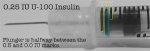
Do you think you could measure 0.25U or 0.5U?

Here's a picture of 0.25U, in a syringe with 1/2U markings on the barrel.


Levimir does have a later onset and a later nadir, so once you are able to test more consistently, you will have test data to know how Juno will react to different doses.

"Better too high for a day, than too low for a moment." Let's keep Juno safe, and lower that dose.
 

Attachments

  • 025unit-1.jpg
    025unit-1.jpg
    11.7 KB · Views: 1,288
I totally agree too Cristina!

I think going down to maybe .5 unit and seeing how he does is a good idea, but it also means you will have to get the regular insulin syringes. You can't measure the .75, .5 or .25 unit doses with the Flex Pen

It's also possible if you're still using the Flex Pen to shoot Juno that it's giving more than 1 unit. The "dial a dose" is just not accurate enough for our sugarcats.

I hope you've been able to locate some regular insulin syringes there in Denmark!
 
If you can't shoot less insulin, a compromise to prevent hypo is selecting foods closer to or even slightly above 10% calories from carbohydrates.
 
I definitely need to buy regular syringes with 1/2 unit marks. I just tested Juno's BG (23 hours I gave him the last shot) and it is 195mg/dl, but this is probably a biased value since I only got to test him after he ate something. He likes eating small meals during the day, so I leave to him and my other cat Zack some food in their bowls. I think it's a too low value to give him 1 unit in the evening. Oh boy, this is so unpredictable, but I'm very glad that I found this great forum with so many helpful people.
 
Hi Chris!

Thanks a lot for asking! On Friday I went to the pharmacy to buy regular insuling syringes with unit half unit marks. I explained to the technician why I needed them but she got very confused. When she showed me the syringes I didn't know what to do. The syringes are very much alike the one I'm sending attached, but I don't think they have half unit marks. I also don't know how much does correspond 1 unit of the Levemir FlexPen to the regular syringes. I ended up not buying them.

Juno's glucose values have been oscillating quite a bit, because I've been avoiding a few shots. He's also becoming very uncooperative everytime I need to test his ears. Today morning he started growling when I had to prick his ears.

Yesterday we had a busy day. I'm living abroad and I needed to travel to my home country. Sometimes I also need to travel for professional reasons. I wasn't sure what to do, but I didn't want to leave him alone with the pet-sitter for a week since he needs medication and he's not a friendly cat. In the end, I decided to bring Juno with me. It was 12 hours of travelling (train + plane) but Juno did very well. His values were a bit high the night before the trip but I didn't want to shoot given that he wouldn't be eating that much during the trip. Juno didn't eat much, but from time to time I was giving him water in a syringe. How do you do everytime you have to travel with a diabetic cat?

Now that I'm in my country I will probably be with Juno's vet who knows since he was a kitten. He's also a very good friend of mine, so I'll ask him about the regular syringes.
 
I take J.D. with me on vacation once a year across the country and it is also a 12 hour (car/plane/car) trip for us. I don't give insulin the morning of travel, but give it as soon as possible when I get to my destination (within reason, I still have to be thoughtful to the new time and when I want the new shot schedule to be for the duration of the trip).

I have had pharmacists confused when I asked for the syringes with half unit markings, too. The packages that I get from Walmart do not say half unit marks, but they are there. I think if all you can get is syringes with 1 unit markings, you would be better off than using the flex pen, as you can at least estimate a dose. You do need to make sure that you buy U-100 syringes.

I am currently trying these Terumo syringes Terumo ThinPro 3/10cc
 
If you cannot get the half unit marked syringes, you might find using calipers helpful in consistently measuring and adjusting the dose.
 
Thanks for the feedback :). I will meet Juno's vet soon and I will ask him about the half unit syringes.
 
Since you're in another country, I don't know what options are available to you, but you might try calling and asking about these to see if they have 1/2 unit markings and they can be shipped to you.

http://www.medisave.co.uk/b-d-insulin-needles-8mm-x-30g-with-03-ml-syringe-per-100-p-5354.html

If the only thing you can get are the 1 unit syringes, we'll just have to make do and teach you how to use calipers.

I also don't know how much does correspond 1 unit of the Levemir FlexPen to the regular syringes.

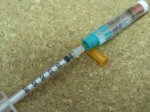
1 unit in a syringe is 1 unit from the Flex Pen. The problem with using the "dial a dose" that comes as part of the Flex Pen is that it's not accurate enough for cats. Humans can be on 25 units per shot, so if it's wrong by 1/2 unit, it's really not going to make much difference. In our cats, who only get tiny amounts per shot, being "off" can be deadly.

You just take the cap off the pen and on the inside you'll see a little vial with a rubber stopper. You use a regular insulin syringe, push it into the rubber stopper, and draw out the correct dose.


398133_10151346575284666_1963265129_n.jpg
 

Attachments

  • syringe in pen1 (Custom).jpg
    syringe in pen1 (Custom).jpg
    63.3 KB · Views: 1,172
Status
Not open for further replies.
Back
Top