Newly Diagnosed 12.5 Y, Female - Reluctant to Eat/Lower Energy

Status
Not open for further replies.

M Taha

Member Since 2023
Hello,

My cat sandy (12.5 Y, Female) just recently got diagnosed with diabetes. Upon starting insulin therapy at 7 am, with 2 units (2x a day) with her regular kibble (Feline Care Nutrition™ Weight Care Dry Cat Food which was recommended to me by a previous vet). Before her first ever dose of the Caninsulin, she ate a really good amount of the kibble (gobbled it all up fast too!). We did her first dose and it went pretty smooth.

After that, the problem started. At 7 pm, she refused to eat. We couldn't give her insulin. Then she refused to eat up until the next morning at 7 am. We got afraid that she might've become hypoglycemic because she was noticeably refusing food and seems a little lethargic/tired. She had even thrown up the same morning (5 hours after her dose) to which we called our vet and he said to maybe feed her 3 times rather than 2. We took her to the emergency vet right away who said her blood sugar was a little high so they gave her a half dose instead and they also put her on anti-nausea and appetite stimulant to get her eating.

On this day at 7 pm, we tried to feed her her old kibble again and she was not interested in eating at all. But she was notably crying for food (sounded hungry!). I really needed to get something in her system so I gave her some Fancy Feast (Classic Paté Cat Food) chicken feast flavour topped with a little bit of freeze dried chicken. I gave her a bit at first to see how she responded and she ate it all up! Then an hour later, I gave her a more proper portion (about the rest of the can up until 1/2 a can), and she ate it up too. We were able to administor insulin (full dose) as per instructions from our vet. After this, she seemed pretty energetic and responsive (was playing with her toy and all), walking here and there.

Up until this morning now at 7 am, we were told to continue to give anti-nausea med (which she ate) but only give the appetite stimulant if she was not eating. I gave her the same meal as before and she ate it but definitely seemed to be more reluctant to finish. Its now about 7 hours past her last shot/meal. She has been definitely a lot less energetic than yesterday and seems to be pretty sleepy. No other symptoms though such as vomiting or weakness. Just seems to be more reluctant to respond to any playing with her toys and me. Or walking downstairs. It just seems like she wants to sleep and is drowsy.

The vet recommended I switch to a Hills canned diet but she only eats that if I feed her by hand and warm it in the microwave. If I just put it on the plate, she doesn't eat it at all but she gobbles it all up if I feed it to her by hand and I don't know why!

I called my vet again and waiting to hear on what it might be but I feel like I am in such a pickle. On the one-hand, she's not eating her old food at all and if she doesn't eat, I can't give her insulin. On the other hand, she eats new food but i don't know if I change her diet rapidly but its the only way I can give her insulin and get her to eat something. With the Hills food, she only eats if I hand feed her? Further, I don't know if its only because of the appetite stimulant and/or anti nausea meds that shes even eating. It seems like even with those she doesn't want her old kibble but I don't want it to be the case where she only eats depending on those meds.

Can somebody please give me some advice on if this is normal, future steps etc. Is she just more tired and lethargic in general because she has a lower blood sugar than what she usually had (only been 3 days since she started insulin, but only 3 full doses and 1 half dose in total within those days). Is she hypoglycemic and if so, what are notable symptoms other than lethargy because that can just come across as being sleepy (Which she used to do pretty often before too, but not to this level)? Is it bad if I switched her diet? Is she always going nauseous at the site of her food? Why is she only eating the Hills food by hand? I can't tell if her lower activity level and being more drowsy is because she just started her insulin so her blood sugar is lower than normal or if her blood sugar is dangerously low. I understand that glucometers help but I haven't been introduced to that with my vet and I want to be able to build this intuition for seeing it right now before I obtain a glucometer with my vet.
 
Hello, Sandy's owner. I am so happy for you and Sandy's that you've found us. https://felinediabetes.com/FDMB/threads/12-5-year-old-just-diagnosed-not-eating-tired.284486/ is your post from yesterday. I'm sorry no one was able to get to you yesterday and I took awhile today. Again, my apologies.

There is a lot of knowledge to gather and retain and retention isnt expected of you immediately. People are very helpful here and will answer your questions, so keep asking them. We are here for you both. We all have been where you are and understand how overwhelming it can be.

I am not the one that will be advising you, I wanted to let you know I've seen your post and someone will be along but I do recommend that you have your cat checked for ketones. You can check Sandy's ketones yourself with a ketostrip from Walmart (I have no clue what country you are in) by cqtching her in the litterbox, first pee in the am is the best or a blood ketone meter. If this seems overwhelming to do yourself, I would have the vet check her immediately. This is a very serious condition that will cause death if untreated. My cat had ketones present at diagnosis, stopped eating and ended up with hepatic lipidosis and needed a feeding tube. I test him often for ketones. This can't be stressed enough. Here is info on ketones. https://felinediabetes.com/FDMB/thr...and-diabetic-cats-a-primer-on-ketones.239971/

There are a few underlying conditions that could be causing her to not be hungry and be lethargic. Has she been tested for pancreatitis? You'll want the quantitative test, fPLI.

Was did her kidney and liver values look like when she was diagnosed?

Vetsulin isn't the best insulin to use as was created for dogs. Here is a link for info on vetsulin. Also, if you scroll down to the insulin support group under the forums tab, there is one for caninsulin/vetsulin. I recommend reading all the flagged post. you.https://felinediabetes.com/FDMB/threads/beginners-guide-to-caninsulin-vetsulin.231587/

"If you aren't hometesting, you should start today.
Always aim for the sweet spot warm the ears up first, you can put rice in a sock and put it in the microwave, test it on the inside of your wrist to be sure it's not to hot, like you would test a babies bottle. You can fill a pill bottle with warm water and roll it on the ears also.Just keep rubbing the ears with your fingers to warm them up

As the ears get used to bleeding and grow more capilares, it gets easier to get the amount of blood you need on the first try. If he won’t stand still, you can get the blood onto a clean finger nail and test from there.
When you do get some blood you can try milking the ear. Get you finger and gently push up toward the blood , more will appear
You will put the cotton round behind his ear in case you poke your finger, after you are done testing you will fold the cotton round over his ear to stop the bleeding , press gently for about 10 or 20 seconds until it stops. Get 26 or 28 gauge lancets. A lot of us use the lancets to test freehand not the lancing device. I find it better to see where I'm aiming. Look at the lancet under a light and you will see one side is curved upward, that's the side you want to poke with." Link for tips and info on hometesting with pictures and videos included.
https://felinediabetes.com/FDMB/threads/hometesting-links-and-tips.287/

Also, most of us use human glucose meter. Our information on this forum was based off of figures from a human glucose meter. The pet meters are costly and the strips are $1 each. I use 20 strips the day of my cats curve. Mine was less than $20 at Walmart and my strips are $17.99 for 100. Very cost effective. I use the ReliOn Classic meter. I'd review the options on line of you are in the US. If you aren't, let us know the country you are in and if we have other active members from your area, they will be tagged.

Help us help you. Please visit this link and fill in the missing information. I can help if you want. We will need to work on a spreadsheet for you too. https://felinediabetes.com/FDMB/threads/new-how-you-can-help-us-help-you.216696/
Info on how to set up spreadsheet and other info pertinent to using the site.
https://felinediabetes.com/FDMB/forums/spreadsheets-tech-support-testing-area.6/

Please create a hypo box if you haven't all ready. Info is here.
https://felinediabetes.com/FDMB/threads/how-to-treat-hypos-they-can-kill-print-this-out.15887/

Switching her diet is fine provided she is eating AND you are home testing. If she now eats low carb food, that will most likely drop her blood glucose, which would in return, most likely change her dose amount. Home testing will be key for a lot of questions you have. If you don't home test, you have no way of knowing what is happening with her blood glucose.

I'm concerned about ketones/low blood glusocse the most. That insulin is harsh and that dose isn't low.

What type of meds is she currently taking? Also, what date was she diagnosed? I see times, but no date.
 
Last edited:
Sorry your cat isn’t feeling well. I would give the nausea medicine until eating normally. It’s fine to give the appetite stimulant if she is eating but it probably won’t work if she’s nauseous. It’s important to check for ketones as mentioned. There’s no reason to switch to Hills. It’s not a better food but a money maker for vets. Fancy feast pates are great if she will eat it.

Did your vet mention whether she had ketones at diagnosis? Do you have a copy of her labs that we could see? Any medications or prior illnesses? My cat had chronic pancreatitis which led to his diabetes. Some of your cat’s symptoms sound like it if no ketones.
 
Hello,

My cat sandy (12.5 Y, Female) just recently got diagnosed with diabetes. Upon starting insulin therapy at 7 am, with 2 units (2x a day) with her regular kibble (Feline Care Nutrition™ Weight Care Dry Cat Food which was recommended to me by a previous vet). Before her first ever dose of the Caninsulin, she ate a really good amount of the kibble (gobbled it all up fast too!). We did her first dose and it went pretty smooth.

After that, the problem started. At 7 pm, she refused to eat. We couldn't give her insulin. Then she refused to eat up until the next morning at 7 am. We got afraid that she might've become hypoglycemic because she was noticeably refusing food and seems a little lethargic/tired. She had even thrown up the same morning (5 hours after her dose) to which we called our vet and he said to maybe feed her 3 times rather than 2. We took her to the emergency vet right away who said her blood sugar was a little high so they gave her a half dose instead and they also put her on anti-nausea and appetite stimulant to get her eating.

On this day at 7 pm, we tried to feed her her old kibble again and she was not interested in eating at all. But she was notably crying for food (sounded hungry!). I really needed to get something in her system so I gave her some Fancy Feast (Classic Paté Cat Food) chicken feast flavour topped with a little bit of freeze dried chicken. I gave her a bit at first to see how she responded and she ate it all up! Then an hour later, I gave her a more proper portion (about the rest of the can up until 1/2 a can), and she ate it up too. We were able to administor insulin (full dose) as per instructions from our vet. After this, she seemed pretty energetic and responsive (was playing with her toy and all), walking here and there.

Up until this morning now at 7 am, we were told to continue to give anti-nausea med (which she ate) but only give the appetite stimulant if she was not eating. I gave her the same meal as before and she ate it but definitely seemed to be more reluctant to finish. Its now about 7 hours past her last shot/meal. She has been definitely a lot less energetic than yesterday and seems to be pretty sleepy. No other symptoms though such as vomiting or weakness. Just seems to be more reluctant to respond to any playing with her toys and me. Or walking downstairs. It just seems like she wants to sleep and is drowsy.

The vet recommended I switch to a Hills canned diet but she only eats that if I feed her by hand and warm it in the microwave. If I just put it on the plate, she doesn't eat it at all but she gobbles it all up if I feed it to her by hand and I don't know why!

I called my vet again and waiting to hear on what it might be but I feel like I am in such a pickle. On the one-hand, she's not eating her old food at all and if she doesn't eat, I can't give her insulin. On the other hand, she eats new food but i don't know if I change her diet rapidly but its the only way I can give her insulin and get her to eat something. With the Hills food, she only eats if I hand feed her? Further, I don't know if its only because of the appetite stimulant and/or anti nausea meds that shes even eating. It seems like even with those she doesn't want her old kibble but I don't want it to be the case where she only eats depending on those meds.

Can somebody please give me some advice on if this is normal, future steps etc. Is she just more tired and lethargic in general because she has a lower blood sugar than what she usually had (only been 3 days since she started insulin, but only 3 full doses and 1 half dose in total within those days). Is she hypoglycemic and if so, what are notable symptoms other than lethargy because that can just come across as being sleepy (Which she used to do pretty often before too, but not to this level)? Is it bad if I switched her diet? Is she always going nauseous at the site of her food? Why is she only eating the Hills food by hand? I can't tell if her lower activity level and being more drowsy is because she just started her insulin so her blood sugar is lower than normal or if her blood sugar is dangerously low. I understand that glucometers help but I haven't been introduced to that with my vet and I want to be able to build this intuition for seeing it right now before I obtain a glucometer with my vet.
Hello and welcome. I'm not experienced enough to offer dosing advice but wanted to let you know that Fancy Feast pates are totally acceptable for a diabetic cat. Most people on this forum feed Fancy Feast, or I think even Friskies, but just the pate versions, as they're the ones low in carbs. Most vet prescribed foods are high in carbs so actually bad for diabetic cats.

Cannisulin (aka Vetsulin, depending on where you live) isn't the best insulin for diabetic cats. It results in fast, steep drops that can put them at risk of going hypo. It also doesn't last the full 12 hours in a cat's system. Lantus and Prozinc are much safer, more stabilizing, and offer a better chance at remission. I see that Basic's Mom gave you some good info and tagged some more experienced members for you. I think I'll also tag @Ale & Bobo & Minnie (GA) because they're around a lot and know tons. Try not to stress too much. Things will get better. :)
 
Hello and welcome. We have a couple posts that can tell you what hypos look like and how to deal with them.
How to treat HYPOS - THEY CAN KILL! Print this Out!!
jojo and bunny's HYPO TOOL BOX


Some lethargy can be a mild symptom of a hypo. Since you have changed from her high carb dry food to a lower carb wet food, she will not need as high a dose of insulin. As long as she is testing negative for ketones, I think dropping down to 1 unit would be a good idea. That's what our normal starting dose is for Caninsulin. To test for ketones, you can get some ketone test strips, which are available at most pharmacies. Ketostix is a common brand. These tips might help. Tips to catch and test a urine sample You can also get meters that test ketones in blood, but testing urinary ketones might be easier to start.

It was a good idea to switch her diet. A low carb wet or raw food is best for diabetic cats, however, it can mean you have to lower the insulin dose. If you let us know what country you are in, we can suggest additional foods that might be suitable, although the Fancy Feast pate will work.
 
Thank you everyone for your support! It feels so good knowing there's people out there to help me out here. I am a university students going through my exam season in my final year and this whole new cycle with Sandy started just in this exam season too so its been really stressful. Your support makes it a little easier.

When I had took Sandy to the vet (after she was not eating), she was tested for ketones and it came out that she had none so she was good. No medication or prior illnesses. Besides for the indicator for diabetes, her bloodwork came back relatively normal! The lethargy and tiredness seems to have faded for the most part, while she isn't the most active kitty, she's definitely moving her fair share!

I really appreciate the advice about the glucose monitor and will begin as soon as I get some guidance from the vet (Who will conduct a glucose curve on Sandy in a week). I understand that this something I can do at home but I feel more comfortable with guidance on how to do it through a vet first. I will also look into the self ketone testing. How often do we do a glucose curve and ketone tests?

Also, I believe the biggest issue I am facing right now is her food scenario! She has been really picky lately and I am not sure why. She won't even look at her old kibble which she used to eat before. As mentioned, she ate a bit of the Hills diet at first but she won't eat that now at all either. Same thing with freeze dried chicken that I used as a little topper, won't even touch it! She seems to only eat the fancy feast classic pate (which the vet told me was bad for her) but it seems to be the only thing Sandy responds to and wants to eat. The issue is that she will be hungry, she will ask for food and she'll even eat the fancy feast can if I put it down on the ground - the caveat is that she will not eat it on a plate outside the can. If I put it in a little ceramic plate for her, she won't even look at it or eat it. If I give it to her straight from the cat, she'll do her licks and eventually start working at it but I can tell she can't bite the food because the cat is a little steep. Eventually, I would hand feed her it and she'll gobble it right up.

  1. Can someone please explain this? Is it the dishes she doesn't like or the food or is it another underlying problem? Is the smell of the plates? Is there some other plates I can use?
  2. What do I do if she doesn't eat at insulin time or doesn't eat the food I give her at all? Can I switch to a Friskies pate can for example?
  3. One of my biggest concerns is also how much should she eat of the fancy feast pate can if she only eats twice a day - right now I am trying to give her a can in the morning and night approximately (2 cans a day) but it seems like she eats a little, comes back, eats a little comes back, and I basically wait about 40 minutes for her to finish her food before I can give her insulin. I asked the vet and he seems really like vague about how much to give her and I am not understanding. Sandy is about 20 lbs for reference. She eats about 75-80% of a can right now but it feels like a good 20% i have to feed her by hand.
  4. How long before giving the insulin can I give her her food? I feel like I am rushing her to eat and she's a really slow eater that eats depending on how she feels so is there a certain gap between when I can give her her food, wait for her to finish and give her the insulin shot? I also don't always have time to sit there and watch her eat/hand feed her for an hour because as I mentioned, its exam season and I get a lil busy taking care of my furry friend (even though I wish its all I can do).
  5. Do you guys have any recommended wet or dry foods for Sandy that you can recommend in Canada (I am toronto based)? I am willing to spend the money but cost-effective would also be nice for a student like me. Recommendations with portion sizing would be greatly appreciated. I ask because the Fancy Feast Pate is good but I want other options incase she decides to ditch that.
Thank you so much again everyone, I would greatly appreciate the help.
 
Fancy Feast is totally fine and so is Friskies. That’s what most of us feed. It’s the only food Bobo will eat and I’ve tried them all! What’s important is that they eat so please let her eat her FF, especially since the pates are low carb. Your vet may be trying to push expensive prescription food because unfortunately, most vets do not know a lot about feline diabetes….they have many animals to look after and they all have different diseases and treatments. Vets also get their information about nutrition from the big cat food manufacturers so they are biased in what they recommend.

why are you feeding her only twice a day? Was that what the vet told you to do? Most of us feed the larger meals at shot times with 3-4 smaller meals or treats throughout the day. Smaller meals or treats during the day are easier on their pancreas and help avoid big sugar spikes.
 
Do you think you could fill out your signature please? I had to scroll all the way to the top and search for what insulin you’re using. If you noticed, our members have some basic information about their cat's in their signature. This helps us to not pester you by asking the same questions (your cat's name, insulin type, date of diagnosis, etc.) repeatedly. We also have a link to our spreadsheet in our signature.

with caninsulin, you need to feed and wait at least 30 minutes to give the shot because it’s a harsh fast acting insulin and not really the best one for cats since it was created for canines who have a much slower metabolism. She doesn’t have to finish all the food as long as she’s eaten a good amount. If she’s 20 pounds the rule of thumb for daily calories intake is ideal weight x20 so she should be getting 400 calories a day. 2 cans of FF is only about 1/2 of that so she needs a lot more food. Unless she’s over weight?

tagging @Red & Rover (GA) and @Chris & China (GA) who are also in Canada
 
Here is a link helping us to help you link. If you noticed, our members have some basic information about their cat's in their signature. This helps us to not pester you by asking the same questions (your cat's name, insulin type, date of diagnosis, etc.) repeatedly. We also have a link to our spreadsheet in our signature. We are very numbers driven. The spreadsheet is a record of your cat's progress. By linking it in your signature, we can follow along and provide feedback should you need the help
 
This is a link to canned foods available in Canada. We recommend low carbohydrate (i.e., under 10%) canned food.

Dishes can always be an issue. Try a dish where your cat's whiskers to not brush the sides. It may also help to elevate the dish. Not all cats prefer to eat with their head down. You can put the food on a box to elevate the bowl or look for a bowl that is raised off of the floor.

Your cat needs to eat before giving insulin if you are still giving Caninsulin. It is a fast acting insulin and can drop numbers dangerously low especially if your cat hasn't eaten. Generally, you want your cat to have eaten at least 20 min prior to a shot. It's also fine to let your cat graze throughout the cycle.
 
Hi and welcome to the forum. Waving to you from Calgary :). In addition to the canned food list that Sienne posted, you will actually find quite a lot of the foods from the main list that is also available here in Canada. Some cats prefer pate while others like more of a shredded texture.

Wellness, Merrick, Nulo, Tiki Cat, Weruva to name a few, but those would be available in pet food stores like PetSmart, Pet Planet, Pet Valu vs. your Walmart or Superstores which carry fancy feast, friskies and a few others. The PC brand from the Canada list of course is specific to Superstore.

A cat regularly exhibiting not wanting to eat is often an indication of some issue, so I do hope her appetite gets better. If it continues where she is not wanting to eat, getting to the bottom of why it is occurring would be important.. Warming the food helps, as well as hand feeding, sometimes it just takes a little help like that to get their appetite kick-started so they eat on their own. There are a few other ideas here in this post How to stimulate kitty’s appetite
 
Hello all,

Just an update, so Sandy seems to be eating from a dish (less steep) but more so prefers to eat from a can.

As for everyone saying that my cat needs to eat before insulin, I'm really confused because my doctor said that insulin should be administered twice a day after a meal but was not clear about how much to feed or anything, just said that makes sure she eats before her insulin. He had said one in the morning and one in the night and after her meals then only, basically implying 2 meals a day. He said she can have a small snack in between but that's about it just so that when it comes to insulin time, she can eat because she's hungry and get the shot. This is exactly what I am struggling with because I don't know:
  • how much she should eat?
  • when she should eat? If she allowed to eat between her shots? If so, how big should her meals be before her shots compared to grazing throughout the day
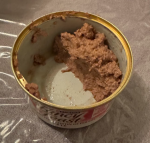
  • how much food is ""enough" for her before an insulin shot? People say "if she's eaten before a shot, then its fine" but I don't know how to gauge if she's eaten a good amount so that she can get a shot. I know right now, she'll most definitely finish half the can in a small period of time but to get almost 80% of the can finished (as shown in the picture below), it'll take her a lot longer.
  • Over what duration should that food have been eaten before she gets a shot (e.g., right now, I get her food at 7:10 am (pm in the night) and then have to wait about 40-50 minutes before she finishes the amount in the picture below:
upload_2023-12-13_20-38-12.png
    • However, I don't know if this is enough for her but right now it takes her that long to finish about this much consistently.
I'd really appreciate if someone can help me understand this feeding scenario and how to feed a cat with diabetes.

Thank you everyone!

P.S. I have tried updating my signature to contain relevant information. Hopefully it makes it easier. Sorry for not having it earlier. Still trying to work things out.
 

Attachments

  • upload_2023-12-13_20-38-12.png
    upload_2023-12-13_20-38-12.png
    536.7 KB · Views: 550
Hi, there are more experienced members than me but I'll try to answer at least some of your questions.

Caninsulin (aka Vetsulin) is not the preferred insulin for cats. It's no longer recommended by the American Animal Hospital Association because it was created for dogs and doesn't work as well in cats.

A lot of times Vetsulin causes a fast (as in too fast/too low) drop that can possibly result in a hypo event, especially if your cat has not eaten. It also wears off quicker than other insulins. The better insulins are Lantus, it's generic glargine, and Prozinc.

Because of the steep and quick drop Vetsulin creates, you need to feed, wait, and then shoot. That way the increase in blood glucose that comes from the food kicks in at the same time as the Caninsulin, preventing your cat from dropping too low. Does that make sense?

I copied and pasted this from the Vetsulin forum for you.

(1) test , (2) feed (3) wait 20 – 30 minutes (4) shoot

If you were giving Lantus or Prozinc you don't have to wait. You can test, feed, and shoot all in like five minutes because those insulins result in a flatter, more stable curve than Caninsulin and are less likely to cause a hypo.

As for how much to feed at meal time, your two biggest meals should come at shot time. Smaller snack-size meals can be given a couple times between shot times. They will ensure your kitty doesn't drop too low and generally help the blood sugar stay more stable. Just giving food twice a day is old school thinking.

I don't know how much food to feed your cat each day. Other members could answer that better than me. I'd say that for now, just try dividing up however much you give in any given day so that your two biggest meals are at shot time. And try to get your cat to eat most or all of the biggest meals before injecting. Hope this helps.
 
@M Taha
I can't find the exact post I've had with someone regarding caloric intake a day. If you google the question, different veterinary sites and some food sites typically say 20 calories per pound (US). Talk to your vet to see what formula they suggest.

That is currently the formula I use (20 calories per pound) for my guy until we get to the vet to discuss whether we can start a diet or not. His previous vet never had the conversation with me other than saying the calories I was feeding him was fine. My guy isn't small. He eats a little over 400 calories a day. Before his diagnosis and food change, it was much more. With Sandy weighing 20 lbs, I would definitely increase her caloric intake. I'm curious what you were feeding her previously. I'm sorry if you've already answered this and I missed it.

Most fancy feast classic pates are just under 100 calories. She should have four of those cans per day. The amount in your photo looks like ⅓ of the can, which would be 33 calories.

I hope this helps you. Also, like others have explained. Feed her more than twice a day please. Leave food out for her especially if you aren't able to pop in every few hours to feed and check BG. Some members use timed feeders, but if that isn't in your budget, try freezing sections (like the portion in your photo) and leaving some of those out for the day. I do this when I have to be gone all day.

I'm hopeful you are able to get the info on home testing very soon. In the meantime, watching videos and reading tips can help.

Remember to breathe and hug Sandy for us.
 
Last edited:
Did you read my posts above? I answered some of your questions. Copying and pasting here again:

with caninsulin, you need to feed and wait at least 30 minutes to give the shot because it’s a harsh fast acting insulin and not really the best one for cats since it was created for canines who have a much slower metabolism. She doesn’t have to finish all the food as long as she’s eaten a good amount. If she’s 20 pounds the rule of thumb for daily calories intake is ideal weight x20 so she should be getting 400 calories a day. 2 cans of FF is only about 1/2 of that so she needs a lot more food. Unless she’s over weight?

Most of us feed the larger meals at shot times with 3-4 smaller meals or treats throughout the day. Smaller meals or treats during the day are easier on their pancreas and help avoid big sugar spikes.

most vets don’t know a lot about feline diabetes which is why their advice can be outdated. Your vet prescribed caninsulin which is not the best insulin for cats as it was created for canines so I’d take his or her advice with a grain of salt.

thanks for setting up your signature!
 
Hey friends! I see a lot of you saying to feed and wait sometiem before the shot because its harsh acting. I have started doing this immediately! I would also like to point out the rule of 400 calories a day being 4 cans as a good rule of thumb. However, one key thing that I should've mentioned is that Sandy is an orange tabby that is overweight (obese). I do not know by how much she is and what her healthy weight should be, but based off this information, should I still aim for this 4 cans a day thing? If so, then how would I distribute this 4 cans a day in a way where shes having her larger portions/ensuring she eats before her two insulin shots? Like would 2 larger meals be like 2.5 cans with 1.5 cans in between like Ale mentioned (3-4 smaller meals and treats)? If I should aim for less like 3 cans, can someone recommend a distribution for that? All I know is that Sandy is obese and going for more 4 cans to keep her at her current weight is not something im 100% confident in if weight loss is something I'd like to pursue for sandy to be at a healthier weight.

Just to add onto that as well, this might be a dumb question I guess but its worth asking in my eyes, but how much would be a "good amount" as a rule of thumb before an insulin shot incase we were talking about the fancy feast pate can I sent above? Say, I wanted to feed her the entire can as her portion, but she doesn't? What would a good amount of that can that she should've eaten so that she can get her shot? This is one the most crucial questions I am having a hard time understanding as well.
 
Last edited:
Did your vet say to start her on a diet? While she may be over weight, cats must lose weight extremely slow and truly should be monitored by a vet while on the diet. The vet should discuss the safest way for sandy to lose weight. Cutting her caloric intake significantly without a diet plan from your vet can be very unsafe. When you throw in diabetes in that pot, and mix that with an extremely harsh insulin, seems like a recipe for disaster to me.

What did you feed her before diagnosis? And how much? This information is important. Until you have a diet plan from your vet, I would give her that number of calories.

Also, if Sandy didn't struggle to eat before, something else could be making her uninterested in food. A lot of those things have been discussed here. If she is barely eating 200 calories a day and she is used to 400 or more, it can make her extremely ill and cost you thousands of dollars. I learned the hard way what happens to cat's health when they don't eat enough calories.

If you don't have a great deal of time for her because of your current schedule, you definitely won't have time for an extremely sick cat. My cat required 24 hour constant care for 6 weeks. I barely left my home. I won't even tell you the money involved in that.

We are all sharing this knowledge with you because we are trying to keep Sandy safe.

What did she weigh before diagnosis, at diagnosis appointment, and now? That is also important information.

I don't have the answer regarding how many calories should she consume before she receives the vetsulin. I know nothing about the insulin. We have a vetsulin forum. Your answer may be in there, if no one is able to get back with you.
 
Last edited:
Your vet should be able to tell you what her ideal weight is. Can you ask him/her?

unregulated diabetic cats may start to lose weight because they can’t process the nutrients in food like a healthy or regulated cat can. So I wouldn’t reducing her calorie intake by too much even if she does need to lose weight.
 
Did your vet say to start her on a diet? While she may be over weight, cats must lose weight extremely slow and truly should be monitored by a vet while on the diet. The vet should discuss the safest way for sandy to lose weight. Cutting her caloric intake significantly without a diet plan from your vet can be very unsafe. When you throw in diabetes in that pot, and mix that with an extremely harsh insulin, seems like a recipe for disaster to me.

What did you feed her before diagnosis? And how much? This information is important. Until you have a diet plan from your vet, I would give her that number of calories.

Also, if Sandy didn't struggle to eat before, something else could be making her uninterested in food. A lot of those things have been discussed here. If she is barely eating 200 calories a day and she is used to 400 or more, it can make her extremely ill and cost you thousands of dollars. I learned the hard way what happens to cat's health when they don't eat enough calories.

If you don't have a great deal of time for her because of your current schedule, you definitely won't have time for an extremely sick cat. My cat required 24 hour constant care for 6 weeks. I barely left my home. I won't even tell you the money involved in that.

We are all sharing this knowledge with you because we are trying to keep Sandy safe.

What did she weigh before diagnosis, at diagnosis appointment, and now? That is also important information.

I don't have the answer regarding how many calories should she consume before she receives the vetsulin. I know nothing about the insulin. We have a vetsulin forum. Your answer may be in there, if no one is able to get back with you.
Yes I completely understand that too. My vet said she needed to lose weight but didn't prescribe a diet. I really appreciate your advice and I couldn't imagine that scenario which is why I am listening to what the experienced individuals in this form are recommending. Before, Sandy used to eat about 80-100 g of the Royal Canin Weight Care kibble a day. Each day she had about 3/4 of a cup I believe that's what it equivalated too which is about 190.5 calories. She was eating this portion for a good year and a half atleast.

Also, as a relevant update, she is most definitely eating like before now but she is used to grazing and not having her entire meals in like the span of 40-50 minutes before her insulin. So she doesn't want to eat all her food at that time but if I put it infront of her enough, she'll eat it.

I will also ask my vet what her ideal weight is as recommended.

I will also check the Vetsulin form and provided resources to see any information on how much is a good amount to eat for Sandy before administering insulin.
 
Yes I completely understand that too. My vet said she needed to lose weight but didn't prescribe a diet. I really appreciate your advice and I couldn't imagine that scenario which is why I am listening to what the experienced individuals in this form are recommending. Before, Sandy used to eat about 80-100 g of the Royal Canin Weight Care kibble a day. Each day she had about 3/4 of a cup I believe that's what it equivalated too which is about 190.5 calories. She was eating this portion for a good year and a half atleast.
If she was eating 190 calories before diagnosis and that is basically the amount you are feeding her now and you vet is aware, I'd say you are fine. Every cat is different. My 11 pound cat eats about 190 calories a day. I'm shocked Sandy isn't screaming at you for food constantly.

Also, as a relevant update, she is most definitely eating like before now but she is used to grazing and not having her entire meals in like the span of 40-50 minutes before her insulin. So she doesn't want to eat all her food at that time but if I put it infront of her enough, she'll eat it.
I'm very happy her appetite has returned. I was terrified when I read your initial post. All of those warnings about ketones still apply. Make sure to order the strips or the meter. The meter for blood ketones is a bit pricing and the strips are $1 each, but I had to get it because I don't always catch my male in the litter box.

I will also ask my vet what her ideal weight is as recommended.
I would definitely ask that and what her caloric intake should be per day. Also, if they want her on a diet, they need to provide you the proper steps. How much is safe for her to lose in a month? And what is the safest way to achieve this?

Don't be afraid to ask all these questions. Sandy's safety depends on it. I'm not telling you to find a new vet, but I am saying your vet needs to be on the same page as you are in regards to the best and safest plan of action for Sandy for ALL of her health needs.

Thank you for caring enough about your cat to even be here. I'm proud of you.

Also, if you ever start a new post here or in the vetsulin forum, please post this link at the beginning of your new thread.
 
And don't forget, you were getting the glucose meter from your vet and having them show you how to use it.

Most of us use human meters, as explained. If you feel you have to get the pet glucose meter through your vet, those strips are $1 each, here in the US. I usually use at least 6 strips on a normal day. Curve days I use 10 and when I'm worried and constantly checking, it could be more than 10 per day. If he had a bad month and I needed to use 300 strips, that is $300 (US dollars) in strips alone. I pay $17.99 for 100 strips and my meter was less than $20. Nothing about this disease is cheap. We all try to save where we can.

Home testing or having a freestyle libre placed (not sure if they are available in Canada) is the only way to keep her safe. Don't let anyone tell you otherwise, not even a vet.
 
Typos etc
Fancy Feast is totally fine and so is Friskies. That’s what most of us feed. It’s the only food Bobo will eat and I’ve tried them all! What’s important is that they eat so please let her eat her FF, especially since the pates are low carb. Your vet may be trying to push expensive prescription food because unfortunately, most vets do not know a lot about feline diabetes….they have many animals to look after and they all have different diseases and treatments. Vets also get their information about nutrition from the big cat food manufacturers so they are biased in what they recommend.

why are you feeding her only twice a day? Was that what the vet told you to do? Most of us feed the larger meals at shot times with 3-4 smaller meals or treats throughout the day. Smaller meals or treats during the day are easier on their pancreas and help avoid big sugar spikes.


BEWARE MOST FRISKIES IS NOT OK - All BLUE BUFFALO IS DANGEROUS Carbs 30 - 45% (cheeseburgers and candy bars, look up class action lawsuit)!
The Friskies I was feeding my Rain - had 23% carbs, gluten, and pea protein!
Cats don't eat bread(gluten) or dig in gardens for pea/bean protein(legumes). Read all food ingredients and run a feline nutritional calculator on all your food choices. ALL Vet "prescription" diabetic foods have 10% or more carbs, most protein is from combined corn and wheat gluten, soy bean, and. pea and cost almost $8/day for 10lb cat. . Guess what the BIGGEST DEAL OF ALL IS..... THERE ARE ABSOLUTELY NO SCIENTIFIC STUDIES OF RX DIABETIC CATFOOD DIETS, INGREDIENTS, NUTRICIAN, EFFECTS OR SAFETY!! Lots of mfgr driven Vet profits, articles and opinions though.
I made my food choices after looking up what others were feeding and which foods matched the nutritional values of mice, birds and small fish! There's 2 brands: Fancy Feast Classic pate's and TikiCat Canned Chicken & Fish varieties (check lables and Calc - some of their foods are higher in carbs)
My story....
Rain was Diag 11/21/23, BG upper 300s to high 400s, 1U vetsulin twice a day, switched to Tiki Cat Chicken, and a Fish 0 to 3% carbs, NO gluten all animal protein. His numbers dropped by 20% over 2 days.
Tiki is fantastic but he left a lot on plate & it's a bit spendy, so I switched to Fancy Feast Classic Pate 0 to 3 carbs, and stopped forcing meal times. He eats when he wants! Suddenly he just relaxed and his interest and attitude improved immensely! I put a new can down when bowl is empty - not licked clean. At night I mix any leftovers into his last serving, room is cool, bowl is ceramic & clean, food is cooked it's safe. He gets is 3 - 3oz cans a day total for 10.5 lb cat @ $0.88/can at Walmart (click in-store, and filter Walmart as seller) for lowest prices.
Since 12/1 his numbers have steadily dropped! His BGs are high 130s to 250s, and insulin down to 1/2U twice per day. Saw New Vet today, She was very pleased and surprised he has turned around so quickly!
If your kitty has always been a browser, like mine, Vetsulin maker and RECENT(>2018} vet publications agree, let your cats follow nature and browse on its daily allotment. Cats are not people. In nature all small cats eat many small meals throughout day & night as prey presents opportunity.
Testing and insulin should ALWAYS be at same, set times daily!
Good luck!
 
Last edited:
Yes I completely understand that too. My vet said she needed to lose weight but didn't prescribe a diet. I really appreciate your advice and I couldn't imagine that scenario which is why I am listening to what the experienced individuals in this form are recommending. Before, Sandy used to eat about 80-100 g of the Royal Canin Weight Care kibble a day. Each day she had about 3/4 of a cup I believe that's what it equivalated too which is about 190.5 calories. She was eating this portion for a good year and a half atleast.

Also, as a relevant update, she is most definitely eating like before now but she is used to grazing and not having her entire meals in like the span of 40-50 minutes before her insulin. So she doesn't want to eat all her food at that time but if I put it infront of her enough, she'll eat it.

I will also ask my vet what her ideal weight is as recommended.

I will also check the Vetsulin form and provided resources to see any information on how much is a good amount to eat for Sandy before administering insulin.

Skip calorie counting, it's useless if carbs are not removed from diet! Switch to near zero carb Fancy Feast Classic Pate or TikiCat. Stabilize cat by feeding daily amount suggested on food label for cat's current weight for 1 - 2 weeks, until cat is improving from lack of carbs- BGs should drop and level out if insulin is consistant.

** The "Recommended" weight loss for a stable diabetic cat is 0.5% to 1% per week. *f

The Cat in thie following example has no diabetic complications or other illness::

Fat cat weighs 15lbs(240oz) is eating 4 and 1/3 cans FF per day, is improved and stabile but didn't lose weight during stabilization.
1% of 15 lb STABLE Fat cat= 2.4 oz.
Fancy Feast recommends 1 can (3oz) per 3.5 lbs of cat. For Fat cat to lose weight reduce FF feed of 4.3 cans(12.9 oz) per day by 2.4 oz == 10.7 oz or 3 2/3 cans FF per day.
Weigh cat weekly, same day of week and time of day. Watch BG numbers and adjust insulin and food reduction according to Fat cat's health and condition.
Feed Fat cat the recommended amount for new weight less 1% each following week slowing food reduction to 1/2 % per week until Fat cat approaches ideal condition, is well defined, happier, more active and doing well (look up cat ideal body condition chart). NotFat cat will need You to continue to watch, monitor and adjust food and insulin to maintain good health and condition.
 
Last edited:
In Kel's post (her screen name is Red & Rover) she provided some links to a wonder website on feline nutrition that is authored by a vet. The section on feline obesity will answer most of your questions. The author, Lisa Pierson, DVM is very practical. Bottom line is be aware of what your cat's calorie needs are and track your cat's weight. The weight loss process should be gradual. Most low carb foods are lower in calories unless they are higher in fact (and this is the case with Wellness brand). Dr. Lisa also has a food chart that lists out most of the canned foods available in the US along with the calories and percent of carbohydrates.

Many of the members here feed their cat Fancy Feast or Friskies pate style food. Despite the comment above, not all cats do well on very low carb food (i.e., near zero percent). Just like humans, your cat's sensitivity to carbs may be very different than OFWLC's cat.

  • How much she should eat?
  • when she should eat? If she allowed to eat between her shots? If so, how big should her meals be before her shots compared to grazing throughout the day
  • how much food is ""enough" for her before an insulin shot? People say "if she's eaten before a shot, then its fine" but I don't know how to gauge if she's eaten a good amount so that she can get a shot. I know right now, she'll most definitely finish half the can in a small period of time but to get almost 80% of the can finished (as shown in the picture below), it'll take her a lot longer.
  • Over what duration should that food have been eaten before she gets a shot (e.g., right now, I get her food at 7:10 am (pm in the night) and then have to wait about 40-50 minutes before she finishes the amount in the picture below:
How much your cat eats actually does depend on calories. You may want to see if you can approximate how much she was eating when her appetite was good -- even if she was eating too much. You can then adjust the amount to a little less. Cats are like humans -- there are some people who can eat the same amount of food and one person will gain weight and others will lose weight. There is a formula in the Obesity section that Kel and I linked that will give you an approximation for calories per day. Please keep in mind that it's an approximate value.

The only time we advocate that your cat does not eat is in the 2 hour period before you're getting your pre-shot test. You want to have a test that is not influenced by food. Because Caninsulin is a harsh, faster acting insulin, I would encourage you to feed your cat in several installments. Give a decent size portion of food after you get your pre-shot test (wait 20 + minutes, they give insulin), and I'd suggest giving another installment of food an hour or so later. To be honest, I feed my nondiabetic cats in 3 installments. (One of the cats grew up with my diabetic cat and expects food to be dispensed in more than one sitting.) If your schedule won't permit you to do this, I'd consider a timed feeder so there is food available at least during the early part of the cycle.

I think your cat's telling you that 1/2 of a can is a fine amount in one sitting. Some cats are natural grazers. Other cats will hoover up as much food as you put out and then eat anything else they can find including your sandwich. If your cat grazes, it's unlikely that you'll be successful in changing than and all you'll do is frustrate yourself and your cat.

Is it possible to move your shot time a bit earlier? If you're able to do so, you'll have more flexibility with the time lag between feeding and giving a shot. If she's eaten a half then you're waiting roughly 40 min, you should be fine. Frankly, I think if you gave her her shot after about 30 min while she was still eating, you would likely be fine as well. Just leave the food in place so your cat can come back to her bowl.
 
Hello all,

Just an update, so Sandy seems to be eating from a dish (less steep) but more so prefers to eat from a can.

As for everyone saying that my cat needs to eat before insulin, I'm really confused because my doctor said that insulin should be administered twice a day after a meal but was not clear about how much to feed or anything, just said that makes sure she eats before her insulin. He had said one in the morning and one in the night and after her meals then only, basically implying 2 meals a day. He said she can have a small snack in between but that's about it just so that when it comes to insulin time, she can eat because she's hungry and get the shot. This is exactly what I am struggling with because I don't know:
  • how much she should eat?
  • when she should eat? If she allowed to eat between her shots? If so, how big should her meals be before her shots compared to grazing throughout the day
  • how much food is ""enough" for her before an insulin shot? People say "if she's eaten before a shot, then its fine" but I don't know how to gauge if she's eaten a good amount so that she can get a shot. I know right now, she'll most definitely finish half the can in a small period of time but to get almost 80% of the can finished (as shown in the picture below), it'll take her a lot longer.
  • Over what duration should that food have been eaten before she gets a shot (e.g., right now, I get her food at 7:10 am (pm in the night) and then have to wait about 40-50 minutes before she finishes the amount in the picture below:
    • However, I don't know if this is enough for her but right now it takes her that long to finish about this much consistently.
I'd really appreciate if someone can help me understand this feeding scenario and how to feed a cat with diabetes.

Thank you everyone!

P.S. I have tried updating my signature to contain relevant information. Hopefully it makes it easier. Sorry for not having it earlier. Still trying to work things out.
Are you just putting can down? If so, that's a part of your problem. It's too small, has sharp edges. Put it in a shallow glass, ceramic, or stainless bowl or on a plate, walk away & leave it until next feeding. Many cats can't eat a whole can as a meal. Giver time, walk away
 
Hi, there are more experienced members than me but I'll try to answer at least some of your questions.

Caninsulin (aka Vetsulin) is not the preferred insulin for cats. It's no longer recommended by the American Animal Hospital Association because it was created for dogs and doesn't work as well in cats.

A lot of times Vetsulin causes a fast (as in too fast/too low) drop that can possibly result in a hypo event, especially if your cat has not eaten. It also wears off quicker than other insulins. The better insulins are Lantus, it's generic glargine, and Prozinc.

Because of the steep and quick drop Vetsulin creates, you need to feed, wait, and then shoot. That way the increase in blood glucose that comes from the food kicks in at the same time as the Caninsulin, preventing your cat from dropping too low. Does that make sense?

I copied and pasted this from the Vetsulin forum for you.

(1) test , (2) feed (3) wait 20 – 30 minutes (4) shoot

If you were giving Lantus or Prozinc you don't have to wait. You can test, feed, and shoot all in like five minutes because those insulins result in a flatter, more stable curve than Caninsulin and are less likely to cause a hypo.

As for how much to feed at meal time, your two biggest meals should come at shot time. Smaller snack-size meals can be given a couple times between shot times. They will ensure your kitty doesn't drop too low and generally help the blood sugar stay more stable. Just giving food twice a day is old school thinking.

I don't know how much food to feed your cat each day. Other members could answer that better than me. I'd say that for now, just try dividing up however much you give in any given day so that your two biggest meals are at shot time. And try to get your cat to eat most or all of the biggest meals before injecting. Hope this helps.


If you are HER Vet - you can prescribe or recommend insulin!

Vetsulin is indeed for cats, 3 vets, Merck, and every resource and journal article I've read, agree it's just fine.

Vetsulin (avg $67) it is one of the two long acting insulins for felines. The other is Lantus Glargine (avg $370), it costs 5 to 6 times more than Vetsulin! USE WHAT YOUR VET Prescribed! I am not a Vet. I only share what I've read & learned. & experienced!


Notes on forum AND any published Feline diabetes information; Including the much touted Food List , meds, protocols and information: CHECK THE POSTED & PUBLICATION DATES!
The Food List is 6 - 8 years out if date, even 'new' version!!!! yes, tons of work, but old in an extremely work in fast changing market. Most foods listed are gone or changed by manufactures. Mars stopped producing it's cat foods several years ago including EVO & others - just gone! Friskies values on the list rarely match today's ingredients! I run the numbers through a calculator for every food I consider.

Here is One of the best resources I've found: published by AAFP, it's very in depth, without brand pushing or $$ motivation! I CALLED - IT'S CURRENT!!

https://catvets.com/diabetes-toolkit/treatment

Full download link at bottom of page. It's a small books worth of very good info!
Source Background...
AAFP Mission:
The American Association of Feline Practitioners (AAFP) supports its members in improving the health and wellbeing of cats through high standards of practice, continuing education, and evidence-based medicine.
 
Last edited:
If you are HER Vet - you can prescribe or recommend insulin!

Vetsulin is indeed for cats, 3 vets, Merck, and every resource and journal article I've read, agree it's just fine.
Vetsulin (avg $67) it is one of the two long acting insulins for felines. The other is Lantus Glargine (avg $370), it costs 5 to 6 times more than Vetsulin! USE WHAT YOUR VET Prescribed! I am not a Vet. I only share what I've read & learned. & experienced!


Notes on forum AND any published Feline diabetes information; Including the much touted Food List , meds, protocols and information: CHECK THE POSTED & PUBLICATION DATES!
The Food List is 6 - 8 years out if date, even 'new' version!!!! yes, tons of work, but old in an extremely work in fast changing market. Most foods listed are gone or changed by manufactures. Mars stopped producing it's cat foods several years ago including EVO & others - just gone! Friskies values on the list rarely match today's ingredients! I run the numbers through a calculator for every food I consider!
I've found 2 brands - I can almost afford, certain Tiki Cat chicken and fish varieties and Fancy Feast classic pates.

Flavor and smell mean things to your cat pick a different flavor or style. Try gerber chicken or other meat only baby food as an enticement, I've never heard of a cat that didn't scarf it like candy! If kitty's smell is fading, touch a bit of food to mouth. A jar is 90 calories of 35% protein and fat, no added nutrients, so not a good steady diet, but a great enticer!

Cats evolved eating many small meals throughout the day, mice don't run by an a schedule. The big deal is to never give insulin to a cat that has not eaten. I shoot Rain as soon as his head hits the bowl - waiting 20 min is not necessary for long acting insulin one your kitty is eating regularly.

Here is One of the best resources I've found: published by AAFP, it's very in depth, without brand pushing or $$ motivation!
https://catvets.com/diabetes-toolkit/treatment
Full download link at bottom of page. It's a small books worth of very good info!
Source Background...
AAFP Mission:
The American Association of Feline Practitioners (AAFP) supports its members in improving the health and wellbeing of cats through high standards of practice, continuing education, and evidence-based medicine.
I'm not sure what you mean by this post and your more recent ones. No one on this forum recommends Vetsulin as a preferred insulin. I'm not going to debate with you. Best of luck. All good wishes.
 
Hello all,

Just an update, so Sandy seems to be eating from a dish (less steep) but more so prefers to eat from a can.

As for everyone saying that my cat needs to eat before insulin, I'm really confused because my doctor said that insulin should be administered twice a day after a meal but was not clear about how much to feed or anything, just said that makes sure she eats before her insulin. He had said one in the morning and one in the night and after her meals then only, basically implying 2 meals a day. He said she can have a small snack in between but that's about it just so that when it comes to insulin time, she can eat because she's hungry and get the shot. This is exactly what I am struggling with because I don't know:
  • how much she should eat?
  • when she should eat? If she allowed to eat between her shots? If so, how big should her meals be before her shots compared to grazing throughout the day
  • how much food is ""enough" for her before an insulin shot? People say "if she's eaten before a shot, then its fine" but I don't know how to gauge if she's eaten a good amount so that she can get a shot. I know right now, she'll most definitely finish half the can in a small period of time but to get almost 80% of the can finished (as shown in the picture below), it'll take her a lot longer.
  • Over what duration should that food have been eaten before she gets a shot (e.g., right now, I get her food at 7:10 am (pm in the night) and then have to wait about 40-50 minutes before she finishes the amount in the picture below:
    • However, I don't know if this is enough for her but right now it takes her that long to finish about this much consistently.
I'd really appreciate if someone can help me understand this feeding scenario and how to feed a cat with diabetes.

Thank you everyone!

P.S. I have tried updating my signature to contain relevant information. Hopefully it makes it easier. Sorry for not having it earlier. Still trying to work things out.

Actually, she ate a perfect 2 oz kitty sized meal. More than enough to shoot. Rain eats about the same at his meals -.scarily NOT enough! That's why I researched A LOT! I LEARNED - Just leave the whole can down in her bowl and let her eat more when she wants. Don't take away leftover food, let her finish on her own time (I will stir it occasionally if it's mashed to sides of bowl. If muti cat home, pickup her food, but offer it back to her every two or so hours.

She is eating this food fine, You're doing great, she eats it! Just not enough per day! It doesn't matter when. Present her with additional cans in a clean bowl as needed for her complete diet as bowl empties throughout daytime. With Rain, his stress decreased and overall behavior improved amazingly within 48 hours! She will train you really quickly once she figures out there will be food when she's hungry. Time it so a fresh can is offered just after scheduled blood draws, then give scheduled insulin as needed.

Our vet approved protocol is working - his BGs are down 35% since diagnosis in mid Nov 2023, insulin cut in half Dec 12:
Our Vetsulin shot times are 10A & 10P. First bowl goes down after AM blood draw. Rain gets 3 cans FF per day. 2nd fresh bowl goes down when 1st is crumbs, NOT licked clean ~ 4 PM. 3rd goes down after 10PM blood draw before shot. He slows down on eating in early dark evening and there is often significant leftover from afternoon, he needs the calories so I mix leftovers to the 3rd (last) can in a fresh, clean bowl. Spoilage is not an issue, if each can gets a clean bowl or plate.
Your kitty is not my kitty, all are different, so are we!

Our house cats evolved in deserts eating many small meals throughout the day. Mice, birds, & other critters don't run/fly by on a schedule.
The big deal is to never give insulin to a cat that has not eaten!! You don't need to watch cat eat, just check the bowl. I shoot Rain as soon as his head hits the bowl - waiting is not necessary for long acting Vetsulin insulin if your kitty is eating regularly and you're on time!!

I arrived at this protocol, with aproval of 2 unassociated Vets, 1 call to U of MN small animal hospital, The AAFP, Merck and ~ 40 hours of reading CURRENT information: Vetsulin full prescribing insert (the insert for vets), Journal articles and study data, current vet training materials, and this forum. I check all pertinent references in all publications.
 
I'm not sure what you mean by this post and your more recent ones. No one on this forum recommends Vetsulin as a preferred insulin. I'm not going to debate with you. Best of luck. All good wishes.

My sincere apologies, I attempting to was reply to SIENNE & GABBY's post regarding Vetsulin not meant for cats..
That "it's harsh" etc. All opinions not founded in fact or science! Please research. Not just web search! Don't accept a website or other source without digging out their sources and dates of information. Anyone can buy a website with vet in the name. Anyone can and does write paid or unpaid Opinion articles and present them as fact. Look up the references, if there are none, leave it and move on::
https://askus.baker.edu/faq/:~:text...is publishing the information. ... More items
 
My sincere apologies, I attempting to was reply to SIENNE & GABBY's post regarding Vetsulin not meant for cats..
That "it's harsh" etc. All opinions not founded in fact or science! Please research. Not just web search! Don't accept a website or other source without digging out their sources and dates of information. Anyone can buy a website with vet in the name. Anyone can and does write paid or unpaid Opinion articles and present them as fact. Look up the references, if there are none, leave it and move on::
https://askus.baker.edu/faq/:~:text=Here are some ways to research the accuracy,who is publishing the information. ... More items
No worries. However, @Sienne and Gabby (GA) is very experienced and I feel certain that they can respond with links to articles and various resources. Many of the experienced members in this forum do offer specific advice on insulin and dosing. That's why many of us come here, so it's kind of the point. I don't mean for that to sound rude or snarky in any way. I just know that, personally, I value Sienne's advice, along with that of other members.

I totally understand preferring to take the advice of your vet, and if their advice works for you then I think that's great! Unfortunately, many people have had negative experiences with their vets. I actually love my vet and have had mostly positive experiences. But not everyone is the same. I'm glad you are researching and have found what works for you. :)
 
Typos etc


BEWARE MOST FRISKIES IS NOT OK - All BLUE BUFFALO IS DANGEROUS Carbs 30 - 45% (cheeseburgers and candy bars, look up class action lawsuit)!
The Friskies I was feeding my Rain - had 23% carbs, gluten, and pea protein!
Cats don't eat bread(gluten) or dig in gardens for pea/bean protein(legumes). Read all food ingredients and run a feline nutritional calculator on all your food choices. ALL Vet "prescription" diabetic foods have 10% or more carbs, most protein is from combined corn and wheat gluten, soy bean, and. pea and cost almost $8/day for 10lb cat. . Guess what the BIGGEST DEAL OF ALL IS..... THERE ARE ABSOLUTELY NO SCIENTIFIC STUDIES OF RX DIABETIC CATFOOD DIETS, INGREDIENTS, NUTRICIAN, EFFECTS OR SAFETY!! Lots of mfgr driven Vet profits, articles and opinions though.
I made my food choices after looking up what others were feeding and which foods matched the nutritional values of mice, birds and small fish! There's 2 brands: Fancy Feast Classic pate's and TikiCat Canned Chicken & Fish varieties (check lables and Calc - some of their foods are higher in carbs)
My story....
Rain was Diag 11/21/23, BG upper 300s to high 400s, 1U vetsulin twice a day, switched to Tiki Cat Chicken, and a Fish 0 to 3% carbs, NO gluten all animal protein. His numbers dropped by 20% over 2 days.
Tiki is fantastic but he left a lot on plate & it's a bit spendy, so I switched to Fancy Feast Classic Pate 0 to 3 carbs, and stopped forcing meal times. He eats when he wants! Suddenly he just relaxed and his interest and attitude improved immensely! I put a new can down when bowl is empty - not licked clean. At night I mix any leftovers into his last serving, room is cool, bowl is ceramic & clean, food is cooked it's safe. He gets is 3 - 3oz cans a day total for 10.5 lb cat @ $0.88/can at Walmart (click in-store, and filter Walmart as seller) for lowest prices.
Since 12/1 his numbers have steadily dropped! His BGs are high 130s to 250s, and insulin down to 1/2U twice per day. Saw New Vet today, She was very pleased and surprised he has turned around so quickly!
If your kitty has always been a browser, like mine, Vetsulin maker and RECENT(>2018} vet publications agree, let your cats follow nature and browse on its daily allotment. Cats are not people. In nature all small cats eat many small meals throughout day & night as prey presents opportunity.
Testing and insulin should ALWAYS be at same, set times daily!
Good luck!
Having been here well over 13 years, I have to disagree with many, many of your statements. For one, testing can and should occur at different times during each cycle. Insulin, while ideal given every 12 hours apart, has flexibility, especially an insulin like Vetsulin which has much more leeway than one of the gold standard insulins like lantus and levemir.

Not all cats respond well to a 0-3% calories from carbs diet. In fact, we have found over the years that many cats do better with foods which are in the 6-10% calories from carbs range. While you might not like Friskies, I, personally, would not feed my cat Tiki Cat or Fancy Feast as their ingredients are not ideal. However, I believe each person should decide what their cat eats and I have no judgement on that unless they are feeding a diabetic cat a dry or HC canned diet when the latter is not warranted. In addition, most diabetic cats (your cat appears to not be one) shouldn’t be allowed to graze all day because it can greatly shorten the duration of the insulin.

Typically members here post their cat’s spreadsheet so others can see the progress the cat is making, especially if you are giving advice.

Skip calorie counting, it's useless if carbs are not removed from diet! Switch to near zero carb Fancy Feast Classic Pate or TikiCat. Stabilize cat by feeding daily amount suggested on food label for cat's current weight for 1 - 2 weeks, until cat is improving from lack of carbs- BGs should drop and level out if insulin is consistant.
I disagree and I’ve studied feline nutrition for years and years. It’s important to know how many calories your cat is getting each day because there is a minimum calorie requirement. While it’s important to consider % calories from carbs for any cat, but especially a diabetic cat, I closely monitor the number of calories per day my two non-FD cats get so I can be sure they have the requisite calories needed to power their bodies and carry on physiological functions.

Vetsulin is indeed for cats, 3 vets, Merck, and every resource and journal article I've read, agree it's just fine.
Again, based on our experience and the number of years we three moderators have spent looking at spreadsheets for cats on Vetsulin vs PZ or one of the long-duration insulins, I can attest that Vetsulin is an inferior insulin. It is harsh and causes harsh curves to occur in many cats. The incidence of cats having hypoglycemic episodes is higher on Vetsulin than on the other long-duration insulins.

Here is One of the best resources I've found: published by AAFP, it's very in depth, without brand pushing or $$ motivation! I CALLED - IT'S CURRENT!!

https://catvets.com/diabetes-toolkit/treatment
But it does not specifically recommend Vetsulin over any of the other insulins and doesn’t provide a detailed analysis of each. I agree there are some circumstances where a caregiver cannot afford one of the L insulins or even PZ and Vetsulin is all they can afford. Obviously, treatment with insulin appropriate for a cat is desired over not treating because they can’t afford the gold standard insulins.

The big deal is to never give insulin to a cat that has not eaten!!
This is also incorrect. You might want to read this post which contradicts your statement.

waiting is not necessary for long acting Vetsulin insulin
Vetsulin is not considered to be a long-acting insulin having a duration of only 8-10 hours at best. It is also recommended that food be on board before Vetsulin is given as onset can be quick and sometimes involve a harsh drop.

That "it's harsh" etc. All opinions not founded in fact or science! Please research. Not just web search! Don't accept a website or other source without digging out their sources and dates of information. Anyone can buy a website with vet in the name. Anyone can and does write paid or unpaid Opinion articles and present them as fact. Look up the references, if there are none, leave it and move on::
I will also reiterate that Sienne is one of our very most experienced members and has a Ph.D in a medical field and access to a medical library. She knows how to do research. We, in this forum, do our research before we post information. We’ve had many, many, many years (decades) of experience with Vetsulin so it’s a little difficult to understand that someone who has less than a month of experience is advising another new member contradictory to the knowledge and experience we have here.

It is certainly any caregiver’s choice to accept the advice of their vet and to share their experience here in a less aggressive manner especially considering how new you are to the process.
 
No worries. However, @Sienne and Gabby (GA) is very experienced and I feel certain that they can respond with links to articles and various resources. Many of the experienced members in this forum do offer specific advice on insulin and dosing. That's why many of us come here, so it's kind of the point. I don't mean for that to sound rude or snarky in any way. I just know that, personally, I value Sienne's advice, along with that of other members.

I totally understand preferring to take the advice of your vet, and if their advice works for you then I think that's great! Unfortunately, many people have had negative experiences with their vets. I actually love my vet and have had mostly positive experiences. But not everyone is the same. I'm glad you are researching and have found what works for you. :)

I believe in evidence based health care for my broken self and my sick kitty.
I value my friends, family, those with historical experience and even medical professionals advice and information. However, anyone and everyone can be WRONG!

I've had a Vet kill a cat by misdiagnosis. I've had doctors laugh at me in the ER about my orphan disease while in anaphylaxis and tell me I couldn't be allergic to what was killing me. Another Doc almost killed me for failure to read my chart 15 minutes before C-spine surgery! Surgeon was pissed, had to have extra Doc in OR to monitor for anaphylaxis!

I switched Vets this week, because the first was more interested in selling me unresearched, unproven, gluten based, "prescription food", than the fact Rain was quickly approaching very early indications of remission BG numbers and vet didn't bother to call me back, after conversation with tech & sending logs.

Basic proven FACTs: All Diabetics do best with steady balanced blood sugar! Vetsulin is 12 hour long term insulin, not a 24 hr long term.

Tuesday, after two days of AM BG under 200 - "no insulin" needed, getting a single 1U dose every 24 hrs and no call from vet1 - I went on a research binge. Learned a ton, but it was a call to my cousin, a longterm(>30 yrs), well managed diabetic who has managed to remiss for two years, who actually helped!
After listening to his history, she didn't hesitate, her first words were: "His body is trying to remiss - Split the dose! Unbalanced insulin can f¿¢k him up quicker than no insulin!". That evening I split the dose to 1/2U vetsulin tid. His midday UA taken Thursday at new vet had no glucose and fully normal for all other values. Lab BG was normal too!

Personally, I feel that Rain's un-stressing; after I learned set meal times were not necessary; and he returned to his lifetime eating habbits was the turning point! Food with or just prior to insulin is important!

So, regardless of how much I wish, hope, or think someone is correct in their advice regarding my or my cat's health - I always ask and look for the basis of their opinion, then get a second from another source. I personally try to fact check as I write, be honest when I'm wrong, and correct noted errors!

BTW: Cousin lost her remission to SARSCoV-2. We are all greatful that's all it took!
Best to you & yours!
 
I believe in evidence based health care for my broken self and my sick kitty.
I value my friends, family, those with historical experience and even medical professionals advice and information. However, anyone and everyone can be WRONG!

I've had a Vet kill a cat by misdiagnosis. I've had doctors laugh at me in the ER about my orphan disease while in anaphylaxis and tell me I couldn't be allergic to what was killing me. Another Doc almost killed me for failure to read my chart 15 minutes before C-spine surgery! Surgeon was pissed, had to have extra Doc in OR to monitor for anaphylaxis!

I switched Vets this week, because the first was more interested in selling me unresearched, unproven, gluten based, "prescription food", than the fact Rain was quickly approaching very early indications of remission BG numbers and vet didn't bother to call me back, after conversation with tech & sending logs.

Basic proven FACTs: All Diabetics do best with steady balanced blood sugar! Vetsulin is 12 hour long term insulin, not a 24 hr long term.

Tuesday, after two days of AM BG under 200 - "no insulin" needed, getting a single 1U dose every 24 hrs and no call from vet1 - I went on a research binge. Learned a ton, but it was a call to my cousin, a longterm(>30 yrs), well managed diabetic who has managed to remiss for two years, who actually helped!
After listening to his history, she didn't hesitate, her first words were: "His body is trying to remiss - Split the dose! Unbalanced insulin can f¿¢k him up quicker than no insulin!". That evening I split the dose to 1/2U vetsulin tid. His midday UA taken Thursday at new vet had no glucose and fully normal for all other values. Lab BG was normal too!

Personally, I feel that Rain's un-stressing; after I learned set meal times were not necessary; and he returned to his lifetime eating habbits was the turning point! Food with or just prior to insulin is important!

So, regardless of how much I wish, hope, or think someone is correct in their advice regarding my or my cat's health - I always ask and look for the basis of their opinion, then get a second from another source. I personally try to fact check as I write, be honest when I'm wrong, and correct noted errors!

BTW: Cousin lost her remission to SARSCoV-2. We are all greatful that's all it took!
Best to you & yours!
Errr... I'm a little confused by your post. Are you responding to me or did you mean to respond to someone else again? Are you in this forum to provide advice or ask for it? It doesn't sound as if you want advice from anyone here, so I don't really get what you're doing. And, with all respect, you should probably leave the advice giving to moderators like @Marje and Gracie @Sienne and Gabby (GA) and those with practical experience. Either way, if you plan to stay on this forum it would probably help if you set up your signature. At least then we would be able to see what sort of insulin you use, and so forth. It would lend more context to your words.
 
@OFWLWC
I just want to advise you that every single person here, that has been here for years, is here to help saves cats. Offering advise that contradicts what these senior members have research for years is asinine. The senior members helping everyone are doing so free of charge. They aren't advising individuals becasue they get a kick back from something or someone. They volunteer their TIME and ENERGY because of their LOVE of cats.

If you want to be a part of the forum, put information in your signature and start a spreadsheet. Share your knowledge, but stop saying everyone's advise is incorrect. There is science behind their facts.

Stop speaking over these members and offering advise that I believe could be dangerous to a cat, if someone followed.

These individuals helped save my cats life not my vet. Period. Please allow them to do the same for others, without taking up their resources that they aren't being paid for.
 
I believe in evidence based health care for my broken self and my sick kitty.
I value my friends, family, those with historical experience and even medical professionals advice and information. However, anyone and everyone can be WRONG!

I've had a Vet kill a cat by misdiagnosis. I've had doctors laugh at me in the ER about my orphan disease while in anaphylaxis and tell me I couldn't be allergic to what was killing me. Another Doc almost killed me for failure to read my chart 15 minutes before C-spine surgery! Surgeon was pissed, had to have extra Doc in OR to monitor for anaphylaxis!

I switched Vets this week, because the first was more interested in selling me unresearched, unproven, gluten based, "prescription food", than the fact Rain was quickly approaching very early indications of remission BG numbers and vet didn't bother to call me back, after conversation with tech & sending logs.

Basic proven FACTs: All Diabetics do best with steady balanced blood sugar! Vetsulin is 12 hour long term insulin, not a 24 hr long term.

Tuesday, after two days of AM BG under 200 - "no insulin" needed, getting a single 1U dose every 24 hrs and no call from vet1 - I went on a research binge. Learned a ton, but it was a call to my cousin, a longterm(>30 yrs), well managed diabetic who has managed to remiss for two years, who actually helped!
After listening to his history, she didn't hesitate, her first words were: "His body is trying to remiss - Split the dose! Unbalanced insulin can f¿¢k him up quicker than no insulin!". That evening I split the dose to 1/2U vetsulin tid. His midday UA taken Thursday at new vet had no glucose and fully normal for all other values. Lab BG was normal too!

Personally, I feel that Rain's un-stressing; after I learned set meal times were not necessary; and he returned to his lifetime eating habbits was the turning point! Food with or just prior to insulin is important!

So, regardless of how much I wish, hope, or think someone is correct in their advice regarding my or my cat's health - I always ask and look for the basis of their opinion, then get a second from another source. I personally try to fact check as I write, be honest when I'm wrong, and correct noted errors!

BTW: Cousin lost her remission to SARSCoV-2. We are all greatful that's all it took!
Best to you & yours!
Vetsulin is not a 12-hour long-duration insulin. Sorry but you are incorrect on this. You should also know that some cats diagnosed with feline diabetes can see drastically improved BGs with a diet change and a little insulin support. That is not a common occurrence but perhaps what you might be seeing with Rain. If so, you are lucky. But again, without seeing a SS, we can’t see where he started and where he is now. As they say, “the proof is in the pudding”!
 
@OFWLWC
I just want to advise you that every single person here, that has been here for years, is here to help saves cats. Offering advise that contradicts what these senior members have research for years is asinine. The senior members helping everyone are doing so free of charge. They aren't advising individuals becasue they get a kick back from something or someone. They volunteer their TIME and ENERGY because of their LOVE of cats.

If you want to be a part of the forum, put information in your signature and start a spreadsheet.

Stop speaking over these members with advise that I believe could be dangerous to a cat, if someone followed.

These individuals helped save my cats life not my vet. Period. Please allow them to do the same for others, without taking up their resources that they aren't being paid for.
Well said. I wholeheartedly agree.
 
@M Taha How is it going with Sandy today? Any updates? Is she eating more? Is Sandy still getting the anti nausea medication and if so, which one is it? Ondansetron is a better medication for nausea, but more expensive in Canada. Cerenia is another option, and since Sandy was vomiting, it's a good choice to prevent that. The down side to Cerenia is it is very bitter, so best to disguise it. I used to put it in a blank gel cap. If you put it in her food and she eats it and notices the taste, she might go off of that food.

Sorry that your thread seems to have gotten derailed. This thread should be about Sandy and your care.

As someone else from Canada who's cat was on Caninsulin (because that's what the vet did), then switched to Lantus with a locum vet, I just wanted to comment on a couple of the points made above. First, Caninsulin doesn't last as long as Lantus did in most cats. It definitely did not in my cat. However, it it's what you have for now, that's OK, it does work in some cats and getting some insulin is a good first step. My girl was on Caninsulin for almost three months before we switched.

Lantus is a lot cheaper in Canada than the number that was quoted above, which was a US cost. Side note, there is a post on the Lantus forum about being able to get Lantus for $35 through Goodrx in the US. Plus there are now biosimilar and generic versions of Lantus, which are even a bit cheaper that in Canada. The 2018 AAHA Diabetes Management Guidelines for Cats and Dogs recommends both Lantus and Prozinc for cats. Vetsulin (called Caninsulin outside of the US) is mentioned for dogs.
 
Last edited:
The information supplied here is based on research and is not old school. Unfortunately for your cat your information is. Do some reading on the various insulins available. Lantus is no longer so expensive and there are biosimilar products now on the market. Insulting those trying to help will not help your cat. Nobody here pretends to be a vet.
 
@M Taha My apologies as well that your thread got hijacked. It is unfortunate when this happens but we have many people who read but don’t post and it’s important they have the correct information. I hope we can all move forward now to help you and put the other comments behind as I know you wish.
 
The majority of the membership on FDMB support an evidence based approach to diabetes management and pretty much anything else. The current guidelines for diabetes management that were published by the American Animal Hospital Assn in 2018 and updated in 2022 recommend that either Lantus (glargine) or Prozinc be used for the treatment of feline diabetes. They note that other insulin, such as Vetsulin, does not have adequate duration given a cat's fast metabolism.
 
Status
Not open for further replies.
Back
Top