? Mimi 1/6 AMPS 224, dropped to 150 at +2. Questions

Mimis mom

Member Since 2019
http://www.felinediabetes.com/FDMB/...ncing-or-failed-increase.223924/#post-2504853


Was that from clearing another bounce?
She was ravenous before I left for work at +2 so I put a little bit of HC FF on top of her raw (to make a MC, and still keep her with raw in the meal) that was scheduled to feed at +2.5 and a little again on her +5 timed meal because it looked as though she was dropping quickly and worried about the nadir.

Can anyone help me with this? Did I do the right thing?

Thanks.

@Marje and Gracie
@Wendy&Neko

Or whoever else can chime in!
 
http://www.felinediabetes.com/FDMB/...ncing-or-failed-increase.223924/#post-2504853


Was that from clearing another bounce?
She was ravenous before I left for work at +2 so I put a little bit of HC FF on top of her raw (to make a MC, and still keep her with raw in the meal) that was scheduled to feed at +2.5 and a little again on her +5 timed meal because it looked as though she was dropping quickly and worried about the nadir.

Can anyone help me with this? Did I do the right thing?

Thanks.

@Marje and Gracie
@Wendy&Neko

Or whoever else can chime in!
Looks like she is clearing the bounce. You’ll have to see when you get home if that worked or not. Remember feeding is very ECID and you will have to learn what works for Mimi. It depends on how carb sensitive a cat is and how they respond to the amount of food you give as well. So, unfortunately, we can’t predict this. The absolute, only way you will ever know what works best for her is if you keep track of it: what you fed, how much, when, % carbs, etc. If you look at Gracie’s SS, you’ll see how I did it. You don’t have to copy that but I did it so I had everything together in one place and, in the early days when people were helping us, they could see the effect. Still, it was our responsibility to know what worked for her.
 
So would you say she bounced from the skinny increase?
What do I do now that I’ve been using the caliper with the Relion mm readings.
 
DItto what Marje said about today so far. I expect the event causing the low was the evening of the 4th. Cats don't bounce from an increase. They bounce either because they saw a number lower than they are used to, or a fast drop.
 
So she bounced from the 4th- from what- was it from giving insulin late or from the 118 number, she might have dropped low during the night?
so bounces don’t always happen as a result of a number below 50 (which is what I thought) they just happen when they are seeing numbers they aren’t used to which could be anything in the dark green or even blues depending on how high they typically are?
off topic - I have a client that’s a medical doctor and she actually admitted she didn’t even know cats got diabetes and was interested in knowing more. I said it’s usually type 2 and she was surprised it was treated with insulin usually it’s pills, but it’s not “unheard of” also- this is with humans.
She also said she’s never heard of a type 2 diabetic getting DKA, but again, this is in humans.
She also said with humans, they don’t always follow suggested lifestyle and meal changes but with Mimi she doesn’t eat anything but LC (I think it’s even no carb) because I control what she eats and why that alone hasn’t put her into remission, because the body is still making insulin it just resistant.
What are your thoughts or opinions? I always found that odd too- that she has no carbs and isn’t overweight but still has diabetes- and it can’t be type 1 right?

Thanks!
 
She either bounced from the 118, or however low she went that night. Her nadir tends to be later than +3. Cats can even bounce from yellows if they aren't used to it.

Cats are not humans. They have the unique ability to possibly go into diabetic remission. Plus their body metabolizes things differently. In order to go into remission, a cat first has to get regulated, mostly numbers under 100, so the pancreatic cells can rest and recover. Focus on regulation first. It's a process that takes time. Mimi is still relatively newly diagnosed.
 
My understanding was Type I is where little to no insulin is produced in the body. It can be because there was congenital issues with islet cells in the pancreas or they are damaged beyond recovery- which is why it is often diagnosed at younger ages in humans. Type 1 is a chronic illness known as insulin-dependent diabetes in humans. Type II is where the body doesn't respond to the levels of insulin being produced and then later often stops producing appropriate levels. Type II is often "treatable" with diet and lifestyle changes...which is how people and cats can have changes in their insulin needs based on things like diet changes and exercise.
There is a pill that some pets take for DM, but it doesn't work as well in cats and is not as safe for cats with kidney/liver issues. Most house cats are nowhere near as active as they should be and most were not eating appropriate diets across their lifespan , so even if a cat is not technically obese they can develop diabetes.
Honestly, the veterinary community is not even 100% sure on why one cat develops diabetes as opposed to another- it can just "happen" unfortunately like cancer. I wouldn't be too shocked that a doctor who didn't know cat even got diabetes is also surprised on how it is treated. Cats are different - even then dogs on how we manage and treat diabetes.
 
I'm Happy to see you're getting the best advice from some of the most Knowledgeable people here.
Hang in there & be Patient. Sending good vibes your way.
964f51aa178cb8b0871771f5c4d3bffb--positive-vibes-spiritual-quotes.jpg
 
My understanding was Type I is where little to no insulin is produced in the body. It can be because there was congenital issues with islet cells in the pancreas or they are damaged beyond recovery- which is why it is often diagnosed at younger ages in humans. Type 1 is a chronic illness known as insulin-dependent diabetes in humans. Type II is where the body doesn't respond to the levels of insulin being produced and then later often stops producing appropriate levels. Type II is often "treatable" with diet and lifestyle changes...which is how people and cats can have changes in their insulin needs based on things like diet changes and exercise.
There is a pill that some pets take for DM, but it doesn't work as well in cats and is not as safe for cats with kidney/liver issues. Most house cats are nowhere near as active as they should be and most were not eating appropriate diets across their lifespan , so even if a cat is not technically obese they can develop diabetes.
Honestly, the veterinary community is not even 100% sure on why one cat develops diabetes as opposed to another- it can just "happen" unfortunately like cancer. I wouldn't be too shocked that a doctor who didn't know cat even got diabetes is also surprised on how it is treated. Cats are different - even then dogs on how we manage and treat diabetes.
Which is why there’s an entire site dedicated to it with thousands of members!! :bighug:
 
Mimi’s been high yellow tonight :(
Why can’t we figure this thing out? Is she due for full 1.75? Oh shoot also- @Marje and Gracie
How do I figure out the conversion for the Ulticare? Are you able to link me directly to it?

Or what good will that due if I’ve been measuring her based on Relion meters... I wonder how off Ucare is to them.
 
Mimi’s been high yellow tonight :(
Why can’t we figure this thing out? Is she due for full 1.75? Oh shoot also- @Marje and Gracie
How do I figure out the conversion for the Ulticare? Are you able to link me directly to it?

Or what good will that due if I’ve been measuring her based on Relion meters... I wonder how off Ucare is to them.
Rosa....syringes and meters are apples and oranges. Also what dose she needs is apples and oranges from the syringe measurement. Once you determine what dose she needs, then you use the caliper measurement that you should have already figured out.

If you read the Dosing with Calipers post, it will tell you exactly how to determine how many mm are in 1u if your syringe type is not listed. There isn’t a conversion for Ulticare unless another member on this site uses them and has already done it. Not long ago, I asked for members to provide me with any info on the measurements for their syringes so other members using the same syringe brand and type wouldn’t have to reinvent the wheel. No one was using Ulticare.

I thought you were using Carepoint syringes? The measurement for that syringe is on the Dosing with Calipers post.

Let me see if I can try and clear this up.
  • pick a syringe...if you are using calipers, it doesn’t really matter if the syringe type has half-unit markings;
  • look at the Dosing with Calipers post and see if the measurement in mm for 1u is already listed for your syringe type. If it is, use that to determine how many mms would be in your different doses;
    • As an example, if the syringe used was 1u = 1.52 mm, then every 0.1u would be changed by 0.15mm (there are 10-0.1u in 1u as 0.1 x 10 = 1) because 1.52/10 = 0.15. Therefore, 0.1u = 0.15mm; 0.2u = 0.3mm; 0.3u = 0.45 mm and so on.
  • the dose is determined by the method of regulation you are using; Wendy suggested yesterday that you fatten the dose because you were worried Mimi would drop lower while you were gone but, if you were able to be there to test, it is much better to do dose increases (for where her BG is) by 0.25u.
  • when you use calipers, you don’t need to put 1.5+u on the SS because you should know to the 0.1u what the dose is; that’s what I was trying to tell you in post 7 on 1/3.
Insofar as what dose she needs, the TR protocol tells you to told the dose 6-10 cycles if she’s seeing blue and she is. She is likely going to need 1.75u but with blue nadirs, you should give her a few more cycles.
Does that help any?
 
Rosa....syringes and meters are apples and oranges. Also what dose she needs is apples and oranges from the syringe measurement. Once you determine what dose she needs, then you use the caliper measurement that you should have already figured out.

If you read the Dosing with Calipers post, it will tell you exactly how to determine how many mm are in 1u if your syringe type is not listed. There isn’t a conversion for Ulticare unless another member on this site uses them and has already done it. Not long ago, I asked for members to provide me with any info on the measurements for their syringes so other members using the same syringe brand and type wouldn’t have to reinvent the wheel. No one was using Ulticare.

I thought you were using Carepoint syringes? The measurement for that syringe is on the Dosing with Calipers post.

Let me see if I can try and clear this up.
  • pick a syringe...if you are using calipers, it doesn’t really matter if the syringe type has half-unit markings;
  • look at the Dosing with Calipers post and see if the measurement in mm for 1u is already listed for your syringe type. If it is, use that to determine how many mms would be in your different doses;
    • As an example, if the syringe used was 1u = 1.52 mm, then every 0.1u would be changed by 0.15mm (there are 10-0.1u in 1u as 0.1 x 10 = 1) because 1.52/10 = 0.15. Therefore, 0.1u = 0.15mm; 0.2u = 0.3mm; 0.3u = 0.45 mm and so on.
  • the dose is determined by the method of regulation you are using; Wendy suggested yesterday that you fatten the dose because you were worried Mimi would drop lower while you were gone but, if you were able to be there to test, it is much better to do dose increases (for where her BG is) by 0.25u.
  • when you use calipers, you don’t need to put 1.5+u on the SS because you should know to the 0.1u what the dose is; that’s what I was trying to tell you in post 7 on 1/3.
Insofar as what dose she needs, the TR protocol tells you to told the dose 6-10 cycles if she’s seeing blue and she is. She is likely going to need 1.75u but with blue nadirs, you should give her a few more cycles.
Does that help any?
Ohh if she’s seeing blue. I have to look over it again.
I’ll try and figure out the mm for the Ulticare. I measure it by eye on the syringe and then line it up to the caliper and it seems to look like somewhere between 1.5 and 1.75. Maybe it will be my luck the conversion is the same!
I always push the plunger to the top to see where it lands on the top line (because some aren’t printed the same as others) and then I measure it from that spot.
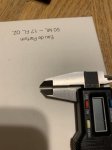
I think my caliper has a flaw on it- the tip of the top jaw doesn’t come to a complete point.. I’ll attach a picture. Might have to return to Harbor F


So you don’t think she’ll need an increase just keep her at the dose she’s at. Do you think her higher numbers are a result of my giving some carb food today in her meals, or did she drop and it bouncing again.
When will her little body know to not bounce and just chill out. :( it’s like every time she gets a good number it lasts a cycle. Is it just her pancreas learning to work properly again and it simply takes time? Could she have been pre diabetic for years before and maybe she’s had diabetes longer than I knew before diagnosis. I think her bladder surgery put some stress on her body and activated the diabetes that was waiting to happen.
 
If you zoom in the very tip of the top jaw doesn’t have a distinct point- it almost looked like the got chipped off somehow and it’s always looked like that.
 

Attachments

  • AAE8203F-1F6A-4A72-93CE-860241D136C2.jpeg
    AAE8203F-1F6A-4A72-93CE-860241D136C2.jpeg
    34.2 KB · Views: 65
Back
Top