
Marycatmom
Member Since 2014
Mikey is helping me with my school work this morning. He is positive that I am unable to use the stapler unsupervised.



DON'T PANIC! or HOW TO HANDLE LOW NUMBERS
First, try to not panic. Post to the Lantus Insulin Support Group or on the Health Board. Make sure your subject line indicates you are concerned about a possible hypo and/or add the 911 icon to the first post in your condo. People who are experienced in dealing with low numbers will be there to help. After posting, remember to refresh your browser periodically to see if people have replied.
It’s important to recognize that just because your cat may be experiencing low BG numbers doesn’t mean that your kitty is critically hypoglycemic. Many cats will have low numbers and never have symptoms. It’s important, though, to bring those numbers up into a safe range. ALWAYS make sure you have a stock of test strips, high carb (HC) canned food that contains gravy and is over 15% carb such as Fancy Feast grilled, marinated, or Gravy Lovers varieties (see Dr. Lisa's Cat Food Nutritional Composition List for a full list of options), and/or a simple sugar solution such as Karo/corn syrup, honey, maple syrup, etc.
If your cat is experiencing symptoms, especially if those symptoms are severe, you need to rub Karo syrup, honey, or maple syrup on the gums or, if symptoms are very severe, administer rectally and get your cat to the nearest 24-hour emergency facility. Take the bottle of syrup with you to administer on the way if necessary. (Note that it is rare that we see episodes of symptomatic hypoglycemia with Lantus and even rarer to see severe symptoms. But, you need to know what to do should they occur.)
The symptoms to be concerned about include but are not limited to:
staggering, uncoordinated movements, 'drunken' walk, wobbling, balance problems
ataxia - usually lack of muscular coordination, but maybe changes in head and neck movements
disorientation (yowling, walking in circles, etc.)
twitching
stupor
convulsions or seizures
coma
If your cat is testing in low numbers and you are not getting a quick response to your post, there are several things you need to do. (Low numbers are under 50mg/dL or 2.8 mmol/L.)
Depending on how carbohydrate sensitive your cat is, feed approximately a teaspoon or less of gravy from high carb food or high carb food only.
(If you have a cat with GI issues, using a couple of drops of syrup plus low carb food is an alternative.)
Test again in 15 – 20 min. Depending on the numbers, give more HC food.
Repeat the above steps every 15 – 20 min. until your cat tests in the 50 mg/dL (2.8 mmol/L) or above range for 2 consecutive tests. Continue to feed in small amounts to keep numbers in a safe range.
Test in 30 - 40 min. and repeat the test and feed process until there are 2 consecutive tests where numbers are stable or rising.
Test in an hour and follow the same steps.
DO NOT become complacent. If number have risen after one or two tests, it’s important to continue testing. Numbers may bobble up and down as the HC food and/or Karo wear off. DO NOT get one test where your cat has risen from low numbers into the 50s and go to sleep or leave the house. You are putting your cat in a risky situation. When in doubt, leave HC food out.
In the case of an accidental overdose or should there be symptoms of hypoglycemia, even if you have caught this in the early stages, you may need to monitor for literally 16 or more hours. Lantus and Levemir are long acting types of insulin. This means if your cat is over dose, you will need to stay alert for hours in order to closely monitor and to keep your cat safe.
Please post your numbers. Those people who are helping you will not abandon you. In fact, they are staying up with you. The experienced people will even work in shifts to make sure your cat is safe and you have the support you need. Remember to refresh your browser to see new posts and keep posting so we know all is well.
~ written by Sienne and Gabby


julie & punkin (ga) said:There is one smaller dose than the 0.25u - 0.1u. You can look at the pictures on the New to the Group? sticky. I'm not sure what syringes you are using. Some syringes have a narrower barrel than others and are easier to draw up this dose. What brand do you have?
Would you look at those pictures and see if you can work at a dose of 0.1u? That is one drop. There are 2 ways to draw up that dose. One way is to draw up 1.0u, point the needle to the ceiling and try to "screw" the plunger and see if you can work out 10 drops. With some practice, some people can succeed at that. You'll have to be able to repeat the process a couple of times until you are confident you can leave 1 drop in the syringe.
Another way to do it is to take your syringe, press the plunger in hard (you're expelling any air) and while holding the plunger in, insert the needle into your insulin. Release the plunger and it will draw in a tiny drop. Remove the needle from the insulin and push the plunger to see if a drop comes out.
Jill & Alex (GA) said:here's a picture of 0.1 unit:julie & punkin (ga) said:Would you look at those pictures and see if you can work at a dose of 0.1u? That is one drop. There are 2 ways to draw up that dose. One way is to draw up 1.0u, point the needle to the ceiling and try to "screw" the plunger and see if you can work out 10 drops. With some practice, some people can succeed at that. You'll have to be able to repeat the process a couple of times until you are confident you can leave 1 drop in the syringe.
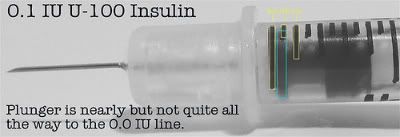
actually what julie has described here is considered "some" insulin. here's a picture of "some" insulin:julie & punkin (ga) said:Another way to do it is to take your syringe, press the plunger in hard (you're expelling any air) and while holding the plunger in, insert the needle into your insulin. Release the plunger and it will draw in a tiny drop. Remove the needle from the insulin and push the plunger to see if a drop comes out
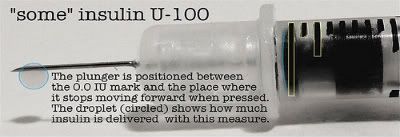
"some insulin" is just a little bit less than 0.1 unit. some people will eyeball it. others will press the plunger in and while holding the plunger in, insert the needle into their insulin. when the plunger is released it will draw in a tiny drop.
measuring tiny doses can be challenging, but hope this helps a little...

