julie & punkin (ga)
Member Since 2011
good morning sam!
glad to see Shivee's done ok. don't beat yourself up at all. as i said yesterday, many people arrive here in a crisis just like you. Most of us have made mistakes with our diabetic cats. When you saw symptoms, you did the right thing to bring her up and post here to learn how to keep her safe. We just move on from here. You can only work with what you know - now you've gotten familiar with testing and some ways to keep her safe. That's the important thing.
About testing her blood sugar - ears are often easiest, although the foot pads work well for some people. One thing that will help tremendously is to get some neosporin ointment with pain relief to ease the owie of the pokes. Some people put it on and rub it in about 15 minutes before they are going to test to numb it. I put it on afterwards and then wiped off any excess before the next test. It's very effective at numbing. You can also put it on at night and by morning the ears appear to be healed. When people begin testing, it's common to not get blood at first. It might take several pokes, or even then you might not get any. But the poking is doing some good - it stimulates the growth of capillaries in the ear and after about 2 weeks you'll get blood every time. Always give a treat when you test and soon Shivee will accept the testing without trouble. You can boil a chicken breast and dice it small (1/2" cubes), freeze most and keep a little out in the fridge to dole out. Some people buy freeze dried meats (no sugar) to give as treats.
One trick that people use if the cat is hard to handle is to scrape the blood drop off onto your fingernail and then test it from there.
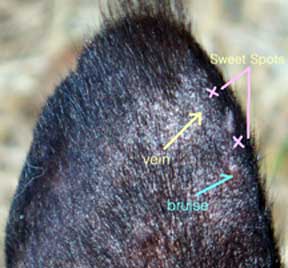
My previous computer died so i don't have all the resources i'd bookmarked in the past, but there is a diagram of a cat's ear and where to test that works best. Hopefully someone will post that for you. We test in between the vein that runs along the outside edge of the ear, starting about 1/2" down from the tip and going down about an inch. She may tolerate the ear testing better than the foot pads.
One other thing worth noting - cats that are newly diagnosed have an excellent chance at healing and becoming diet-controlled, ie, no longer getting insulin shots if their blood sugar is kept in non-diabetic cat numbers. Cats have the unique ability to have their pancreas heal and begin producing their own insulin again. You mentioned the problems you've got coming up with going back to college and having your family taking care of her in another month or so. I'd encourage you to read this page on the Tight Regulation Protocol, especially the PDF link about 5 paragraphs down from the top called "Management of Diabetic Cats Using Long-Lasting Insulin." Not every cat goes off, but many do. We'll have to wait and see what the consequence of yesterday will turn out to be, but I want you to have this information to look at now. That's the protocol that people on the Lantus/Lev Tight Regulation Insulin Support Group are following. There is a lot of good information on the top of that page that might be helpful to you as well - look for the posts with the yellow stars.
Do you have any questions?
glad to see Shivee's done ok. don't beat yourself up at all. as i said yesterday, many people arrive here in a crisis just like you. Most of us have made mistakes with our diabetic cats. When you saw symptoms, you did the right thing to bring her up and post here to learn how to keep her safe. We just move on from here. You can only work with what you know - now you've gotten familiar with testing and some ways to keep her safe. That's the important thing.
About testing her blood sugar - ears are often easiest, although the foot pads work well for some people. One thing that will help tremendously is to get some neosporin ointment with pain relief to ease the owie of the pokes. Some people put it on and rub it in about 15 minutes before they are going to test to numb it. I put it on afterwards and then wiped off any excess before the next test. It's very effective at numbing. You can also put it on at night and by morning the ears appear to be healed. When people begin testing, it's common to not get blood at first. It might take several pokes, or even then you might not get any. But the poking is doing some good - it stimulates the growth of capillaries in the ear and after about 2 weeks you'll get blood every time. Always give a treat when you test and soon Shivee will accept the testing without trouble. You can boil a chicken breast and dice it small (1/2" cubes), freeze most and keep a little out in the fridge to dole out. Some people buy freeze dried meats (no sugar) to give as treats.
One trick that people use if the cat is hard to handle is to scrape the blood drop off onto your fingernail and then test it from there.
My previous computer died so i don't have all the resources i'd bookmarked in the past, but there is a diagram of a cat's ear and where to test that works best. Hopefully someone will post that for you. We test in between the vein that runs along the outside edge of the ear, starting about 1/2" down from the tip and going down about an inch. She may tolerate the ear testing better than the foot pads.
One other thing worth noting - cats that are newly diagnosed have an excellent chance at healing and becoming diet-controlled, ie, no longer getting insulin shots if their blood sugar is kept in non-diabetic cat numbers. Cats have the unique ability to have their pancreas heal and begin producing their own insulin again. You mentioned the problems you've got coming up with going back to college and having your family taking care of her in another month or so. I'd encourage you to read this page on the Tight Regulation Protocol, especially the PDF link about 5 paragraphs down from the top called "Management of Diabetic Cats Using Long-Lasting Insulin." Not every cat goes off, but many do. We'll have to wait and see what the consequence of yesterday will turn out to be, but I want you to have this information to look at now. That's the protocol that people on the Lantus/Lev Tight Regulation Insulin Support Group are following. There is a lot of good information on the top of that page that might be helpful to you as well - look for the posts with the yellow stars.
Do you have any questions?