Just Diagnosed

Status
Not open for further replies.

Jacque- Tiger & Jazz Man

Member Since 2014
Hi, my cat's name is Sarah 10yrs. old. I originally took her to the vet's because of blood in her urine, the doc did a blood test and found out she has diabetes and aids. So, she stayed there for a week..doing the curve. Now she is on 8 units of PZI, twice a day and clavamox(kidney infection). Also, started her on Friskies Pate...2 cans a day. 1 of the posts that I read said I should lower the units since I changed her diet.
 
That is an awful lot of insulin. Most cats here are on about one unit. Did the vet tell you what her blod glucose number was? We generally assume that the number from the vet is inflated, due to stress, but even if she was in the 500s (which would be very high) that is an incredible amount for a starting dose. And yes, changing to wet low carb can bring down levels. Our Oliver came down 100 points overnight when we switched.

If she were mine, I would go out today and get a meter and start testing her blood glucose levels. Then you will know whether that dose is safe, and how low it is taking her during the 12 hour cycle. People here like the Walmart ReliOn meters as they are the best and least expensive and have the cheapest strips (strips are the most expensive part of this testing thing.). We can give you a shopping list and teach you how.

Here is our protocol for ProZinc

http://www.felinediabetes.com/FDMB/viewtopic.php?f=24&t=109077
 
She had a reading of over 400. She had an infection, maybe that was why it was so high. I'll go into town tomorrow and pick up supplies and stop at the vets to get a copy of her readings. A shopping list would be wonderful. I'm new to diabetes(human or pet).

I have a bunch of cats(free feeding), is there a best choice dry food..just in case Sarah sneaks some?
 
Here's the shopping list:

A human glucometer. Any one that sips and takes a tiny sample is fine. Some members stay away from any meter with True in the name and the Freestyle meters. Some people think they are unreliable and read lower than other meters. The meters are often free at drug stores; it’s the strips that are expensive. You can, however, buy them on ebay at less than half the price of stores. Lots of people here also like the ReliOn from Walmart. It is an inexpensive meter and its strips are the cheapest around. Try the meter out on yourself or someone else before you try it on your cat. You want to be familiar with it before you poke the cat.

Lancets and a lancet device. Usually, until the ears “learn” to bleed, a 26-28 gauge is good. Any brand will work as long as the lancets match your device.

Ketone strips. (Ketostix) Just like human diabetics use. You will sometimes need to test urine if the numbers are high.

Rice sack. Make this out of thinnish sock, filled with raw rice or oatmeal and then knotted. You heat this in the microwave until very warm but not hot. Then heat the ears before poking. You can also use a prescription bottle filled with very warm water. It provides a good surface to poke against.

Also nice to have. Flashlight: so you can look at the ears and find the little capillaries that come off the vein running down the ear. Vaseline: Put a tiny smear where you want to poke. It will help the blood bead up.

And some lo carb treats to give your kitty, successful test or not Lo carb treats

And to get your kitty ready:

First pick a place where you want to test. Some people use the kitchen counter, a blanket on the floor, between your legs while sitting – whatever works for you. Take the kitty there and give him/her lots of praise while you play with his/her ears. Give a treat and release. Next time, add the rice sack (thin sock filled with raw rice, heated in the microwave until very warm but not hot) or a prescription pill bottle filled with very warm water. Lots of praise, treat and release. Finally add the lancet so he/she will get used to the noise. The hope is that when you finally poke, they will be used to the process and know a treat is coming!

And a video to show you how we do it:

Video for hometesting

Let us know how else we can help. I am so glad you are going to test at home; it will give you a real feeling of confidence and control over what is happening.

 
You should always test before each shot, to make sure the dose you are planning to give is safe. And a test 5-7 hours after the shot will show you how the insulin is working, how low it is taking her. That's the best times to start with.

Your question about food. There are a couple of dry lower carb foods but wet is really best. A vet explains why here: http://www.catinfo.org If you could switch all your cats over to a wet low carb, you might prevent another of your kitties from becoming diabetic. Friskies pate is one of the low carb foods that is the least expensive.

40 is too low and requires intervention to bring up the number. 500/600 are very high numbers. 200 is a good preshot number for a new diabetic and anything in the 50-100 range is a nice nadir.
 
ReliOn is a WalMart brand.
The specific meter names are:
Confirm - takes the smallest blood droplet with the 2nd least expensive test strips
Prime - takes a slightly larger blood droplet and has the least expensive strips
 
Hi JK and Sarah,

For a Relion meter, I suggest the Confirm or Micro. Although the Relion Prime is less expensive, it takes twice the amount of blood, and I have heard some very bad things about its reliability. The Confirm and Micro are the meters that Diabetic Cats in Need supports.

I see Sue commented on the extremely high level of PZI that your vet has Sarah on. 8 units BID :shock: could result in a severe hypoglycemic (low blood glucose--BG--level) event, which can result in death or permanent brain damage.

If Sarah were mine, I would cut her insulin dose immediately down to no more than 2 units (and probably to 1 unit) and immediately start testing her BG levels. And I WOULD NOT have changed her high carb level food until I cut the dose and started home testing. BG vs. food carb load is a balancing act--scales of justice, if you will--and dropping carb load in her food without lowering her insulin dose increases the chance of a hypo.

Yes, an infection can lead to high BG levels. It may even be the sole cause of transient hyperglycemia. This is an article in the Pets with Diabetes Wikia that explains the different numbers. http://petdiabetes.wikia.com/wiki/Blood_sugar_guidelines. The Wikia also has articles on hypoglycemia (http://petdiabetes.wikia.com/wiki/Hypoglycemia) and on rebound, which creates high BG numbers when the insulin dose it too high (http://petdiabetes.wikia.com/wiki/Somogyi_rebound).
 
Good morning and welcome to FDMB.

You have received some great advice. I also agree with Venita that you should drop the dose back to 1 (preferred) or 2 units and not change your diet until you do. 8 units is very high and we do not want you to risk Sarah becoming hypoglycemic. It is better to start at a low dose and then gradually, over a period of weeks, increase the dose if needed. It is very rare that any cat would need that high of a dose unless there are other medical conditions present that would require that amount.
 
Hello to you and to Sarah, and welcome to FDMB. :smile:

As others have said, that 8 units is a very high dose. Was that the starting dose???

If you could learn to hometest that would help you and Sarah enormously.
Hometesting isn't hard to learn (though it may take you a few goes to get the hang of it), and it shouldn't hurt Sarah because there are very few nerve endings in the outer edge of the ear. Many of us reward our cats for tests with low carb treats or a wee cuddle, and it's amazing how quickly the cat can learn to associate tests with nice things. cat_pet_icon

Here is a link to a page of pics and info about hometesting. I learned to test from this page.
http://www.sugarpet.net/bloodtst.html

Would you like to tell us your name?

Eliz
 
Thanks to everybody for your advice. The vet started her on the 8 units since Thurs. April 10th, she seems to be fine. I went to the Wiki Pet Diabetes page she is having none of the symptoms of Hypo.

She has always been on Friskies Pate and only nibbled on dry...she only has 2 teeth, so I don't think there would be a problem with sticking to the canned only diet without any possible side effects.
So, if I cut the units down to 1 or 2...tonight, would that be okay? Or should I wait until I get a meter?

She had a kidney infection(she's on Clavamox), and she tested positive for Aids.

I didn't get to the store today for a meter, though. Will order online a Relion Confirm through Walmart.
 
I just don't know. I wish you had a meter (know any diabetics who live nearby?) so you had some idea of her numbers before you reduced. Infections and sometimes meds raise blood glucose; i don't know the impact the FIV has on numbers. It's certainly true that we don't have any cats here on that high of a dose unless they have secondary, high dose conditions. But I hate to tell you to reduce when we have no idea of her numbers.

Any chance you could get a meter tonight and at least get one reading?

If you are going to reduce, you should also be doing regular ketone testing.. You need to pick up ketone strips at the store too.
 
Ok, So...I just called my Vet, and she said that Sarah is on 3.2 units not 8units. The 8 on the label means "8 on the syringe" so, I was giving you guys the wrong number, I'm so sorry. Please remember that I'm new to this. Again, I'm sorry for the confusion on my part. Have an appt. on Friday to check her numbers then.
 
That's a relief! 3.2 is still a higher dose but with her other issues, it makes more sense. Don't worry - this whole thing is complicated and overwhelming. We all were confused at first. I am not sure what 8 on the syringe means. Can you explain?

I would still pick up a meter and test her at home. The numbers are the vet are influenced by stress and higher than you'll get at home. So doses based on those numbers can be too high once she gets home and relaxes. And hometesting, is not only more accurate, but also will save you a lot of money. Once you get some home numbers, you can really see how the dose is working.
 
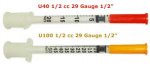
Are you using U-40 insulin syringes or U-100 insulin syringes? The U-40 syringes have a bright red end cap. The U-100 syringes have a paler orange end cap.


Does it look more like the top syringe or the bottom syringe?

What concentration is written on your bottle of insulin?
 

Attachments

  • u-40 and u-100 syringe pic.jpg
    u-40 and u-100 syringe pic.jpg
    5.5 KB · Views: 1,530
So if your bottle of insulin is labeled U-100 concentration, then if you are drawing up the insulin to the 8 mark on the syringe, you are giving 8 units of insulin.
 
not sure what the concentration is, the vet says its 3.2 units of insulin she said anymore than that it would kill her....when i took her in last monday her glucose was over 500, they did the curve thing...when i brought her home she was still high, the lower 400's
 
The only way the dose could be 3.2 units is if the insulin were U-40 being shot with a U-100 syringe, as you would multiply the U-100 syringe mark by 0.4 to adjust for the 40% concentration.

I think the vet may have missed the info on the PZI concentration being U-100.
 
It sounds like the OP and vet are trying to say it is a U40 insulin being administered with a U100 syringe. The conversion from U40 to U100 is 2.5.

3.2 units of U40 insulin times 2.5 = 8 unit mark on the U100 syringe.
 
Please check with your vet the following:

1) if the bottle says U-100 which means 100 units per milliliter (mL) - ask the vet if was this diluted in any way. If the answer is 'No dilution', then it is a U-100 insulin.

2) an orange capped syringe is a U-100 syringe, intended to be used with a U-100 insulin. When a U-100 syringe is used with a U-100 insulin, the number marking on the barrel is the number of units being given.

3) a red-capped syringe is a U-40 syringe, intended to be used with a U-40 insulin. When a U-40 syringe is used with a U-40 insulin, the number marking on the barrel is the number of units being given.

4) if you measure a U-40 insulin with a U-100 syringe, the number on the U-100 barrel is multiplied by 0.4 to obtain the dose of the U-40 insulin. We have a conversion chart for this so you don't have to do math. The short version is that every half unit tick mark on a U-100 syringe only measures 0.2 units of a U-40 insulin.
 
BJM said:
Please check with your vet the following:

1) if the bottle says U-100 which means 100 units per milliliter (mL) - ask the vet if was this diluted in any way. If the answer is 'No dilution', then it is a U-100 insulin.

2) an orange capped syringe is a U-100 syringe, intended to be used with a U-100 insulin. When a U-100 syringe is used with a U-100 insulin, the number marking on the barrel is the number of units being given.

3) a red-capped syringe is a U-40 syringe, intended to be used with a U-40 insulin. When a U-40 syringe is used with a U-40 insulin, the number marking on the barrel is the number of units being given.

4) if you measure a U-40 insulin with a U-100 syringe, the number on the U-100 barrel is multiplied by 0.4 to obtain the dose of the U-40 insulin. We have a conversion chart for this so you don't have to do math. The short version is that every half unit tick mark on a U-100 syringe only measures 0.2 units of a U-40 insulin.
So, according to the math and the color of the syringe...she must be on U-40 insulin with a u-100 syringe, because i draw out to the 8
 
Venita and Ennis93 said:
It sounds like the OP and vet are trying to say it is a U40 insulin being administered with a U100 syringe. The conversion from U40 to U100 is 2.5.

3.2 units of U40 insulin times 2.5 = 8 unit mark on the U100 syringe.
yeah, i thinks that it....I read on Diabetic Cat Help that vets almost always prescribe u40 insulin because of the small doses
 
I'm saying to verify this with your vet and make sure that is the case.

If it is a U-40 insulin with a U-100 syringe then the following is true:
U-100
mark * 0.4 = U-40 dose
1.0 * 0.4 = 0.4
2.0 * 0.4 = 0.8
3.0 * 0.4 = 1.2
4.0 * 0.4 = 1.6
5.0 * 0.4 = 2.0
6.0 * 0.4 = 2.4
7.0 * 0.4 = 2.8
8.0 * 0.4 = 3.2
 
Sue and Oliver (GA) said:
Interesting. We do have lots of PZI users who use U100 needles but we see few vets who do. [/url]

True, Sue. In facts lots of vets discourage it because of the confusion it can cause.
 
My 11 yo calico was diagnosed the other day and has spent the night at the vet's to get her therapy underway. She wasn't eating for them yesterday so had to be force-fed to get her started. They told me this morning that she did eat on her own last night and were waiting for the first test and injection of the day. I was told to use the Purina D/M, but after reading several pages of reports have decided to return it and switch her and my other cats over to an all wet diet. The home testing will be done, but have to admit being a tad overwhelmed with all the info and possible complications of "getting it wrong". Good to know there is this forum to get real advice and tips on how to manage this new development. Does anyone here feed any dry food at all, or is the switch to wet food pretty universal?
 
Kay, I am going to start a new thread for you. You could get lost here. When you want to post, choose ""New Topic". Look for a thread "New Diabetic kayb" with a star next to it.
 
I'm nervous today, taking Sarah to the vet's at 4 to check on her numbers and to see if the insulin should be changed....hoping I can take her off of it since I've been feeding her ONLY Friskies Pate, Pray for us, Please
 
Sending good vet visit vines for Sarah! Please keep us posted!

We started using u100 syringes to dose the u40 ProZinc and after seeing our spreadsheet and how Eddie was responding to much smaller increments, our vet actually started prescribing u100 syringes with the conversion chart to her new ProZinc patients.
 
Seven hours or so after Sarah's injection should be roughly nadir, or the peak of the insulin cycle - when blood glucose is lowest. Have you had a chance to get a meter for home testing yet? Spot checks at the vet can unfortunately be misleading as to what's happening during the course of a cat's cycle. A lot of them will have higher numbers due to "bouncing" or "rebound" and spot checks will miss the lower numbers that they are experiencing. When we first started with Eddie, our vet was raising his dose based on spot checks as well, and it looked like his BG was going higher, not lower, despite raising his dose. We started to home test and quickly found out that he was dropping quite low during his cycle, and the higher numbers we were seeing were due to rebound spikes. Keep us posted!
 
Status
Not open for further replies.
Back
Top