Introducing the fabulous Fitzel and her mommy

Status
Not open for further replies.
Hello all: my name is Shai and I am the life-time guardian of the fabulous Fitzel. She fabulous for so many things, not the least of which is she is the last kitty my mom adopted from the big wide world before she died. Fitz was one year old at the time, she's now 12 and one of my most precious inheritances.

She was diagnosed a diabetic about 9 weeks ago and is on 1 unit of insulin moring and night. When she was first diagnosed she weighed only 6 pounds - in the ensuing weeks she has returned to her normal weight of 7.8 pounds. She's back to playing with her much younger sister and brother (4 and 3 respectively)

However, when I bring her to her vet for a blood glucose test she's coming in way low. (55 two weeks ago and 46 last Friday). When her first test came back so low I was advised to decrease her insulin to 1 unit in the morning when she's most active, and to .75 at night. She deteriorated rapidly - drinking excessive water, throwing up, hiding. The decrease was handled over a period of 3 days. (the best I could considering it's all by sight). I was told to go ahead and return her to 1 unit at night. She recovered very fast.

However, her test last Friday came in at 46. So, now I need to do an every two hour glucose test on her starting before her first shot in the morning and going up to her night shot. My vet showed me how, but I'm nervous about doing this right and am trying to find a video to walk me through it again. I purchased an Ultra One Touch Mini and am a bit overwhelmed with the directions and coding, etc. I have the control solution and all the acutraments.

I guess, ultimately, I'm looking for support. This kitty is my special, precious girl. I know you all understand this amazing priviledge and feeling.
 
Good for you for deciding to home test and getting all the equipment.

Some hints for testing.
Have treats ready - lo carb, like freeze dried chicken.
Warm target ear with rice sock (rice in a thin cotton sock, microwaved for a few seconds to be warm) or moist cloth in a baggie.
Massage ear gently to stimulate blood flow.
Give treat.
Put strip in metre, get lancet ready. Some use device, some use lancet free hand.
Pick ear - along the outside edge seems to work for most ears. Milk ear a bit if not enough blood. If cat is squirmy, pick up blood on your fingernail and give treats. Test blood.

What insulin are you using? It should normally be the same dose am and pm.
 
Did the vet rule out hyper-T? Apparently the symptoms for FD and hyper-T are similar in some respects.

There are two tests that need to be done. One a free-T and I don't know what the other one is, sorry.

How did the vet determine diabetes in the first place? And did you have any lab work done to check on Fitzels' kidneys (BUN and ... another test that I can't remember) Cechin I think.

I hope you get this puzzle straightened out.
 
Here's a video that may help: Video for hometesting The two things that made the difference for us were to use a lancet that would make a big enough hole (25-27 gauge) and to warm the ear so it was very warm.

Let us know how it goes; we all have tips that helped us.
 
If you tell us where you live (town, state, country only), there might be someone nearby who can help you to get started with home testing. And remember, the calmer you are, the calmer Fitzel will be.
 
hmjohnston said:
Did the vet rule out hyper-T? Apparently the symptoms for FD and hyper-T are similar in some respects.

There are two tests that need to be done. One a free-T and I don't know what the other one is, sorry.

How did the vet determine diabetes in the first place? And did you have any lab work done to check on Fitzels' kidneys (BUN and ... another test that I can't remember) Cechin I think.

I hope you get this puzzle straightened out.

Don't know if this helps, but I think this is what Heather was talking about:
http://www.lbah.com/word/hyperthyroid/
Diagnostic Tests
An important tool in the diagnosis of Feline Hyperthyroidism is a blood panel. We can sometimes detect the effects of the excess thyroid hormone on the internal organs by running a routine blood panel. This panel might show an elevation in the red and white blood cells. It is not uncommon to find elevated liver enzyme tests in cats that have hyperthyroidism. If the liver problem is secondary only to hyperthyroidism, it will usually resolve when we treat the hyperthyroidism.
In addition to this blood panel we run a specific thyroid test called a T4. Frequently this is all we need to make the diagnosis. Since thyroxine levels fluctuate, we occasionally need more sophisticated tests to make an accurate diagnosis.
A cat can have a normal thyroid test yet still have hyperthyroidism. This is because the thyroid hormone level fluctuates throughout the day or it might be early in the course of the disease. Also, these older cats can have other problems, which can suppress the production of the thyroid hormone. In these cats we will run a free T4 test.
Sometimes a T3 suppression test is performed. In a normal cat, the administration of T3 orally will cause the T4 levels to decrease, in a hyperthyroid cat they will not decrease or will only slightly decrease.
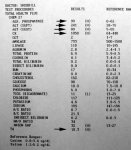
The arrows at the top point to the elevated liver enzymes tests in this cat. Note the arrow on the bottom pointing to the very elevated thyroid level.

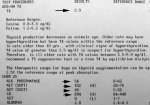
After 2 weeks of treatment the thyroid level (arrow at top) and liver enzyme levels (lower arrows) have shown a significant improvement.

You'll notice in the top chart, the glucose level is 98, which is "normal".

Carl
 

Attachments

  • t41.jpg
    t41.jpg
    20.3 KB · Views: 568
  • t42.jpg
    t42.jpg
    21.1 KB · Views: 560
Thank you all so much. I wanted support and feel like you've all come over for coffee or tea, comfy on our couches (with your kids purring sweetly on your laps) to help Fitzel and me through the tough beginnings.

To start, Fitzel had the hyper T test and her results were normal. I really appreciate the heads up, because if my vet hadn't brought the issue up I never would have.

Fitzel and I live in the San Fernando Valley, a suburb of Los Angeles. I actually live with my family in the house in which I was born. When I was in high school I dragged my parents into TNR (trap neuter and release). Our house is near a park where people love to dump pets they don't want anymore, or can't afford anymore. In their living trust my folks actually put down that a condition of inheritence was to continue to care for the kitties in the area - as well as the ones in the house who survived them.

I've had many kitties through out my life with various ailments, but never diabetes.

I gratefully viewed the testing videos and adhered to the advise so generously given here before beginning what was going to be testing day. However, the only one with enough blood to test was me. While Fitzel will accept the insulin shots with no fuss, pricking her ears is an entirely different story. She's never had any issues with me stroking her ears during our loving up sessions, but taking a pin to one caused a reaction I've never seen from her. Ears flat back and claws out.

I have a needle which is large enough to get blood on the first prick, but she struggled so it smeared and became untestable. I tried again, once I could pry her ear up from her neck, to very much the same result. Fresh cooked chicken, which is my insulin shot secret weapon, was freely offered, and eaten. Her ear was warmed and gently massaged. All to no avail for testing. As I hadn't given her her morning shot, I abandoned my attempts for testing and gave her shot. For that she was a bit agitated, but took it in her usual calm manner. Right now she's sound asleep by my side with her head on my knee.

I'm going to try again this afternoon, but I'm concered about the same result, and I don't want to make her so agitated that the shots will become an issue.

I would love some hands on help with this, but I'm alone during the day as spouse is at work.

Anyone here with a similar first time story? Any ideas other than the wonderful ones already offered?

I'm a bit at a loss.

much love sent to all: Shai
 
Are you using a lancet or a needle? We use lancets, the same little pokers humans use. Although we use a 25-28 gauge in the beginning (rather than the 31 gauge used by most humans) to make a bigger hole.

Are you sure offering a treat she likes? At first, we had to wrap Oliver in a kitty burrito with only his head showing (Towel wrapping around him) and we gave treats while poking. He ate the treats and we poked. Later, after he was used to it, we gave him the treat after and he knew to hold still because the treat was coming.

This is all about you finding what works for you and Fitzel - where to sit, how to hold her, what treats and when. It may take some time to figure out what she responds to. But don't despair. Those lovely kitties in the videos weren't that compliant at first; it takes time. Give her a treat every time, successful or not. Three tries and she gets a treat and gets to leave. And anytime you get blood and she is ready to escape, you can get the blood on your fingernail and test it from there.

Everyone will have tips that worked for them. You can try them all and see what works for you.
 
Hi Sue - I'm using a sterilized pin - the lancets I got are too thin (31). Maybe I should purchase some larger ones today. Should I use the lancet in the device or do it by hand? I'm worried that if I use the device it will puncture her ear all the way through.

No problems with the treats. She adores cooked chicken. She even ate some during our session while she was growling at me.

I like the three times and out suggestion - this takes the onis off both of us. And if not successful soon, I'll try the towel.

Thank you!!

shai
 
We liked the lancet device; some people like to free hand. Another one of those "what works best for you" things. Yes, I would get the larger gauge ones. Are you putting something behind the ear to poke against? We used a small make up sponge; other people like folded up kleenix.
 
I used a cotton ball and freehanded the lancet. Some people use an old pill bottle with warm water in it. Don't worry about poking all the way through. At times you'll do that whether you use the device or not.
Carl
 
Went to purchase larger gage lancets at Costco and they were out. They called around to other warehouses close by - but no go. They're going to get some in by Friday, but I think I'll try again with the sterilized pin.

My vet did the puncture w/o anything behind her ear - I think this will be a big help to me and warming something soft in the microwave sounds good. We have a warmy toy for our youngest kitty - Hobson - who's now three and 22 pounds of pure muscle (our vet is astonished every time he sees him) but still loves his warmy toy to sleep with. I'll borrow it. Shhhhhh.....

Thank you sue and carl, debby, just as appy (do you also have a horse?) and hmjohnston.

Didn't get to try this afternoon, so I'm going to try again tonight. Fingers crossed.

shai
 
I haven't had a diabetic cat in 4 years, but here are the testing tips from when I had a "sweet" cat:

1. Pet your kitty and massage the ear while you are petting him or use a rice sock to warm his ears.

2. Find a place with good light to do the testing. I used a section of my kitchen counter because it's a good height and has under cabinet lights. Put a towel down on the counter. Some people get the cat in between their legs while kneeling on the floor. Others use a couch or chair and put the cat between them and the arm. Others test in their lap. I sometimes tested Maggie in her bed.

3. Set out everything you need before getting your cat. I put the tesing strip part way into the meter, cock the pen.

4. Put a very thin smear of vaseline on the ear to help the blood bead up and not flow into the hair. I would talk to her and tell her she's being a very good girl.

5. Put something firm behind the ear - I used a waded up paper towel. It gives a firm base to work on, and keeps you from getting poked. It's handy to put light pressure on the spot after it bleeds. A little pressure will stop the bleeding and reduced bruising.

6. Most lancet pens have adjustment for depth. I started with it almost at the deepest. I worked down to the next to the smallest. Some people don't use the pen, they use the lancet free-hand.

7. Hold the ear firmly or you'll get the dreaded "ear flick" that send little spots of blood all over!

8. Some people use their fingernail to "scoop" up the blood drop, and test from the nail.

9. Don't forget the treats!


It takes time to get the technique down that will work the best for you. And If you're tense, your cat will be tense. So breathe and try to relax. Don't give up. After a while it will become second nature. And Maggie would actually purr during her test, so I know it didn't hurt her. The thing she disliked the most seemed to be holding the glucometer up to her ear - I think it tickled.

Oh! I would limit testing to 4 attempts. If you haven't gotten a reading, consider giving a reduced dose or try later.
 
Thank you Debby! I wrote down your excellent pointers, as well as the ones from other responses.

I wanted to update Fitzel's condition. Last night she had a hypo episode. Luckily I recognized it and was quick with the Karo. She came out of it pretty fast. I fed her protein and she ate, but I stayed up with her until 5am. I called my vet at 9am and made an appointment. I'm am blessed with this wonderful Vet!!!!

He checked Fitzel out and took blood. Her number was 73 and he felt that was okay. He told me to decrease her insulin to .75 in the morning and evening and see how she is. He gave me several of the needles he uses to poke her ear. I did it in his office and it worked! YEAH.

But, he also felt that Fitzel has had enough poking stress for a day or two and felt that unless I notice anything out of her ordinary behavior, to not do the twelve hour (every 2) test on her until Saturday. Right now, she's on my lap and sleeping.

To top off the good news from this emergency visit, my vet didn't charge me for his time, his office use, or the needles. And he gave me quite a few.

I'll be staying up with her again tonight (I'll have popcorn - she'll have roast beef treats). I hope she likes the Thin Man series of films because that's what'll be showing.

Shai
 
I know it is hard to hear advice that differs from your vet, particularly when you like your vet. But I disagree. 75 is a non diabetic number. And if it was at the vet, it is likely that it was lower than that because of vet stress. If you don't test before each shot, you have no idea how low she might be. Even .75 could be dangerous if she is in double digits. The "stress" of testing is nothing compared to the stress and possible dangers of a hypo.

It looks like your kitty may be headed off insulin. The only way to safely get her into remission is to test and adjust doses or withhold insulin based on those numbers. Shooting blind when her numbers are lowering is very dangerous.

Just for a reference, a cat off insulin ranges from 40 - 120.
 
Status
Not open for further replies.
Back
Top