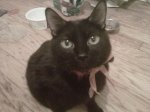
This is my kitty, Kisa. He's 7 years old as of this posting, born September 8th, 2006. A year ago, he weighed in at 16 pounds, and the vet ordered me to get his weight down. He's now down to 9. He was diagnosed diabetic about a week ago, as of this posting, and he's a lot bigger than the picture makes him look. Also, the brown highlights in his fur really only show up under very bright light, otherwise, he looks jet black. Anyway, I'll be giving periodic updates as he's tested, I'll be learning how today

You are using an out of date browser. It may not display this or other websites correctly.
You should upgrade or use an alternative browser.
You should upgrade or use an alternative browser.
Introducing Kisa
- Thread starter Derek
- Start date
- Status
- Not open for further replies.

Sue and Oliver (GA)
Member Since 2009
Welcome Kisa and Derek. He is beautiful! We'd love to help you both.
We have a very successful protocol for feline diabetes:
1. A slow, long lasting insulin. Lantus, Levemir and ProZinc are popular as they have a slow onset; they are not harsh and they are easiest to use for regulation. Humulin and Canninsulin are less popular because, in most cats, they have a rapid onset and don’t last as long. We like new diabetics to start low and go slow. That is, start at a low dose of .5 or one unit twice daily every 12 hours. And increase slowly, by .25 or .5 units as the numbers indicate.
2. A low carb, wet diet. We like to feed under 8-10% carbs. There are several food charts you can use: Dr. Lisa’s food chart
Hobo’s Food Chart Rhiannon’s 8% and under list
Whatever food you can afford that your cat will eat in that lower range. BUT do not change over to wet until you are hometesting. With our Oliver, the switch meant an overnight change of 100 points downward. If we hadn’t been testing and had given our usual amount., he could have hypoed.
2. And most importantly, hometesting. We think cats tend to be stressed at the vet
and we know stress raises blood glucose levels. So we test our cats at home. You want to know what the number is before you give the shot to be sure the amount you are planning to give is safe. And testing midcycle will show you how the insulin is working. We use human glucometers and test on their ears or paws. Here is a video that shows you how it is done: Video for hometesting
Read and reread. There is great info on this site. Let us know how we can help
We have a very successful protocol for feline diabetes:
1. A slow, long lasting insulin. Lantus, Levemir and ProZinc are popular as they have a slow onset; they are not harsh and they are easiest to use for regulation. Humulin and Canninsulin are less popular because, in most cats, they have a rapid onset and don’t last as long. We like new diabetics to start low and go slow. That is, start at a low dose of .5 or one unit twice daily every 12 hours. And increase slowly, by .25 or .5 units as the numbers indicate.
2. A low carb, wet diet. We like to feed under 8-10% carbs. There are several food charts you can use: Dr. Lisa’s food chart
Hobo’s Food Chart Rhiannon’s 8% and under list
Whatever food you can afford that your cat will eat in that lower range. BUT do not change over to wet until you are hometesting. With our Oliver, the switch meant an overnight change of 100 points downward. If we hadn’t been testing and had given our usual amount., he could have hypoed.
2. And most importantly, hometesting. We think cats tend to be stressed at the vet
and we know stress raises blood glucose levels. So we test our cats at home. You want to know what the number is before you give the shot to be sure the amount you are planning to give is safe. And testing midcycle will show you how the insulin is working. We use human glucometers and test on their ears or paws. Here is a video that shows you how it is done: Video for hometesting
Read and reread. There is great info on this site. Let us know how we can help

KPassa
Member Since 2012
Welcome! :YMHUG: Kisa is a beautiful kitty!
I hope the learning session went well and you're on your way to home-testing. Most people around here use human meters since the test strips are a lot cheaper and more readily available than the pet meters and they're just as accurate (although they have a difference in numbers akin to Celsius vs. Fahrenheit). Depending where you live, we can give you some advice on inexpensive meters, for example, in the US, the Relion/Arkray brand is used by many as it's the cheapest for the test strips (where the price really adds up).
Here's another link to some more tips on ear-testing that might help you along.
And please let us know if you have any questions.
I hope the learning session went well and you're on your way to home-testing. Most people around here use human meters since the test strips are a lot cheaper and more readily available than the pet meters and they're just as accurate (although they have a difference in numbers akin to Celsius vs. Fahrenheit). Depending where you live, we can give you some advice on inexpensive meters, for example, in the US, the Relion/Arkray brand is used by many as it's the cheapest for the test strips (where the price really adds up).
Here's another link to some more tips on ear-testing that might help you along.
And please let us know if you have any questions.

Kim & Twice
Member Since 2013
Hello and Welcome Derek and Kisa. What a gorgeous kitty!
It's great to have you here and I am happy you found this site so quickly. I look forward to seeing your updates.
It's great to have you here and I am happy you found this site so quickly. I look forward to seeing your updates.
So nice to see everyone so welcoming, and complementary, of my kitty. The issue I'm having now is getting his ears to bleed at all. I started the testing yesterday, and have yet to get a single drop. I gave up after half a dozen contacts, as it was needlessly stressing him. Hopefully I'll get it today
Sue and Oliver (GA)
Member Since 2009
We say, three tries and then treats all round.
What size lancet? 25-27 gauge is usally best till their ears learn to bleed. Are you heating his ear? Very important at first for most cats. You can use the rice sack or fill a prescription bottle with very warm water. You can also double poke - a quick second poke to increase the hole. Where are you poking? Have you seen the picture of the sweet spot? Do you have something behind the ear to poke against? Some people use a folded kleenix; we liked a small make up sponge.
You'll get your technique down. Just try a couple times, then treats and a break.
What size lancet? 25-27 gauge is usally best till their ears learn to bleed. Are you heating his ear? Very important at first for most cats. You can use the rice sack or fill a prescription bottle with very warm water. You can also double poke - a quick second poke to increase the hole. Where are you poking? Have you seen the picture of the sweet spot? Do you have something behind the ear to poke against? Some people use a folded kleenix; we liked a small make up sponge.
You'll get your technique down. Just try a couple times, then treats and a break.

RobinCot
Member Since 2013
Hi Derek
Sue gives good advice about warming the ear. I use a rice sock which is uncooked rice kernels tied up in a baby sock or other thin sock. Pop it in the microwave for 30 seconds and then use it to warm the ear. The ear will learn to bleed, capillaries will be more prominent there after some time of poking. The rice sock was a real help to me. I barely have to jab now and get plenty of blood for a test.
and then of course
That's really important because your cat can tell when you are stressed. KPassa provided a great link that really helped me when I first started. You will get the hang of it in no time.
Welcome!
Sue gives good advice about warming the ear. I use a rice sock which is uncooked rice kernels tied up in a baby sock or other thin sock. Pop it in the microwave for 30 seconds and then use it to warm the ear. The ear will learn to bleed, capillaries will be more prominent there after some time of poking. The rice sock was a real help to me. I barely have to jab now and get plenty of blood for a test.
and then of course
Sue and Oliver (GA) said:We say, three tries and then treats all round
That's really important because your cat can tell when you are stressed. KPassa provided a great link that really helped me when I first started. You will get the hang of it in no time.
Welcome!

Wendy&Tiggy(GA)
Member Since 2011
Hello and welcome to the board!
What food are you feeding? Are you currently giving insulin? we can help more if we know this.
Take a look at Kays tip link - there are a lot of good ideas in there for testing but the key things are a warm ear, something behind the ear to press against, big lancets. Are you free handing the lancets or using the tool?
Wendy
What food are you feeding? Are you currently giving insulin? we can help more if we know this.
Take a look at Kays tip link - there are a lot of good ideas in there for testing but the key things are a warm ear, something behind the ear to press against, big lancets. Are you free handing the lancets or using the tool?
Wendy
I was given a list of foods by the vet that were good, and told high protein was desirable. So he's getting Friskies wet food, flaked with tuna or flaked with tuna and egg. I try between 3 and 6 attempts, then I just give him his insulin. I do watch him after to make sure he doesn't react badly, Periodically call him and make sure he's alert, since I can't check his sugar. I've tried heating, tried near the sweet spot of the ear, in both ears, inside and out. Earlier today when the sun was out I could see the red spots where he'd been jabbed, but not one of them produced even a single drop of blood
Ok everyone, I have good news and bad news. I got blood today. That's the good news. The bad news is, it wasn't a full drop, at least not enough to test on. But I have the general feel of where to get him, and I think changing the setting on the lancet will get a drop tonight
Sue and Oliver (GA)
Member Since 2009
Hurrah! Welcome to the Vampire Club. Blood is a start. Any time you get some but the cat is moving away etc, you can get the drop on your fingernail and test from there.

Wendy&Tiggy(GA)
Member Since 2011
The food sounds good - Friskies pates are low carb and that can help cats into remission. Sooner you get the hang of testing the better.
What size lancets are they? Bigger the better for newbies. Also I second trying it without the tool. Or trying two small pokes beside each other.
Wendy
PS What kind of insulin is it do you know?
What size lancets are they? Bigger the better for newbies. Also I second trying it without the tool. Or trying two small pokes beside each other.
Wendy
PS What kind of insulin is it do you know?
Wendy&Tiggy(GA)
Member Since 2011
Lantus is a great insulin.
Chances are those lancets are 30 or 33g - too fine to start out with. You want something thicker like 28g.
A few tips
- the ear must be really warm
- when freehanding (no tool) go in a 45 degree angle - use 1 or 2 pricks in the same spot
- aim for the vein (use a flashlight if need be to see it)
- hold the ear firmly under the spot to help dam the blood and it to well up
- have something firm ( like a pile bottle lid) behind the ear to press against
- always give a treat
The ear will learn to bleed after about a week so don't give up!
Wendy
Chances are those lancets are 30 or 33g - too fine to start out with. You want something thicker like 28g.
A few tips
- the ear must be really warm
- when freehanding (no tool) go in a 45 degree angle - use 1 or 2 pricks in the same spot
- aim for the vein (use a flashlight if need be to see it)
- hold the ear firmly under the spot to help dam the blood and it to well up
- have something firm ( like a pile bottle lid) behind the ear to press against
- always give a treat
The ear will learn to bleed after about a week so don't give up!
Wendy
Sue and Oliver (GA)
Member Since 2009
I'm sorry you are struggling. Rest assured not everyone gets it on the first try. We poked poor Oliver all weekend before we got a drop. What finally helped was really heating the ear and having something to poke against. (we used a makeup sponge; some people use folded kleenix)
Just to check. Are you sure poking in the "sweet spot"?
Sweet spot see step 5
Have you tried double poking - a quick second poke in the same spot?
Just to check. Are you sure poking in the "sweet spot"?
Sweet spot see step 5
Have you tried double poking - a quick second poke in the same spot?
Wendy&Tiggy(GA)
Member Since 2011
lol! You are probably being too gentle.
What do you use to put behind the ear to press against?
What do you use to put behind the ear to press against?

Deb & Wink
Member Since 2013
Hi Derek and sugardude Kisa.
The rice sock is probably too soft to poke against. How about trying either a folded up tissue in several layers to protect your finger or a pill bottle lid or if you use a flashlight to see the area where you want to poke, you can poke right against that flashlight shining up to highlight the sweet spot.
When I first started out, I shaved a tiny patch on Wink's ears with a safety razor so I could see better. That blood drop just seemed to disappear in his long black ear fur and this helped me in the beginning. Something to think about. I also used a really bright light because my ageing eyes don't see as well any more.
The colder weather has set in and Wink's ears don't bleed as easily. Takes longer to warm them up and get the blood flowing too. So maybe try holding your rice sock on Kisa's ear a bit longer.
Keep trying. It's a learning experience and can take some practice to be successful every time. Most of us can do it still groggy, poor light, stumbled out of bed to test. You'll probably need a bit more time to become an 'ear poking pro' like us. Patience grasshopper.
The rice sock is probably too soft to poke against. How about trying either a folded up tissue in several layers to protect your finger or a pill bottle lid or if you use a flashlight to see the area where you want to poke, you can poke right against that flashlight shining up to highlight the sweet spot.
When I first started out, I shaved a tiny patch on Wink's ears with a safety razor so I could see better. That blood drop just seemed to disappear in his long black ear fur and this helped me in the beginning. Something to think about. I also used a really bright light because my ageing eyes don't see as well any more.
The colder weather has set in and Wink's ears don't bleed as easily. Takes longer to warm them up and get the blood flowing too. So maybe try holding your rice sock on Kisa's ear a bit longer.
Keep trying. It's a learning experience and can take some practice to be successful every time. Most of us can do it still groggy, poor light, stumbled out of bed to test. You'll probably need a bit more time to become an 'ear poking pro' like us. Patience grasshopper.
Wendy&Tiggy(GA)
Member Since 2011
I agree with Deb - you need something firmer like a pill bottle lid.
Are you free handing the lancet or using a tool?
Are you free handing the lancet or using a tool?
KPassa
Member Since 2012
If you're using the tool, you want to make sure it's flat against the ear, otherwise, the device doesn't poke deep enough, regardless of the setting.
Which device is it? Some are much better than others. I've used quite a few and my favorite is the Accu-Chek FastClix. You can buy the devices separately from the meters and I use that device with my ReliOn Prime because the lancing devices that came with my ReliOns are not that easy to use, are overly loud, and are harder to switch out lancets.
Which device is it? Some are much better than others. I've used quite a few and my favorite is the Accu-Chek FastClix. You can buy the devices separately from the meters and I use that device with my ReliOn Prime because the lancing devices that came with my ReliOns are not that easy to use, are overly loud, and are harder to switch out lancets.
Well, the good news is I finally got enough blood to test. The bad news is, either it was set too high, or I was too near the edge, because it punched through. So I'm gonna dial it back a setting or two to prevent that next time. Though it was good that I didn't have to milk it, it isn't worth hurting him over.
His rating was 445. Is that good, bad, or otherwise?
His rating was 445. Is that good, bad, or otherwise?
Sue and Oliver (GA)
Member Since 2009
Not great. We generally consider a cat regulated if they are in the low/mid 200s at preshot and in the 100s or below at midcycle (but not under 40 which is hypo territory.). 400s are an area where you want to be testing regularly for ketones.
I don't use Lantus so can't advise on dosing. You might start a new thread with your number and history (you could link to this thread) and ask for Lantus dose advice.
I don't use Lantus so can't advise on dosing. You might start a new thread with your number and history (you could link to this thread) and ask for Lantus dose advice.
KPassa
Member Since 2012
:RAHCAT Congratulations on your first successful poke and test! :RAHCAT
If you have the device set too high, it can also cause difficulties with getting blood. ohmygod_smile With Mikey, when I first started out testing, I got the best results on the 4th setting, then lowered it to 3 after about a week, then to 1 after that and it's been on 1 ever since on every device I've used.
What time was the 445? Was that right before you gave him a shot? What is your current dose? And keep practicing on that ear testing! It will get easier and it's all downhill from here.
If you have the device set too high, it can also cause difficulties with getting blood. ohmygod_smile With Mikey, when I first started out testing, I got the best results on the 4th setting, then lowered it to 3 after about a week, then to 1 after that and it's been on 1 ever since on every device I've used.
Derek said:His rating was 445. Is that good, bad, or otherwise?
What time was the 445? Was that right before you gave him a shot? What is your current dose? And keep practicing on that ear testing! It will get easier and it's all downhill from here.

PaulaF
Member Since 2013
Welcome! Kisa is most BEAUTIFUL!
I'm a new/returning member here - everyone here has excellent advice for you and Kisa. I don't think I would have survived when my kitty, PJ, was first diagnosed in 2004 w/o this forum.
Just take a deep breath and you and Kisa will be fine!
I'm a new/returning member here - everyone here has excellent advice for you and Kisa. I don't think I would have survived when my kitty, PJ, was first diagnosed in 2004 w/o this forum.
Just take a deep breath and you and Kisa will be fine!
KPassa
Member Since 2012
If you can, try to grab another test around 5 to 7 hours after the shot so we can see how low Kisa might be going. What dose is he on?
Since you're going to be getting a lot more successful tests in the future, ;-) here are some instructions for setting up a spreadsheet that we all use. And here is some help explaining how to use the spreadsheet.
As for testing, I always try to get at least 4 tests minimum each day:
Here is an example of a typical Lantus cycle:
One other thing that helped me out significantly when I first started testing was Wikipedia's Blood Sugar Guidelines so I knew what those numbers I kept writing down on my spreadsheet actually meant. :lol:
Since you're going to be getting a lot more successful tests in the future, ;-) here are some instructions for setting up a spreadsheet that we all use. And here is some help explaining how to use the spreadsheet.
KPassa said:Questions on understanding how to use the spreadsheet get asked a lot, so I thought I'd share a quick run-down of spreadsheet-specific terminology:
- Fur shot: when the syringe needle pokes through almost like a sewing needle through fabric and it is unknown how much, if any, insulin actually made it inside the cat. Usually detected by wet fur or the smell of insulin (it smells like band-aids or scotch or antiseptic). IT IS ALWAYS ASSUMED THAT THE CAT GOT THE INSULIN AND YOU NEVER GIVE ANOTHER SHOT. It is always better to miss a shot than to give too much insulin.
- AMS/PMS: morning (AM)/evening (PM) shot
- AMPS/PMPS: morning pre-shot test/evening pre-shot test (it's assumed the shot is given within 15 minutes or less of this test).
- +1, +2, +3...: How many hours after a shot, i.e. +1 would be one hour after their last PS (pre-shot) test
- BG/BS: Blood Glucose or Blood Sugar (numbers). Usually used in relation to testing and dosing and what "level" or "point" the cat is at. Used in a sentence: "Michelangelo's BGs have been high so I've been increasing his dose."
- AMBG/PMBG: morning/evening Blood Glucose. Used when no shot has been given at the regular shot time.
As for testing, I always try to get at least 4 tests minimum each day:
- AM Pre-shot test to know if it's safe to give a shot
- AM mid-cycle test, if possible (this one I sometimes skip because of work). It lets me know how the dose is working and how low Mikey might go
- PM Pre-shot test to know if it's safe to give a shot
- Before-bed test to see how low he might go overnight while I'm sleeping
Here is an example of a typical Lantus cycle:
Most cats don't follow this pattern exactly or even from cycle to cycle, but it'll give you a good idea of the direction the numbers are supposed to take (i.e. going up or going down).+0 - PreShot number.
+1 - Usually higher than PreShot number because of the last shot wearing off. May see a food spike in this number.
+2 - Often similar to the PreShot number.
+3 - Lower than the PreShot number, onset has started.
+4 - Lower.
+5 - Lower.
+6 - Nadir/Peak (the lowest number of cycle).
+7 - Surf (hang around the nadir number).
+8 - Slight rise.
+9 - Slight rise.
+10 - Rising.
+11 - Rising (one of the quirks of Lantus/Levemir: some cat's blood glucose numbers dip around +10 or +11... not to be confused with nadir).
+12 - PreShot number.
One other thing that helped me out significantly when I first started testing was Wikipedia's Blood Sugar Guidelines so I knew what those numbers I kept writing down on my spreadsheet actually meant. :lol:
Yesterday Night Pre-Feed: 367
Yesterday Night Post-Feed: 388
Morning Pre Feed: 162
Morning Post Feed: 282
I'm a little concerned, the lowest setting on the lancet gun isn't pricking him enough to draw blood, and the next lowest punches through his ear. I dunno if I'm too close to the edge or something, but it's stressful for me...he doesn't seem to mind it much, but it's upsetting to me. And I don't trust myself to do it by hand and not hurt him
Yesterday Night Post-Feed: 388
Morning Pre Feed: 162
Morning Post Feed: 282
I'm a little concerned, the lowest setting on the lancet gun isn't pricking him enough to draw blood, and the next lowest punches through his ear. I dunno if I'm too close to the edge or something, but it's stressful for me...he doesn't seem to mind it much, but it's upsetting to me. And I don't trust myself to do it by hand and not hurt him
Sue and Oliver (GA)
Member Since 2009
Try a double poke on the lowest setting? Do you sure have something behind the ear to poke against?
KPassa
Member Since 2012
Which lancing device are you using? I've used most of them and by far, the easiest one to use is the AccuChek FastClix. For me, I know how to poke with just the lancet or a lancing pen that uses regular lancets, but it takes me forever because I have to take the cap off the lancet, I have to actually see where I'm poking, I have to get it angled properly, I have to recap the lancet, etc.... It's like a 100 steps vs. the FastClix where it's already primed with 6 lancets and all I have to do is just press it against Mikey's ear, make sure by feel that the lancet hole is close to the edge of his ear, and then press a button and it's done. You don't have to buy a meter to get the lancing device (you can buy it separately), so I would suggest that if you're planning on sticking with a lancing device, invest in a good one!
(FYI: I reuse the lancets in my FastClix, so it takes me forever to go through a box of 100, which IIRC runs around $10. A box of 100 regular lancets might be cheaper, but I don't feel as comfortable reusing those as much or as often.)
(FYI: I reuse the lancets in my FastClix, so it takes me forever to go through a box of 100, which IIRC runs around $10. A box of 100 regular lancets might be cheaper, but I don't feel as comfortable reusing those as much or as often.)
Wendy&Tiggy(GA)
Member Since 2011
it will be more useful to us if you can give the times of tests in relation to the shot - that way we get a better idea of how the insulin is working.
Also I usually recommend 3- 4 tests a day
- always before the shot - this is mandatory as you don't want to shoot when too low. As a newbie this too low number is 200 but is reduced over time once you have the data to know if its safe.
- mid cycle - 5-7 hours after morning shot depending on your schedule. This is to see how low he is going. The low point "nadir" is what you base dose changes on since you don't want him dropping too low (under 50).
- before bed (2-3hours after Pm shot) to get an idea of what his overnight plans are. If this number is less than the pre shot test number you may want to set the alarm for a test a few hours later as this implies an active cycle.
Wendy
Also I usually recommend 3- 4 tests a day
- always before the shot - this is mandatory as you don't want to shoot when too low. As a newbie this too low number is 200 but is reduced over time once you have the data to know if its safe.
- mid cycle - 5-7 hours after morning shot depending on your schedule. This is to see how low he is going. The low point "nadir" is what you base dose changes on since you don't want him dropping too low (under 50).
- before bed (2-3hours after Pm shot) to get an idea of what his overnight plans are. If this number is less than the pre shot test number you may want to set the alarm for a test a few hours later as this implies an active cycle.
Wendy

Dyana
Member Since 2009
Hello Derek and Kisa, and Welcome 
You're doing a good job so far. Getting Kisa on an all wet diet and learning to test is important.
I would try to get a mid-cycle test whenever you can. You want to know how low the insulin dose is taking Kisa.
That would happen at the nadir, which with Lantus is generally around 5 to 6 hours after the shot is given.
If you get a test that is lower than normal for him, I would test again in 1 to 2 hours.
If you get a test that is under 100, I would test again in 1 hour, and post the number on this board.
If you get a test that is under 60, I would feed, and test again in 30 minutes, and post the number.
Those are just some general guidelines. If you're ever not sure or nervous about what to do, just ask.
You're doing a good job so far. Getting Kisa on an all wet diet and learning to test is important.
I would try to get a mid-cycle test whenever you can. You want to know how low the insulin dose is taking Kisa.
That would happen at the nadir, which with Lantus is generally around 5 to 6 hours after the shot is given.
If you get a test that is lower than normal for him, I would test again in 1 to 2 hours.
If you get a test that is under 100, I would test again in 1 hour, and post the number on this board.
If you get a test that is under 60, I would feed, and test again in 30 minutes, and post the number.
Those are just some general guidelines. If you're ever not sure or nervous about what to do, just ask.
Deb & Wink
Member Since 2013
The testing schedule needs to fit around all your other life and family responsibilities. Try to pick a time that will work consistently for you, as close to 12 hours apart as you can make the times. With most insulins, the test, feed, shoot cycle should all be in about a 15 minute timeframe. The NPH insulins like Novolin or Humulin need a slightly different schedule and order.
We always strongly encourage you to get that pre-shot test. You don't want to shoot the insulin if the number is too low.
Since we all live in different time zones around the world, we use a plus hour system so we are all on the same page as far as hours from the shot and understand how much time has elapsed. Shot time is hour zero, called AMPS for morning pre-shot test, PMPS for evening pre-shot test. The times are then counted and expressed as elapsed time from the shot.
One hour after shot = +1, 2 hours after shot = +2, 6 hours after shot = +6, seven and a half hours after shot = +7.5. So if you shoot at 9, then 10 would be a +1 for example. Some days you may end up shooting earlier or later. That is still hour zero, and the elapsed times are still counted in + hour increments. For example, you may not shoot until 10 am one morning. That is your AMPS and 11 am would be your +1.
Understand?
We always strongly encourage you to get that pre-shot test. You don't want to shoot the insulin if the number is too low.
Since we all live in different time zones around the world, we use a plus hour system so we are all on the same page as far as hours from the shot and understand how much time has elapsed. Shot time is hour zero, called AMPS for morning pre-shot test, PMPS for evening pre-shot test. The times are then counted and expressed as elapsed time from the shot.
One hour after shot = +1, 2 hours after shot = +2, 6 hours after shot = +6, seven and a half hours after shot = +7.5. So if you shoot at 9, then 10 would be a +1 for example. Some days you may end up shooting earlier or later. That is still hour zero, and the elapsed times are still counted in + hour increments. For example, you may not shoot until 10 am one morning. That is your AMPS and 11 am would be your +1.
Understand?
Wendy&Tiggy(GA)
Member Since 2011
It depends on your work schedule but i would do
8.30am test feed shoot
2-4pm mid cycle test (depending on whether you are home - otherwise do at weekends)
8.30pm test feed shoot
11pm before bed test
Wendy
8.30am test feed shoot
2-4pm mid cycle test (depending on whether you are home - otherwise do at weekends)
8.30pm test feed shoot
11pm before bed test
Wendy
I haven't been awake to do his mid-cycle tests, but here are his recent numbers:
303 7am, 11/13
285 7pm, 11/13
359 7am, 11/14 (I don't have 7pm numbers because I couldn't get blood after 4 tries)
349 7am, 11/15
225 7pm, 11/15 (No shot on this one, his numbers looked good by the range you told me)
350 7am, 11/16
289 7pm, 11/16
303 7am, 11/13
285 7pm, 11/13
359 7am, 11/14 (I don't have 7pm numbers because I couldn't get blood after 4 tries)
349 7am, 11/15
225 7pm, 11/15 (No shot on this one, his numbers looked good by the range you told me)
350 7am, 11/16
289 7pm, 11/16
Wendy&Tiggy(GA)
Member Since 2011
Those numbers aren't bad but of course we don't know if he is dropping too low. Or staying this high all day. Neither are good.
Can you get a before bed test at 9pm?
Wendy
Can you get a before bed test at 9pm?
Wendy
I've been informed by a woman at Petsmart that Kisa is, in fact, a Bombay.
On that note, here are his numbers. I haven't had the chance to do his mid cycles, it's been a very hectic week
334 7am, 11/17
321 7pm, 11/17
296 7am, 11/18
247 1pm, 11/18
349 8am, 11/19
176 10:30pm, 11/19
385 7am, 11/20
369 5:52 am. 11/21
280 7:04pm, 11/21
371 7am, 11/22
347 10:46pm, 11/22
294 7am, 11/23
424 7am, 11/24
300 7pm, 11/24
439 7am, 11/25
348 7pm, 11/25
On that note, here are his numbers. I haven't had the chance to do his mid cycles, it's been a very hectic week
334 7am, 11/17
321 7pm, 11/17
296 7am, 11/18
247 1pm, 11/18
349 8am, 11/19
176 10:30pm, 11/19
385 7am, 11/20
369 5:52 am. 11/21
280 7:04pm, 11/21
371 7am, 11/22
347 10:46pm, 11/22
294 7am, 11/23
424 7am, 11/24
300 7pm, 11/24
439 7am, 11/25
348 7pm, 11/25
Wendy&Tiggy(GA)
Member Since 2011
You always shoot at 7pm and 7am right? Are you shooting every 12 hours consistently? give or take 30 mins?
I assume you didn't shoot at 1pm on the 18th right?
Wendy
I assume you didn't shoot at 1pm on the 18th right?
Wendy
Wendy&Tiggy(GA)
Member Since 2011
Ok makes sense. Can I suggest though you test first then feed? We recommend no food for two hours prior to the shot because you don't want the preshot test influenced by food.. Because a food spike will make his preshot level look higher than it is and when the food wears off, he could suddenly drop too low. So all these numbers you have could just be the food spike.
I am interested in the night of the 19th.. I wonder how much lower he dropped that night. I would definately try and get another test in 2-3 Hours when you see a number under 200. And as a newbie I wouldn't shoot under 175 for now.
Wendy
I am interested in the night of the 19th.. I wonder how much lower he dropped that night. I would definately try and get another test in 2-3 Hours when you see a number under 200. And as a newbie I wouldn't shoot under 175 for now.
Wendy
The cold weather (and my unexplained nocturnal shift) have kept me asleep during the day, keeping me from doing mid cycle checks. There are a few gaps in my numbers, usually because even though I take his blood and do his shot, in the process of putting everything away, I completely forget to write down the numbers. I'm gonna start taking paper with me when I do it. Anyway, his numbers:
Forgot the morning numbers
160 7pm, 11/26
354 7am, 11/27
377 7pm, 11/27
326 7pm, 11/29
212 7am, 11/30
367 7pm, 12/01
247 8am, 12/02
12/03 = didn't get the numbers written down before I forgot them
369 8pm, 12/04
Forgot to write the numbers down in time on 12/05
359 10am, 12/06
367 10pm, 12/06
345 9am, 12/07
Couldn't get blood on first three tries
Forgot Numbers
294 8pm, 12/08
I'm trying to keep him up to date and get his numbers, even though I'm not posting everything daily.
Forgot the morning numbers
160 7pm, 11/26
354 7am, 11/27
377 7pm, 11/27
326 7pm, 11/29
212 7am, 11/30
367 7pm, 12/01
247 8am, 12/02
12/03 = didn't get the numbers written down before I forgot them
369 8pm, 12/04
Forgot to write the numbers down in time on 12/05
359 10am, 12/06
367 10pm, 12/06
345 9am, 12/07
Couldn't get blood on first three tries
Forgot Numbers
294 8pm, 12/08
I'm trying to keep him up to date and get his numbers, even though I'm not posting everything daily.
Sue and Oliver (GA)
Member Since 2009
We have a very useful Google spreadsheet that you can use to keep track of your numbers and share with us. Since your life seems a bit hectic right now, would you like me to set one up for you? If so, reply to my private message. It's at the top of the page "1 new message"
Sue and Oliver (GA)
Member Since 2009
Wendy&Tiggy(GA)
Member Since 2011
Thats great to see the spreadsheet. Really need to see some mid cycle numbers to know how the dose is working though.
Wendy
Wendy
- Status
- Not open for further replies.