Regarding your chart...
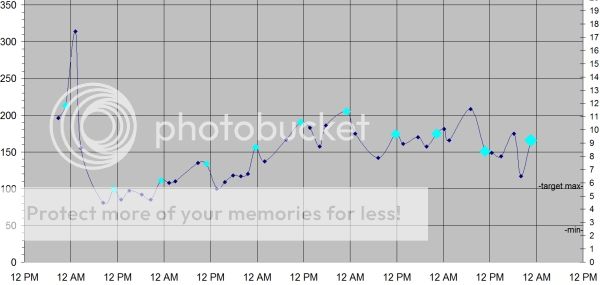
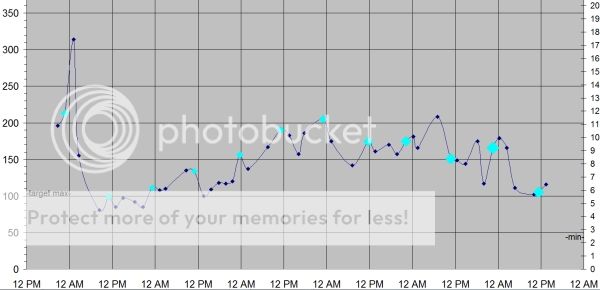
I have no problem if the chart is what works for you. As others have pointed out, it does have its drawbacks though. I can read it just fine. It just doesn't contain the information that I need in order to give you advice on dosage.
I can't tell where in the cycle the mid-cycle tests were taken in terms of how many hours after the shot. I'm guessing based on the space between your 12 hour marks, but all I can do is guess.
I can't tell what the dose is just by looking. I can tell that the bigger dots mean a bigger dose, but there's no scale to reference. They just get bigger.
I like charts and graphs. I personally don't feel that the way you are doing the recording of your data is as effective as the way people here use spreadsheets, but I guess that's because from a feline diabetes management point of view, my brain is "wired" to the way people here do it. This is the only site I've "used" since my cat got diagnosed so I don't have another way to compare "our way" to. `My cat was only on insulin for 10 weeks, and I used to jot his numbers down in a notebook and fax them to my vet. I never took the time to create a spreadsheet. I look at a spreadsheet, and my brain visualizes a "curve" much like what your chart shows. The only difference, I guess, is that with the times and dose amounts provided in the spreadsheets, the curve makes more sense in my head to me than yours does "on paper".
I don't really think the problem is with the way you are presenting your data. Rather, I think it's the perception you are giving people that "your way" is more "intellligent" and you seem to be insulting their intelligence with comments like these:
I think it is generally accepted (outside this forum anyway) that a graph usually presents data in a way which is easier and quicker to understand than a table of figures. In fact that is the point of graphs.
I suspect, from their problem understanding a graph curve or reading numbers off it, that they don't really understand why they are doing what they do, they just do it rigidly as if by rote.
Please if you can't read a graph do save your time and mine and don't comment, stick with your numbers.
I've no doubt that this forum has saved the lives of many cats but it is clear to me that a few members cannot read a graph. So I don't understand how they are interpreting their figures. If you cannot at least visualise figures as a graph you would have to sit down with a calculator and calculate rates of change and even then that would just be a figure and give you no proper conception of what is happening.
I can visualize figures taken off of spreadsheets as a graph, and I don't need a calculator to figure out the rates of change. I can do it in my head. I'm a geek. It isn't that I can't understand your graph. It's that your graph doesn't give me enough information, and the spreadsheets do. Actually, if I wanted to spend the time doing it, I could take someone's spreadsheet, download the data into MS Excel, create a graph, and plot it just like you have. But my graph would include the data I need to make sense of it.
But really, the problem isn't your graph or your data. The problem is the way you are using the Lantus. It's not effective. You need to do more research on how a basal insulin like Lantus acts on a cat vs. how it works on a human. More importantly, to understand what happens "inside the body" once you inject Lantus. It isn't well suited to be adjusted in dose every 12 hours. The "Tight Regulation Protocol" used here, adapted from the protocol used in the U of Q study, calls for holding a dose for a specific number of cycles for logical reasons, not just "because".
The other issue is that you seem to be expecting immediate results from a dose adjustment. Lantus doesn't work that way. Prozinc might, Humulin might, as they are shorter acting, shorter duration insulins, and there's not a "depot" to consider and once the insulin has run its course is less than 12 hours, there isn't a residual effect from prior doses to worry about.
There are only two things you have "control over" with this disease. Food and insulin. You can control how much, and when. What you can't control is "everything else" that has any effect over your cat's blood glucose on a day to day, or an hour-by-hour basis:
Serum glucose, at any single time point during the glucose curve, represents the sum effects in the *rate* and *amount* and *timing* of:
*Exogenous insulin absorption
*Endogenous insulin production
*Intracellular uptake of exogenous and endogenous insulin
*Insulin degradation and elimination - different for exogenous vs endogenous
*Intestinal glucose absorption
*Endogenous glucose production
*Tissue glucose uptake and utilization
and then throw in the amount of exogenous insulin....excess body fat....inflammation....subclinical infection....etc...etc....
That quote is from Dr. Lisa Pierson, a true expert on feline nutrition and feline diabetes management.
Any fluctuations you are currently seeing in BG levels could have something to do with the doses you're shooting. But they could also be due to all of the things Dr. P lists. By changing the dose every cycle or every day, you're removing one of the two "constants" at your disposal from the equation. So there's simply no telling what might be causing the numbers you're seeing.
Lastly (sorry for the novel, but it's "what I do") -
By insisting on doing things "your way" with the graph rather than the spreadsheet, what you're missing out on is the input from the people here who know the most about managing this disease. There are a lot of people here who use the same insulin you are using. And some have more knowledge and experience with this than you or I will ever have. None of them have posted here. It isn't because they don't care. The only thing people care about here is the welfare of your cat. I suspect they haven't chimed in because they simply don't have the time to readjust their way of thinking to accomodate the way that you are presenting your data. There's dozens of cats they help every day and they are only able to do that because their "beans" have no problem conforming to "FDMB standards" in order to get the help they want or need. So they aren't here telling you that it's too hard to wrap their heads around your charts and graphs. It isn't that they can't, it's that they don't have time to do so. They aren't stupid, they're just overworked and underpaid.
So if you really want help, put all your data into a googledocs spreadsheet, drop by the Lantus TR forum, and ask for advice. There's a point where "conformity" makes sense.
Carl