
Help!!

Status
Not open for further replies.

MamasBoBoMan

Member Since 2017
My baby clearly doesn't feel good because he hasn't touched his food this morning and although he seems to be acting OK you can tell he still doesn't feel well, and I have to leave work probably by the time most of you read this post, I don't know what to do or what this means, obviously it means his levels are high but I'm at a loss, but I did give him his insulin just now
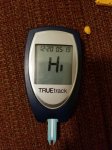
 

Attachments

  • 20171220_061738.jpg
    20171220_061738.jpg
    56.2 KB · Views: 82
Are you testing for ketones? Hopefully he's just feeling yucky from the high numbers, but any time a diabetic cat is acting "off" and not eating, ketones should be suspected and tested for. It's a good idea to test regularly anyway, but definitely in this situation. You test with little urine dipsticks (sold in human pharmacies with the diabetic supplies), dipping into the stream when he pees (if he'll let you), or else catching a bit of urine with a long-handled spoon or, if he's really bashful or you can't catch him in the act, putting a bit of plastic wrap in the litterbox.

Another possibility when a diabetic cat doesn't eat is pancreatitis. Let's see how he does today and see what the ketones test says first, though.

Hope he's feeling better by the time you get home. Did he eat last night at all?
 
Not sure if you're already at work, but what insulin are you using, and what dosage? Even though his numbers were hi this morning, I'm concerned about giving the shot with no food on board. If you haven't already left, I might try to tempt him with some old favorite foods, even if they are higher carb than you'd normally give him now that he's been diagnosed with FD.
 
Yes Unfortunately I have left just because it takes me an hour to get to work, which obviously doesn't set well with my nerves right now. He ate really good last night and his keytones were last tested at the vet on Saturday and they were negative, I didn't know that I could test at home since I'm new to all of this but thank you for the advice. I will certainly keep all of this in mind and continue my research, I'm gonna stay positive and do the very best that I can. He just started on Novalin N insulin on Sunday with 1.5 units twice A-day
 
Ah, good to hear that he ate well last night! That's a good sign, he probably just does feel a little yucky this morning from the high numbers. Hopefully he'll perk up and chow down soon. Next time, especially with an insulin like Novalin N, please do make sure he's eating before shooting-- it's an insulin that can have pretty strong action in a cat. It's tough when you have to go to work and the clock is ticking, I know. Is there anyone who can look in on him during the day, just to calm your nerves a bit?

Ketones testing is easy, and a good way to feel a bit more informed and in control of the whole situation. You're doing a great job already with testing BG!
 
Thank you for your kind words, it's hard being new and getting yelled over things you don't know anything about.

I might be able to ask my mother in law to go over and check on him but if there is anything that she can do then there wouldn't be much point( at least the vet said if it's too high then nothing can be done) but my husband will be home a couple hours before I will & he will make sure he is okay & loved on!
 
The early days are very hard and there's a huge information overload. Those of us who have been at it a while have to remind ourselves of this. Please keep asking questions whenever you're unsure of something. The fact that you're testing at home is great - many new people struggle with the idea of tackling that. :bighug:
 
Last edited:
I heartily second the recommendation to test daily for ketones. Don't delay getting him to see a vet for a check-up if he doesn't start eating today so as to make sure that ketones don't become a problem; with the high BG and poor appetite there is a significantly greater risk of ketone build-up because the cat's body can't metabolise food properly (and they can build up quickly).

As Nan says above, Novalin N has a fairly rapid onset and can significantly drop the BG levels in the early part of the cycle so it's really important that a kitty has food on board before giving the normal dose. If there are appetite issues along with high BG numbers there can sometimes be a need to give a 'token dose' (a reduced dose) so that the cat gets at least some insulin to protect against ketone problems. If I were in your situation I would call my vet today to discuss the possibility of giving a reduced dose in circumstances such as this, and also I'd ask what size that token dose should be.

The early days can be very tough indeed but try not to let it get you down. The vast majority of the members here knew little or nothing about FD when we first landed at the forum and we all recognise only too well that awful feeling of being incredibly overwhelmed and terribly scared. The learning curve is indeed steep, but we'll do all we can to help you both. And we have a bottomless supply of :bighug::bighug::bighug:.


Mogs
.
 
Last edited:
If your mother-in-law could check in on him today to see if he's eaten (and if not, try tempting him with something super-yummy), that would be good.

This does all get easier, really it does! It is so hard at first, and there is so much information to learn...
 
Thank you all very much, hubby says that he has eaten and is doing OK. I am on my way home now and will double check his food and his level prior to his insulin .

I purchased a new glucose meter today and should receive his new young again cat food tomorrow, so fingers crossed however I will not be started the new food until Saturday so I can wean & monitor him.
 
Test, feed, shoot.
When insulin is due per your schedule (you said 2x day - I assume 12hrs apart), do a test (to ensure not too low), feed (to ensure food on board for insulin) and shoot your dose. All within say a 5 to 15 minute window depending on how cooperative your baby is. :bighug::bighug:
 
For disposal - I'm in Austin TX. There are no rules. I put them in a plastic walled orange juice container. Then screw on the lid after 50 syringes in there, then put in the trash.
 
Thank you all! I gave him a little bit of a mixture last night both his MD dry food and some friskies pate, he had thrown up twice last night and level is backup to 536 this morning but other than that he appears to be doing OK. It just seems like he isn't used to the wet food so maybe it just upset his stomach.
 
Thank you all! I gave him a little bit of a mixture last night both his MD dry food and some friskies pate, he had thrown up twice last night and level is backup to 536 this morning but other than that he appears to be doing OK. It just seems like he isn't used to the wet food so maybe it just upset his stomach.
Please pay close attention to how he feels. A different food can cause tummy upset for sure but diabetic cats can develop ketones if their BG is high and they don't eat enough. Testing urine ketones at home is actually quite easy and is a good thing to monitor regularly but especially at times like this.

Would you consider setting up a spreadsheet like the one we use here? It's the best way we have to get the info we need to help you.
 
Should I wean him into wet food since it' upsetting his stomach? I got the young again food today but I feel like I should mix it before going straight to it... Don't want to overwhelm his body more than it already is... recommendations?
 
Yes, I would love that. I purchased ketones test strips last night with his new monitor but haven't been able to do it yet.
Here are the SS instructionS. If you need help there are people here who will do it for you - just ask. :)
http://www.felinediabetes.com/FDMB/threads/fdmb-spreadsheet-instructions.130337/

If you haven't seen this before, here are some ways of testing urine for ketones:

How to test for urine ketones at home:
  • put the end of the test strip right in his urine stream as he's peeing
  • slip a shallow, long handled spoon under his backside to catch a little pee - you don't need much
  • put a double layer of plastic wrap over his favourite part of the litter box and poke some depressions in it too catch pee.
Most test strips have to be dipped and allowed to develop for 15 seconds before viewing the colour change in very good light.
 
Should I wean him into wet food since it' upsetting his stomach? I got the young again food today but I feel like I should mix it before going straight to it... Don't want to overwhelm his body more than it already is... recommendations?
I don't have much experience with that but generally it's best to do a food transition slowly over a few days, gradually increasing the fraction of new food until it's 100% of the diet.
 
A new food in and of itself definitely can put a cat "off". The YA is somewhat notorious for giving cats the runs and tummy upsets as they get accustomed to it, so I second the notion of doing the food transition slowly. I wish I'd done that with my guy Tux, I switched him to the Catkins diet quickly and it ended up giving him tummy upsets and runs until he adjusted.
 
none whatsoever - test - feed - shoot all in 10 - 15 min.
NB:

While it may not be necessary to wait a while before administering insulin after feeding for 'gentler' onset insulins like Lantus, this is not the case for insulins like Novolin N which typically have a hard, fast onset: there really need to be some carbs 'on board' ready for the insulin to act on when using these insulins.

For info here's the FDMB guide to N/NPH insulins:

http://www.felinediabetes.com/FDMB/threads/beginners-guide-to-novolin-humulin-nph.186097/

The guide recommends waiting an hour after feeding before administering a dose of Novolin N (especially if there's limited BG data).

Caninsulin/Vetsulin's another insulin where one needs to wait a while after feeding before giving the dose (about 30 minutes).


Mogs
.
 
While it may not be necessary to wait a while before administering insulin after feeding for 'gentler' onset insulins like Lantus, this is not the case for insulins like Novolin N which typically have a hard, fast onset: there really need to be some carbs 'on board' ready for the insulin to act on when using these insulins.
Thank you Critter Mom for pointing it out - so true!

I believe the same goes for ProZinc and Vetsulin. Is that right?

A cat on any of these must be allowed to digest its foods well before the shot is administered. I read it was an hour - between eating a shooting? Is that right?
 
@Tanya and Ducia -

You definitely need to leave a delay after feeding before giving Caninsulin/Vetsulin (about 30 minutes - especially if the cat has a natural tendency towards early onset/nadir).

I don't know much about Prozinc/PZI insulins. To the best of my limited knowledge Prozinc typically tends not to tank BG the way that Vetsulin and Novolin N are wont to do but I think that I've seen mention here about waiting a little while after feeding before administering Prozinc (though I could just be imagining that! :rolleyes:). Hopefully someone with Prozinc experience will chime in below to give a more solid answer.


Mogs
.
 
@Tanya and Ducia -

You definitely need to leave a delay after feeding before giving Caninsulin/Vetsulin (about 30 minutes - especially if the cat has a natural tendency towards early onset/nadir).

I don't know much about Prozinc/PZI insulins. To the best of my limited knowledge Prozinc typically tends not to tank BG the way that Vetsulin and Novolin N are wont to do but I think that I've seen mention here about waiting a little while after feeding before administering Prozinc (though I could just be imagining that! :rolleyes:). Hopefully someone with Prozinc experience will chime in below to give a more solid answer.


Mogs
.
I had Teasel on ProZinc for over 9 months and I rarely waited more than 15 or 20 minutes after eating before shooting. It's also possible to inject as the kitty is eating if that works best as a distraction. ProZinc's (measurable by BG test) onset time is rarely much less than 2 hours.
 
Prozinc, Lantus, and Levemir are all engineered insulins with intentionally slow onsets. The way they release into the body is different for each one. However, they are all slow release. I dose Leo during his morning and evening feedings.
- One advantage to this is that he is distracted.
- Another advantage is that I know he is eating, and will have carbs onboard to work with the insulin.

As pointed out by others,
Novolin, Vetsulin, and Caninsulin are all fast onset, requiring food on board before injection.
 
I give Callie her injection just as she is finishing her food. I test while she is eating and by the time her syringe is filled, she has finished most of the food. It sure works for us. We used to use Vetsulin but changed to Prozinc to avoid the fast action.
 
Regarding food transition, I'm doing that now with Quintus -- slowly because he got the runs (and stepped in it because he is blind, and then stepped on my face while I was sleeping). There is a tab on his spreadsheet for the food transition, looking at it might help!
 
Status
Not open for further replies.
Back
Top