

Glucose still unregulated after two months. Am I doing something wrong?

It'sSunshineOverHere

Member Since 2026
Hello everybody. I am Sunny, I am new to the forum, but I've been using the feline diabetes subreddit since I got my eight year old kitty Boy. I've had him for two months and am starting to feel unsure and frustrated, and I was recommended this forum as a way to hear other people's experiences. I've read the sticky and hope I've followed the rules.

  • Boy is eight years old. He is not spayed and is an inside cat.
  • He is on ProZinc insulin. Shots given twice daily, food withheld three hours before.
  • He gets fed Bozita wet food exclusively, smaller meals every three hours. Bozita has a 0.5% carb content. Occasional treats are freeze dried minnows or chicken hearts.
  • All testing is done at home, glucose curves are done at home.
  • I'm european and glucose levels are measured in mmol in this post
  • His last vet visit was two weeks ago

I adopted him on the tenth of April, and the same day his insulin treatment started. I'm told that before I took him he had all the symptoms; rapidly losing weight, drinking entire water bowls, peeing extremely much, ravenously hungry, lethargic. His first vet visit his fructosamine was at 621. It is unknown how long he's been diabetic (his previous owner was an old lady who had to go into care, so she has not been able to care for him properly for a while) but they suspect a long time.

After I've started treatment, all these symptoms have reversed. He plays with toys, we go for walks, he pees three times a day and poops once like clockwork, he has entirely stopped drinking water from a bowl and instead gets all his water from the wet food. His fructosamine measured 420 last vet visit two weeks ago. Vet confirms he's a healthy weight and well hydrated.
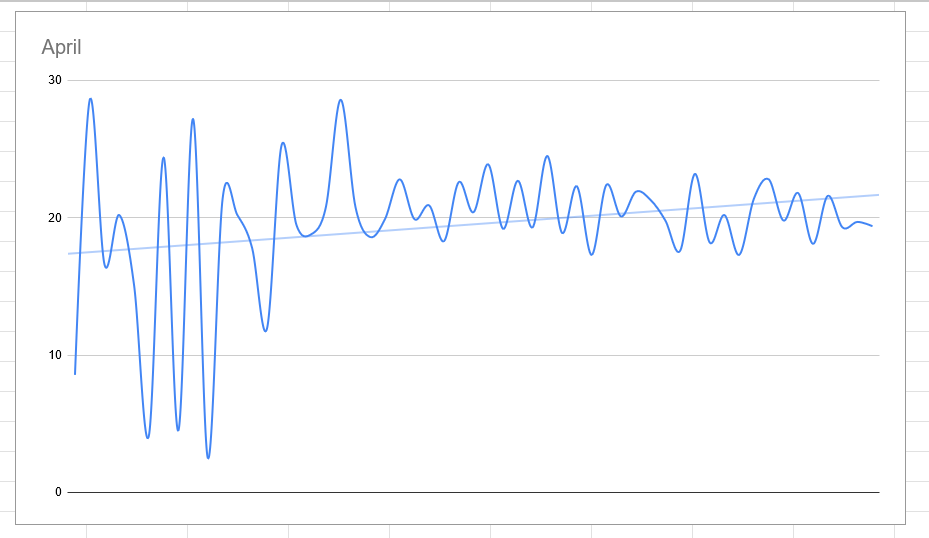
1779622152305.png

This graph is his glucose readings from April; I measure before every shot. As you can see in the beginning he had a period of wildly swinging back and forth, reaching hypoglycemic levels every night. Vet said this was the Somogyi effect and to lower his dose. After lowering his dose he stabilized somewhat but his number stayed high, at an average glucose reading of 20 mmol (360mg/dl)

After that I was advised to do weekly glucose curves, and to up his dose by 0.5 if the nadir did not reach acceptable range. I wait 7 to 10 days between each curve and dose change.
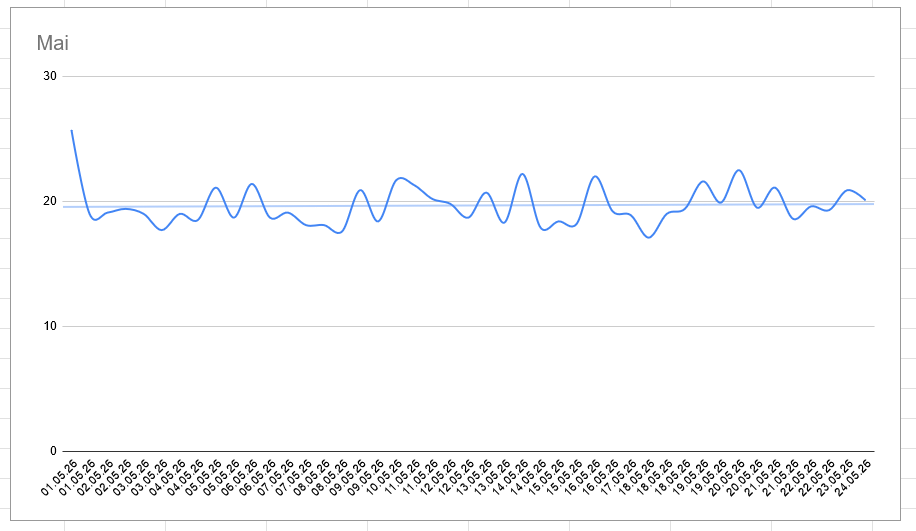
1779622322988.png

This is his graph from May.

After many glucose curves he has never reached a nadir below 16 (288 mg/dl). His average reading for May is 19,6, despite having been slowly upped to 3,5 units twice daily.
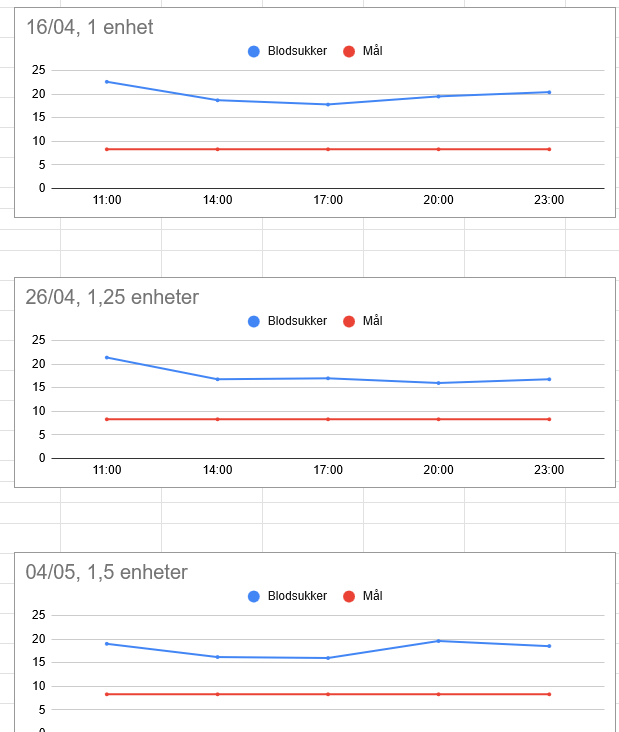
1779622648660.png

These are his first few glucose curves
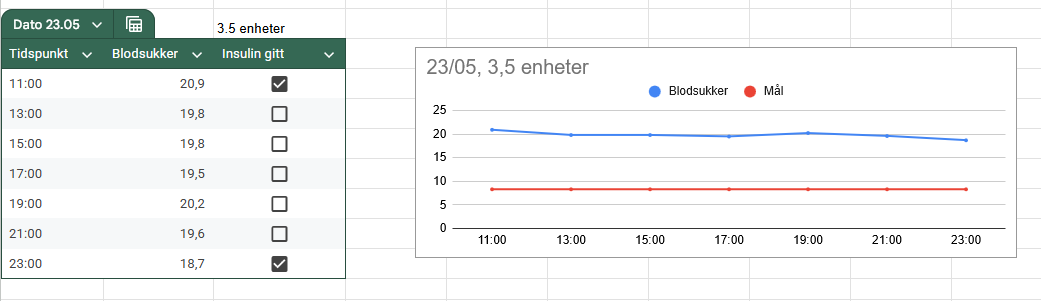
1779622691497.png

This is his last glucose curve, done yesterday.

I've also done spot testing on days off, and never seen him lower than 16.

What we've tried:
  • The vet confirmed that his insulin is stored correctly in the fridge
  • I sent a picture of the syringes I use and a picture of me having drawn up 3 units of insulin, to confirm I am drawing it up correctly, and I was
  • I am very sure I'm not giving fur shots, I can feel both the needle going in and the needle "letting go" when I pull back. I still feel his fur after every shot to make sure it's not wet.
    • I also demonstrated my shot technique to the vet last time I was there (administering just fluids in front of her) and she said it looked perfect
  • To the very best of my ability I have confirmed that he isn't eating anything he shouldn't be
Insulin resistance?
  • Vet says it would be weird if he was insulin resistant, considering he was so sensitive to insulin at the very beginning. A shot of 1,25 units would bring him down into hypo ranges.
  • I know that insulin does something, because in the early days when he was still very hungry he once broke into the bread box and ate some hamburger buns. He measured at 25 that morning, much higher than his average (that's the spike at the beginning of the May graph), but his morning insulin brought him down to "his" average
  • Vet says she doesn't want to test for acromegaly unless he reaches 5 units, which I think is the standard
I'm just confused and frustrated. I feel like I'm failing. It looks to me that the higher his dose is the higher his average levels are. I know it sounds ridiculous, but it almost feels like his body is actively fighting me. I just want to do right by this cat.

Can any of you lovely people spot something I should be doing that I'm not? Things I can try? Has anyone else experienced this and found a solution?
 
Sunny --

It would be enormously helpful if you could use our spreadsheet for tweaking your cat's blood glucose test results. The spreadsheet, and other information, is in this post on helping us to help you. The spreadsheet is a much better way for us to look at trends and provide you with the feedback you're looking for regarding dosing.
 
Sunny --

It would be enormously helpful if you could use our spreadsheet for tweaking your cat's blood glucose test results. The spreadsheet, and other information, is in this post on helping us to help you. The spreadsheet is a much better way for us to look at trends and provide you with the feedback you're looking for regarding dosing.
Thank you for the response, and sorry for missing that. I have now Made the spreadsheet, thank you again.
 
Hello Sunny, welcome to the forum. I'm sure Sienne is going to get back to you with some guidance, but in the meantime, allow me to encourage you in your treatment of Boy. You're doing your very best, as evidenced by your willingness to learn about this disease, Boy's response to it, and that you are trying so hard to get him regulated. You are NOT failing him. It can take time to get kitties down into better numbers.
 
Thanks for putting together your spreadsheet.

The good news -- Boy has been prescribed a good insulin for managing his diabetes. I'm in the US so I'm not familiar with Bozita but it looks like it's an appropriately low carbohydrate food.

What may be tripping up your management of Boy's diabetes is how you're testing. We encourage more testing than what you're doing. We suggest testing a minimum of 4 tests per day. You want to test at shot times so you know if it's safe to give insulin. You also want to get at least one additional test during both the AM and PM cycles. It's very important to get PM tests. Many cats drop into lower blood glucose numbers at night. In addition, if you have no tests from the PM cycle, you're missing half of your data. The other reason to get more daily tests is that you have no idea how low Boy's numbers may be dropping. As an example, my cat could have an AMPS in the 400s and drop into the 40s during the AM cycle and then bounce back to the 400s by PMPS. If all I was seeing was the pre-shot tests, I would be increasing her dose. However, that 40 was an indication that the dose needed to be reduced. Dose changes are based on how low the dose is taking your cat's numbers.

We also tend to make dose changes in 0.25u increments.

You might want to take a look at other members' spreadsheets. Some members use continuous glucose monitors (CGMs like the Freestyle Libre) so if you're seeing hourly tests, that's why. I was a bit of a testaholic (and CGMs weren't available then) due to my cat having a tendency to drop fast and low.

I'm tagging one of our members who is very skilled with Prozinc. @Suzanne & Darcy

Also, it's a holiday weekend in the US so people may be a bit slow in responding.
 
Thanks for putting together your spreadsheet.

The good news -- Boy has been prescribed a good insulin for managing his diabetes. I'm in the US so I'm not familiar with Bozita but it looks like it's an appropriately low carbohydrate food.

What may be tripping up your management of Boy's diabetes is how you're testing. We encourage more testing than what you're doing. We suggest testing a minimum of 4 tests per day. You want to test at shot times so you know if it's safe to give insulin. You also want to get at least one additional test during both the AM and PM cycles. It's very important to get PM tests. Many cats drop into lower blood glucose numbers at night. In addition, if you have no tests from the PM cycle, you're missing half of your data. The other reason to get more daily tests is that you have no idea how low Boy's numbers may be dropping. As an example, my cat could have an AMPS in the 400s and drop into the 40s during the AM cycle and then bounce back to the 400s by PMPS. If all I was seeing was the pre-shot tests, I would be increasing her dose. However, that 40 was an indication that the dose needed to be reduced. Dose changes are based on how low the dose is taking your cat's numbers.

We also tend to make dose changes in 0.25u increments.

You might want to take a look at other members' spreadsheets. Some members use continuous glucose monitors (CGMs like the Freestyle Libre) so if you're seeing hourly tests, that's why. I was a bit of a testaholic (and CGMs weren't available then) due to my cat having a tendency to drop fast and low.

I'm tagging one of our members who is very skilled with Prozinc. @Suzanne & Darcy

Also, it's a holiday weekend in the US so people may be a bit slow in responding.
Hello, and thank you so much for taking the time to reply

Forums like this are so important because I had no idea I should be testing after the last shot of the day. My vet just told me to measure before every shot, and during a glucose curve test every two to three hours between the AM and PM shot. Tonight I will test a few times more before I go to bed, too see if he is dropping lower than I thought. Thank you very much.
 
You might want to look over the sticky notes at the top of the Prozinc board. There's a ton of information there.

Some vets are weird about home testing -- or they think we're too aggressive about testing. I like having the data so I know what's going on with my cat. With humans, most people test at shot times. They also know when they're feeling off and will test to check their levels. Cats aren't always good about letting you know if their blood glucose is too high or too low. There are also times when numbers drop lower than expected and then bounce back up like I described with my cat.
 
An update on Boy:

I got in touch with the vet today. She said that when there is a disparity between the clinical symptoms and the glucose readings, it's better to keep the dose a little longer and instead use the fructosamine levels as a pointer of which direction things are going. Since Boy is peeing a normal amount, has been well hydrated at every vet visit, isn't losing weight, isn't drinking water really (he seems to get what he needs from his wet food) and has plenty of energy, she would like me to stick to 3.5 units for now. She also said that the international consensus of diabetic cats is that a fructosamine level between 350 and 450 is considered "good glycemic control", and Boy was at 420 his last visit.

She has earlier said that we could try Lantus insulin, but she said that looking at the curve it looks like ProZinc is lasting long enough and therefore we shouldn't switch.

I've been a little worried about glucose toxicity. As far as I can tell doing research online, the "key" if the cat has glucose toxicity is to keep upping the dose until you find a "breakthrough dose." Doing that goes against vet advice at this moment, and so I feel a little conflicted. If it is glucose toxicity then, as far as I can tell, it's a little time sensitive to treat it.

I will follow vet advice for now.

I have earlier been a little apprehensive about testing too much or doing too many curves because I've been using the Wellion pet meter and the strips for that are really expensive. I have now bought a human glucometer, as I see most of the people on this forum are using, which would allow me to test more frequently without breaking the bank. I've done two tests with both meters at the same time to get a sense for how different the readings are; right now it seems that the human meter tests consistently about three points mmol lower, and I still have some Wellion strips left if I feel unsure and need that extra accuracy.
 
She also said that the international consensus of diabetic cats is that a fructosamine level between 350 and 450 is considered "good glycemic control", and Boy was at 420 his last visit.
Normal cat blood glucose numbers for a cat are 50-120 (human meter). Keeping a cat in high numbers like 350-420 is extremely damaging to their poor little body. It is extremely hard on the kidneys as well as other organs. Have you ever tested with the urine strips to see if there’s glucose in Boy’s urine? Do you test for ketones (with urine test strips or with a blood ketone meter.) It’s important to know how low the dose is taking him in order to keep him safe. A fructosamine test will never be able to tell you that. It will give you an average blood glucose over a couple of weeks. It won’t tell you the highs or the lows.

It looks like you have been gathering some good data though on your spreadsheets. Well done!
 
It looks like you should hold this dose for four more days, keep gathering data, and then decide upon an increase. If you are still having yellow nadirs still then I would recommend an increase to 4.25 units.
 
Normal cat blood glucose numbers for a cat are 50-120 (human meter). Keeping a cat in high numbers like 350-420 is extremely damaging to their poor little body. It is extremely hard on the kidneys as well as other organs. Have you ever tested with the urine strips to see if there’s glucose in Boy’s urine? Do you test for ketones (with urine test strips or with a blood ketone meter.) It’s important to know how low the dose is taking him in order to keep him safe. A fructosamine test will never be able to tell you that. It will give you an average blood glucose over a couple of weeks. It won’t tell you the highs or the lows.

It looks like you have been gathering some good data though on your spreadsheets. Well done!
Hello, thank you for your input!

The vet did give me the supplies to do a single urine test - it's one of those strips with several colored squares down the side, and you drip urine on each of them to see what color they turn. It has a square for glucose and one for ketones. I haven't done one yet because the special non-asborbent litter the vet gave me is just a little baggie, I don't imagine it's enough to fill the litterbox. I got the impression from the vet that doing urine testing at home wasn't a priority, but if you say I should then I will ask the vet for more of that litter (I can't find anywhere to buy it online in my country) and try.

When the vet told me to hold the 3.5 dose I had already increased to 4 units as per our old instructions. I did say in an earlier post that I would follow her advice and hold it, but when it was time for the next dose I saw the lowest numbers I've seen in a while (confirmed with both the human and pet meter), so I was like "oh what if I found the right dose" and stuck to that. I will hold this dose until he's been on it for a week and then increase by 0.25 as per your advice; that's kind of what I wanted to do, I was just scared to go against the vet.
 
You don't need to fill the entire litter box with non-absorbent litter. Most cats just need enough litter to feel under their feet. Then you just tip the box to pool up the urine in a corner and dip the test strip in.

There are bags of non-absorbent litter you can buy if your cat needs more than a handful. Kit4Kat is one brand. There are others. See if ZooPlus has any.

Clean fish tank pebbles (the bigger dime-size ish pebbles, not the typical tiny gravel) and decorative flower vase pebbles work too.

The litter box has to be completely brand new for the urine test strip to give an accurate reading. Litter residue can affect the reading.

Alternatively, you can try sticking a clean long handled spoon or a cup under the cat to catch the urine. Then pour / dip the test strip into that.

Urine testing should be part of managing the diabetes especially for ketone prone cats.
 
when it was time for the next dose I saw the lowest numbers I've seen in a while (confirmed with both the human and pet meter),
What numbers? Your spreadsheet is not up to date. Would you please update it? Is everything all right? I can only see the pink (300s) numbers on the spreadsheet.

You can hold the test strip in the cat’s urine stream if that’s possible. I never found it convenient so I bought a blood ketone meter.
 
What numbers? Your spreadsheet is not up to date. Would you please update it? Is everything all right? I can only see the pink (300s) numbers on the spreadsheet.

You can hold the test strip in the cat’s urine stream if that’s possible. I never found it convenient so I bought a blood ketone meter.
I switched to a human meter, which is a different spreadsheet, so I have both spreadsheets in my signature now. The pet meter one has the most data but the human one is the one I am using now, sorry for any confusion.
 
I don’t understand why the 3.5 dose in the morning and a 4 unit dose in the evening. He is way too high in his blood glucose.
 
I don’t understand why the 3.5 dose in the morning and a 4 unit dose in the evening. He is way too high in his blood glucose.
I've been getting quite frustrated and scared about how higher and higher doses seem to do nothing for him. A particular point of confusion is how it seems, to me, that the higher his insulin dose is the higher his glucose levels get. When he was on 1.5 units I could get a nadir of 16 mmol; when he was at 3 units I got 18 as an average AMPS; and now on 4 units I keep seeing 20+ numbers. So I reached out an online friend who I know has cared for a diabetic cat before, and she told me her kitty had a kind of dramatic success with having a lower AM dose than PM dose. So I tried that, since (to me) it looks like his numbers were better when his dose was lower.

I know that "trying stuff" isn't smart, I admit I might be doing dumb stuff out of desperation. Because you're very right, his glucose is too high. I feel frustrated because I know the right thing to do is to slowly increase by 0.25 increments every week, but I worry that means he'll have these high numbers for several months to come.
 
I love his picture. He’s a handsome cat, Sunny!
He is. He looks like a little trucker with his big tomcat cheeks.

He was a streetcat, taken in by an old lady about 8 years ago. She sadly had to go into care due to dementia, which is why Boy had to be rehomed. He looks like a big tough guy but he has the most angelic little silver bell meow, it's very funny. I hope to so right by him and his previous owner.
1000016172.jpg
 
He is. He looks like a little trucker with his big tomcat cheeks.

He was a streetcat, taken in by an old lady about 8 years ago. She sadly had to go into care due to dementia, which is why Boy had to be rehomed. He looks like a big tough guy but he has the most angelic little silver bell meow, it's very funny. I hope to so right by him and his previous owner.
View attachment 78437
You obviously have a very big heart!
 
I've been getting quite frustrated and scared about how higher and higher doses seem to do nothing for him. A particular point of confusion is how it seems, to me, that the higher his insulin dose is the higher his glucose levels get. When he was on 1.5 units I could get a nadir of 16 mmol; when he was at 3 units I got 18 as an average AMPS; and now on 4 units I keep seeing 20+ numbers. So I reached out an online friend who I know has cared for a diabetic cat before, and she told me her kitty had a kind of dramatic success with having a lower AM dose than PM dose. So I tried that, since (to me) it looks like his numbers were better when his dose was lower.

I know that "trying stuff" isn't smart, I admit I might be doing dumb stuff out of desperation. Because you're very right, his glucose is too high. I feel frustrated because I know the right thing to do is to slowly increase by 0.25 increments every week, but I worry that means he'll have these high numbers for several months

How is your Boy?
 
How is your Boy?
Nothing has really changed. He's up to 5 units now, consistently staying in the upper 200s/lower 300s. When I give his AM dose he measures high, then dips down, then slowly climbs back up for the PM dose, as expected. When I give him his PM dose he doesn't dip at all, just keeps steadily climbing until he's at his typical AM values. The vet suggested this might mean that the insulin doesn't last long enough, and she was going to get back to me about the possibility of switching to a different insulin. I did try switching to a new vial of insulin, to see if maybe the old one was defective, but it made no difference.

I did however do my first at-home urine test two days ago and he tested negative for any ketones, so that's good.

Edit: also, forgot to mention, I asked the vet about acromegaly and she said they usually don't test for that until the cat has reached 1,5 units per kilo of body weight, but she did offer to test now if I want too. It would cost me $500 and I'm already scraping by, so I have to wait a little longer for that anyway.
20260608_235915.jpg
 
That’s quite a markup on the testing. Michigan State University who does both the Acro testing and the insulin auto antibodies testing (you should check both) do not charge that much. Of course there’s a shipping charge. The blood is shipped frozen as I recall. It did cost me maybe $300 but not $500. It is a little premature to test for it since he was only diagnosed in April. You could wait a month. We usually recommend testing after the dose is 6 units or more. From his spreadsheet, I would go ahead and increase again. 5 units doing it for him. I would go to 5.5 in his case with the higher yellow nadirs.
 
That’s quite a markup on the testing. Michigan State University who does both the Acro testing and the insulin auto antibodies testing (you should check both) do not charge that much. Of course there’s a shipping charge. The blood is shipped frozen as I recall. It did cost me maybe $300 but not $500. It is a little premature to test for it since he was only diagnosed in April. You could wait a month. We usually recommend testing after the dose is 6 units or more. From his spreadsheet, I would go ahead and increase again. 5 units doing it for him. I would go to 5.5 in his case with the higher yellow nadirs.
Thank you very much for the response. It might be more expensive for me because I live in Norway? I didn't realize it was marked up so severely.

I as under the impression you needed to hold a dose for a week before you could increase, but if you're saying I could up it now I will. I very much want to see him get better.
 
So hopefully with a fee from your vet for blood drawing and preparation for shipment you will come in at less than $300. But FEDEX shipping is horribly expensive these days so that is probably part of the large estimate.
 
Thank you very much for the response. It might be more expensive for me because I live in Norway? I didn't realize it was marked up so severely.

I as under the impression you needed to hold a dose for a week before you could increase, but if you're saying I could up it now I will. I very much want to see him get better.
Oh. Right. It may cost you more. Where will they send the blood then? To the Royal College of Veterinary Medicine in England?
 
Well, if he eats only a low carb wet food diet (which I believe he does) we can increase his dose more quickly. He obviously has insulin resistance and his nadirs are only in the higher 200s (higher yellow numbers) so I believe an increase to 5.5 units is warranted and safe. We need to try to reach a breakthrough dose if possible. It’s in his best interest to try to get his numbers down more quickly if we can. You also test him enough to watch and keep him safe.
 
Back to the testing… if you test too soon after diagnosis it’s possible to get a false negative result. It’s recommended to wait 73 days after diagnosis. Anyway, you said you would need to wait a while for financial reasons.
 
Well, if he eats only a low carb wet food diet (which I believe he does) we can increase his dose more quickly. He obviously has insulin resistance and his nadirs are only in the higher 200s (higher yellow numbers) so I believe an increase to 5.5 units is warranted and safe. We need to try to reach a breakthrough dose if possible. It’s in his best interest to try to get his numbers down more quickly if we can. You also test him enough to watch and keep him safe.
Okay, thank you. I didn't know that. He does eat exclusively low carb wet food (it's Bozita brand, 0.5% carbs)

I will increase the dose and keep monitoring.
 
Back to the testing… if you test too soon after diagnosis it’s possible to get a false negative result. It’s recommended to wait 73 days after diagnosis. Anyway, you said you would need to wait a while for financial reasons.
Thank you for this information, I also didn't know that. Weird that my vet offered to test already now, but I've also gotten the impression many vets aren't as educated as they should be on feline diabetes.

Current plan is to keep keeping a close eye on him and keep upping the dose at responsible intervals until anything happens, I will report back

Thank you very much for your help
 
Thank you for this information, I also didn't know that. Weird that my vet offered to test already now, but I've also gotten the impression many vets aren't as educated as they should be on feline diabetes.

Current plan is to keep keeping a close eye on him and keep upping the dose at responsible intervals until anything happens, I will report back

Thank you very much for your help
You are very welcome. With a cat who is insulin resistant, I would recommend holding the dose for three days (6 cycles) and increasing again until the nadirs start to come down. When you start seeing blue nadirs, especially if they are in the lower blue range, we would slow down a little bit and give it a few more days on the dose. The thing with insulin resistant cats is that, if you hold a dose too long they tend to have glucose toxicity, which is a fancy way of saying that his body is really comfortable in the higher numbers and it’s harder to break through.
 
I just got acromegaly and IAA testing done earlier this week and it was $389. I had some vets quote me almost $1000 though, and quite a few others that wouldn't even do it at all. so I'm lucky I found the vet I did. (I live in SoCal so I think it's the shipping that adds so much to the cost. The vet did tell me that they had to buy a special shipping container from MSU and that itself was $33, so I think all the little things add up.)
 
I just got acromegaly and IAA testing done earlier this week and it was $389. I had some vets quote me almost $1000 though, and quite a few others that wouldn't even do it at all. so I'm lucky I found the vet I did. (I live in SoCal so I think it's the shipping that adds so much to the cost. The vet did tell me that they had to buy a special shipping container from MSU and that itself was $33, so I think all the little things add up.)
Sunny and Boy live in Norway. So they will have the testing done in Europe somewhere and the costs are bound to be different. Hopefully, when she is ready, she can find the best price.
 
Back
Top