My cat (Miss Kitty) was diagnosed with diabetes back in April 2012. She is feral by nature and only responds to me ever since she was a kitten. She will be 14 years old in June and was fed dry food most of her life. It has always been very difficult to take her to the Vet, but when I started noticing an increase in her water intake, I scheduled an appointment. Since she is considered feral and would never allow strangers to get near her, she had to be put in a box and fully sedated in order for the Vet to examine her and draw blood. If not, she would always attack the Vet and Vet techs if they came within 3 feet of her. However, she is a very loving cat once she gets to know you. Basically, it extremely torturous for her and myself to take her to the Vet when something is wrong. The blood results showed that her glucose level was 396. With her temperament, I had very limited options at that time in treating her diabetes. I thought insulin injections twice a day with home blood tests would be impossible. The first option at that point was to change her diet to all wet food (3 cans of Fancy Feast Classic with no fish, 3 can per day) to see if that would help. I asked about a glucose lowering pill and the Vet said it was not a good treatment in place of insulin because of negative long term effects. She was also 16 pounds at that time, so a loss of weight needed to be achieved. Miss Kitty's highest weight was originally 19 pounds at one point and she has always been an indoor cat. After switching her over to an all wet food diet, her water intake decreased, she dropped to 12.5 pounds and was much more active by September 2012 (5 months after diagnosis). I would weigh her once a week and kept a record of her progress. She maintained that weight until November 2012, but then dropped 2 pounds in two months. By early January 2013, she was 10.5 LBS. I called the Vet and discussed my concerns. He knew how difficult it would be to bring her in, but explained that he needed to see her to rule out unregulated diabetes or hyperthyroid issues. I scheduled an appointment to have her sedated and fully checked over. Her blood glucose dropped slightly from 396 to 360 compared to last year, but still very high. All other blood test results came back normal with exception to the urinalysis, which showed high glucose and UTI. After treating the UTI, I had to make a difficult decision of treating the diabetes with either Glipizide or Lantus insulin. I searched the internet for a week researching the options and came to the conclusion of going the insulin route. The question now was how to administer the insulin to a very difficult patient. I turned to the internet again and found a way to possibly make this work. After a few attempts to inject the insulin and test her blood glucose all by myself while she was eating (distraction), I felt relieved knowing that I was on the road to saving her life. After 4 months of being on Lantus insulin and now gradually up to 4 units twice a day, I am very discouraged with the current results. I started out with 1 unit twice a day for two weeks and then did a glucose curve. After reviewing the curve results, my Vet recommended that we go up slowly and increase the insulin by ½ unit twice a day. After that, perform another curve. As the months went by with slight increases of insulin determined by glucose curves, we are now up to 4 units twice a day and show worse results than before starting the insulin therapy. With 1 unit of insulin twice a day, she would start out at 390 and have a low of 305. Now that she gets 4 units of insulin twice a day, she starts out in the low to mid 400 range and peak in the mid 300s. It seems that her glucose curve goes up when we increase the insulin. I've researched the Symogi Effect and insulin resistance, but her glucose has never gotten too low and she does respond with insulin since her numbers do decrease at peak. My Vet and I have ruled out injection technique error, infections, bad insulin and calorie intake. Also, my Vet thinks that any other underlying health issues possibly causing this to happen are rare and does not believe this could be our issue. However, further testing would be needed to completely rule them out. Miss Kitty is on a very structured feeding and insulin schedule. I have an automatic pet feeder giving her ¼ a can of fancy feast every 3 hours during the day and then I’ll give her ¾ a can at the time of insulin injection. She is now down to 9.5 LBS and is just skin and bones. Her appetite is voracious and water intake is back up to pre-diagnosis consumption. I feel like I am losing this battle for her with every obstacle I try to overcome. Any advice or guidance would be greatly appreciated. Thank you in advance.

You are using an out of date browser. It may not display this or other websites correctly.
You should upgrade or use an alternative browser.
You should upgrade or use an alternative browser.
Glucose Curve Rises With Increased Units
- Thread starter ptaylorc
- Start date
- Status
- Not open for further replies.

Deb & Wink
Member Since 2013
How many cans of Fancy Feast does Miss Kitty eat per day? I could not tell if she only gets 1 3/4 cans a day or is fed more. She may need 12-15 ounces a day when still unregulated with those high BG numbers. I think you may be severely underfeeding her.
What is here ideal weight according to your vet?
How underweight is she?
You said her appetite is voracious. How long does it take her to eat that 3/4 can of Fancy Feast?
How often do you inject insulin? Once a day? Twice a day?
Are you injecting on a consistent schedule? 12/12 schedule or something different?
Do you home test the blood glucose? If so, would you be willing to share some numbers with us.
What is here ideal weight according to your vet?
How underweight is she?
You said her appetite is voracious. How long does it take her to eat that 3/4 can of Fancy Feast?
How often do you inject insulin? Once a day? Twice a day?
Are you injecting on a consistent schedule? 12/12 schedule or something different?
Do you home test the blood glucose? If so, would you be willing to share some numbers with us.
I'm feeding Miss Kitty 3 cans of Fancy Feast a day and her ideal weight should be around 11-12 pounds. She's about 2 LBS under right now. She eats 3/4 of a can in a few minutes and is always hungry right after, but she gets 1/4 of a can every 3 hours thereafter until the next insulin shot (then she gets another 3/4 can). All together, it's 3 cans in a 24 hour period. I administer insulin twice daily and get as close to 12/12 as possible with my work schedule. Below are her 12 hours glucose curve numbers with different insulin units as they progressed:
1 UNIT:
390/305/328/349/327/351
2 UNITS:
338/316/262/315/368
3 UNITS:
317/386/258/341/370
3.5 UNITS:
436/337/463/383/389
4 UNITS:
421/348/376/362/416
Thanks.
1 UNIT:
390/305/328/349/327/351
2 UNITS:
338/316/262/315/368
3 UNITS:
317/386/258/341/370
3.5 UNITS:
436/337/463/383/389
4 UNITS:
421/348/376/362/416
Thanks.

Wendy&Tiggy(GA)
Member Since 2011
Hello and welcome to the board
Does she get outside at all? I am wondering if a neighbour is feeding her kibble.
There could be a few things going on here - she could be a high dose cat (my Tiggy is on 8IU), she could have a condition like acromegaly or insulin resistance. Or she could be "bouncing"!!
Bouncing is similar to somogyi but not quite the same ie . As the insulin starts to take effect and numbers start to come down, the liver has to learn to adjust to the lower numbers. We call this "liver training school". But before it relearns that low numbers are ok, when the BG drops to a number lower than the liver is accustomed, or if BGs drop low, or if the BG drops suddenly, the liver”panics” and reacts by releasing counterregulatory hormones and glucagon. This drives the BG back up. This is what we call a "bounce". Bounces can take up to 72 hours to clear so we are generally careful about increasing doses during the bounce. Once the bounce clears, then you can see the "real" numbers and determine if the dose needs to go up or down.
How often do you do your curves? Since "bouncing" can last 72 hours you could be missing when she does come down into low numbers and it could be her dose is too high.
Anyway it will help immensely if you can set up a spreadsheet and start tracking her over the next few days. here is how to do a spreadsheet :http://www.felinediabetes.com/FDMB/viewtopic.php?f=6&t=18207
Can you do the following tests? Before every shot, one mid cycle, and another before bed for the next few days? Then we can take a look and see what other tests we may need to see what is going on.
Wendy
Does she get outside at all? I am wondering if a neighbour is feeding her kibble.
There could be a few things going on here - she could be a high dose cat (my Tiggy is on 8IU), she could have a condition like acromegaly or insulin resistance. Or she could be "bouncing"!!
Bouncing is similar to somogyi but not quite the same ie . As the insulin starts to take effect and numbers start to come down, the liver has to learn to adjust to the lower numbers. We call this "liver training school". But before it relearns that low numbers are ok, when the BG drops to a number lower than the liver is accustomed, or if BGs drop low, or if the BG drops suddenly, the liver”panics” and reacts by releasing counterregulatory hormones and glucagon. This drives the BG back up. This is what we call a "bounce". Bounces can take up to 72 hours to clear so we are generally careful about increasing doses during the bounce. Once the bounce clears, then you can see the "real" numbers and determine if the dose needs to go up or down.
How often do you do your curves? Since "bouncing" can last 72 hours you could be missing when she does come down into low numbers and it could be her dose is too high.
Anyway it will help immensely if you can set up a spreadsheet and start tracking her over the next few days. here is how to do a spreadsheet :http://www.felinediabetes.com/FDMB/viewtopic.php?f=6&t=18207
Can you do the following tests? Before every shot, one mid cycle, and another before bed for the next few days? Then we can take a look and see what other tests we may need to see what is going on.
Wendy
Deb & Wink
Member Since 2013
More questions for you. :YMSIGH:
Would you please add the dates to each of those strings of BG curve numbers? Thanks!
Were doses raised in 1 unit increments? From 1U to 2U to 3U? How many days on one dose before the dose was raised?
What were the dates of the dose increases?
Wendy has asked if you would be willing to create our standard format spreadsheet and link it into your signature. That will take some time and effort on your part. The most useful numbers to start entering on the spreadsheet would be the BG tests from the last couple of weeks.
It really does help us to see the patterns. That is why we like our standardized color coded spreadsheet.
Would you please add the dates to each of those strings of BG curve numbers? Thanks!
Were doses raised in 1 unit increments? From 1U to 2U to 3U? How many days on one dose before the dose was raised?
What were the dates of the dose increases?
Wendy has asked if you would be willing to create our standard format spreadsheet and link it into your signature. That will take some time and effort on your part. The most useful numbers to start entering on the spreadsheet would be the BG tests from the last couple of weeks.
It really does help us to see the patterns. That is why we like our standardized color coded spreadsheet.
Thanks for your reply. WOW...8 units for Tiggy? ..........Miss Kitty is always indoors and never goes out of the house. I have checked all areas of the house and monitored her while I'm at home to see if she gets into anything, but all is good. I usually wait 2-3 weeks after a dosage change before performing a curve. I won't be able to do a curve test like you requested until next weekend since I'm working at the time of her peak. The doses were increased by 1/2 unit except for one, which I think was the transition between 2-3 units. Here are the dates of the curves I perfomed listed below with more detail. When I get a chance next weekend, I will put all the numbers on the spreadsheet you suggested. Thanks again.
1 UNIT (TWICE DAILY): 2/10/2013
390/305/328/349/327/351
2 UNITS MORNING/1 UNIT EVENING: 3/3/2013
464/414/300/342/376/345
2 UNITS (TWICE DAILY): 3/24/2013
338/316/262/315/368
3 UNITS (TWICE DAILY): 4/14/2013
317/386/258/341/370
3.5 UNITS (TWICE DAILY): 5/5/2013
436/337/463/383/389
4 UNITS (TWICE DAILY): 5/18/2013
421/348/376/362/416
1 UNIT (TWICE DAILY): 2/10/2013
390/305/328/349/327/351
2 UNITS MORNING/1 UNIT EVENING: 3/3/2013
464/414/300/342/376/345
2 UNITS (TWICE DAILY): 3/24/2013
338/316/262/315/368
3 UNITS (TWICE DAILY): 4/14/2013
317/386/258/341/370
3.5 UNITS (TWICE DAILY): 5/5/2013
436/337/463/383/389
4 UNITS (TWICE DAILY): 5/18/2013
421/348/376/362/416
Wendy&Tiggy(GA)
Member Since 2011
Ok but can you get a test before every shot and a before bed test every day till then? That would still give us a lot of info..

BJM
Member Since 2010
If she is unregulated, then she can't use the calories she's eating very well. You may need to increase her overal food 50% to help with that.
Not all Fancy Feast are low carb; only the Classic pates. There's a food list at Cat Info that provides nutiritional info on a variety of brands.
In my signature link are some Secondary Monitoring Tools, including urine ketone monitoring. That is important to do while she is unregulated. Ketones are a by-product of fat breakdown. Too many may indicate diabetic ketoacidosis (DKA), a potentially fatal complication of diabetes.
Not all Fancy Feast are low carb; only the Classic pates. There's a food list at Cat Info that provides nutiritional info on a variety of brands.
In my signature link are some Secondary Monitoring Tools, including urine ketone monitoring. That is important to do while she is unregulated. Ketones are a by-product of fat breakdown. Too many may indicate diabetic ketoacidosis (DKA), a potentially fatal complication of diabetes.
Deb & Wink
Member Since 2013
Too much insulin as well as too little insulin can cause high BG numbers. That is one reason I was asking how quickly you had raised the dose.
Without some more test numbers at those lower doses, we really don't know if those doses were working for Miss Kitty or not.
You said you changed doses from 1 to 1.5 to 2 to 3 to 3.5 to 4 but I do not see any test numbers to indicate why you raised to each of those half units. You only provided us curves for the whole unit numbers.
Where I'm going with this is it looked to me like the BG numbers were better back on 2 units, maybe 3 units. Even 2 units may have been too much insulin. You may have bypassed the good dose for Miss Kitty. The good dose may be somewhere between 1.5 units and 3 units.
The TR (tight regulation) protocol we use increases in smaller increments, by 0.25U increases, holding a dose for a minimum of 6 cycles before increasing. There is also a SLGS (start low, go slow) component or protocol that can be used. With those nadirs you got back on 3/24 and 4/14, the TR protocol would only have called for a 0.25U increase in dose.
I'm thinking that with those high BG numbers, the dose may be too high. I really don't think you should increase the dose right now without some more test data. In fact, my recommendation would be to decrease the dose.
We also need to know if you are using a human glucometer for testing or one of the pet specific ones and which meter. For example, I use the Relion Confirm human glucometer for testing now but used to have an Alphatrak pet specific monitor.
My recommendations:
1. Increase food intake by at least 3oz per day. She can not use the food she eats properly because of the wacky insulin levels.
2. Get more tests. A morning pre-shot test every time, a midday test when possible, an evening pre-shot test, a test before you go to bed every night.
3. You may want to consider dropping the insulin dose back down to 1.5U and slowly increasing by 0.25U. It would take about two weeks to get back to what might have been a more optimal dose. Might work, might not.
4. Test for ketones daily. Those high BG numbers you are getting along with an infection and not eating enough can cause DKA.
5. Check dental health. Infections in the mouth are really hard to find and can elevate BG numbers.
6. Be sure to use 3/10cc insulin syringes with half unit markings. Those are so important for getting those quarter unit increments consistent.
Without some more test numbers at those lower doses, we really don't know if those doses were working for Miss Kitty or not.
You said you changed doses from 1 to 1.5 to 2 to 3 to 3.5 to 4 but I do not see any test numbers to indicate why you raised to each of those half units. You only provided us curves for the whole unit numbers.
Where I'm going with this is it looked to me like the BG numbers were better back on 2 units, maybe 3 units. Even 2 units may have been too much insulin. You may have bypassed the good dose for Miss Kitty. The good dose may be somewhere between 1.5 units and 3 units.
The TR (tight regulation) protocol we use increases in smaller increments, by 0.25U increases, holding a dose for a minimum of 6 cycles before increasing. There is also a SLGS (start low, go slow) component or protocol that can be used. With those nadirs you got back on 3/24 and 4/14, the TR protocol would only have called for a 0.25U increase in dose.
I'm thinking that with those high BG numbers, the dose may be too high. I really don't think you should increase the dose right now without some more test data. In fact, my recommendation would be to decrease the dose.
We also need to know if you are using a human glucometer for testing or one of the pet specific ones and which meter. For example, I use the Relion Confirm human glucometer for testing now but used to have an Alphatrak pet specific monitor.
My recommendations:
1. Increase food intake by at least 3oz per day. She can not use the food she eats properly because of the wacky insulin levels.
2. Get more tests. A morning pre-shot test every time, a midday test when possible, an evening pre-shot test, a test before you go to bed every night.
3. You may want to consider dropping the insulin dose back down to 1.5U and slowly increasing by 0.25U. It would take about two weeks to get back to what might have been a more optimal dose. Might work, might not.
4. Test for ketones daily. Those high BG numbers you are getting along with an infection and not eating enough can cause DKA.
5. Check dental health. Infections in the mouth are really hard to find and can elevate BG numbers.
6. Be sure to use 3/10cc insulin syringes with half unit markings. Those are so important for getting those quarter unit increments consistent.
Thank you all for your knowledge and advice. Sorry for not replying back sooner. Come Monday, my weekdays are very busy between work and of course, Miss Kitty. Since Sunday, I decided to lower her dosage of insulin back down to 2 units twice a day and see where that takes her BG level. I also increased her food intake by 1/2 can more per day, eventually going to 1 can more per day (4 cans total). I agree with BGM's post that she was not getting enough food with her high numbers. I was concerned about giving her more food thinking it would raise her glucose level. Is this true? I researched this back in January and read that she should be in the 250-300 calorie per day range for her weight. To measure her BG, I use the Alphatrak 2 meter. Back in March, Miss Kitty's Vet and I decided to raise her insulin from 2-3 units based on the 2 units curve. We also thought that she would be a high insulin dose cat based on these readings. I spoke with him this past Monday and we agreed to put her back on the 2 units per day to see where that goes. I agree with Deb and Wink, I think there might have been a place between 2-3 units that could have been the good dose, but only time will tell. Question is, how long do I keep her on the 2 units twice a day before considering to raise it? I use the 1/2 unit measured syringes, but how do you measure 1/4 unit accurately and consistently if I need to raise the insulin slowly? Also, what is TR suppose to be? I've heard it should be 90 (peak) and 300 (ending). To Wendy&Tiggy, I took your advice and started monitoring her levels by testing her before her insulin shot and just before I go to bed. I did stay up last night to get the peak reading with the 2 units that I started Tuesday morning. Here are her numbers so far with the units administered (before the change to 2 units) and after. I work 12pm-9pm 2 days of the week with my job schedule, but all other days are 8am-5pm, so that's why you'll see a time difference in the readings performed today (5/22).
5/18 5:30PM 423 4 UNITS INJECTED (END OF CYCLE)
5/19 11:30AM 348 PEAK
5/19 8:30PM 389 3 HOURS LATER
5/20 5:30AM 355 4 UNITS INJECTED (END OF CYCLE)
5/20 5:30PM 368 4 UNITS INJECTED (END OF CYCLE)
5/20 8:30PM 301 3 HOURS LATER
5/21 5:30 AM 368 2 UNITS INJECTED (END OF CYCLE)
5/21 5:30PM 350 2 UNITS INJECTED (END OF CYCLE)
5/21 8:30PM 386 3 HOURS LATER (NOT SURE WHY IT WENT UP)
5/21 11:30PM 273 PEAK
5/22 7:30AM 365 2 UNITS INJECTED (END OF CYCLE AND 14 HOURS AFTER THE 5/21 5:30PM 2 UNIT INJECTION).
Thank you again for everyone's help. I hope this works for Miss Kitty. Any more thoughts and advice would be greatly appreciated. Thank you so much again!
5/18 5:30PM 423 4 UNITS INJECTED (END OF CYCLE)
5/19 11:30AM 348 PEAK
5/19 8:30PM 389 3 HOURS LATER
5/20 5:30AM 355 4 UNITS INJECTED (END OF CYCLE)
5/20 5:30PM 368 4 UNITS INJECTED (END OF CYCLE)
5/20 8:30PM 301 3 HOURS LATER
5/21 5:30 AM 368 2 UNITS INJECTED (END OF CYCLE)
5/21 5:30PM 350 2 UNITS INJECTED (END OF CYCLE)
5/21 8:30PM 386 3 HOURS LATER (NOT SURE WHY IT WENT UP)
5/21 11:30PM 273 PEAK
5/22 7:30AM 365 2 UNITS INJECTED (END OF CYCLE AND 14 HOURS AFTER THE 5/21 5:30PM 2 UNIT INJECTION).
Thank you again for everyone's help. I hope this works for Miss Kitty. Any more thoughts and advice would be greatly appreciated. Thank you so much again!
Deb & Wink
Member Since 2013
Question is, how long do I keep her on the 2 units twice a day before considering to raise it?
A minimum of 3-5 days or 6-10 cycles.
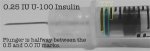
I use the 1/2 unit measured syringes, but how do you measure 1/4 unit accurately and consistently if I need to raise the insulin slowly?
Picture of quarter unit with syringe with 1/2 unit markings
Also, what is TR suppose to be? I've heard it should be 90 (peak) and 300 (ending).
Tight Regulation is a method for management of dosing changes, not specific numbers.
Here is the TR protocol in full: http://felinediabetes.com/FDMB/viewtopic.php?f=9&t=1581
and some excerpts from this document:
REQUISITES WHEN FOLLOWING A TIGHT REGULATION PROTOCOL WITH LANTUS OR LEVEMIR:
•Kitty should be monitored closely the first three days when starting Lantus or Levemir.
Blood glucose levels should at least be checked at pre-shot, +3, +6, and +9.
More monitoring may be needed.
•It will be necessary to test kitty's blood glucose levels multiple times per day.
•Learn the signs of and how to treat HYPOGLYCEMIA and prepare a HYPO TOOLBOX.
•Test regularly for ketones and know about DIABETIC KETOACIDOSIS (DKA).
•Use U-100 3/10cc syringes with half units marked on the barrel for fine dosing.
•Feed a high quality low carb canned or raw food diet.
•Feed small meals throughout the day. Some kitties adapt well to free feeding.
Many Lantus and Levemir users in this forum have been successful following a somewhat modified version of this Tight Regulation Protocol for the last few years. These "general" guidelines are based on anecdotal evidence and personal experiences of laypersons frequenting the forum.
"General" Guidelines:
•Hold the initial starting dose for 5 - 7 days (10 - 14 consecutive cycles) unless the numbers tell you otherwise. Kitties experiencing high flat curves or prone to ketones may want to increase the starting dose after 3 days (6 consecutive cycles).
•Each subsequent dose is held for a minimum of 3 days (6 consecutive cycles) unless kitty earns a reduction (See: Reducing the dose...).
•Adjustments to dose are based on nadirs with only some consideration given to preshot numbers.
Increasing the dose:
•Hold the dose for 3 - 5 days (6 - 10 consecutive cycles) if nadirs are less than 200 before increasing the dose by 0.25 unit.
•After 3 days (6 consecutive cycles)... if nadirs are greater than 200, but less than 300 increase the dose by 0.25 unit.
•After 3 days (6 consecutive cycles)... if nadirs are greater than 300 increase the dose by 0.5 unit.
Reducing the dose:
•If kitty drops below 40 (long term diabetic) or 50 (newly diagnosed diabetic) reduce the dose by 0.25 unit. If kitty has a history of not holding reductions well or if reductions are close together... sneak the dose down by shaving the dose rather than reducing by a full quarter unit. Alternatively, at each newly reduced dose... try to make sure kitty maintains numbers in the normal range for seven days before reducing the dose further.
•If an attempted reduction fails, go right back up to the last good dose.
•Try to go from 0.25u to 0.1u before stopping insulin completely.
Random Notes:
•Because of the cumulative nature of Lantus and Levemir:
An early shot = a dose increase.
A late shot = a dose reduction.
•A "cycle" refers to the period of time between shots. There are 2 cycles in one day when shooting twice a day.
•Sometimes a dose will need to be "fine tuned" by adding some "fat" or "skinny-ing up" the dose
Attachments
Wendy&Tiggy(GA)
Member Since 2011
Hello there
How is the testing going? I think it woiuld help both us and you immensely if you can set up a spreadsheet. We can then see trends etc. you can also share it with your vet. Anyway heres how - et us know if you have issues and we can help : http://www.felinediabetes.com/FDMB/viewtopic.php?f=6&t=18207
Also I summarized your readings from the last few days (below). Its great you are getting preshot tests - you want to do that every time. Its also interesting you got the 271 on the lower dose. But I will be better able to see whats going on when you get the spreadsheet done.
5/18 PMPS 423 4IU
5/19 +6 348
5/19 +9 389
5/20 AMPS 355 4IU
5/20 PMPS 368 4IU
5/20 +3 301
5/21 AMPS 368 2IU
5/21 PMPS 350 2IU
5/21 + 3 386
5/21 +6 273
5/22 AMPS+2 365 2IU
How is the testing going? I think it woiuld help both us and you immensely if you can set up a spreadsheet. We can then see trends etc. you can also share it with your vet. Anyway heres how - et us know if you have issues and we can help : http://www.felinediabetes.com/FDMB/viewtopic.php?f=6&t=18207
Also I summarized your readings from the last few days (below). Its great you are getting preshot tests - you want to do that every time. Its also interesting you got the 271 on the lower dose. But I will be better able to see whats going on when you get the spreadsheet done.
5/18 PMPS 423 4IU
5/19 +6 348
5/19 +9 389
5/20 AMPS 355 4IU
5/20 PMPS 368 4IU
5/20 +3 301
5/21 AMPS 368 2IU
5/21 PMPS 350 2IU
5/21 + 3 386
5/21 +6 273
5/22 AMPS+2 365 2IU
- Status
- Not open for further replies.