FYI: Additions to the"New to Group?" Sticky

Status
Not open for further replies.
jill - just fyi - i really like all the stickies you've got in the lantus forum. they are so helpful!

one that i've been giving to every one new is this: http://www.diabetesclinic.ca/en/diab/2treat/lantus_vs_levemir.htm although i kept reading things about lantus being a depot-type of insulin, i really didn't understand about it turning into a solid when injected. reading this helped me better understand the mechanism of the shed. it might be helpful to have it added to the "insulin depot" sticky.
 
Julie - I've read that article before and found it interesting also. I have wondered where you got the idea that Lantus turned into a "solid." The article says
it precipitates out into a form that's not soluble in subcutaneous fat, and there forms a relatively insoluble depot.
but they never use the term "solid" and I don't know that they mean a solid in the way a normal lay person would take that to mean; i.e., something no longer in liquid form. I took it to mean that it's like oil and water, they just don't mix and stay together. I may be wrong...I'm definitely not a scientist. Maybe someone else with some biology/chemistry background could chime in!!
 
hmmm. good point. i don't know. soluble means dissolved in fluid, insoluble means not dissolve-able - so i interpreted it to mean solid. not sure if i read that somewhere else or if i made it up. :lol:
 
Thanks Jill

Awesome info, Julie. Thanks for doing the research.

As a biologist, I would have to agree with Patty that insoluble doesn't necessarily mean solid. It just means that it is not dissolved by some other form.
 
science was my least favorite topic and i managed to avoid most classes in it! but if it's not dissolv-able - what is it? your choice of matter is liquid, gas or solid, right? so is it still a liquid?
 
several years ago, we thought Lantus may turn into crystals beneath the skin (not really a solid, but not a liquid either). i have no idea if that's correct, but it sure helped me visualize how some crystals could go to work in the system faster than others. :mrgreen:

it might be helpful to have it added to the "insulin depot" sticky.
the link to Lantus and Levemir: What's the Difference? has already been included in the very first sentence in the STICKY: LANTUS & LEVEMIR - INFO, PROPER HANDLING, & STORAGE, but I can also add it to the Insulin Depot Sticky if you'd like.
 
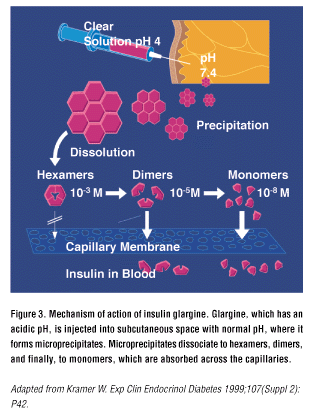
Yes, precipitates are solids. Lantus forms micro-precipitates so the solids would be microscopic. Technically they are crystals.

This deposit of precipitates is your depot/shed.

From "petdiabetes.wikia.com/wiki/Lantus":
White3.gif
 
Yes, precipitates are solids. Lantus forms micro-precipitates so the solids would be microscopic, technically they are crystals.

This deposit of precipitates is your depot/shed.

upon further research ~O) ...
When Lantus is first injected it forms into micro-precipitates (hexamers) that are too large to be absorbed and are put into "storage". They immediately start to break down and after 1-2 hours (ECID) the smaller (dimers) and smaller molecules (monomers) start to be absorbed (the shed doesn't have to be totally filled before any is available). This gradual process ensures that Lantus is slowly and steadily released. In a human study some Lantus is still at the injection site 24 hours (low dose) to 36 hours (high dose) after the injection! With a 12/12 hour injection schedule the next injection occurs well before the previous injection is gone resulting in 2 (or more) overlapping cycles. This carryover helps with Lantus’ already relatively flat curve.

Be aware that as you increase the dose, or are already using a large dose, the depot fills with more of the large precipitates and higher insulin concentrations causing the whole breakdown/diffusion/absorption process to slow down, you end up with a higher and longer duration insulin peak. A delayed shot is like a dose reduction because as the depot dissolves away its carry-over effect is continuing to be reduced for the next shot and cycle. After a long shot delay the process is refered to as refilling the shed, this is getting the 2 (or more) overlapping cyles back up to their full initial and carry-over strengths. It takes a couple cycles for the process to reach equilibrium again whenever you make a dose change.

You'll need to base the dose more on the nadirs than the pre-shot (see “Shooting &Handeling Low Numbers”!). The peak of these insulins is so late and the effect of the dose so long-lasting, well past the next shot, that the dose size is more likely to affect your next pre-shot than to have any effect on the immediate situation.

Did I mention ECID? ;-)
Be patient and go slow.

From "petdiabetes.wikia.com/wiki/Lantus":

White3.gif
 
Status
Not open for further replies.
Back
Top