
food fat content help

Status
Not open for further replies.

kalypso

Member Since 2019
Hello,
After an episode of vomitting of my 8yo cat (not diabetic and no other medical condition), and my vet suspicion of pancreatitis (due to great response on corresponding treatment), I am rearching food with respect to fat content.
So, I see that dr Pierson suggests moderate fat which is ~20-40% calories (https://catinfo.org/docs/CatFoodProteinFatCarbPhosphorusChart.pdf).
And then I look at % calories from fat in european wet food and most of them are too high!
For example if you see here: https://drive.google.com/file/d/0B-mMJBQ_r05GdDBEY0pWbURmRE0/view, granatapet which is considered one of the best available foods is 57% calories from fat! And mac's is 59.5%! These are the two brands I am alternating, and I thought they were great, so I am really surprised!
Why are these brands considered so good if they are so off the recommended fat levels? What would you suggest me to feed my cat?
I am really confused!
 
Hello,

What is "best available" may be the best available for felines that do not have any health issues. Once a cat is diagnosed with a medical condition, "best available" becomes what is necessary or best for a particular cats underlying medical condition. This becomes more complicated when there is more than one diagnosis such as pancreatitis &/or IBD with diabetes because now one needs to look at fat AND carbohydrate. In addition, some cats who have IBD require novel proteins due to food sensitivity or allergy, so that limits options. To go one step further, add a diagnosis such as CKD to the mix (which happens) & now phosphorous must also be looked at.

Moderate fat is what is currently recommended for cats with pancreatitis. With that being said, depending on your specific cat, a little more fat may be ok while it may not be great for another cat. Some of this, albeit a bit frustrating, is trial and error. Ultimately, find a few food options that meet the criteria you need (or are close) & then start there. Part of this process will be what the cat will eat. Even if you were to find the "perfect" can of food, or what seems like the most ideal food, the cat may choose one that is a little less perfect!

The best advice I have received from one of my vets is to become as patient as the cat is stubborn :). My boy is definitely strong willed so it is definitely is an exercise in patience :bighug: !
 
Last edited:
My cat is fortunatelly not picky with food. And she may have had pancreatitis, but the ~20-40% calories from fat recommendation is for healthy cats. So I am dissapointed to realize that food like granatapet and mac's are not within this range and are not really "best available" for any cat according to this recommendation.
Unfortunatelly, I am not aware of a specific % Kcals from fat recommendation for cats who have had pancreatitis, and neither do I know of any signs that show that a particular food is not good for her. But I understand that it should at least not be more than the 40% mentioned above. If anyone knows food available in europe that meets the criteria, or fat recommendations for pancreatitis cats, please let me know!
 
My cat has chronic pancreatitis, he was hospitalized twice this summer with pancreatitis. I have problems with the fat content in food for Buddy and what he will eat. At this time the only food he is eating is Dr. Elsey's dry chicken, I would like to find a wet food lower in fat that he will eat.
 
Hello Teresa!
What are his symptoms and how was he diagnosed? How do you tell if it is chronic or not?
My vet suspected my cat has had pancreatitis, I am not sure, but I am searching for food anyway.
Do you know how low fat should be for cats with pancreatitis?
Anyway, I saw Dr. Elsey's dry chicken dry weight analysis (don't know if it is guaranteed or typical) and derived the carb percentages:
52,18% protein, 39,39% fat, 8,42% carb.
I see that you are in the US, so you can check out this cat food database https://catinfo.org/chart/index.php,
set the mins and maxs you like and order the results. I would set min protein 50%, max carb 10%, max fat 40% and order by phosphorus (it better be low).
You are lucky because in the US you will find many options.
I think it is better to switch to wet food too. But if you want to find the % of a food not in the above database, you can input the typical analysis values in a calculator like this one: https://drive.google.com/file/d/1NOyUfaKxNa580Wnz-0c0_kRQgvlMJgnu/view
 
My cat was diagnosed years ago, he would not eat, throwing up , bad diarrhea. A vet can run a test for pancreatitis for cats, I think it is called Spec Fpl, that might not be exactly what it is, but it is close. I would not want even 25% fat, carbs no more than around 10%. I called Dr. Easley's, in the dry the fat is around 18% and the carbs are 5.98, their can food is low in fat and carbs, but Buddy will not eat it.
Good luck, I hope your kitty does well. Right now Buddy has a Uti and is taking his second round of antibiotics, which some cats with diabetes get often, which Buddy does.
 
I do not know what you should feed your cat, I am always looking for something that Buddy can eat. The fat really bothers Buddy, I don't know if your cat is as sensitive as Buddy.
 
My cat is fortunatelly not picky with food. And she may have had pancreatitis, but the ~20-40% calories from fat recommendation is for healthy cats. So I am dissapointed to realize that food like granatapet and mac's are not within this range and are not really "best available" for any cat according to this recommendation.
Unfortunatelly, I am not aware of a specific % Kcals from fat recommendation for cats who have had pancreatitis, and neither do I know of any signs that show that a particular food is not good for her. But I understand that it should at least not be more than the 40% mentioned above. If anyone knows food available in europe that meets the criteria, or fat recommendations for pancreatitis cats, please let me know!

That is awesome that she is not picky :)! It should make life a little bit easier with the food aspect at least.

My cat was initially diagnosed with pancreatitis back in July 2015. He was diagnosed using the SpecfPLI (https://www.idexx.com/files/spec-fpl-treatment-for-feline-pancreatitis.pdf) which is the most sensitive test at this point in time for diagnosing feline pancreatitis. It is highly reliable with moderate to severe pancreatitis but does have reliability to mild cases as well. There is also a rapid version called SNAPP fPL that can be taken in the vet's office to indicate if pancreatitis is most likely the problem, but to get the actual value it should be sent out to get the SpecfPLI to confirm the diagnosis. T also underwent subsequent abdominal ultrasound to further confirm the diagnosis back in Jan 2016. In addition, there was inflammation the liver which later resolved. He was prescribed Royal Canin Gastrointestinal Moderate Calorie wet food & has done well on that over the years. It is lower in fat. Unlike canine pancreatitis dietary fat intake is not typically worried about, however, for my T, like with your cat & Teresa's, it is a source of aggravation for T's gut. In addition, the current research shows that feline pancreatitis is generally associated with other inflammatory conditions, particularly IBD. It is definitely a challenge given that so many of the diets have a high percentage of fat! When T was first diagnosed with DM & I started looking at the various food choices, so many would be fantastic for DM but awful for his additional underlying medical issues. So, I chose a little more carbs & less fat & calories.

One additional note/resource. When looking at nutrients, make sure to not only determine %'s based on dry matter basis, but also take the calories into account. The nutrient amounts must be converted to the same unit amounts--units per 100 calories (kcal)-- to be able to compare foods aka apples to apples ;). I am attaching a link to the Cummings Vet Med Center Pet Foodology Page, specifically, the calculator to help with this, which may be helpful when looking for foods. It also has some other great information & you have an ability to subscribe to a newsletter.

https://vetnutrition.tufts.edu/2017/08/nutrient_converter/

I hope this helps in some small way :)!
 
Hello! thank you for your replys!
My cat used to have occasional mild diarrea, as well as bad breath, which hadn't concearned me. However last Monday, she was vomitting all day and cryed like she was in pain as I was told. As soon as I came home I took her to the vet who suspected pancreatitis and put her on a three day injection therapy with lincospectin, catosal, tagamet, bitamin K and metacam. She responded right away, so he suspects she did have pancreatitis. The intresting thing is that her bad breath problem disapeared too! Do you think it was pancreatitis? Now she seems fine (and with a great breath and that's great because she likes to lick me a lot), I don't know if I should test her with this test for chronic pancreatitis sometime, maybe I will if she vomits again.

But I have been looking for better food choices anyways. I do the transformation to % Kcals too. I use this excel https://drive.google.com/file/d/1NOyUfaKxNa580Wnz-0c0_kRQgvlMJgnu/view. It should be similar as your calculator, TSP.

Teresa, I also think you should do the calculation. Dr. Elsey's dry chicken fat is 18% on the guaranteed analysis. This is not even typical analysis, so it is just minimum 18% consistency. But this number is not useful because you must take out the water and then calculate the carbs in order to be able to get useful information and compare with other foods. When I tell you it is 39,39% Kcals fat, I have done these calculations.

I would also like to ask you, how do you guys understand that fat bothers your cat? Do you see some symptoms when she eats something with more fat?

TSP, my vet also suggested me Royal Canin Gastrointestinal. This is 34,41% Kcals fat, 28,7% Kcals carbs and 36,73% Kcals protein. Carbs are definetly high. Fat is within the range dr Pierson suggests (moderate fat which is ~20-40% calories), however this suggestion is for healthy cats. How low should fat be for pancreatitis cats (in %Kcals )? Have you seen this food database? https://catinfo.org/chart/index.php I would love to have had access to brands like tiky cat and weruva and a few others that offer some wet food within dr pierson's range and with low phosphorus too. I am looking for alternatives I can get here.
 
I’m in the US and my cat (not diabetic) was just diagnosed with IBD and is now on steroids, and I’m also struggling to find a low carb, low fat, high protein novel protein (venison or duck) food. The prescription limited ingredient foods are too high in carbs, and the non prescription limited ingredient food is too high in fat (60%). Even though she doesn’t have pancreatitis, I feel like 60% fat for a cat who has GI inflammation and can’t digest food properly is way too high, since it’s way out of the recommended rage for even a healthy cat. I would prefer not to give high carbs either given steroids and overweight status, I worry she might develop diabetes, and simply bc she doesn’t need those carbs, they’re empty calories. It’s been weeks and I still can’t figure out what I’m going to feed her, right now I just have her on the prescription dry and wet food that the vet gave us. I definitely feel your frustration that a more appropriate food doesn’t seem to exist!
 
Hello! thank you for your replys!
My cat used to have occasional mild diarrea, as well as bad breath, which hadn't concearned me. However last Monday, she was vomitting all day and cryed like she was in pain as I was told. As soon as I came home I took her to the vet who suspected pancreatitis and put her on a three day injection therapy with lincospectin, catosal, tagamet, bitamin K and metacam. She responded right away, so he suspects she did have pancreatitis. The intresting thing is that her bad breath problem disapeared too! Do you think it was pancreatitis? Now she seems fine (and with a great breath and that's great because she likes to lick me a lot), I don't know if I should test her with this test for chronic pancreatitis sometime, maybe I will if she vomits again.

But I have been looking for better food choices anyways. I do the transformation to % Kcals too. I use this excel https://drive.google.com/file/d/1NOyUfaKxNa580Wnz-0c0_kRQgvlMJgnu/view. It should be similar as your calculator, TSP.

Teresa, I also think you should do the calculation. Dr. Elsey's dry chicken fat is 18% on the guaranteed analysis. This is not even typical analysis, so it is just minimum 18% consistency. But this number is not useful because you must take out the water and then calculate the carbs in order to be able to get useful information and compare with other foods. When I tell you it is 39,39% Kcals fat, I have done these calculations.

I would also like to ask you, how do you guys understand that fat bothers your cat? Do you see some symptoms when she eats something with more fat?

TSP, my vet also suggested me Royal Canin Gastrointestinal. This is 34,41% Kcals fat, 28,7% Kcals carbs and 36,73% Kcals protein. Carbs are definetly high. Fat is within the range dr Pierson suggests (moderate fat which is ~20-40% calories), however this suggestion is for healthy cats. How low should fat be for pancreatitis cats (in %Kcals )? Have you seen this food database? https://catinfo.org/chart/index.php I would love to have had access to brands like tiky cat and weruva and a few others that offer some wet food within dr pierson's range and with low phosphorus too. I am looking for alternatives I can get here.


That is not accurate info for the Prescription RC Moderate Calorie wet food. We don’t use the dry so I cannot comment on the dry, but your info on the wet is not accurate. I actually revisited the nutrient content via a remote consult with one of the board certified Vet nutritionists (ACVM) who calculated the #s for the call.
 
Last edited:
Hi Ana, I feel for you, it seems there's a serious gap in the market there. It's really frustrating. Have you considered giving only wet food and averaging out with combination with a cooked no fat meal ?

That is not accurate info for the Prescription RC Moderate Calorie wet food. We don’t use the dry so I cannot comment on the dry, but your info on the wet is not accurate. I actually revisited the nutrient content via a remote consult with one of the board certified Vet nutritionists (ACVM) who calculated the #s for the call.

Hi TSP,do you mean the initial numbers are not accurate or the calculation? I used the numbers in zooplus for wet pouches (https://www.zooplus.co.uk/shop/cats...canin_vet_diet_wet_cat/veterinary_diet/516321).
I also checked with rc site, and I found a can with slightly different numbers https://www.royalcanin.com/us/cats/...rointestinal-moderate-calorie-canned-cat-food. These are stated as guaranteed analysis, so they are just mins and maxs, but they give 38,6% Kcals protein, 23,29% Kcals fat and 38,09% Kcals carbs. Is this the can you give? Can we check if our calculation results are similar?
 
Hi TSP,do you mean the initial numbers are not accurate or the calculation? I used the numbers in zooplus for wet pouches (https://www.zooplus.co.uk/shop/cats...canin_vet_diet_wet_cat/veterinary_diet/516321).
I also checked with rc site, and I found a can with slightly different numbers https://www.royalcanin.com/us/cats/...rointestinal-moderate-calorie-canned-cat-food. These are stated as guaranteed analysis, so they are just mins and maxs, but they give 38,6% Kcals protein, 23,29% Kcals fat and 38,09% Kcals carbs. Is this the can you give? Can we check if our calculation results are similar?[/QUOTE]

I am seeing you are in the UK, so I am not sure if the #s you are listing are world vs. U.S.?

When I use the RC link you attached, the #s you have listed are not the #s I see (not sure if it auto directing me to U.S. site & it is different?!). In any case, I contacted RC directly months ago (#1.800.592.6687) & they put me on the phone with a vet secondary to T's multiple health issues.

The Ash for the Prescription RC Mod Calorie is 1.4% and the Carbs (dry matter basis) is 6%. The Fat is 9.68% MAX (*the key word is MAX) so at MOST- 9.68% Fat. If you look at most of the foods, even with RC, with the exception of this particular food, Fat is listed as MIN which is an issue for cats who need lower to moderate fat diets. When the ACVM vet I consulted with, who actually specializes in pancreatitis, provided the nutrient content she based it on
100 kcal basis vs. just dry matter basis & as a result:

Calories per 3oz can= 60
Carb (g)= 7.9
Fat (g)= 3.7
Fiber= 2.0
Phosphorus (mg)= 280
Protein (g)= 9.9

One note with the RC Mod Cal food is there is a bit more fiber vs other wet foods so, depending on the cat, this can be helpful with managing BG but may cause gas in other cats. The rest of the nutrients are in line with the needs. Again, this is not a low carb food but it is not very high either. I will say that I agree with the vets with respect to looking for a lower carb food, but that it doesn't have to be super low with every cat. At one point within the last 2 months, T would not eat the RC & I gave him Tiki-Chicken which is slightly higher fat (but may have been higher because the listed % in MIN) & unlike the RC, it is a very low carb food. His BGs were not any different than when he ate the RC. I do not see spikes from the RC or even a dry food he ate occasionally when was diagnosed with DM. One reason may be how it is digested by his particular digestive system.

Another note that is interesting, from the call with RC, & it applies to looking at the nutrients with all foods, is that you really have to pay attention to the word MAX vs. MIN on the food. The vet who took the call told me that although their Prescription Mod Cal wet food & DM wet food both list fat on the website as 1.5%-wet matter, in actuality, the DM fat content is going to be much higher. Again, when they use the word MIN next to protein & fat, you may actually be getting much higher fat content than you would even imagine. It is not uncommon practice for companies to use fatty meat vs the lean meat for the foods. I will say that the tiki chicken looked pretty lean but it was also very dry looking (except for the broth it was in) so who knows?

Since you are in the UK & I have no idea if ingredients are slightly different, I would highly recommend giving RC customer service a call. Let them know your specific needs secondary to medical issues so they get you an appropriate person on the phone.
 
I’m in the US and my cat (not diabetic) was just diagnosed with IBD and is now on steroids, and I’m also struggling to find a low carb, low fat, high protein novel protein (venison or duck) food. The prescription limited ingredient foods are too high in carbs, and the non prescription limited ingredient food is too high in fat (60%). Even though she doesn’t have pancreatitis, I feel like 60% fat for a cat who has GI inflammation and can’t digest food properly is way too high, since it’s way out of the recommended rage for even a healthy cat. I would prefer not to give high carbs either given steroids and overweight status, I worry she might develop diabetes, and simply bc she doesn’t need those carbs, they’re empty calories. It’s been weeks and I still can’t figure out what I’m going to feed her, right now I just have her on the prescription dry and wet food that the vet gave us. I definitely feel your frustration that a more appropriate food doesn’t seem to exist!


Knows that you are not alone with your situation AND frustrating with the food:banghead:. There is also rabbit & that is lower in fat than duck. One thing to keep in mind is you can always use the RX food for a limited time just to identify what is or isn't a problem for your particular cats IBD aka elimination trial. Once you do that & you get some information, there is the ability to look at over the counter foods that will probably fit your needs better & you will have many more options. The prescription limited ingredient diets are highly recommended at first because quite a few of the "limited" ingredient diets off the shelves are in fact not extremely limited with the ingredients. For example, one food that say limited ingredient rabbit, but when you look at the actual ingredients, there are also mussels in the food! Hopefully in a short time you will be able to figure out if the diet helps/doesn't help, what aggravates the IBD, what doesn't & then you move to the next step & refine the food by using other options outside the prescription foods currently being offered.
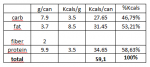
 
Hi TSP, I am in greece, but the values I see for the can are from the US rc site (if you notice, "us" is in the url and I don't get redirected). On the site they list the guaranteed analysis (mins and maxes), whereas I suppose that the values they gave you is the typical analysis (exact values). It is however expressed in weight (g) and not in % Kcals. If you want to calculate the Kcals, you have to multiply carbs and protein by 3.5 and fat by 8.5, as fat contributes more calories than the other two. If you do this, you will get a total of 93.75 Kcals, which does not verify the number 60 Kcals per can they gave you. So, the % Kcals we get from the typical analysis are as follows:
upload_2019-10-21_16-37-43.png

I will email them for the typical analysis myself and get back!
 

Attachments

  • upload_2019-10-21_16-32-45.png
    upload_2019-10-21_16-32-45.png
    4.7 KB · Views: 154
Hi TSP, I am in greece, but the values I see for the can are from the US rc site (if you notice, "us" is in the url and I don't get redirected). On the site they list the guaranteed analysis (mins and maxes), whereas I suppose that the values they gave you is the typical analysis (exact values). It is however expressed in weight (g) and not in % Kcals. If you want to calculate the Kcals, you have to multiply carbs and protein by 3.5 and fat by 8.5, as fat contributes more calories than the other two. If you do this, you will get a total of 93.75 Kcals, which does not verify the number 60 Kcals per can they gave you. So, the % Kcals we get from the typical analysis are as follows:
View attachment 48555
I will email them for the typical analysis myself and get back!

The values that RC gave me are exact values based dry matter basis & are percentages not grams & also not based on kcal. Again, RC did NOT convert the nutrients on a per 100 kcal basis, however, the Board Certified Vet Nutritionist Vet out of Ohio State University that I did the remote consult with did convert the values for me & those are in GRAMS not %. I trust that between the 2 sources that the #s I have are correct. I have also had local vets look at & confirm the info. At the end of the day, he has been eating it since 2015 & has done extremely well on it, so I am actually happy with it. The fact that it is primarily pork is also key for T since we have recently discovered that he does have some sensitivity to chicken. Ideally, I would love to find something that has no chicken at all to see if that helps anything, but in the meantime, this works well for his issues, including the DM.

RC customer support is very helpful so I am sure they will be happy to assist you.
 
Last edited:
Our cat is definitely the ultimate judge, so I am happy that you found a food that your cat is so well on :)!
I on the other hand cannot tell differences in my cat among different wet food, so I was just trying to verify my calculations, because I use the same on the analysis of many different brands and wet food.
 
Our cat is definitely the ultimate judge, so I am happy that you found a food that your cat is so well on :)!
I on the other hand cannot tell differences in my cat among different wet food, so I was just trying to verify my calculations, because I use the same on the analysis of many different brands and wet food.
Definitely let us know what RC tells you. I am curious if there are any differences, even minor, for US vs UK. It would be good for others to know if there is a difference!
 
Hello TSP!
They just replied. It was rc US (info.usa@royalcanin.com), I didn't find any other email in EU.
Unfortunately it is in units of weight and I don't know how to transform these in %Kcals so I can compare with other food.
What values did they give you?

upload_2019-10-23_18-43-14.png
 
When I spoke with RC directly, they said carbohydrates are 6% based on dry matter basis.

The ACVN (American Board Certified Vet Nutritionist) did her nutrient calculation based on 100 kcal using grams & it is 7.9 grams based on a 100 kcal (see my post in this thread from a few days ago) which is exactly the # this RCs chart shows for Carbs (you just have to convert into 100 kcal vs 1000kcal).
 
At this time Buddy is only eating Dr.Elsey's dry, recently I called Dr. Elsey's and spoke to Theresa, she said the fat in the dry is 18%. With dry food it is always on a dry matter basis, you do not need to take the water out. If this is wrong please correct me.
Buddy's vet does not sell Royal Canin, but I sure would like to try what TSP is eating on Buddy.

Good to see you Ana.
 
@ Teresa & buddy If you can get a prescription for it from your vet, you are able to order it from Chewy. Just make sure to get the moderate calorie formula :). I purchased the Tot OXO food masher off of Amazon to smash the squares into the gravy (https://www.oxo.com/food-masher-1769.html) Otherwise my cats love to lick all the gravy off & leave the squares :banghead:. However, that gravy has come in handy when T has had a few low numbers! I just tear open the 3oz can & let him start licking!! He can get just enough & then squares get in the way so that he doesn’t get too much when it’s not needed :)
 
Hi Teresa!
You do need to take the water content out from dry food too, in order to get the dry matter basis (it is listed as moisture).
If you see the analysis provided for dr Elsey's chicken (https://www.drelseys.com/products/chicken-recipe/), moisture is 12%.
Also, this is a guaranteed (not typical) analysis, so 18% fat is actually a minimum (and 12% moisture is a maximum).
They do have a dry weight analysis below (where they have taken the water out), where fat is listed as 19,46%, but it is not clear to me if it is still a minimum or not.
Hi TSP thanks for your reply!
Could you give me the percentage values they gave you from rc?
 
That is the % for CARBS-6%
ASH (which is not listed)- 1.4%
FAT MAX- 9.68%

All of these #s are DRY MATTER. If you go onto the website you will be able to calculate the rest by having the #s I just provided for you
 
@ Teresa & buddy If you can get a prescription for it from your vet, you are able to order it from Chewy. Just make sure to get the moderate calorie formula :). I purchased the Tot OXO food masher off of Amazon to smash the squares into the gravy (https://www.oxo.com/food-masher-1769.html) Otherwise my cats love to lick all the gravy off & leave the squares :banghead:. However, that gravy has come in handy when T has had a few low numbers! I just tear open the 3oz can & let him start licking!! He can get just enough & then squares get in the way so that he doesn’t get too much when it’s not needed :)
My vet will write me a prescription, but I do not know if Buddy will eat it, he has a lot of food aversions from having so much nausea. I have had samples of food sent here and he ate them like he loved them, them I would order on line, when we got them he would not have any thing to do with them. Right now I have 2 cases of 24 cans each of canned food that he will not eat.
 
Hi Teresa!
You do need to take the water content out from dry food too, in order to get the dry matter basis (it is listed as moisture).
If you see the analysis provided for dr Elsey's chicken (https://www.drelseys.com/products/chicken-recipe/), moisture is 12%.
Also, this is a guaranteed (not typical) analysis, so 18% fat is actually a minimum (and 12% moisture is a maximum).
They do have a dry weight analysis below (where they have taken the water out), where fat is listed as 19,46%, but it is not clear to me if it is still a minimum or not.
Hi TSP thanks for your reply!
Could you give me the percentage values they gave you from rc?
where did you see the fat listed as 19,46%, that is a lot of fat.
 
where did you see the fat listed as 19,46%, that is a lot of fat.
In the manufacturers site for the food in the link I gave you (https://www.drelseys.com/products/chicken-recipe/), scroll down and press "Nutrition".
Under "guaranteed analysis" it lists 18% fat minimum and under "dry weight" it lists 19,46% fat.
(again, I am not sure if 19,46% is minimum too or not)

But you also need to transform to % of calories in order to get meaningful information. If you input the above "dry weight" values in a calculator like this one (https://drive.google.com/file/d/1NOyUfaKxNa580Wnz-0c0_kRQgvlMJgnu/view), you will get 52,18% Kcals protein, 39,39% Kcals fat and 8,43% Kcals carbs. These are within the ranges suggested for healthy cats by dr Pierson. However fat that we're intrested in is almost on the upper limit. So it is not really a low fat food.
 
Last edited:
Hello TSP!
They just replied. It was rc US (info.usa@royalcanin.com), I didn't find any other email in EU.
Unfortunately it is in units of weight and I don't know how to transform these in %Kcals so I can compare with other food.
What values did they give you?

View attachment 48593

About rc feline gastrointestinal moderate fat cans, I transformed the typical analysis I got from rc from calorie content basis (g per 1000 Kcal) to % Kcals. Fat seems moderate, but protein is low and carb is very high.
upload_2019-10-25_12-28-0.png
 
@Teresa & Buddy

The fat is definitely 9..68% and that is MAX (PLEASE call customer service at RC if you need to). That is % DRY matter. If you break the nutrients of the product down by 100 kcal instead of just dry matter % it is 3.7 grams. This was actually double checked & confirmed by an American Board Certified Vet Nutritionist from OSU for me for a recent nutrition consult. So if you take the 37 & divide by 10 to break it down from 1000kcal to 100kcal, you get the 3.7 grams :)! Again, my T cannot tolerate high fat.

Chewy will provide refunds if your cat will not eat the product, even if you have used some cans. They refund your credit card & then tell you to donate the food. They are really understanding.
 
Hi Teresa! We don't disagree!
Fat is indeed 3,7g per 100 Kcals. You can see int on the first column in my calculations (37 g per 1000 Kcal).
However, fat contributes more than double calories than protein and carbs (see coefficients in second column).
So 30,79% is the percent of Kcals contributed by fat. I use this metric of % Kcals to compare foods because this is proposed by dr Pierson.
 
I quote from here https://vetgirlontherun.com/interpr...aHTpyLXULF6Cbfm74kGbbJw3QsxPk08rg2WJMmJbgj_vc
"There are four common ways of expressing nutrient composition of pet food:
  1. As fed percent (grams of nutrient per 100 grams of food on an as fed basis)
  2. Dry matter percent (grams of nutrient per 100 grams of food on dry matter basis)
  3. Calorie content basis (grams of nutrient per 100 kcal or 1000 kcal of food)
  4. Percent metabolizable energy (ME) (percent of calories coming from protein, fat, and carbohydrate)"
So, 9.69% is dry matter percent (maximum though) (no 2)
3,7 g is calorie content bases per 100 Kcal (no 3)
30,79% is percent metabolizable energy (no 4)
 
Hi Teresa! We don't disagree!
Fat is indeed 3,7g per 100 Kcals. You can see int on the first column in my calculations (37 g per 1000 Kcal).
However, fat contributes more than double calories than protein and carbs (see coefficients in second column).
So 30,79% is the percent of Kcals contributed by fat. I use this metric of % Kcals to compare foods because this is proposed by dr Pierson.

I hope we haven’t confused people reading this :)!
It is definitely challenging finding perfect foods & what I have found is when you go lower carb the fat is very high & when you reduce the fat, the carbs often become higher. If you the need something other than chicken or fish to be the primary protein source it becomes even more difficult.

I think it is worth trying a food to see if it will work. Otherwise, honestly, the saying “Analysis Paralysis” comes to mind :)! Definitely look at the nutrients & try to find some options that are close to what your cat needs as possible and more important, that the cat will eat & tolerate :bighug:

Also, definitely make sure to look at the total calorie amount for a particular food & how much your cat is eating . At the end of the day, no matter what the calculation of the nutrients, if your cat is eating more calories than it needs, it will lead to obesity which contributes to insulin resistance.
 
Last edited:
I hope we haven’t confused people reading this :)!
It is definitely challenging finding perfect foods & what I have found is when you go lower carb the fat is very high & when you reduce the fat, the carbs often become higher. If you the need something other than chicken or fish to be the primary protein source it becomes even more difficult.

I think it is worth trying a food to see if it will work. Otherwise, honestly, the saying “Analysis Paralysis” comes to mind :)! Definitely look at the nutrients & try to find some options that are close to what your cat needs as possible and more important, that the cat will eat & tolerate :bighug:

Also, definitely make sure to look at the total calorie amount for a particular food & how much your car is eating . At the end of the day, no matter what the calculation of the nutrients, if your cat is eating more calories than it needs, it will lead to obesity which contributes to insulin resistance.

:bighug: I hope we haven't caused any confusion too! It's definitelly a challenge trying to read nutrients and evaluate food and also a process that never seems to end! It's also frustrating to realize that food companies add carbs or fat to save on meat protein. But it's never bad to be aware of what compromizes you are making. :)
If it makes sense, the measure of "percent metabolizable energy" is useful just because it takes out differences in calorie content among different food (like needing twice as much grams of a food to get the same calories).
 
But that is where is gets very tricky even if you use that formula & think.most of the calories are coming from one nutrient vs another. Many foods list protein as minimum and fat as minimum so you may think based on your calculation that you are getting more protein but you are not! In addition, If you dive into this even further, there is the question of the quality of that protein & that is another issue. I am going to try some homemade diets so that I have complete control over the quality & type of protein (and fat) and hope my cat will eat it. Some cats are tough & refuse to eat them! I figure it is worth a try!
 
But that is where is gets very tricky even if you use that formula & think.most of the calories are coming from one nutrient vs another. Many foods list protein as minimum and fat as minimum so you may think based on your calculation that you are getting more protein but you are not! In addition, If you dive into this even further, there is the question of the quality of that protein & that is another issue. I am going to try some homemade diets so that I have complete control over the quality & type of protein (and fat) and hope my cat will eat it. Some cats are tough & refuse to eat them! I figure it is worth a try!

It is indeed tricky, I know. Analysis with maxs and mins is the so called "guaranteed analysis" as opposed to the "typical analysis" where they are exact numbers. This is why I asked rc for the typical analysis. But even if you start from guaranteed analysis, it is better to convert to % Kcals in order to compare different food.
About quality, yes you need to also check actual ingreedients to see if protein is actually animal protein rather than plant protein (if for instance peas or sth is high in ingredients list). And then it should better be like chicken meat than meat in general or than derivatives. It's complicated :(.
 
It is indeed tricky, I know. Analysis with maxs and mins is the so called "guaranteed analysis" as opposed to the "typical analysis" where they are exact numbers. This is why I asked rc for the typical analysis. But even if you start from guaranteed analysis, it is better to convert to % Kcals in order to compare different food.
About quality, yes you need to also check actual ingreedients to see if protein is actually animal protein rather than plant protein (if for instance peas or sth is high in ingredients list). And then it should better be like chicken meat than meat in general or than derivatives. It's complicated :(.

And actually, many say stay away from chicken as it is a common allergen for cats—it is definitely a sensitivity for mine. Some say it’s what the chicken was fed, but even homemade organic grass fed chicken causes an issue for mine. Others say do not feed fish. Then there is some recent data about pea protein. I know Dr Piersons info is really amazing but I have also reached out to some vets who are nutritionists & currently studying/researching nutrition in order to expand my knowledge beyond one persons thought process. It is interesting how there are so many absolutes out there re: protein sources or fiber content etc yet, it doesn’t always apply to every cat. It is much more complicated than the cat is a carnivore, feed it meat & they will be healthy. Again, I like the basic info for a place to start, but I have found it interesting to talk with some additional vet nutritionists to hear what they are finding with respect to diet :).

Hopefully @Teresa & Buddy is able to find a food that will work best. I have found that patience is key & I am thankful my boy currently has something that he will eat that isn’t causing issues while I try to find additional options.
 
Sorry, I know chicken is said to be common allergen among cats. I just wanted to say, its better when meat of specific animals is listed in the ingredients(than meat in general or derivatives). Please share any new information about cat food you learn!
 
No apology necessary! I am enjoying the deep dive into this topic :)! Even with Metabolized Energy there are different formulas that are used & then there is actually some recent published literature citing that Gross Energy improves ME predictive equations. There is so much to try to factor in. They are also factoring in complex carbs vs non complex carb sources. There is a lot to read, learn & figure out how it applies to your individual cat.
 
I quote from here https://vetgirlontherun.com/interpr...aHTpyLXULF6Cbfm74kGbbJw3QsxPk08rg2WJMmJbgj_vc
"There are four common ways of expressing nutrient composition of pet food:
  1. As fed percent (grams of nutrient per 100 grams of food on an as fed basis)
  2. Dry matter percent (grams of nutrient per 100 grams of food on dry matter basis)
  3. Calorie content basis (grams of nutrient per 100 kcal or 1000 kcal of food)
  4. Percent metabolizable energy (ME) (percent of calories coming from protein, fat, and carbohydrate)"
So, 9.69% is dry matter percent (maximum though) (no 2)
3,7 g is calorie content bases per 100 Kcal (no 3)
30,79% is percent metabolizable energy (no 4)
I have no idea what you are talking bout when you say something is based on kcal and really I don't care. All I know is that Buddy is very sensitive to fat and he can eat dr.esley's dry chicken without getting sick, that is all that matters to me, no matter what the nutrient composition is.
 
@Teresa & Buddy

The fat is definitely 9..68% and that is MAX (PLEASE call customer service at RC if you need to). That is % DRY matter. If you break the nutrients of the product down by 100 kcal instead of just dry matter % it is 3.7 grams. This was actually double checked & confirmed by an American Board Certified Vet Nutritionist from OSU for me for a recent nutrition consult. So if you take the 37 & divide by 10 to break it down from 1000kcal to 100kcal, you get the 3.7 grams :)! Again, my T cannot tolerate high fat.

Chewy will provide refunds if your cat will not eat the product, even if you have used some cans. They refund your credit card & then tell you to donate the food. They are really understanding.
I know I have done this lot of time, every time I order something he will not eat it. I am really embarrassed.
 
I have no idea what you are talking bout when you say something is based on kcal and really I don't care. All I know is that Buddy is very sensitive to fat and he can eat dr.esley's dry chicken without getting sick, that is all that matters to me, no matter what the nutrient composition is.

Amen to that! :bighug:The cat must eat. You do your best to come as close as you can to what the cat needs for its health issues & go from there. At the end of the day you can compare foods & do kcal until your head hurts & yet, because each cat is going to metabolize it differently—especially if there is IBD—it goes out the window to some extent!!
 
What flavor is this cat food from Royal Canin, I wish I could find a vet that would sell me a couple cans.

It is a chicken flavor but not an overwhelming smelling chicken. My boy loves chicken so apparently it is a close enough smell that he will eat it!
 
It is a chicken flavor but not an overwhelming smelling chicken. My boy loves chicken so apparently it is a close enough smell that he will eat it!
For some reason Buddy loves liver flavor, his favorite wet cat food is FF grilled chicken & liver, he has not had any for almost a year because it made him sick. Recently his vet sold us some Hill's wet food that had liver flavoring and he loved it, but it had too much fat and he got sick. I just wondered if by some chance it had liver.
 
For some reason Buddy loves liver flavor, his favorite wet cat food is FF grilled chicken & liver, he has not had any for almost a year because it made him sick. Recently his vet sold us some Hill's wet food that had liver flavoring and he loved it, but it had too much fat and he got sick. I just wondered if by some chance it had liver.

It may have chicken liver. The food is brown & definitely doesn’t smell like a chicken food given that is pork & chicken. It’s one of those things that you never know until you offer it to him :)
 
Status
Not open for further replies.
Back
Top