
First shots and failure with the meter - but now she threw up

Status
Not open for further replies.

Berta and Louise

Member Since 2016
We took Louise to the vet yesterday. He sedated her, took sterile urine, and sent it out for labs to make sure that she has no infections. She doesn't seem to have any infection symptoms, so that's good. When we went to pick her up, he and the vet tech demonstrated how to take the blood glucose levels, we talked about nutrition, and he taught us how to give the insulin shots, and how to notate what you have done. She has long hair, so he shaved a spot on her back, and on her ears so we know where to give the shot and find the veins easily. They took a reading of 401 (earlier he said it had been 497, but attributed the high numbers to stress of being at the office). He is very cautious. We are using Vetsulin, 2u twice a day. We gave the first real shot last evening - she was still a bit sedated, so it wasn't too bad. She was ravenous when she came home from the vet, and ate the new food with no problem. We had been free feeding them dry food - bad idea - and giving Fancy Feast twice a day.
This morning, we weren't so lucky. Tried to take the blood glucose at 8:30 am - epic fail - twice. I think I didn't have the needle against the skin, but too far out. Damn.
She didn't want to eat until almost 10:30. Our vet said - no insulin without food. Better to skip one than to the insulin without her having a meal. So, after she ate, we gave the shot - a little harder than yesterday, but okay. We watched her, and she seemed just fine. Several hours later, she threw up - all pale yellow liquid. She seems fine - no symptoms of hypo that I saw on the sheet or the vet told us about. But I don't know if her numbers may be too high - what are those symptoms?
Should I be worried?
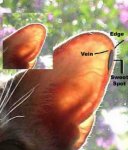
 
hi. are you using lancing device or just the needle to prick the ear? and has she vomited at all since the first one?
 

Attachments

  • 28ecb8dd.jpg
    28ecb8dd.jpg
    23.4 KB · Views: 53
We are using the lancing device.
And she threw up 5 hours later, just once. She seemed to be looking for food later, so we gave her a few pieces of kibble. She ate ravenously. We are waiting the 12 hours to really feed again - no more free feeding.
Right now she is sitting in the window in the sun, enjoy the spring breeze.
 
We are using the lancing device.
And she threw up 5 hours later, just once. She seemed to be looking for food later, so we gave her a few pieces of kibble. She ate ravenously. We are waiting the 12 hours to really feed again - no more free feeding.
Right now she is sitting in the window in the sun, enjoy the spring breeze.
Take the cap off the lancing device so you can see the needle. its a lot easier to do it like that and see where to prick the vein.
 
It could be an empty stomach issue or low blood sugar. In either instance if it were my cat I would give it some food. I'd also give the vet a quick call for advice. If at all possible, I'd recommend that you have another go at getting a BG measurement. Try warming the ear a lot longer than you might think is necessary. (Helps a lot during the early days of testing.)

Though only formed on the basis of anecdotal evidence witnessed here and in my own cat, I think that starting insulin treatment can upset some cats' digestive systems. (Lantus can cause GI upsets in humans.)

Until you're home testing if your cat gets insistent on eating a couple of hours after giving the Vetsulin if I were in your shoes I'd feed the cat.


Mogs
.
 
Thanks ! I will feed her a bit now, and see how she feels about it. But will save the larger meal for before her shot. I'm sure you are right about the stomach upset, because she is acting happy and relaxed other than that. Thank heavens for this group..... and your good advice!
 
If it were my cat on insulin and I hadn't a clue what her blood glucose levels were at and she was really hungry I would feed my cat. Other members may have different suggestions for you.

Keep at the testing. Even if you don't get a blood sample at each attempt, the very act of poking at the test zones will encourage more capillaries to grow there and it will get easier and easier to get a sample to test. I was actually very surprised at how warm I needed to get Saoirse's ear when I first started testing.


Mogs
.
 
will save the larger meal for before her shot.
When Saoirse was on Caninsulin (UK brand name for Vetsulin) I gave her half of her 12-hour food allowance before giving her the insulin injection. It's recommended to feed and then wait 20-30 minutes before giving the Vetsulin injection so as to give the body a bit of a head start to get the glucose into the bloodstream ready for the insulin to start working on at onset.

Given that you're not able to reliably test at the moment, keep an eye out for any uptick in appetite after the insulin is injected. With Saoirse somewhere between 1-2 hours after the dose was given she'd look for some food. That's a relatively good flag that the insulin dose is kicking in (onset). Nadir is typically between +3 and +5 hours after the dose was given (though not always) but if you are able to monitor Louise's behaviours and appetite a bit more closely between +2 and +6 it may give you a heads-up about whether she might be going low. Crude, I know, but better than nothing. Once you get the testing down pat it will take an awful lot of guesswork and worry out of the mix. :)


Mogs
.

ETA:

Should have added earlier that it is VITAL for the cat to have the largest feed in a cycle before giving a dose of Vetsulin/Caninsulin.
 
Last edited:
I'm learning that the advice to feed a cat on insulin every 12 hours may not be best for all cats. Sometimes cats on insulin will have hypo episodes and need access to a little food. In fact, they often know that they need to eat because of the actions of the insulin. Make some food available until you get a good feel of how she responds to the insulin.
 
Have you tried warming up her ear with a warmed rice sock or massage? You can also put a dab of neosporin on the ear to make the drop of blood stay as a droplet instead of dispersing into the fur. This was advice from the AlphaTrak2 booklet, though I haven't had to try that yet.
 
Hi Berta,

It might well be a stomach issue.
When cats go without food for any length of time the acid can build up in the stomach as it 'anticipates' it's next meal. That build up of stomach acid can - in the absence of food - irritate the stomach itself, causing the cat to puke. (Or maybe it's the cat's natural way of ridding itself of excess acid...? Hmmm....)

There seem to have been a few instances of this lately on the forum (or on the FB group - I can't remember!) but the solution to this is to not let the cat go too long without food. In the cases where I've seen this the cat was being fed just twice a day. Smaller, more frequent meals can be much easier on the cat's system.

And with Vetsulin/Caninsulin it can be helpful to feed a snack (or portion of a main meal) 1.5 to 2 hours after the insulin shot, to temper the effects of the insulin (Vetsulin/Caninsulin can drop the blood glucose quite fast in some cats, and the snack can help to slow that down.)
This page has some helpful info on Vetsulin/Caninsulin:
Vetsulin/Caninsulin user guide

Or it may be that something else caused your kitty to puke. It's furball season here in the UK. Maybe it is where you are too...?

Eliz
 
Tried to take the blood glucose at 8:30 am - epic fail - twice.
Do be kind to yourself.
The most important point is not that you 'failed' but that you 'tried'. :bighug:
Don't worry, it can take a few goes to hang of it, like learning anything new.

At times when you're not attempting a test, it can be helpful to gently hold or massage the cat's ear for just a couple of seconds and then immediately reward with a treat. This can soon help the kitty to associate 'ear contact' with yummy treats. Similarly, you can click the lancing device or rattle the test strip vial and reward with a treat.

Other things that helped me with testing:
1. Warm Ears: Warm ears bleed infinitely more easily than cold ones. Massaging the ear briefly, or holding something warm against the inside of the ear can really help with that (some people use a pill bottle filled with warm water).
2. Vaseline: A teensy weensy smear of Vaseline on the edge of the ear can help the blood to 'bead up' rather than disappear into the fur.
3. Putting a little pressure against the inside of the ear (opposite to where you're pricking): The lancet needs something to 'resist', otherwise it can sometimes just push the ear away rather than pricking it. You can use a bit of cotton wool or folded tissue. (I usually just use my fingertip these days but do sometimes end up taking a blood sample from myself that way.... ;) )
4. Two ear pricks close together can often produce enough blood for a test where one ear prick might not.
5. Massaging immediately below the ear prick can 'milk' more blood out. I almost always do this unless I'm blessed with testing a very warm ear.
6. Always reward the kitty for attempted tests whether successful or not.

I'm sure you will soon get the hang of this. :cat:

Eliz
 
Thank you, thank you! Took your advice and am feeding her a little when she asks - but only a little so she will eat before the shot. Always feeding before the shot - and hope we can get the testing this afternoon. She seems fine today - no throwing up. Alternating sleeping and cuddling with her dad. And as sassy as usual. She is the most skittish of the three.
Will try your advice about the testing this afternoon..... Wish us luck...
 
Status
Not open for further replies.
Back
Top