GA Diabetes Ketoacidosis (DKA)

Status
Not open for further replies.

Kiera Richardson

Member Since 2023
Hello all

Found this message board by recommendation and can really use some advice.

I’m new to the feline diabetes world as my cat, Kush was just diagnosed with Diabetes in November.

The vet has put her on Caninsulin for about a month now. After doing well on her initial dosage (0.01ml or 1 unit), she relapsed and was withdrawn and losing her appetite. The vet then asked me to increase her insulin dosage (0.02ml or 2 units).

Kush did well on her new dosage for about 3 weeks then relapsed again but this time, I knew something was very wrong. She was extremely lethargic, vomiting, not eating at all and was losing so much weight! I rushed her to an emergency vet and they suspect she’s got DKA, diabetes Ketoacidosis.

Her blood work came back with very mild ketones in it so the vet thinks we’ve caught DKA very early. She also doesn’t have any indication that her vital organs (liver, kidney, pancreas) are doing poorly. So I’m really not sure how my cat’s got DKA as I understand it, cats must have a second underlying condition to have caused DKA.

At the minute, Kush’s latest blood work shows no more ketones. But she’s still not eating on her own that they had to give her a nasogastric tube, a feeding tube to make sure she’s got enough nutrients before they give her insulin.

I’ve been worried sick. I hear it’s life threatening. I want Kush back, happy and healthy. Does anyone have a similar experience here and how did your cat do? Thank you.
 
Welcome Kiera and Kush
I'm so sorry you and Kush are going through this
Is Kush in the hospital right now
I'm going to tag a few experienced members for you
@Wendy&Neko
@Sienne and Gabby (GA)
@Suzanne & Darcy
@Marje and Gracie
@Bron and Sheba (GA)

Thank you so so much. I’m new to this board so not sure how to get the post out there.

Yes Kush has been in a 24/7 hospital since Christmas Day when she was diagnosed with DKA. It’s been about 2 days now since she’s been hospitalised.

Although the blood work comes back looking like she’s somewhat responding to the treatment, I just cannot grasp how she’s physically so sick and not wanting to eat. My poor baby.
 
Hopefully one of the members I tagged will reply soon.

Before this happened were you home testing?
While waiting
I'm going to give you a link ,it's information we need about Kush
Here is a link helping us to help you link. If you noticed, our members have some basic information about their cat's in their signature. This helps us to not pester you by asking the same questions (your cat's name, insulin type, date of diagnosis, etc.) repeatedly. We also have a link to our spreadsheet in our signature. We are very numbers driven. The spreadsheet is a record of your cat's progress. By linking it in your signature, we can follow along and provide feedback should you need the help

Take a look at mine ,it's at the end of every members posts in gray letters
If you want help setting up our spreadsheet just ask we have a member who will help you.
I'll give you the link anyway if you want to give it a try, it will also explain how to use it
https://felinediabetes.com/FDMB/threads/how-to-create-a-spreadsheet.241706/
 
Oh I'm so sorry that you're going through all this right now! I hope your kitty feels better soon.

Looks like Diane has tagged many people who can help and have experience with DKA. I'm not one of them, but I can tell you that Vetsulin is not the preferred insulin for cats. It was actually created for dogs, who have a faster metabolism. Vetsulin results in fast, steep drops in blood sugar, which can be dangerous. It's also not as long-acting as other insulins. I believe Vetsulin typically lasts from 8-10 hours whereas something like Lantus lasts 12 hours. Lantus and Prozinc are much better and safer insulins for kitties. This probably doesn't help you much while Kush is in the hospital, but it can be helpful after he gets out. You might want to talk to your vet about switching insulins once the DKA is resolved.

Good for you for recognizing the signs that something wasn't right with Kush and getting them to the emergency vet. You definitely did the right thing there!
 
Welcome to FDMB.

DKA can be a life threatening condition and your instincts to get your cat to the emergency vet were on target. That said, many of us, myself included, have had cats who were survivors of DKA. I had two vets prepare me that my cat might not survive. At the time, she was just diagnosed with diabetes and we were not only dealing with DKA but pancreatitis and hepatic lipidosis, as well. She did and lived for 6.5 more years and never had another episode of DKA.

It depends on what you mean by an "underlying condition" when it comes to DKA. The basic recipe is an infection or inflammation + not enough insulin + not enough calories. The infection or inflammation may not be something terribly obvious such as gingivitis (i.e., dental tartar causing a gum inflammation) or pancreatitis. The early signs of pancreatis are sometimes overlooked and a test for pancreatitis (i.e., Spec fPL) is not part of a routine blood panel. Your vet may have an in-office test, the Snap fPL, available.

If Kush isn't eating, a feeding tube is a very good idea. I'm assuming the vet has your cat on fluids and is testing for electrolyte levels at minimum once a day. In particular, potassium, phosphorus, and sodium need to be monitored. All of the fluid levels can change rapidly so monitoring is key. In addition to calories and getting Kush out of metabolic acidosis, insulin is also important. Most vets use a quicker acting insulin (i.e., Regular insulin -- also called Humulin R or Novolin R) that act very quickly and can have a big impact on blood glucose levels. As ketones become under control, this is switched to a basal-bolus approach. A longer acting insulin is included or substituted. This gives you a baseline level of insulin. A bolus insulin, such as Regular insulin, is added as needed. This is a good paper on DKA -- it's a bit old and a bit technical but will give you a solid idea of what is done treat DKA.

You will need to be prepared to monitor Kush once he's home. Home testing will be an important tool at your disposal. You can also purchase Ketostix to test your cat's urine for ketones. There are also ketone meters that you can use to test your cat's blood for ketones.

I'm guessing you're not in the US -- Caninsulin is referred to as Vetsulin here. The American Animal Hospital Assn has not recommended Caninsulin for the treatment of feline diabetes since 2018. It does not have the duration needed given a cat's fast metabolism. Rather, glargine (e.g., Lantus or one of the generic/biosimilars) or Prozinc are the two insulins that are recommended for treating feline diabetes. Please discuss this with your vet. If you're in Canada, in most parts of the country, you don't need a prescription for Lantus/glargine. It's a human insulin and available at any pharmacy. (You will need different syringes. Caninsulin is a U40 syringe whereas Lantus is a U100 syringe.)

Please let us know how we can help. When my kitty was diagnosed with diabetes and DKA I was a wreck. Many of us have been in your shoes and know how stressful this is.
 
Last edited:
Kiera,
I'm so glad you found the group for both you and Kush. Welcome.

I was in almost the same shoes you are in just 3 months ago. You aren't alone. Unfortunately, this is more common than any of us would like.

Posting questions here and communicating with the senior members will help you and Kush tremendously throughout this entire ordeal. Knowing you aren't alone helps too.

Each of us are here to help in any way we can.
 
After doing well on her initial dosage (0.01ml or 1 unit), she relapsed and was withdrawn and losing her appetite. The vet then asked me to increase her insulin dosage (0.02ml or 2 units).
Hello and welcome to the board.

I’m curious as to the syringes you’re using. Are they insulin syringes or regular syringes? And if they’re insulin syringes (which should be labeled as such) are they U-40 or U-100?

We’ve had a few folks come on the board from countries where regular (not insulin) syringes seem to be standard, so it’s good to know exactly what syringes you’re using.

The dose you mentioned (0.01ml or 1unit) is also confusing me. Caninsulin is a U-40 insulin, meaning there are 40 units of insulin per ml. So, unless there’s something funky happening (like the vet diluting the insulin, which I don’t believe is supposed to be done), 0.01ml would actually only be 0.4 units of Caninsulin (40 units/ml * 0.01ml = 0.4 units). Likewise, 0.02ml would be 0.8u of Caninsulin. You’d have to draw to 0.025ml to get 1 unit of Caninsulin.
 
Welcome to FDMB.

DKA can be a life threatening condition and your instincts to get your cat to the emergency vet were on target. That said, many of us, myself included, have had cats who were survivors of DKA. I had two vets prepare me that my cat might not survive. At the time, she was just diagnosed with diabetes and we were not only dealing with DKA but pancreatitis and hepatic lipidosis, as well. She did and lived for 6.5 more years and never had another episode of DKA.

It depends on what you mean by an "underlying condition" when it comes to DKA. The basic recipe is an infection or inflammation + not enough insulin + not enough calories. The infection or inflammation may not be something terribly obvious such as gingivitis (i.e., dental tartar causing a gum inflammation) or pancreatitis. The early signs of pancreatis are sometimes overlooked and a test for pancreatitis (i.e., Spec fPL) is not part of a routine blood panel. Your vet may have an in-office test, the Snap fPL, available.

If Kush isn't eating, a feeding tube is a very good idea. I'm assuming the vet has your cat on fluids and is testing for electrolyte levels at minimum once a day. In particular, potassium, phosphorus, and sodium need to be monitored. All of the fluid levels can change rapidly so monitoring is key. In addition to calories and getting Kush out of metabolic acidosis, insulin is also important. Most vets use a quicker acting insulin (i.e., Regular insulin -- also called Humulin R or Novolin R) that act very quickly and can have a big impact on blood glucose levels. As ketones become under control, this is switched to a basal-bolus approach. A longer acting insulin is included or substituted. This gives you a baseline level of insulin. A bolus insulin, such as Regular insulin, is added as needed. This is a good paper on DKA -- it's a bit old and a bit technical but will give you a solid idea of what is done treat DKA.

You will need to be prepared to monitor Kush once he's home. Home testing will be an important tool at your disposal. You can also purchase Ketostix to test your cat's urine for ketones. There are also ketone meters that you can use to test your cat's blood for ketones.

I'm guessing you're not in the US -- Caninsulin is referred to as Vetsulin here. The American Animal Hospital Assn has not recommended Caninsulin for the treatment of feline diabetes since 2018. It does not have the duration needed given a cat's fast metabolism. Rather, glargine (e.g., Lantus or one of the generic/biosimilars) or Prozinc are the two insulins that are recommended for treating feline diabetes. Please discuss this with your vet. If you're in Canada, in most parts of the country, you don't need a prescription for Lantus/glargine. It's a human insulin and available at any pharmacy. (You will need different syringes. Caninsulin is a U40 syringe whereas Lantus is a U100 syringe.)

Please let us know how we can help. When my kitty was diagnosed with diabetes and DKA I was a wreck. Many of us have been in your shoes and know how stressful this is.


Hello all, I’d like to quickly come on here and give an update. Apologies as the last few days have been hectic, I’ve been in and out of the hospital and just trying to hold myself together.

Today is Day 6 of Kush’s hospitalisation. Her initial prognosis was way better, with the vets saying she will likely be discharged on Day 3. Unfortunately, Kush is still not eating on her own so they’ve had to put a feeding tube in (nasogastric tube in her case) to ensure she gets the max calories intake. Because of that, we couldn’t discharge her and had to keep monitoring.

In recent blood work, it shows that Kush’s blood glucose (71 - 159 mg/dL) has actually dropped to a normal range and she’s somehow managed to keep it in the normal range for the past couple days so the vets think she’s entering remission. Because of that, we’ve not started her back on any kind of insulin. I cannot understand how she’s managed to be in remission from such a dire situation. I’ve always assumed remission was something positive and can only be achieved through years of correcting the cat’s lifestyle, diet and insulin contribution.

Besides that, some other positives I’d like to highlight is we’ve done several other tests and her heart is looking good. She also tested negative for ketones. She also started passing stools on her own after being on the feeding tube for days so that indicates good bowel movement.

Now I’ll get to the concerning bits..
  1. Her electrolytes are not not ideal so we continue fixing that with fluids
  2. Kush still refuses to eat on her own. The inappetence and anorexia is prolonged and the most concerning. She’s on a feeding tube to help her receive her max calories intake. Vet says this is as aggressive as they can get with nutritional support, the rest is up to the cat. If she would eat on her own, it would likely resolve the rest of her issues
  3. Kush is still extremely weak and for the most part, seems very out of it (she’s behaving like she’s sedated although she’s not)
  4. Kush is showing signs of jaundice. She has yellowing in her ears. Vet is fairly certain it’s hepatic lipidosis. We already have Kush on liver supplements since Day 1 of her hospitalisation but perhaps her liver is still under a lot of stress so it doesn’t seem to be improving very much
  5. Today Kush’s body temp dropped to 35 degrees. Normal range is between 36-37 degrees. They’ve got her on a heat warmer and will continue to monitor. This upset me because inability to regulate your body temp is never a good sign
  6. I will be forcing them to do an abdominal ultrasound because at this point, I want to see what’s going on with the liver and if there’s any other organs acting up. I don’t want us to miss anything here. If it’s just hepatic lipidosis, the best course of treatment remains to be aggressive nutritional support and liver supplements. I read that an average cat can take up to 6-8 weeks to eat on their own.
  7. Kush has just got a freestyle libre (glucose monitoring device) attached to her today. The poor girl.
  8. I am almost 6k in and I don’t want to give up. I want my baby back. It worries me that although her results are coming back fairly optimistic, physically she just seems to have been deteriorating so much. As I eagerly await for the moment Kush bounces back, I’m also terrified she’s giving up on the battle

I’d love to attach her results here but unfortunately does not seem like I have permissions to do so.

I appreciate any advice or help please. My vet is open to second opinions so I’ve been taking down notes from this message board to go through with the vet.
 
Hello and welcome to the board.

I’m curious as to the syringes you’re using. Are they insulin syringes or regular syringes? And if they’re insulin syringes (which should be labeled as such) are they U-40 or U-100?

We’ve had a few folks come on the board from countries where regular (not insulin) syringes seem to be standard, so it’s good to know exactly what syringes you’re using.

The dose you mentioned (0.01ml or 1unit) is also confusing me. Caninsulin is a U-40 insulin, meaning there are 40 units of insulin per ml. So, unless there’s something funky happening (like the vet diluting the insulin, which I don’t believe is supposed to be done), 0.01ml would actually only be 0.4 units of Caninsulin (40 units/ml * 0.01ml = 0.4 units). Likewise, 0.02ml would be 0.8u of Caninsulin. You’d have to draw to 0.025ml to get 1 unit of Caninsulin.


Hello!

Sorry I’m still very new to this so I may have been confusing.

Kush was prescribed Caninsulin with the Terumo insulin syringe needles 1/2cc. On the packaging of the syringes, it says ‘for use with U-100 insulin only’. I’ve been giving her 0.02ml (twice daily) with that syringe.

I had no idea Caninsulin is U-40

On the box of Kush’s Caninsulin it says, 40 IU/ml and to inject 0.02ml twice a day to Kush

Please do not tell me the vet has miscalculated this and I’ve been giving Kush the wrong dose this whole time.
 
Last edited:
One suggestion is to bring a piece of your clothing -- preferably something you've worn and is a bit smelly -- to keep in Kush's cage may help her feel more relaxed in what is undoubtedly a stressful situation. I'd also ask the vet if you can visit and try to feed Kush. We've seen many cats who will refuse food from the hospital staff but when put into a quiet room with their "person," they will eat. They may not eat much but they will start eating.

I would also ask the vets if a medication for nausea and/or an appetite stimulant would be indicated.

Just for your information, both ketone levels and electrolyte levels can change quickly. There's going to be some variability until Kush is recovered. Also, we look at 50 - 120 as normal range for blood glucose. If the vet is using an animal glucometer (vs a human glucometer) or a serum chemistry analyzer to assess blood glucose levels, the range may be a bit higher. If there was some underlying infection, as the infection or other problem clears, Kush's numbers may be dropping back into a better range.

If you can save the lab results into a file (e.g., a Google document file) and then cut and paste the link into your thread here, that may work. Just remember if you're using a Google file, you have to give permissions to anyone with the link for us to see the material.

Insulin, regardless of whether it's U40 or U100 is dosed in units, not ml. The "U" number refers to the concentration of the insulin. The "U" for the insulin and syringe should match (i.e., Caninsulin is a U40 insulin so you should have U40 syringes). You can convert the amount of a U40 insulin dose if you're using a U100 syringe. You would multiply the dose (in this case, the 0.02) x 2.5. You should be drawing up 0.5u of Caninsulin in a U100 syringe. This is a link to a conversion chart. I don't know if the vet miscalculated the dose or was unaware that you were given U100 syringes.
 
One suggestion is to bring a piece of your clothing -- preferably something you've worn and is a bit smelly -- to keep in Kush's cage may help her feel more relaxed in what is undoubtedly a stressful situation. I'd also ask the vet if you can visit and try to feed Kush. We've seen many cats who will refuse food from the hospital staff but when put into a quiet room with their "person," they will eat. They may not eat much but they will start eating.

I would also ask the vets if a medication for nausea and/or an appetite stimulant would be indicated.

Just for your information, both ketone levels and electrolyte levels can change quickly. There's going to be some variability until Kush is recovered. Also, we look at 50 - 120 as normal range for blood glucose. If the vet is using an animal glucometer (vs a human glucometer) or a serum chemistry analyzer to assess blood glucose levels, the range may be a bit higher. If there was some underlying infection, as the infection or other problem clears, Kush's numbers may be dropping back into a better range.

If you can save the lab results into a file (e.g., a Google document file) and then cut and paste the link into your thread here, that may work. Just remember if you're using a Google file, you have to give permissions to anyone with the link for us to see the material.

Insulin, regardless of whether it's U40 or U100 is dosed in units, not ml. The "U" number refers to the concentration of the insulin. The "U" for the insulin and syringe should match (i.e., Caninsulin is a U40 insulin so you should have U40 syringes). You can convert the amount of a U40 insulin dose if you're using a U100 syringe. You would multiply the dose (in this case, the 0.02) x 2.5. You should be drawing up 0.5u of Caninsulin in a U100 syringe. This is a link to a conversion chart. I don't know if the vet miscalculated the dose or was unaware that you were given U100 syringes.

I visit her everyday and we get a small room to ourselves. Over there I try to feed her a little but she doesn’t want to eat. On the first day I visited her she actually had some ciao churu but in the days after she wouldn’t even touch that.

Good note on the old clothing. I’ll bring something in later.

I will have to check if she’s on any nausea medication. I’m assuming yes because she’s stopped vomiting. For appetite stimulants, she was on Mirtazapine dermal cream since Day 1. She still wasn’t eating on her own so by Day 3, the feeding tube went in.

I’ll look into sharing a google link here shortly. Thank you!!

On the insulin - her vet personally gave me the U-100 syringes and directions was to inject in ml not units. So she is well aware. There may be a chance of miscalculation here. Or at the very minimum, the vet shouldn’t have given me mismatched syringes for the insulin!

I will definitely be bringing this up later. Might help with Kush’s investigation if they know of this history. Reading your conversions, this would mean I was giving her too little insulin.
 
Having been a member of FDMB for a lot of years, one of the first questions we ask is about is syringes and insulin especially if someone is contemplating a change from a U40 insulin to a U100 insulin (or vice versa). As you correctly noted, given the information with which you were provided, you were giving Kush less insulin that she was ostensibly prescribed. That she was getting much less insulin goes a long way to explaining why she was developing ketones.

As an FYI, some cats need to be prescribed both Cerenia and ondansetron to get nausea under control. Cerenia (maropitant) was specifically developed for pets -- initially for car sickness in dogs. It helps with nausea and has anti-inflammatory properties. Ondansatron (or better known by its popular name, Zofran) is a human medication that was developed for nausea and vomiting resulting from chemotherapy. Their pharmacology is different and they can be given in tandem. The bigger question is why Kush isn't eating. The jaundice is resulting from her not eating/not getting enough calories and may be symptomatic of hepatic lipidosis. It is a bit of a catch-22 in that the jaundice is making her feel lousy and if she feels lousy, she doesn't want to eat. If she's not eating well, it's contributing to the jaundice.
 
I visit her everyday and we get a small room to ourselves. Over there I try to feed her a little but she doesn’t want to eat. On the first day I visited her she actually had some ciao churu but in the days after she wouldn’t even touch that.

Good note on the old clothing. I’ll bring something in later.

I will have to check if she’s on any nausea medication. I’m assuming yes because she’s stopped vomiting. For appetite stimulants, she was on Mirtazapine dermal cream since Day 1. She still wasn’t eating on her own so by Day 3, the feeding tube went in.

I’ll look into sharing a google link here shortly. Thank you!!

On the insulin - her vet personally gave me the U-100 syringes and directions was to inject in ml not units. So she is well aware. There may be a chance of miscalculation here. Or at the very minimum, the vet shouldn’t have given me mismatched syringes for the insulin!

I will definitely be bringing this up later. Might help with Kush’s investigation if they know of this history. Reading your conversions, this would mean I was giving her too little insulin.
Holy cow your vet gave you U-100 syringes for Caninsulin? They should have known better! What the heck.
 
I Am very concerned they have stopped insulin with DKA. I would question that. DKA happens when there is not enough insulin, not enough calories and an infection or inflammation.

Have they identified an infection or inflammation

It is very common for DKA cats to have nausea and not want to eat. Ask them if they are giving ondansetron and or cerenia on a regular basis. She may need antinausea medication for some time.

The hepatic lipidosis would have come on because she was not eating. It is great a feeding tube has been put in so she can get regular nutrition.

Have they been telling you if they are testing regularly for ketones in the blood or urine? If not I would ask. I read there were none or few ketones early on but they need to be monitored at least daily.

Have they said that the electrolytes are back to normal yet or are they still out of balance?

I do hope Kush improves soon:bighug:
 
I Am very concerned they have stopped insulin with DKA. I would question that. DKA happens when there is not enough insulin, not enough calories and an infection or inflammation.

Have they identified an infection or inflammation

It is very common for DKA cats to have nausea and not want to eat. Ask them if they are giving ondansetron and or cerenia on a regular basis. She may need antinausea medication for some time.

The hepatic lipidosis would have come on because she was not eating. It is great a feeding tube has been put in so she can get regular nutrition.

Have they been telling you if they are testing regularly for ketones in the blood or urine? If not I would ask. I read there were none or few ketones early on but they need to be monitored at least daily.

Have they said that the electrolytes are back to normal yet or are they still out of balance?

I do hope Kush improves soon:bighug:

So am I. I was fairly certain that Kush wasn’t recovering because she’s not started back on the insulin. I have tried challenging it. But the recent blood work does show that her BG has been in normal range and she was able to maintain that for the past few days and we can’t give insulin to a cat that’s presenting as non diabetic now.

I’ve just received news an hour ago that Kush has elevated white blood cells count so that indicates she has an infection. They’ve started her on antibiotics now. No inflammation. More results to come in her abdominal ultrasound tomorrow, hopefully will give us more answers.

On the nausea medication and daily monitoring of ketones - Those are some very good points. Thank you so much, I’ve noted this down to ask the vet when I see them later.

Electrolytes are unfortunately still out of balance. We continue to try and correct that with the fluids.
 
Kiera:

Ask them how they are assessing Kush for the possibility of euglycemic DKA. They may look at you cross-eyed. If they do, tell them to look it up. This is a form of DKA where the blood glucose numbers are normal. The electrolyte levels are still out of whack. It is an indication that they may need to be giving whatever the electrolytes are that are outside of normal range, giving fluids, and likely giving insulin. Euglycemic DKA is getting more attention since it is prominent in the warnings for some of the new, oral insulins.

Potassium levels are low but have improved somewhat. They have not assessed phosphorus other than on the 28th. The metabolic panels they are running are not what I would want for a cat with DKA. When Gabby was diagnosed, I was pestering the ICU twice a day for phosphorus and potassium levels. They were running labs twice a day. Go back to the paper I linked above. It talks about what values need to be tested. Have they specifically said what they are putting in Kush's IV? (I'm assuming she's on IV fluids.)
 
Kiera:

Ask them how they are assessing Kush for the possibility of euglycemic DKA. They may look at you cross-eyed. If they do, tell them to look it up. This is a form of DKA where the blood glucose numbers are normal. The electrolyte levels are still out of whack. It is an indication that they may need to be giving whatever the electrolytes are that are outside of normal range, giving fluids, and likely giving insulin. Euglycemic DKA is getting more attention since it is prominent in the warnings for some of the new, oral insulins.

Potassium levels are low but have improved somewhat. They have not assessed phosphorus other than on the 28th. The metabolic panels they are running are not what I would want for a cat with DKA. When Gabby was diagnosed, I was pestering the ICU twice a day for phosphorus and potassium levels. They were running labs twice a day. Go back to the paper I linked above. It talks about what values need to be tested. Have they specifically said what they are putting in Kush's IV? (I'm assuming she's on IV fluids.)

Hello. Thank you for your reply.

I’ve gone through each of your points with the vet and she’s patiently looked at each one of them with me.

Euglycemic DKA - at this point the Vet is not completely ruling this out. We’ll continue to monitor the electrolytes

Potassium and phosphorus levels - we’ve had them looked at today and both of those are doing much better today. Kush actually got off the potassium drip and was put on oral meds to supplement potassium.


Unfortunately I’ve just got the results from Kush’s abdominal ultrasound back. It’s not good. I’m a wreck I have not stopped crying. Besides being heartbroken, I’m obviously also very conflicted on what to do next. I don’t want to keep hurting Kush but also don’t want to take her time away.

The ultrasound shows discolouration in the liver which would suggest something more than hepatic lipidosis. The vet think it could be anything from an infection, cirrhosis or even cancer. We need a biopsy to know more.

That’s not all. We can also see that the kidneys don’t look right. They’re slightly enlarged, or a different size. I can’t remember what the vet has said now. I’ll attach the ultrasound and blood test results.

I’m heartbroken. She’s 14. The biopsy itself is high risk. She is also at risk because her blood count is seeing a downward trend. I don’t want her in any pain.

The vet asked me to consider palliative care. If I bring her home, what are the odds she’ll make it? She has a feeding tube but even with aggressive nutritional support, fluids and 24/7 monitoring in the hospital, she wasn’t getting any better. In fact she was getting worse, her jaundice was worsening by the day. What’s to say bringing her home will improve that?

My poor baby. I’ve only had 2 years with her since I adopted her. Her previous owners had all treated her poorly. I need more time with her. She needs to know she’s loved.
 
It's so hard when things like this happen. But your kitty definitely knows how much you care. Cats always know. She loves you too, and I'm sure she appreciates the good home you've given her these last couple years.
 
This is a lot to deal with however I would want to see how she improves and recovers from dka and hepatic lipidosis. Max stopped eating when he was 12/and I was told everything was wrong with him except pancreatitis which is what it was. The vet thought he had cancer. He didn’t. He lived to be over 19 and never had cancer. I’m not saying that the vets are wrong about Kush but they can’t diagnose cancer by ultrasound. If she improves you could then consider a biopsy. As others have said she is loved and knows that. Trust your gut. :bighug:
 
For some reason I cannot see the bloodwork. It’s very blurry. Can you reattach it separately from the ultrasound images?
 
My boy had DKA and hepatic lipidosis. Was in the hospital for a week before I could take him home. He had an esophageal feeding tube implanted. He also had an abdominal ultrasound and the vet saw something suspicious (hyperechoic) on his liver. We did a fine needle aspiration of the liver and sent it for pathological analysis. It was not anything serious. The FNA was done without anesthesia. Darcy was a very good boy and never gave the vet any trouble so anesthesia wasn’t necessary (plus he wasn’t in any shape to put up a fight at that time.). I’m just saying that I would not consider a full surgical biopsy right now. My boy did have to be under anesthesia (Alfaxan) for about 10 minutes while they placed the feeding tube. Without it he would have died, I am convinced, because he just wouldn’t eat on his own. He also had a very high fever and was on several types of antibiotics. His white cell counts were very high. I also was counseled to euthanize him, but I didn’t give up.

Differences in kidneys sizes are not unusual either from what I have read.
 
I’ve attached new blood work results and ultrasound for anyone willing to have a look.

https://docs.google.com/document/d/155YUNpWG0l3RwuT8HrERIWReqFhOg6i_tthtxIkEm8k/edit?usp=sharing
Thank you for posting these.

First, I would say no one here is qualified to read an ultrasound so you’ll have to rely on your vet for that.

On the labs, a few things to note:
--while her electrolytes are low, her bicarbonate levels and blood pH are high which is often an indication of metabolic alkalosis not metabolic acidosis. I would ask the vet about that. In metabolic acidosis, the converse is usually true: the bicarbonate and blood pH are low. Liver disease can cause the elevation in bicarbonate levels but there are many other things as well.
--her anemia has gotten progressively worse and since her MCV is low and combined with the increased RDW, this makes me wonder if it is iron-deficient anemia. Often, but not always, this occurs from internal bleeding. Have they noted any black, tarry stool which would also indicate internal bleeding.
--creatinine is low which is also likely attributable to liver disease
--I’m a bit surprised they haven’t checked her liver enzymes since 12/28. Her ALT was mildly elevated then and 272 is a very mild elevation. But if she is jaundiced, they should be checking all those liver enzymes frequently (every other day?). Also, with hepatic lipidosis, you would expect to see an elevated ALP but her last test of liver enzymes on 12/28 shows a perfectly normal ALP.
--what liver supplement is she on? Milk thistle is one of the best but it’s supportive so it’s important to know why her ALT is elevated and unless a current test shows a high ALP, then I have to wonder if, as the vet said based on the US, something else is going on besides hepatic lipidosis.
--I agree with Suzanne that I wouldn’t worry right now about the kidney differences. Her kidney values do not indicate any CKD at this time and it’s likely other issues are causing the low creatinine.

Sending much healing light for your baby.
 
What is being done to address the anemia? What antibiotics are they giving her? I would not give up. Sometimes the darkest hour is just before the dawn. I will be praying for her.
 
What is being done to address the anemia? What antibiotics are they giving her? I would not give up. Sometimes the darkest hour is just before the dawn. I will be praying for her.
Treating the anemia depends on what is causing it. As I mentioned in my post above, considering some of the other values, it appears it “could be” iron deficiency so they need to determine if it is and what is causing it. Giving her iron if she has an internal bleed isn’t going to resolve much although it might slow it down. But for it to drop so rapidly, it would not surprise me if something like that is going on.
 
With some of the original symptoms Kush presented (vomiting, lethargy, weight loss) and also taking into consideration the metabolic alkalosis that Marje mentioned and the severe electrolyte imbalances, jaundice, and high WBC, one thing that came to my mind was a possible gastrointestinal or abdominal obstruction. Have you ever seen Kush interested in chewing on things or swallowing things she shouldn’t (i.e. dental floss, part of a cat toy, hair tie, rubber band, etc)? Any chance she got into some garbage, or being Christmas time tinsel or gift wrapping string? It might be a stretch, but that might be something to ask about if it hasn’t already been ruled out by the vet either via x-ray or ultrasound of the abdomen.

Sending loads of positive healing vibes and hugs to you :bighug:
 
Treating the anemia depends on what is causing it. As I mentioned in my post above, considering some of the other values, it appears it “could be” iron deficiency so they need to determine if it is and what is causing it. Giving her iron if she has an internal bleed isn’t going to resolve much although it might slow it down. But for it to drop so rapidly, it would not surprise me if something like that is going on.
I agree. I hope they can get to the bottom of this.
 
Hi all

I think the vets are stumped. At this point we know there’s clearly an underlying condition in the liver or kidneys that’s progressively making Kush worse, and it’s something bad as Kush is already on antibiotics among many other medications - If it was simply an inflection or inflammation, she should in theory be getting better.

We need a biopsy of the liver and kidneys to know more but the vet was blunt and told me that at this point, a biopsy is more to assure the owner that they’ve done everything they can for the kitty. It’s not what the cat would want. Besides, Kush is extremely weak today. Her energy is low. Her body is quite limp. The vet suggests I take kush home for palliative care. I’m heart broken.

My poor girl has been in the hospital for 9 days now. Even with aggressive nutritional support, fluids, medication and care, she just keeps deteriorating. What’s frustrating is her numbers keep dropping as well. She went from a good prognosis to them basically keeping her alive in the hospital.

I will be taking kush home. No more biopsy, at least not today. I don’t know if I’ll just have days or weeks with her but all I can say is my heart is in pieces and I’m shaking as I type this.

I know it’s a silly question to ask - but has anyone seen cats bounce back from this just by going home?

I’ll feed and medicate her through her NG tube at home and give her anything she needs. But I’m afraid because I can’t run tests on her every day, I will likely miss something. I told the vet this feels like I’m signing Kush’s death sentence but at this point, we agree the poor girl has suffered enough. She deserves to be back in her little bed.


This is a difficult time. I’m scared.
 
I am very sorry, Kiera. I have seen very ill cats turn around once they were back home. Sometimes being in the clinic can cause depression and no will to live but with loving care at home and getting calories in her along with a potassium supplement and live support….you just never know.

We had a cat with liver cancer, the chemo almost killed him, and on top of the cancer he got hepatic lipidosis from anorexia caused by the chemo. He had a feeding tube. After they sent him home with us for palliative care, I found a very good homeopathic vet who gave us four high quality months with him and he started eating on his own again.

I don’t know if you are in a large city but perhaps there is a specialist (internal medicine) or a homeopathic vet. Have they rechecked her liver enzymes recently because on 12/28, they were not that elevated. I know that number seemed high but ALT elevations are still considered mild in the 300s. I don’t know what is causing the high bicarbonate and blood pH levels as they did not run those tests when my cat was so ill. Did they send you home with something like milk thistle powder that you can mix on her food and put in the tube? Did they send you home with a potassium supplement?

Sending many prayers for you both.
 
Kiera, I don’t even know if you will read this. I have been thinking about you all the time. And I am so grieved about everything going on with Kush. I do hope you will be able to find another vet — like maybe an Internal Medicine vet — who will be willing to take on Kush’s case. I will continue to pray for you and Kush. I pray that she will improve at home with your love.
 
Kiera, I don’t even know if you will read this. I have been thinking about you all the time. And I am so grieved about everything going on with Kush. I do hope you will be able to find another vet — like maybe an Internal Medicine vet — who will be willing to take on Kush’s case. I will continue to pray for you and Kush. I pray that she will improve at home with your love.

Thank you. I can’t tell you how much that means to me and Kush. It feels as though if enough people care for Kush, a miracle might happen.

I’ll look into speaking with an internal med specialist. Hopefully Kush is strong enough to get till there.
 
I am very sorry, Kiera. I have seen very ill cats turn around once they were back home. Sometimes being in the clinic can cause depression and no will to live but with loving care at home and getting calories in her along with a potassium supplement and live support….you just never know.

We had a cat with liver cancer, the chemo almost killed him, and on top of the cancer he got hepatic lipidosis from anorexia caused by the chemo. He had a feeding tube. After they sent him home with us for palliative care, I found a very good homeopathic vet who gave us four high quality months with him and he started eating on his own again.

I don’t know if you are in a large city but perhaps there is a specialist (internal medicine) or a homeopathic vet. Have they rechecked her liver enzymes recently because on 12/28, they were not that elevated. I know that number seemed high but ALT elevations are still considered mild in the 300s. I don’t know what is causing the high bicarbonate and blood pH levels as they did not run those tests when my cat was so ill. Did they send you home with something like milk thistle powder that you can mix on her food and put in the tube? Did they send you home with a potassium supplement?

Sending many prayers for you both.

That’s what we’re hoping for. Kush is getting all of that at the minute. She has Kaminox Pottasium and SAMe tablets for liver supplements. I ordered NHV milk thistle once I knew I was bringing her home - I hope it’ll get here in time to make a difference for Kush.

We survived our first night of discharge. I brought her home to her favourite bed. I definitely thought I was going to lose her last night.. Her breathing was laboured, rapid and she gasped for air a few times. Some wheezing too. I told her it was ok if she had to go and that I loved her. Cried my heart out. Then we both dozed off and she looked at me with her blue eyes this morning, to my surprise.

Her breathing is significant less laboured today, although still rapid. She’s not once gasped for air either. I know that doesn’t mean anything or help anything… her poor heart is probably already overworked and in early signs of heart failure, whose effects will be irreversible.

Assuming we did treat her liver issues or whatever it is that’s causing her inappetence and ultimate state today, I don’t know if her heart can take it any longer.

Her body feels a lot harder to touch. She’s also not able to maintain a normal temp - sometimes her ears are warm sometimes they’re cold. I’ve got her in a little heated blanket now. I don’t want to lose her but don’t want her in anymore pain. It’s unfair these sweet babies don’t live any longer.
 
Update: Kush has a freestyle libre attached to her. I just scanned it 3-4hrs post feeding and it’s 22mmol/L. It’s saying it’s very high blood glucose.

I’m frustrated. Called my regular vet and they said to quickly inject insulin. But the new vet disagrees because she says Kush is in remission.

Will anything go wrong if I injected insulin into a cat that’s in remission or has an actual BG reading that’s within normal range? Trying to weigh out the risks before I do it.
 
Remission doesn’t always hold and without data, it’s hard for us to know. Do you have the readings from earlier? The more you can give us in the last 24 hours, the better.

Do you have a regular glucometer and can poke her ear to check the FS?

If not, does the FS allow you to see what the reading is in 5 mins? If so, pls check it and post here.

Did you ever get U40 syringes? If you did and her BG is that high, I’d give her a little insulin like 0.25u in a U40 syringe. Be sure she has food on board first and test her 30 mins later.

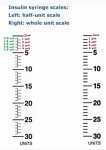
Here is a photo of a U40 syringe which shows 0.5u on the left. You’ll want to give her half of that if you can estimate it. It’s a tiny amount.

upload_2024-1-3_7-22-30.jpeg


Edited to add: if you only have U100 syringes, the conversion would be 0.5u on a U100 syringe. That would be 0.2u on a U40 syringe but we just want to give her a tiny amount and see what it does.
 

Attachments

  • upload_2024-1-3_7-22-30.jpeg
    upload_2024-1-3_7-22-30.jpeg
    43 KB · Views: 508
Last edited:
Update: Kush has a freestyle libre attached to her. I just scanned it 3-4hrs post feeding and it’s 22mmol/L. It’s saying it’s very high blood glucose.
FOr the first 12 hours or so the Libres are not accurate and the Manufacturer says NOT to make dosing decisions based on just the Libre reading. My experience is that throughout the 14 days the libre is always higher than an ear stick. At high BGs the libre is about 100 mg/dL .
Can you do ear or paw stick? I would at least a trend with a Libre befor making dosing desisions especial for a cat that was in remission.
 
FOr the first 12 hours or so the Libres are not accurate and the Manufacturer says NOT to make dosing decisions based on just the Libre reading. My experience is that throughout the 14 days the libre is always higher than an ear stick. At high BGs the libre is about 100 mg/dL .
Can you do ear or paw stick? I would at least a trend with a Libre befor making dosing desisions especial for a cat that was in remission.
She’s had a Libre on since last Saturday. We’ve had many, many members here document the Libre runs lower and we have them do an ear poke before they reduce a dose.

I’ve already suggested she do an ear poke if she has a glucometer and asked for any Libre data. I also asked that she recheck the BG on the Libre. She hasn’t responded.

It would help her if all posts were read so she doesn’t get redundant info or get asked about something she already posted (i.e. that she’s had the Libre several days now).
Thank you :)
 
So glad Kush is home now. I just wanted you to know a lot of us have been thinking about you both and we are all pulling for Kush. No need to respond to my post either. I know exactly how you feel right now and the word overwhelmed doesn't even cover it. I had many of those same conversations that you had with Kush last night with my own boy. Hugs to you both.
 
She’s had a Libre on since last Saturday. We’ve had many, many members here document the Libre runs lower and we have them do an ear poke before they reduce a dose.
At low BGs I found the Libres are lower than ear sticks but at higher BG the Libre ius signufucanlty higher. Since dose adjustment are based on lowest BGs that is what users are saying, not that over full BG range the Libre is lower.
 
At low BGs I found the Libres are lower than ear sticks but at higher BG the Libre ius signufucanlty higher. Since dose adjustment are based on lowest BGs that is what users are saying, not that over full BG range the Libre is lower.
Yes I know. But at 22 mmol/L, which is 396, even 100 mg/dL less, that BG is still too high for a DKA cat if it’s not an isolated BG.
 
Hello all.

I did end up giving Kush the insulin jab after having talked to both her regular and emergency vet.

If she was truly in real remission, then she should not fluctuate to a high diabetic reading in the middle of the night, 4 hours after feeding. Post eating glucose high is usually <16. Her BG trend spiked from 16 to 22 within 6 hours.

Unfortunately this is all not necessary now as my poor Kush passed shortly after her insulin jab, not nearly enough for us to tell if the insulin would’ve helped Kush feel better.

This is unrelated to the insulin. Kush passed due to my incompetence. It was all my fault and I’m having an extremely hard time dealing with it.

I was tube feeding her dinner as usual and she threw up shortly after. I quickly positioned her to throw up comfortably but her head and neck was limp and I was unable to act fact enough. Kush choked in her vomit. My poor girl died with the liquid food coming out of her mouth and nose. Her body was too weak to fight it and her heart was already weak. It must’ve been a painful death.

It really is all my fault. I could’ve skipped one session of her tube feeding. I could’ve fed her slower, paced it out. I wanted her to pass peacefully if she did have to go. This was not how I imagined she’d go - a result of my absolute incompetency.

I failed Kush.
 
Kiera, I know my words won't mean anything right now, but Kush definitely knew how much you loved her. She didn't know anything other than your love and care. This disease and everything they comes along with it is extremely complicated. What it does to their bodies is also very complicated. I do not want you to think anything other than you tried your hardest to help your baby. You can play that what if for the rest of your life, but that will cloud up the space for beautiful memories. Kush would want you to focus on those, not your last memories.

Sending you so much love.
 
Status
Not open for further replies.
Back
Top