

Carb % formula discrepancies?

Status
Not open for further replies.

Patricia&Bernie

Member Since 2023
Hello,

Some backstory....I just adopted a senior (not sure of his age somewhere between 11-13 years old) cat named Bernie. He was a street cat, then rescued and diagnosed diabetic about 2 yrs ago, went into remission and eventually adopted out. It seems like the adopters had him only a few months and for reasons unknown returned him to the shelter/foster system. When they got him back in May 2023 he was diabetic again and put on Prozinc. From his charts it looks like his insulin was raised from 1 unit BID to 3.5 units BID pretty quickly from June to July. The foster had 8 other cats and a dog in the same house, with some cats free feeding, etc etc, and I don't think Bernie had consistent and well managed food and insulin shots. His foster tells me he was consistently in the 300s-400s, and when she called the vet to tell them, they upped the insulin each week. So now he's at 3.5 units BID.

Anyway, I adopted him 2 weeks ago and have been working out a routine for the insulin and food. When I got him and started testing (AlphaTrak 3) he was in the high 300s/400s, and as he's settled it has come down a bit. At around +6 after insulin he is now mid-low 200s and yesterday was just under 200. Progress. FYI, I'm in NYC, have only ever had giant breed dogs and this is my first cat. He sees my vet for the first time tomorrow for some baseline tests and we'll discuss long term management.

Bernie had previously (when he had diabetes the first time 2 years ago and went into remission) had had been eating Tiki cat and apparently loved it. I have no idea what the 1st adopters were feeding him, but he went diabetic yet so was probably high carb. When he was re-diagnosed with diabetes in May with the foster's new vet, he was put on Purina Pro DM canned food and also 1/4 cup of the DM dry food with dinner. Like I said before, I think he was also eating the other cats' food since it was sitting out and accessible. Bernie is food obsessed. I just found this site a few days ago and agree that carbs are the culprit, but with his ravenous appetite, I think Bernie at least should be eating foods he likes. I want to look into getting him back on Tiki if it is indeed low enough carb.

My question is around food, specifically getting dry matter carb %.
I've seen several posts here with the formula for taking the Guaranteed Analysis on the food and translating it to Dry Matter %. The issue is that I've done the calculations for both Purina DM canned as well as Tiki cat Luau Puka succulent chicken, and what I'm getting for carb % (and all the other macros %) as dry matter DOES NOT MATCH what several of you provided in links to catinfo.org food charts. It's not even close.

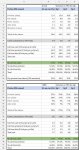
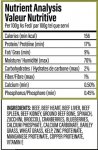
I've seen several people on the forums say the Purina DM canned is about 5% carbs, but from the data on the Purina website and on the can, I'm calculating as only 2% carbs as dry matter. As for the Tiki, on the catinfo website it's states it is 0% carbs, but with info from Tiki and calculating as dry matter, I'm calculating as 6% carbs. These are big discrepancies with what is being said and provided on catinfo.com. I'm going to try to link a google doc with my calculations (based on formula provided on this forum), can anyone verify? Any guidance would be appreciated.

https://docs.google.com/spreadsheets/d/1jhaKOxo1VLVlMletpjBCXF5bgDKxpAbgHlzDnJ38W48/edit#gid=0

Thanks in advance!
Patricia (& Bernie)
 
I can't access the google doc.

Can you post your calculations on the Tiki where you came up with 6% calories from carbohydrates? I am interested to see the math. Please include the specific Tiki variety.

The catinfo charts are based on info from 2017, I believe, so that may have something to do with what you're finding.


[edit] Interesting, using the calculator at this site and the info on the Purina DM pate from Chewy, I also got 2% dry matter calories from carbs
 
Thanks for your reply -- sorry, I forgot to make the google doc accessible. It's fixed now, please try again you should be able to see it and look at the math.

https://docs.google.com/spreadsheets/d/1jhaKOxo1VLVlMletpjBCXF5bgDKxpAbgHlzDnJ38W48/edit#gid=0

I input both the Purina Pro DM can and Tiki can per the info on their website, and used the proper formula to get to Dry Matter %. The purina DM can seems to be super low in carb % from my calculations. The catinfo website is likely outdated.

Thanks again.
 
Dr. Pierson’s pdf food chart (last updated 2017) mentions this with regard to the discrepancy in the % of cals from carbs calculated from the TNA and GNA values:

The data used to calculate the values on this chart are from Typical Nutrient Analysis (TNA) data - not the Guaranteed Analysis (GA) data which is listed on the product’s package (can/pouch/bag). GA values are reported as minimums and maximums and are, by definition, inaccurate since there is no ceiling or floor, respectively.

Data accuracy: Even though TNA data are more precise than GA data, the values on this chart should be taken as very loose approximations. All foods vary in their nutrient composition and, therefore, commercial food formulations will vary from batch-to-batch.

The bottom line is - this chart is the best that we can do but it is important to understand that these values are not ‘etched in stone’ and will also change if a company alters its formula. If you are concerned with having the most current data on the food that you feed to your cat, you will need to call the company periodically to see if the formulation has changed.’

Since Dr. Pierson’s calculations were done with the TNA values sourced from the manufacturers, they’re likely to be closer to the actual %s than the %s derived from the online calculators which are based on the max/min GNA values listed on the food packaging. But she does mention that her list could be outdated too. :)

ETA: One of the Q&As on the Tiki product page says this:
‘Yvette Perez – August 13, 2021
Can you explain why the fiber content is 0%? Also what percent is carbs? My cat was just diagnosed with diabetes and want to make sure his food is low in carbs

Tiki Pets – August 25, 2021
‘Hi! Cats are true carnivores and Tiki Cat Succulent Chicken is formulated as a whole meat diet with added vitamin and minerals, NO fillers. As a result there is no fiber present. Tiki Cat Succulent Chicken averages 0.08% Carbohydrates as-fed.’
 
Last edited:
I understand, thanks for the additional clarification related to "as fed" vs TNA. The "as fed" carb % on the can is similar to what you just quoted from Tiki, but when translated to Dry Matter it still brings it up to ~5%. I understand there is min/max potential outliers, but as general guidance the formula for "as fed" to "dry matter" seems valid. While I agree there is likely a difference of TNA and GA, I don't see how the TNA version would have such a high variance to the GA data. I think I'll reach out to both Purina and Tiki just to get the current TNA and do the analysis from there. I'll post what I find to this thread. Thanks
 
The nutrient analysis can be given either on an As-fed basis or a Dry Matter basis (DMB).
What matters to FD folks while choosing the wet food is the % of cals from carbs which can be calculated either by using the as-fed values or the DMB values, both of which should give the same answer.

If you have the as-fed values, you can derive the DMB values, to further calculate % cals from carbs.

Here’s a useful link on Calculating % of calories from carbs

I think I'll reach out to both Purina and Tiki just to get the current TNA and do the analysis from there
That’d be the best. Dr. Pierson gives this as a tip on her website -
‘Use the following dialog when calling the companies:

“I would like to know the percentage of calories that come from protein, fat, and carbohydrates.”

This is also known as the “metabolizable energy (ME) profile.”

If they do not have ME values, at least obtain dry matter values and you can calculate the ME yourself using the math (formula) tutorial above.
Stress that you do not want the GA figures as they are nothing more than minimums and maximums and this information (as it pertains to protein and fat but not carbs or phosphorus) is already contained on the can.’

While I agree there is likely a difference of TNA and GA, I don't see how the TNA version would have such a high variance to the GA data
I’m using the Purina DM values mentioned in the GA on the can to calculate the % of cals from carbs.
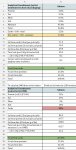
Next to it I’m giving 3 examples to show how differences in TNA (based on min/max limits) can impact the final calculation (rows 21 and 45)

You can see that both as fed and DMB values lead to the same result for %cals from carbs (check rows 21 and 45 under same columns)

upload_2023-8-8_2-1-56.jpeg


You can use an online calculator and play around with the min/max GA values to see how the %cal from carbs value varies.
 

Attachments

  • upload_2023-8-8_2-1-56.jpeg
    upload_2023-8-8_2-1-56.jpeg
    55.4 KB · Views: 884
Hi, here we compare foods on a 'percentage of calories from carbs' basis, not just on a dry matter basis. This is how the foods on Dr Pierson's list are calculated.
('Dry matter' just means the food as if all the water has been removed).

When calculating the percentage of calories from carbs you can use either wet matter or dry matter values (because water has no calories so the result should be the same...). But the 'guaranteed analysis' on the labels of US foods isn't sufficiently accurate to do the calculation with. It's important to have the 'typical' analysis (average values). In Europe this is the norm. But in the US it's often necessary to contact the manufacturer for the typical analysis. Occasionally it will be on the manufacturer's website.

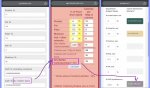
If you can get the typical nutrient analysis you can use the calculator linked below to do the calculation for you, super quick.
If you want to do the calculation manually you do this...
Using the product data, add up the percentages for protein, fat, ash, fibre, and moisture. Deduct that total from 100%. That will give you the percentage of carbs by weight.
Then calculate calories from the macronutrients: Multiply protein and carb percentages by 3.5, and fat by 8.5. That will give you the calories per 100g for protein, carbs, and fat. Adding those up will give you the total calories for the food per 100g.
Then divide the calories from carbs by the total calories, and multiply by 100. That gives the percentage of calories from carbs.

This calculator makes it quick and simple though... :rolleyes:
https://balance.it/convert


Eliz
 
I came to hijack the thread and ask questions, hope it's OK :oops:

When calculating the percentage of calories from carbs you can use either wet matter or dry matter values (because water has no calories so the result should be the same...). But the 'guaranteed analysis' on the labels of US foods isn't sufficiently accurate to do the calculation with. It's important to have the 'typical' analysis (average values). In Europe this is the norm.

  • Being in Europe, we have Guaranteed Analysis... Is the GA listed as per 100g or as "as fed" (given that some pouches are 85g)?
Essentially if the GA refers to 100g and I'm feeding my cat a 85g pouch, then it's not a problem, obviously. It would, however, become a huge problem for us if it was "as fed" when, for example, I were to look at the nation's (and my household's) favourite yoghurt treat, which is calculated to be 25% carbs... per 15g "as fed"? Instead of 25% in 100g aka ~3.75% for 15g. :eek:


“I would like to know the percentage of calories that come from protein, fat, and carbohydrates.”
This is also known as the “metabolizable energy (ME) profile.”


If they do not have ME values, at least obtain dry matter values and you can calculate the ME yourself using the math (formula) tutorial above.
Stress that you do not want the GA figures as they are nothing more than minimums and maximums and this information (as it pertains to protein and fat but not carbs or phosphorus) is already contained on the can.

  • When using these calculators, which one you'd say rather to go with, if we disregarded calorie content? The ME% carbs or the DM% carbs? (Again, in regards of European labels)

I don't even want to look at the wet matter carbs, because that just confuses me, and by now I'm accustomed to focus on dry matter % and keep that as low as possible.
I'm asking this, because according to caticles and scheyderweb the DMC in a specific food in question is 7.5% whereas according to balance.it the MEC is 6.5%. I know it's not a huge difference, I'd just like to know whether I could be even happier for the 6.5% or shall I remain just content with my 7.5% belief :D
 
Thanks Nimi, I see your point regarding min/max range. I will see what info I can get from the companies for both DM and Tiki.

It seems like companies are publishing vague nutritional information, makes you wonder what they are hiding.

I welcome everyone's insights, additional questions or thoughts on this topic, seems like even with formulas and generally accepted calculations, there still is a lot of confusion!
 
I just want to say welcome and good for you for jumping in and taking a deep dive into all the nutritional info already! And also thank you for adopting a senior sugar kitty. What’s wrong with people? Not only did they let him fall out of remission but they returned him like something you buy at a store :mad: I’m happy he’s with you now and it sounds like he’s in wonderful hands so he can live his best rest of his life life :bighug::bighug::bighug:

If you have any other questions, about home testing or dosing, please let us know. We’re here to help you and Bernie!

PS - I tried to get the carb info from fancy feast for some of their grilled wet food options and I gave up. I called several times and emailed only to be told they had to reach out to their nutritionists and never heard from anyone back. It does seriously make you wonder what the heck they are hiding! They make the food, all that info should be readily available to them :banghead::banghead::banghead:
 
Last edited:
Being in Europe, we have Guaranteed Analysis... Is the GA listed as per 100g or as "as fed" (given that some pouches are 85g)?
From the fediaf website, “EU law determines the mandatory minimal nutritional information on the pet food label, listed under the heading “analytical constituents” as grams per 100 grams of food as fed (%). This includes protein (or crude protein), fat (or crude fat), inorganic matter (or crude ash) and crude fibre; but does not include digestible carbohydrates.”

I know you directed the question to Elizabeth since you wanted region specific info but I’ll share my understanding too, in the hopes that I can be corrected too.
Nutrients are commonly listed on pet food labels as percentages.
A percentage is the same as g/ 100g (or 1 unit/ 100 units)
That is, if protein is listed as 30% in the GA, it is equivalent to 30g/100g meaning for every 100g of pet food, 30g of protein is included.
%s are directly converted to g/100g
It doesn’t matter whether the % is as fed or DMB, either way will work when caloric content and % contribution from each nutrient are estimated on ME basis.

“Guaranteed Analysis," "Analytical Constituents," and "Nutrient Information" are used interchangeably to describe the breakdown of the nutrient content in pet food. Pet food labels usually specify whether the values provided are on an "as fed" basis or on a dry matter basis. Look for terms like "As Fed," "Guaranteed Analysis (As Fed)," or "Nutrient Content (As Fed)."

Just an example of how GA could be mentioned on the pet food packaging
upload_2023-8-8_11-10-21.jpeg


It would, however, become a huge problem for us if it was "as fed" when, for example, I were to look at the nation's (and my household's) favourite yoghurt treat which is calculated to be 25% carbs... per 15g "as fed"? Instead of 25% in 100g aka ~3.75% for 15g
When you say 25% carbs, it indicates the energy contribution from the carbs.
So if your cat takes a lick of the yoghurt treat, out of the total energy that is theoretically available to the cat after digestion and absorption of nutrients from the treat, 25% of that energy is contributed by carbs.
The same logic will apply if the cat finishes the entire 15g sachet of the yoghurt treat. The carb contribution to the total energy will still be 25%.
However the total calories consumed i.e. total energy available to the cat will increase.
Let’s broadly assume 15g treat = 15 licks = 8.5kcal energy.
For the first case, a single lick will give 8.5/15 = 0.57 kcal energy, of which 25% is from carbs
And for the second case, eating the entire 15g treat will give 8.5kcal of energy, of which 25% is again from carbs.

When using these calculators, which one you'd say rather to go with, if we disregarded calorie content? The ME% carbs or the DM% carbs? (Again, in regards of European labels)

I'm asking this, because according to caticles and scheyderweb the DMC in a specific food in question is 7.5% whereas according to balance.it the MEC is 6.5%. I know it's not a huge difference, I'd just like to know whether I could be even happier for the 6.5% or shall I remain just content with my 7.5% belief :D

When we talk of LC/MC/HC wet foods, we look at the % of cals or ME% from carbs and accordingly segment them in those 3 categories. For this reason, I’d go with the ME% calculators which compute how much of the metabolisable energy (% cals) comes from the carbs.

I used the salmon lick-e-lix GA values in the 3 calculators and got this

upload_2023-8-8_11-20-34.jpeg


The caticles and scheyderweb calculators do not give you the % of cals from carbs but the % of carbs on a DMB, which is one step short of what we want. It would be better to use the balanceit calculator for that reason.

Sharing a calculation using both as fed and DMB values to compute ME% of carbs in the salmon lick-e-lix (rows 18 and 37) while row 29 gives %carbs on a DMB.
upload_2023-8-8_12-5-7.jpeg
 

Attachments

  • upload_2023-8-8_11-10-21.jpeg
    upload_2023-8-8_11-10-21.jpeg
    69.4 KB · Views: 867
  • upload_2023-8-8_11-20-34.jpeg
    upload_2023-8-8_11-20-34.jpeg
    67.5 KB · Views: 847
  • upload_2023-8-8_11-58-43.jpeg
    upload_2023-8-8_11-58-43.jpeg
    54.4 KB · Views: 155
  • upload_2023-8-8_12-5-7.jpeg
    upload_2023-8-8_12-5-7.jpeg
    54.4 KB · Views: 857
Last edited:
Being in Europe, we have Guaranteed Analysis... Is the GA listed as per 100g or as "as fed" (given that some pouches are 85g)?
'Guaranteed Analysis' is the norm in the US (and some other countries). This is just a 'guarantee' of minimum/maximum values for protein, fat, moisture, etc. But it does not reflect what is 'actually' in the product at any given time.

In Europe we very sensibly use 'typical analysis' which is intended to represent 'average' values. Several samples of food are usually tested and the typical/average data is got from that. ("The analysis of only one sample may not reflect the level declared in the average analysis of the product. To obtain a representative analysis, multiple samples coming from different batches have to be analysed. A composite sample made from multiple samples is also valid" - from FEDIAF guidelines.) ...Of course, the UK Govt may choose to follow something other than European guidelines in the future...now that 'we've got our freedom back'.... :rolleyes:

Foods imported from outside Europe may well have GA data on the labels. And with some foods, such as foods made by the big corporations that make 'veterinary diets', etc, it's not always clear what the data refers to (whether it's GA or TA). And in that case it can be necessary to contact the company and ask them.
 
Of course, the UK Govt may choose to follow something other than European guidelines in the future...now that 'we've got our freedom back'.... :rolleyes:

The snort I just snorted! :D We are sooo doomed.

In Europe we very sensibly use 'typical analysis' which is intended to represent 'average' values.


I stand corrected. I have checked every food label I have in my pantry (about 6 different cat foods), and they all indeed just broadly state 'Analytical Constituents'.

The caticles and scheyderweb calculators do not give you the % of cals from carbs but the % of carbs on a DMB, which is one step short of what we want. It would be better to use the balanceit calculator for that reason.

But... wouldn't it be 'safer' high balling it, and going by the DMC % as opposed to MEC % ?

From the fediaf website, “EU law determines the mandatory minimal nutritional information on the pet food label, listed under the heading “analytical constituents” as grams per 100 grams of food as fed (%).
A percentage is the same as g/ 100g (or 1 unit/ 100 units)
That is, if protein is listed as 30% in the GA, it is equivalent to 30g/100g meaning for every 100g of pet food, 30g of protein is included.
%s are directly converted to g/100g

Look for terms like "As Fed," "Guaranteed Analysis (As Fed)," or "Nutrient Content (As Fed)."

Yeah, I don't have that. On none of the food labels I have to hand. They don't state anywhere, whether the Analytical Constituents refer to 100g or 85g or 15g or "as fed".
But your below explanation kind of cleared it up for me, that it shouldn't really matter, because the % in "as fed" (whatever amount I'm giving him of said food) remains the same as the % in 100g. If I understood you correctly, that is?

When you say 25% carbs, it indicates the energy contribution from the carbs.
So if your cat takes a lick of the yoghurt treat, out of the total energy that is theoretically available to the cat after digestion and absorption of nutrients from the treat, 25% of that energy is contributed by carbs.
The same logic will apply if the cat finishes the entire 15g sachet of the yoghurt treat. The carb contribution to the total energy will still be 25%.
And for the second case, eating the entire 15g treat will give 8.5kcal of energy, of which 25% is again from carbs.

I'm clearly not as math savvy as thought I was. This makes perfect sense, but for whatever reason I assumed 25% (so 25g) DM carbs applies for the whole 100g, therefore if I were to give him only 10g of yoghurt that would equal him consuming only 2.5% (2.5g) carbs... Whereas yes, he's consuming 2.5g DM carbs per 10g, it's still 25% of that 10g, not 2.5% :banghead:

I feel like a total idiot now, but you just gave me a huge lightbulb moment with this, you know, one of those when things 'click' and you go "OOOOH NOW I GET IT FINALLY!" :facepalm: :D
This however feels good, so thank you so much :bighug:


Now to figure out what to sub our trusted Lick-e-Lix with, for all my cats' daily dose of salmon oil, medication and Plaque Off :blackeye:
 
Last edited:
But... wouldn't it be 'safer' high balling it, and going by the DMC % as opposed to MEC % ?
Why do you want to highball it? :D
Regardless of which calculator you use, the fact remains that on a dry matter basis, for every 100g of the salmon lick-e-lix (using this as an example since calculations are above) there is 25g of carbs. And for the same lick-e-lix (regardless of the weight), the carbs within it contribute to 20% of the calories/ energy making it HC.
Carbs on a DMB refer to the quantity of the carbs per 100g of food excluding moisture.
Whereas ME% of carbs refers to calories through carbs.
So two different parameters that you can’t use interchangeably.
Did I confuse you more? :nailbiting:

Yeah, I don't have that. On none of the food labels I have to hand. They don't state anywhere, whether the Analytical Constituents refer to 100g or 85g or 15g or "as fed".
Yeah, that was sort of wishful thinking on my part, that pet food packages would bother mentioning it :blackeye:
But from the little that I’ve read, at least for the wet foods, the GA or analytical constituents means g/100g or % as fed, unless otherwise specified. I could be wrong though.

I'm clearly not as math savvy as thought I was. This makes perfect sense, but for whatever reason I assumed 25% (so 25g) DM carbs applies for the whole 100g, therefore if I were to give him only 10g of yoghurt that would equal him consuming only 2.5% (2.5g) carbs... Whereas yes, he's consuming 2.5g DM carbs per 10g, it's still 25% of that 10g, not 2.5% :banghead:
So, you’re not completely wrong but you’re mixing up the %calories from carbs with the quantity of the carbs within the 10g.
If carbs on a DMB are 25%, and you give 10g of the food, then the food will contain 2.5g of carbs in it (weight).
But if calories from carbs are 25%, and you give 10g of the food, then the food consumed will release some energy of which 25% will be thanks to the carbs.
You can’t convert a HC food into a LC food by feeding lower amounts of it.
Please don’t hit me :p

Now to figure out what to sub our trusted Lick-e-Lix with,
Were you looking for a low carb (%cal) lick-e-lix? I think the jelly one is less than 5% but there’s only one flavor (chicken and potato) that I could see.
 
Carbs on a DMB refer to the quantity of the carbs per 100g of food excluding moisture.
Whereas ME% of carbs refers to calories through carbs.
So two different parameters that you can’t use interchangeably.
Did I confuse you more? :nailbiting:

Yes :arghh:
That's why I said above to let's disregard calorie content, because we don't have weight issues (my cats that is :rolleyes:) so I needn't to focus on that, I believe.
That's one of the reasons I'm more focused on DMC% when choosing food for them.


Why do you want to highball it? :D

OK, so I'm feeding 3 of them, and the other two are very fussy and wouldn't touch Sheba Fine Flakes, therefore sometimes I "dilute" that with the same flavour of Whiskas Kitten (lowest DMC% I found of the same flavours), in a 2:1 ratio. Before anyone suggests to feed them separately: that is a definite no go - they're all intuitive eaters (or grazers, if you will), the two fussy ones hate each other, so the best I can do is feed my diabetic boy with Sheba, let him eat until he's full, then mix Sheba with Whiskas, and leave that down for the other two... But doing so, the diabetic goes and eats from it sporadically.

So... maths (based on my logic, but I could be totally off again :confused:):

Sheba Fine Flakes DMC 3.3%
Sheba Fine Flakes MEC 0%

Whiskas Kitten DMC 7.5%
Whiskas Kitten MEC 5.6%

Looking at DMC: 2x pouch Sheba (6.6%) + 1x pouch Whiskas (7.5%) = 14.1% DMC total for the 3 pouches mixed together = 4.7% DMC / "as I feed it" when divided by 3
Looking at MEC: 2x pouch Sheba (0%) + 1x pouch Whiskas (5.6%) = 5.6% EMC total for the 3 pouches mixed together = 1.9% EMC / "as I feed it" when divided by 3

Both values are technically low carb, because the "as I feed it" falls below 6% but I guess for the peace of my mind I rather believe it's the higher 4.7% amount. If I start going by the lower 1.9% values when looking for food for them, I may get cocky and overlook the fact that it is DMC% that needs to be kept under 6-8%. Does it make sense?

(That's correct, right? The DMC is the one need to be kept under 6-8% not the MEC? "The cat’s natural diet would consist of approximately 8% carbs on a dry matter basis. This comes from the stomach contents of prey since cats eat mainly herbivores.")

Edit: although, depending on the actual Sheba package purchased, I'm finding discrepancies re: analytics... sometimes I get DMC 3.3%, sometimes DMC 0% o_O (I'm still mentally going by the 3.3% regardless, for the above reason.)

Edit edit: Or am I dumb again? Would 2x pouch Sheba still equal to a total of 3.3%? Like this:
Looking at DMC: 2x pouch Sheba (3.3%) + 1x pouch Whiskas (7.5%) = 10.8% DMC total for the 3 pouches mixed together = 3.6% DMC / "as I feed it" when divided by 3

This thread is turning into maths tutoring, I'm so sorry! :bookworm:


But if calories from carbs are 25%, and you give 10g of the food, then the food consumed will release some energy of which 25% will be thanks to the carbs.
You can’t convert a HC food into a LC food by feeding lower amounts of it.
Please don’t hit me :p

Yes yes, that's exactly where my lightbulb moment was. I did hit myself on the forehead, I would never hit you! (You're too far away :D jk jk)


Were you looking for a low carb (%cal) lick-e-lix? I think the jelly one is less than 5% but there’s only one flavor (chicken and potato) that I could see.

I have never heard of or saw that anywhere, but I'll do some digging, thank you :bighug:

Or... I could perhaps use the above equation and "dilute" salmon Lick-e-Lix in unflavoured, plain low carb yoghurt with their added salmon oil (and meds and stuff)?
Or is that a stupid idea? :banghead:

They wouldn't take meds and that nasty plaque off in any other way (I tried everything already), in fact, they're not even keen on any other flavours of Lick-e-Lix, only the salmon :arghh:
 
Last edited:
Yes :arghh:
That's why I said above to let's disregard calorie content, because we don't have weight issues (my cats that is :rolleyes:) so I needn't to focus on that, I believe.
That's one of the reasons I'm more focused on DMC% when choosing food for them.
Sorry! I did wonder why you asked to ignore the calorie content. In my head, I was thinking it was only for your FD kitty :D

So... maths (based on my logic, but I could be totally off again :confused:):
Sheba Fine Flakes DMC 3.3%
Sheba Fine Flakes MEC 0%

Whiskas Kitten DMC 7.5%
Whiskas Kitten MEC 5.6%

Looking at DMC: 2x pouch Sheba (6.6%) + 1x pouch Whiskas (7.5%) = 14.1% DMC total for the 3 pouches mixed together = 4.7% DMC / "as I feed it" when divided by 3
Looking at MEC: 2x pouch Sheba (0%) + 1x pouch Whiskas (5.6%) = 5.6% EMC total for the 3 pouches mixed together = 1.9% EMC / "as I feed it" when divided by 3
This is fine. All 3 cats get 4.7g of carbs per 100g of food and the calories from carbs are 1.9%.

Edit edit: Or am I dumb again? Would 2x pouch Sheba still equal to a total of 3.3%? Like this:
Looking at DMC: 2x pouch Sheba (3.3%) + 1x pouch Whiskas (7.5%) = 10.8% DMC total for the 3 pouches mixed together = 3.6% DMC / "as I feed it" when divided by 3
No, your previous calculation is fine :D
With every pouch that you add to the mix, the amount of carbs on a DMB also increases.

That's correct, right? The DMC is the one need to be kept under 6-8% not the MEC? "The cat’s natural diet would consist of approximately 8% carbs on a dry matter basis. This comes from the stomach contents of prey since cats eat mainly herbivores."
Since a rat carcass has 9.1% carbs on a dry matter basis, that is probably the guideline to follow when selecting any food for a cat, regardless of whether the cat is diabetic or not.
Additionally if diabetes is involved, it’d help to select a food that was LC and less than 10% ME from carbs, preferably under 7%.
I would assume that the % ME from carbs automatically falls under 10% if the carbs on a DMB are less than 10% to begin with.

Or... I could perhaps use the above equation and "dilute" salmon Lick-e-Lix in unflavoured, plain low carb yoghurt with their added salmon oil (and meds and stuff)?
Or is that a stupid idea? :banghead:
I think it would work so long as the low carb ingredient (plain yoghurt) in the mixture was used in a higher proportion than the HC treat :)

This thread is turning into maths tutoring, I'm so sorry! :bookworm:
It truly did. We went down a different rabbit hole :D

Apologies for hijacking your thread, Patricia! :oops:
 
I would assume that the % ME from carbs automatically falls under 10% if the carbs on a DMB are less than 10% to begin with.

See? That's my logic too, and the reason why I rather high ball it and focus on DMC% as opposed to MEC%, to stay on the safe side ;)

I think it would work so long as the low carb ingredient (plain yoghurt) in the mixture was used in a higher proportion than the HC treat :)

That's exactly my plan!


Thank you again for all the input and for the math lessons Nimi :D

I shall hand the thread back to Patricia, and officially zip my mouth (here :p).
 
Oh gosh, guys, i would really like some help with this too, if it is okay, because I have gotten lost in my calculations and worried i got it really wrong.

I've been trying really hard to get my head around it all and figure it out but I have limited cognitive function, it is rather frustrating.

I have done my best to make calculations but think I may have got this wrong.


If i share with you the info i have about this particular food, can you please help me decipher it to get the info i need.


This is a wet canned Whiskas food and here is what i have been told:

"We received your email to WHISKAS and DINE pet food. The WHISKAS loaf style cans have 80 kcal/100g.
The carbohydrate content for the WHISKAS is between 1.5-2.5%. There is a range due to raw material variation and we are not able to provide a set level for this unfortunately. "


On the can all it says is:
Typical Composition
Crude Protein 7.5%
Crude Fat 5.5%
Omega 6 0.7g/100g
Predicted Metabolizable Energy 75 kcal/100g


I have emailed to ask for moisture content because how else can one discern the dry matter.
But if i input this data i have onto a DMB calculator i downloaded, with the moisture set at a theoretical 80%, the ash at a theoretical 1.3% and the fibre 0.5% then it calculates the dry matter carbs percentage as 26%, eeeshK!

So now i am thinking" oh jeez, i got it completely wrong when i was told the carb content was 2.5% and i thought that this food was low carb, because i now ASSUME that the percentage they gave me was as part of the percentage including the moisture (i had a really hard time even getting this info, several emails to get it because they didn't understand when i was asking for specifics like(here is my exact words):

"I would like to know the metabolizable energy (ME) profile of your products, specifically the percentage of calories that come from protein, fat, and carbohydrates.

I do not want the Guaranteed Analysis GA figures as I need more specific information than just guaranteed minimum or maximum values.

If you don't have ME values then i will accept Typical Nutrient Analysis on Dry Matter basis but i still need all three of protein, fat and carbohydrate please"


So have I unwittingly been feeding Gandi with high carb canned food this whole time??!!


EDIT now I am trying the balanceit calculator and getting the carbs coming up around 11%

My brain is checking out though, cannot computer any further :(
 
Last edited:
Hi Kathryn!

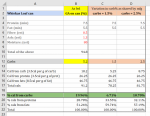
This is a rough calculation assuming the carb content they mentioned to you was on an as-fed basis (including moisture) to be 1.5% and 2.5%, so we could get the lowest and highest values for % calories from carbs (Columns C and D)

Column B uses the carb % we get by assuming estimated values for moisture, ash and fiber.

If the manufacturer has shared the as-fed % of carbs, then the % of calories from carbs could range from 6.7% to 10.7% - I think 6.7% is LC enough to feed but 10.7% would be higher LC or MC.

Using estimated values of ash, fiber and moisture is giving too high a value (~20%).

upload_2023-8-11_13-16-17.png


ETA: If you see row 17, the total calories come to 78 to 82, while the the can says 75kcals/100g, so the calculations for column C (1.5%) come closest, if my understanding of this whole thing is correct.
 

Attachments

  • upload_2023-8-11_13-16-17.png
    upload_2023-8-11_13-16-17.png
    253.9 KB · Views: 894
Oh my, okay, i found this link
https://felinediabetes.com/FDMB/threads/calculating-calories-from-carbohydrates.205128/
and think i may have figured it out!

Protein 7.5% x 3.5% calories = 26.25 calories
Fat 5.5% x 8.5 calories = 46.75 calories
Carb 2.5% x 3.5 calories = 8.75 calories
Total 81.75 calories

so percentages of calories=
Protein 26.25/81.75 = 32%
Fat 46.75/81.75 = 58%
Carb 8.75/81.75 = 11%

Would very much appreciate any feedback on if i am getting this right!!
 
Hi Kathryn!

This is a rough calculation assuming the carb content they mentioned to you was on an as-fed basis (including moisture) to be 1.5% and 2.5%, so we could get the lowest and highest values for % calories from carbs (Columns C and D)

Column B uses the carb % we get by assuming estimated values for moisture, ash and fiber.

If the manufacturer has shared the as-fed % of carbs, then the % of calories from carbs could range from 6.7% to 10.7% - I think 6.7% is LC enough to feed but 10.7% would be higher LC or MC.

Using estimated values of ash, fiber and moisture is giving too high a value (~20%).

View attachment 67427

ETA: If you see row 17, the total calories come to 78 to 82, while the the can says 75kcals/100g, so the calculations for column C (1.5%) come closest, if my understanding of this whole thing is correct.


Thank you. I just posted the above message just at a similar moment, before yours came in. I will do my best to digest yours now :)
 
th
Hi Kathryn!

This is a rough calculation assuming the carb content they mentioned to you was on an as-fed basis (including moisture) to be 1.5% and 2.5%, so we could get the lowest and highest values for % calories from carbs (Columns C and D)

Column B uses the carb % we get by assuming estimated values for moisture, ash and fiber.

If the manufacturer has shared the as-fed % of carbs, then the % of calories from carbs could range from 6.7% to 10.7% - I think 6.7% is LC enough to feed but 10.7% would be higher LC or MC.

Using estimated values of ash, fiber and moisture is giving too high a value (~20%).

View attachment 67427

ETA: If you see row 17, the total calories come to 78 to 82, while the the can says 75kcals/100g, so the calculations for column C (1.5%) come closest, if my understanding of this whole thing is correct.

Thank you Nimi, i think i get it, i see the calculations i made using the highest 2.5% carb value that manufacturer gave me (and yes, assuming as fed), i have the same numbers as you. We can probably ignore my estimated calculations with the moisture but i will be really interested to see if they will come back to me with actual percentages of everything (and if those add up to 100%!).

So my conclusion is that at least it is not 25% which is what i had feared, but could potentially still be a bit too high. Wow. Until i read this thread i was totally missing the piece about calories differing for the different nutrients, and the way that affects the calculations for what constitutes low carb food!!!
 
[QUOTE=

ETA: If you see row 17, the total calories come to 78 to 82, while the the can says 75kcals/100g, so the calculations for column C (1.5%) come closest, if my understanding of this whole thing is correct.


the can says 75kcals/100g yes, in which case, great if the lower carb content is most likely. However.... the email from the manufacturer says 80kcals/100g. How would that affect the calculations?

(sorry, i don't know how to work this quote thingey)
 
BTW maybe this link might have already been shared with you but it lists some info on LC and air/freeze dried cat food available in NZ.
Says Whiskas in Jelly Meat is LC.
Maybe you could opt for a flavor where the protein and fat values listed on the can are higher?
 
BTW maybe this link might have already been shared with you but it lists some info on LC and air/freeze dried cat food available in NZ.
Says Whiskas in Jelly Meat is LC.
Maybe you could opt for a flavor where the protein and fat values listed on the can are higher?

yes, unfortunetly, that Whiskas jellymeat LC info came from me! (perhaps incorrectly).
The only other options is one which is Protein 6.5% and fat 6%.
Well i will work out if those numbers calculate slightly differently with the little bit more fat.
 
the can says 75kcals/100g yes, in which case, great if the lower carb content is most likely. However.... the email from the manufacturer says 80kcals/100g. How would that affect the calculations?
I take the kcals/100g figure to cross check whether my calculation of total calories, using as-fed values, is correct or as close to the value printed on the packaging.
Since any calculations inputting the GA values in online calculators are just loose approximations (thanks to the min/max values), I don't fret too much about the differences in the range so long as it is sufficiently LC (under 8% at least, for me).

yes, unfortunetly, that Whiskas jellymeat LC info came from me! (perhaps incorrectly).
Oops!

The only other options is one which is Protein 6.5% and fat 6%.
Well i will work out if those numbers calculate slightly differently with the little bit more fat.
I think the higher fat% will probably give a slightly lower final result for carbs but not by too much.
 
I've reached out to Purina via email for the DM data and will post when I get it.

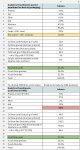
I've also updated my google sheet with a bunch of Fancy Feast and TikiCat varieties in case anyone is interested. I've calculated the Dry Matter content % based on the Guaranteed Analysis provided. I know this doesn't take into account mins/max variances, but it's a good general guide. My spreadsheet highlights the Carb % as dry matter GREEN when it's 10% or below, and RED above 10%. DM wet (original, NOT savory) is the lowest carb at under 2% per the calculator. Fancy feast as some good options in the 3%-8% range as well. Purina Pro DM "savory selects" is 27% carbs which seems crazy for a so-called "dietetic management" food.

Here's the link to the google sheet. I'll continue to update with other foods that I look into.
 
Hah, that's peculiar!
Our ProPlan dry is 23.5% whereas yours is only 11.7% :rolleyes:

Analytical constituents:
Protein (50%), fat content (17%), crude ash (8%), crude fibre (1.5%), starch (12.5%), total sugars (0.8%), essential fatty acids (2%).
 
I don't know how to interpret the UK nutritional label. It looks like where our food shows "Guaranteed Analysis" in the UK it is called "Analytical Constituents" which I would assume is similar to GA.

Anyway, what I also don't see on the UK label is "moisture content %" If I use the same 12% as moisture content and plug in everything else from the UK label, I get 13.1% carbs. Your label also includes a line item for starch, which we don't have on US labels. Anyway, I updated my google sheet to show the UK label version of DM Dry food for your reference, but again I'm not sure that I'm doing the correct calculation starting with UK label info since it's different from the US label.
 
I'm not concerned about starch, sugar and fatty acids being relevant in this equation.
I seldom see moisture content % on dry food labels in the UK... I have always assumed it being 0% since... you know... it's dry?

Edit: The only brand of diabetic dry I have found moisture content on right now in a rush is Integra, which states it being at 6%
 
I understand that of course, I just assumed that they're included in the total carb %, which for me ended up being 23.5% calculated with 0% moisture.
Now I'm wondering whether the starch + sugar combo is the sole carb I should focus on, as their total 13.3% (12.5% starch + 0.8% sugar) being very close to your calculations with the hypothetical moisture content. Because let's be real, where would the remainder of 10 ish % carbs come from then?

But if we're looking at the Integra I've mentioned above:
protein 41.5 %
fat 16.5 %
fibre 2.8 %
ash 4.5 %
moisture 6.0 %
______________
DMC 30.5%

of which
starch 24.0 % + total sugar 2.0 % = 26.0%

...there's 4.5% still missing from the equation somehow. Therefore it'd be foolish of me convincing myself I'm feeding my cat with a 26% carb content dry food, when in reality it's over 30%.

So based on this logic, I'm reluctant of going by ProPlan's 13.3% carb content, and rather high ball it to the 23.5%. Maybe I should actually email them and ask about moisture content... :cool:


Edit: OK so a quick Google search revealed that most dry foods ideally should have a moisture content between 10-12% but some only has as little as 2% ... but definitely (hopefully?) not 0% as I have thought. So I guess being wrong in this case was not a bad thing after all :smuggrin:

Edit 2: Woooow OK so Thrive actually lists their carb % content (including moisture, DMC is a mere +1% higher) and their brand is not even listed amongst diabetic cat kibbles. Although the one I have ordered from Amazon a while ago calculated to be 19% not 10%, and gave all my cats an upset stomach (daily barfs from multiply cats yay!) I'm still impressed by them listing it under the analytics.
 
Last edited:
Update: I received the following information from Purina on the macro content of their DM can and DM kibble. The DM can (regular -- NOT savory selects) seems like a good choice very low carb, so I'm sticking with it.

-------------------------------------------------------------
Thank you for contacting Nestlé Purina PetCare Company.

Here is the info you requested:

Canned (pate and savory selects):
3

3


Dry:
3

3
 
Status
Not open for further replies.
Back
Top