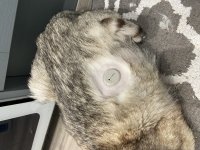
Cannot take blood from cats ears

Rachels Kiska

Member Since 2026
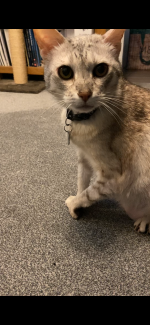
My kitty Kiska has recently been diagnosed with Diabetes as a result of long term steroids prescribed for allergies. She’s 13 and was diagnosed 4 weeks ago).

She currently has nerve damage in front left paw (knuckling) and suspected nerve damage in back legs (weak and although have mobility suspected sensory damage).

She is on 1.5mmol caninsulin after meals at the moment.

I have a major problem getting blood from Kiska for reading of glucose levels. Her ears just won’t bleed!

I’ve watched dozens of videos, warmed her ears for 5 mins with a wheat bag, pricked her ears a dozen times (bleeding myself a couple of times through her ears!) all around the “sweet spot” and cannot get more than a tiny bead of blood which I’ve achieved only once or twice. Not enough for a reading. Even the vet can’t get blood out of her ears.

She also won’t let me get to her paws, I’ve managed a couple of times but they are also very hard to bleed and she won’t stop fighting despite all cuddles and treats. She’s good natured so not biting of scratching, just insane amounts of wriggling and conscious it’s not a long term solution.

Tried a continuous blood glucose meter but was constantly saying she was over 22.1mmol which she was showing no signs of in behaviour or physically. Obviously you are supposed to check against a blood test which I can’t get from her! Took her to the vets after 24 hours just in case and they said their first reading on her was 8.3mmol before went up to 17.3mmol which would be normal from being at vets and traumatised by being bled (from the vein).

I am not squeamish, I’ve injected myself many times when going through ivf, I just can’t get blood out of my adored but wriggly ear bloodless cat!

I cannot believe I am the only one that’s ever experienced this and just wanted to see if anyone has advice or suggestions on how to cope.
 

Attachments

  • IMG_4719.png
    IMG_4719.png
    1.8 MB · Views: 23
  • IMG_4722.jpeg
    IMG_4722.jpeg
    3.5 MB · Views: 23
Hometesting Links and Tips

If the lancet is too thin, you won't get blood. Use 26 gauge. You can use any brand of lancet and the matching device.

The sock needs to be really really warm. Try uncooked rice or dried beans instead of wheat. Wrap the sock around the edge of the ear and hold firmly in place. If it's too hot, your cat will flinch and try to move away. Let the sock and ear cool a bit and try again. The vein that runs along the edge of the ear will plump up when it's warmed up well.

Hold the sock under the ear. Press the lancet device firmly against the other side of the ear, using the sock as a surface to press against. Poke. If no blood, adjust the device depth setting higher and try again. It's easy to just miss the ear too so move the device over a bit. If the device has a clear cap, use that so you can see where you are poking.

Some cats have only one ear that will bleed. Try using the other ear.

Have patience. Few newbies are able to get blood right away.

Caninsulin is not a good choice for cats. It's made for dogs. What country are you in?
 
Thanks, I was using the lancet that came with the device there’s about 200 of them and they start thin and get thicker.
I’ve tried varying the depth but when I wasn’t getting any blood to be honest I started just leaving in the deepest setting. And yes I’ve hurt both her poor ears equally!

I’ll try again using your suggestions.

Caninsulin, yes I’ve realised that, I’m in the UK, I’m going to be asking for a different insulin next time I go to the vets!
 
Hi squeem3

Just an update. Had no problem getting blood out of her ears now, it’s suddenly easy peas!

I’m not sure if it’s because the weather is nicer or because her blood sugar is now much more under control but her ears are now lovely and warm without the wheat bag and bleeding just right! She has also started regrowing the fur on her ears so I’m leaning towards the diabetes causing poor circulation to her ears.

Thanks so much for the advice however as it’s really helped when her ears were colder.

Anyone that is having trouble getting the blood from the ears be aware it gets easier as their blood sugar gets under control!
 
the capillary bed develops over time as well, as long as you keep trying. it is said a cat's ears "learn" to bleed.

Great job "sticking" with it :)

personally I thought the whole thing was impossible and I would never get a blood droplet from my cat. Just the idea of it seemed ridiculous to me. I'm living proof that anyone can do it!
 
ProZinc and Lantus (glargine) are available in the UK. Here's an old info thread: Info - UK INFORMATION (Food, Insulin, Vit B12, and other 'need to know' stuff) It has not been updated in over 10 years so some info is outdated or not included (such as Lantus).

Not sure if @Elizabeth and Bertie are still around.
Hi, yes I'm still around, though not as much these days.
And yes, the UK info is out of date, but can't be updated now. ...I could edit it if I could get access, or, do a new post (a shorter one, haha!)

Eliz
 
Hi squeem3

Just an update. Had no problem getting blood out of her ears now, it’s suddenly easy peas!

I’m not sure if it’s because the weather is nicer or because her blood sugar is now much more under control but her ears are now lovely and warm without the wheat bag and bleeding just right! She has also started regrowing the fur on her ears so I’m leaning towards the diabetes causing poor circulation to her ears.

Thanks so much for the advice however as it’s really helped when her ears were colder.

Anyone that is having trouble getting the blood from the ears be aware it gets easier as their blood sugar gets under control!

Oh, well done. It does get easier over time.

Waving from Surrey, BTW! 😊

For anyone else having trouble getting started with BG testing, here's a list of 'tips and tricks'...
....

HOMETESTING TIPS & TRICKS

When you first get your test kit it’s a good idea to try it on yourself so you can see how it all works. (Prick the side of your finger tip to get blood, and not the very tip which is more sensitive).

1. WARM EARS. Probably THE most important thing. Warm ears bleed very much more easily than cold ones. You can warm an ear (or paw pad) by massaging it, or by holding something warm against it; ie a pill bottle filled with warm water, or a ‘rice sock’ briefly warmed in the microwave. (See immediately below this list for how to make a rice sock).
Warm hands matter too. Cats don’t like cold hands on their ears. You can warm them on the rice sock first if you are using that for your cat.

2. MASSAGING immediately below the ear prick, with finger and thumb, can ‘milk’ more blood out. I almost always do this, if only for a second or two.

3. VASELINE. A teensy-weensy smear of Vaseline on the outer edge of the ear will enable the blood to ‘bead up’ and stops it disappearing into the fur. This also makes it easier to see the blood droplet if the kitty has dark ears.

4. RESISTANCE. The lancet needs something to ‘resist’ otherwise it can push the ear away rather than pricking it effectively. Some folks use a piece of cotton wool or folded tissue on the underside of the ear. I just use one of my fingertips, but sometimes do accidentally take a blood sample from myself that way...

5. LANCING DEVICE? OR JUST THE LANCET, FREEHAND? Some people prefer to use the lancing device to prick the ear. Others much prefer to use just the lancet, freehand. If one way doesn’t work for you try the other.
🙂


6. TWO EAR PRICKS close together can often produce enough blood for a test when one ear prick might not.

7. SCOOPING THE BLOOD DROP ONTO YOUR FINGERNAIL. Doing this is a game-changer for some people. If you can get that drop of blood on your finger or thumb nail you can then let the cat go, and finish the test without her/him.

8. TREATS. It is important to reward the kitty for each attempted test - whether the test was ‘successful’ or not. Cats very soon learn to associate tests with treats. And some will soon come running for their tests.
A ‘treat’ is usually a food reward of some kind, but some folks reward their kitties with a cuddle or a grooming session. Treats can also be used to distract cats during a test.
Remember to reward yourself too. Chocolate is good…
😋


9. GET COMFORTABLE. If you are physically comfortable, you’ll be more relaxed, and also less likely to try to rush the process.
Some people like to test their cats on a counter top or a desk, maybe next to a desk lamp. Some people prefer to hold their cats on their laps when they test. Some incorporate testing into a grooming session.
You’ll find what works best for you. And once you get used to testing you may even find that you’re able to do it anywhere, and maybe even while the cat is asleep.

10. RELAX. Cats pick up on our moods. The more relaxed and ‘matter of fact’ we are, the more relaxed and confident the cat is likely to be. Some people chat or sing to their cats while they test. Try it. It might help you too.

11. BE PATIENT. Learning something new can take time and practice. If things don’t progress as quickly as you’d like please don’t beat yourself up. The fact that you ‘try’ is the most important thing. And never underestimate the power of many small steps in the same direction…
💗

......
Making a ‘rice sock’:
A rice sock is made simply by filling the toe of a thin sock with rice (or other grain), then making a knot in the sock or tying with thread or string. Any excess fabric can be snipped off if necessary.
The rice sock is heated in the microwave until nicely warm but not ‘hot’.

Some people make their rice socks quite firm, almost like golf balls, and these can be held against the underside of the ear to give some resistance while the outer edge of the ear is pricked. But I’ve made mine soft and squishy like a miniature bean bag, and so that it fits nicely in the palm of my hand. Then I stroke it over Bonbon’s head (she likes the warmth) and down over her ear, holding against the ear for a couple of seconds each time.

You do whatever works best for you and your cat.
😺
 
Back
Top