:YMHUG: Hugs again, Marci.
You are not a slow learner! This stuff is hard! It's hard for us to explain well too, especially given the typed communication. We can't make a comment and you immediately respond or ask another question, it's almost like talking with tin cans!
So I got a couple Wellness cans, punched holes in the bottom and put the string through. I'm tossing yours now. Did you catch it?
Ok, here we go.
What you're seeing is exactly what the Pet Diabetes Wiki explains as
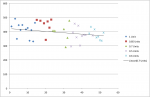
high flat curve, it's just that the lows aren't evident because they can be so sudden you may not always catch them. I guarantee he had at least a 40 the other night to produce that 492 for which you wrote, "never higher AMPS" in notes. Yes that sucks. But it's a big clue, even when you aren't testing the actual low.
Sheila explained what she saw in those cycles very well. I like to call those kinds of spreadsheets the ones with the pretty colors. In one week he has every color in the range, except for 500, but he practically did. Too many pretty colors means rebound.
So the reason it's better to lower the dose considerably than try to slowly go down in dose is because of the "shed" effect. I believe I explained this to Melissa and Celle recently. Let me find that post and I'll come back and edit this one to include that.
Vicky & Gandalf said:
Melissa and Celle said:
I'm just confused. Why is it that we think 0.7 will be different now than just a few days ago?
Oh, Melissa, that's a VERY good question!!
I suppose the best way to explain it is the "shed" theory. Because Levemir has to build up in the system so that you create enough "shed" to maintain steady numbers, you also cannot overflow the shed, so if you're giving too much insulin and overflowing the shed already, you have to drain the shed a little and work on refilling it, making it easier to not overflow it! So although .7U might be a good dose, if you had continued to do .7U and the shed was still overflowing, you wouldn't be able to tell it was good.
By dropping well below the point at which the shed overflows, you allow the system time to drain the excess and essentially start over. That's why you're seeing steadier numbers without rebounds now, even though the numbers are higher.
Hope that makes it clear as mud!
So that's why Sheila is recommending dropping the dose down to as little as .25U. If you don't think he would handle that well, then go down to .5U. You need to drain the shed and in order for it to do that he will just have to have higher numbers, they should be steadier numbers but high like in the 300s. It might look like a disaster, but I've said this to others - Gandalf has been diabetic for 6 1/2 years, on Levemir for soon to be 4 years and he still gets 300s even the occasional 400 because I can't keep to that 12/12 schedule. He is 18 and he's doing pretty darn good, despite other health issues which are far worse to his overall wellness than the diabetes unfortunately. 300s are not the end of the world.
Right now you're still seeing the high, flat curve effect of rebound, so I'm sure this doesn't make a lot of sense. Everyone's impulse is that XX isn't working, so we need more insulin. Our society is obsessed with more, more, more, so we're conditioned to think that more is better or more will work. Unfortunately it does not with insulin, especially Levemir.
I don't know how else to convince you that less Levemir can be better effective than more.
Did the tinned cans work? Did you hear me?



 I hope he comes down from that crappy red number this AM.