
You are using an out of date browser. It may not display this or other websites correctly.
You should upgrade or use an alternative browser.
You should upgrade or use an alternative browser.
Bouncing Chloe
- Thread starter srk4cats
- Start date
- Status
- Not open for further replies.

Tina and Gracie (GA)
Member Since 2017

StephG
Member Since 2016
If she gets a green PMPS tonight, you should do a curve. If she starts bouncing you can end the curve early or get a mini curve.What dose should I give her tonight? AMPS=199 and PMPS=56
I gave her 1.5u this morning. It's now time for her PM shot and I don't know how much to give. She's been eating fine.
Get a test as soon as you get home today so you can see if she's lower than her PS or if she's surfing in those greens.
Green looks good on Chloe but extra tests are needed to make sure she's not getting too low.

Kris & Teasel
Member Since 2016
TR or SLGS Roberta? You're doing an awful lot of dose hopping and that doesn't work with Lantus. Choose either TR or SLGS and follow the guidelines.

srk4cats
Member Since 2017
I'll do a curve tomorrow.If she gets a green PMPS tonight, you should do a curve. If she starts bouncing you can end the curve early or get a mini curve.
Get a test as soon as you get home today so you can see if she's lower than her PS or if she's surfing in those greens.
Green looks good on Chloe but extra tests are needed to make sure she's not getting too low.
StephG
Member Since 2016
That could be just enough time to start a bounce.I'll do a curve tomorrow.
I would get a +2 or +3/+4 tonight to see if she's having an active cycle. If it's active, do the curve tonight. It's much needed data and if you can catch the active cycle tonight-- it might be enough to create a bounce tomorrow.

Stacy & Asia
Member Since 2017
Sorry nobody was around at your shot time last night. You are MST zone, correct? What is your shot time?
Just wanted to put a couple things in your condo that you can absorb and reference later so rather someone is around or not, you have some info to guide your decisions.
Whenever faced with preshots like the ones you've been seeing recently (greens), it would generally not be advised to shoot if you are not able to monitor and keep her safe. You have to be data ready to shoot those numbers. If a caregiver is not able to monitor properly to keep their cat safe, it is often suggested to run that cat in higher numbers, but... On the other hand, Chloe is ketone prone and has a very recent DKA episode in her history, so it's also not advised to skip shots and keep numbers from being too high. Both DKA and symptomatic hypoglycemia can be extremely dangerous and fast acting. This is a rock and a hard place situation which requires extra vigilance on your part.
Shooting a reduced dose with Lantus doesn't work the same as what you're probably used to with Prozinc. Because of the depot (the insulin reserve tank that is always there), when you see a low number and shoot a reduced dose thinking less insulin will be used that cycle, it doesn't always work that way. I've shot reduced doses on lower preshot numbers and still Asia has gone under 50, the cycle looked the exact same as if I had given the full dose. That's the depot. Chloe has been filling up the depot for several cycles with the 1.5 dose, so even when you ask for a fat 1 unit, the depot can say "here is the insulin you ordered, 1.5 units".
It can take several cycles for the depot to adjust to different amounts, an increase could take several cycles to show what it is fully capable of, just as a decrease can take several cycles to show up as a smaller amount. What we do right now isn't always going to show an immediate result. This is also the reason it isn't advised here to change the dose frequently or shoot on a sliding scale with depot insulins like Lantus.
Weekly curves can give us a general idea of how a cat typically reacts on an active cycle, but it's not without exception either, because not all cycles are typical (such as a bounce breaking cycle can gain fast momentum and you can go from black to green in one cycle). The curves you have on Lantus so far have been on bounces, so we don't know if Chloe likes to surf or dive or what. We know she likes to bounce, though! I understand you can't do curves during the week, but as has been suggested before, any extra tests you can get outside of the preshots can fill in some of the blanks and help you help Chloe. This is important for every cat, but doubly so for Chloe because of her DKA history.
Do you have a hypo kit put together? I put mine in a recycled bright orange shoe box, clearly labeled. I keep it near my notebook and wrote important info in the lid of the box so that kids, husband, petsitter, whomever would have tools to keep Asia safe if I am not around. I keep a spare meter in there (in case of broken meter/battery dead), a lancing device, lancets, extra test strips, control solution, nitrile gloves, foods of different variety and carb value, and maple syrup (and I have Karo close at hand). It may seem like overkill, but it's for others who aren't me as well as for myself if I am ever faced with something horrible like an unconscious cat, that everything is in one place and in my panic I won't have to go gathering supplies around the house. I've attached photos below as well as the link to how to make your own.
http://www.felinediabetes.com/FDMB/threads/jojo-and-bunnys-hypo-tool-box.2354/
Were you able to get the ketone meter from Marje?
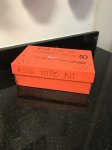
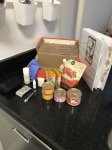
Just wanted to put a couple things in your condo that you can absorb and reference later so rather someone is around or not, you have some info to guide your decisions.
Whenever faced with preshots like the ones you've been seeing recently (greens), it would generally not be advised to shoot if you are not able to monitor and keep her safe. You have to be data ready to shoot those numbers. If a caregiver is not able to monitor properly to keep their cat safe, it is often suggested to run that cat in higher numbers, but... On the other hand, Chloe is ketone prone and has a very recent DKA episode in her history, so it's also not advised to skip shots and keep numbers from being too high.
Both DKA and symptomatic hypoglycemia can be extremely dangerous and fast acting. This is a rock and a hard place situation which requires extra vigilance on your part. Shooting a reduced dose with Lantus doesn't work the same as what you're probably used to with Prozinc. Because of the depot (the insulin reserve tank that is always there), when you see a low number and shoot a reduced dose thinking less insulin will be used that cycle, it doesn't always work that way. I've shot reduced doses on lower preshot numbers and still Asia has gone under 50, the cycle looked the exact same as if I had given the full dose. That's the depot. Chloe has been filling up the depot for several cycles with the 1.5 dose, so even when you ask for a fat 1 unit, the depot can say "here is the insulin you ordered, 1.5 units".
It can take several cycles for the depot to adjust to different amounts, an increase could take several cycles to show what it is fully capable of, just as a decrease can take several cycles to show up as a smaller amount. What we do right now isn't always going to show an immediate result. This is also the reason it isn't advised here to change the dose frequently or shoot on a sliding scale with depot insulins like Lantus.
Weekly curves can give us a general idea of how a cat typically reacts on an active cycle, but it's not without exception either, because not all cycles are typical (such as a bounce breaking cycle can gain fast momentum and you can go from black to green in one cycle). The curves you have on Lantus so far have been on bounces, so we don't know if Chloe likes to surf or dive or what. We know she likes to bounce, though!
I understand you can't do curves during the week, but as has been suggested before, any extra tests you can get outside of the preshots can fill in some of the blanks and help you help Chloe. This is important for every cat, but doubly so for Chloe because of her DKA history. Do you have a hypo kit put together? I put mine in a recycled bright orange shoe box, clearly labeled. I keep it near my notebook and wrote important info in the lid of the box so that kids, husband, petsitter, whomever would have tools to keep Asia safe if I am not around. I keep a spare meter in there (in case of broken meter/battery dead), a lancing device, lancets, extra test strips, control solution, nitrile gloves, foods of different variety and carb value, and maple syrup (and I have Karo close at hand). It may seem like overkill, but it's for others who aren't me as well as for myself if I am ever faced with something horrible like an unconscious cat, that everything is in one place and in my panic I won't have to go gathering supplies around the house. I've attached photos below as well as the link to how to make your own.
http://www.felinediabetes.com/FDMB/threads/jojo-and-bunnys-hypo-tool-box.2354/
Were you able to get the ketone meter from Marje?

No....she never contacted me but I have it available and can meet her somewhere.Sorry nobody was around at your shot time last night. You are MST zone, correct? What is your shot time?
Just wanted to put a couple things in your condo that you can absorb and reference later so rather someone is around or not, you have some info to guide your decisions.
Whenever faced with preshots like the ones you've been seeing recently (greens), it would generally not be advised to shoot if you are not able to monitor and keep her safe. You have to be data ready to shoot those numbers. If a caregiver is not able to monitor properly to keep their cat safe, it is often suggested to run that cat in higher numbers, but... On the other hand, Chloe is ketone prone and has a very recent DKA episode in her history, so it's also not advised to skip shots and keep numbers from being too high.
Shooting a reduced dose with Lantus doesn't work the same as what you're probably used to with Prozinc. Because of the depot (the insulin reserve tank that is always there), when you see a low number and shoot a reduced dose thinking less insulin will be used that cycle, it doesn't always work that way. I've shot reduced doses on lower preshot numbers and still Asia has gone under 50, the cycle looked the exact same as if I had given the full dose. That's the depot. Chloe has been filling up the depot for several cycles with the 1.5 dose, so even when you ask for a fat 1 unit, the depot can say "here is the insulin you ordered, 1.5 units".
It can take several cycles for the depot to adjust to different amounts, an increase could take several cycles to show what it is fully capable of, just as a decrease can take several cycles to show up as a smaller amount. What we do right now isn't always going to show an immediate result. This is also the reason it isn't advised here to change the dose frequently or shoot on a sliding scale with depot insulins like Lantus.
Weekly curves can give us a general idea of how a cat typically reacts on an active cycle, but it's not without exception either, because not all cycles are typical (such as a bounce breaking cycle can gain fast momentum and you can go from black to green in one cycle). The curves you have on Lantus so far have been on bounces, so we don't know if Chloe likes to surf or dive or what. We know she likes to bounce, though!
Do you have a hypo kit put together? I put mine in a recycled bright orange shoe box, clearly labeled. I keep it near my notebook and wrote important info in the lid of the box so that kids, husband, petsitter, whomever would have tools to keep Asia safe if I am not around. I keep a spare meter in there (in case of broken meter/battery dead), a lancing device, lancets, extra test strips, control solution, nitrile gloves, foods of different variety and carb value, and maple syrup (and I have Karo close at hand). It may seem like overkill, but it's for others who aren't me as well as for myself if I am ever faced with something horrible like an unconscious cat, that everything is in one place and in my panic I won't have to go gathering supplies around the house. I've attached photos below as well as the link to how to make your own.
http://www.felinediabetes.com/FDMB/threads/jojo-and-bunnys-hypo-tool-box.2354/
Were you able to get the ketone meter from Marje?
View attachment 35182 View attachment 35183
I agree with the information Stacy has given you. Chloe has already had DKA three times. If you want to prevent a fourth, you have to shoot the correct dose that gives her enough insulin but shooting the correct dose also requires you to be responsible and test her so she doesn’t Hypo.
You are putting her at risk by not testing. Her SS could look so much better and she could be doing better if you were able to get in a few tests each cycle.

I want to underscore what Stacy and Marje both said. Lantus is not ProZinc. If you treat Lantus like ProZinc your risk either putting your cat back in DKA or causing a symptomatic hypoglycemic episode. Dosing is NOT based on the preshot number; it's based on the nadir. Since you switched to Lantus, you've not done a curve so there's no way to know where Chloe's nadir falls so there's no way to support changing her dose. From the standpoint of using a depot type of insulin, as Kris noted, your dosing is all over the map which will cause weird results as Lantus likes consistency. And just to drive home the point further, shooting a 56 at PMPS and not getting any further tests is putting your cat at significant risk for a hypoglycemic event. Chloe's numbers could easily have been in the 20s for hours overnight, or worst case scenario, she could have died. And yes, I am being harsh but I am also being realistic. Insulin can do wonders and it can also kill a human or a cat. The only means you have to keep your cat safe is to test. A low pre-shot number means you need to test early and often.
srk4cats
Member Since 2017
I gave her my phone number... not sure where my phone is...Were you able to get the ketone meter from Marje?

Beenie (GA)
Member Since 2017
I worry for Chloe. I hope testing for ketones happens daily.
Do you find it hard to test her BG? Does she give you a hard time?
I’m a former ProZinc-er and Lantus/Levemir are completely different when it comes to dosing. Took me a little while to re-learn everything. All I can offer is to read the stickies over and over which is what I did along with reading about other kitties journeys. Everyone has given you sound advise. I hope you are able to test more and keep Chloe safe. She loves and needs you. Our furry friends at least in my house mean more to me than most of my crazy family members
They depend on us and in return they give us unconditional love
Do you find it hard to test her BG? Does she give you a hard time?
I’m a former ProZinc-er and Lantus/Levemir are completely different when it comes to dosing. Took me a little while to re-learn everything. All I can offer is to read the stickies over and over which is what I did along with reading about other kitties journeys. Everyone has given you sound advise. I hope you are able to test more and keep Chloe safe. She loves and needs you. Our furry friends at least in my house mean more to me than most of my crazy family members
They depend on us and in return they give us unconditional love
Tina and Gracie (GA)
Member Since 2017
The reason Chloe is so high this morning is because I gave her a different food last night which contained liver.
Hmmmm. There has to be more than that. Was the food HC? I feed Gracie food with liver in it, and it doesn’t spike her BG.
Did you check the carb amount? The food we feed is crucial to successfully managing FD.
Kris & Teasel
Member Since 2016
PLEASE do your part Roberta.
srk4cats
Member Since 2017
Hmmmm. There has to be more than that. Was the food HC? I feed Gracie food with liver in it, and it doesn’t spike her BG.
Did you check the carb amount? The food we feed is crucial to successfully managing FD.
It was 5 carbs according to the Pierson chart. I also gave her maybe 2 oz cooked chicken livers. The chart said that you should give liver once a week. My civvies liked it, too, and, after adding some spices, I'm going to have some for dinner.
What food with liver do you feed Gracie?
Last edited:
srk4cats
Member Since 2017
No. She's usually very patient, knowing she's about to get her meal. I just don't like poking her so much. Her ear looks butchered. I got a ketone test yesterday.Do you find it hard to test her BG? Does she give you a hard time?
srk4cats
Member Since 2017
Why should I test more if I can't adjust the dose anyway? Damned if I do, damned if I don't. Plus, she grazes during the day, so I don't know how accurate the tests are. All I can say is, she seems much better since she started the Lantus. Sorry if I'm not the scientific type. I'm an artist and go by instinct.I worry for Chloe. I hope testing for ketones happens daily.
Do you find it hard to test her BG? Does she give you a hard time?
I’m a former ProZinc-er and Lantus/Levemir are completely different when it comes to dosing. Took me a little while to re-learn everything. All I can offer is to read the stickies over and over which is what I did along with reading about other kitties journeys. Everyone has given you sound advise. I hope you are able to test more and keep Chloe safe. She loves and needs you. Our furry friends at least in my house mean more to me than most of my crazy family members
They depend on us and in return they give us unconditional love
Kris & Teasel
Member Since 2016
Have you read TR or SLGS? Both allow dose adjustments based on BG test numbers.Why should I test more if I can't adjust the dose anyway?
Accurate enough to tell you how she's responding to a dose within her normal daily routine.Plus, she grazes during the day, so I don't know how accurate the tests are.
StephG
Member Since 2016
Kris is right. The only way to know how it's working is to test. You need to test often enough to get an idea of how it's working then you adjust the dose from there. Normally, you don't reduce the dose unless they go under 50 (on TR) or under 90 (on SLGS). If you're not testing to see where she's going at all-- you can't know if she needs an increase or decrease.
Chuck was getting BLUE preshots but staying above 200 the rest of the cycle. I know this from testing. I increased and he started to get better numbers mid cycle.
This proves the importance of testing and determining dose based nadir numbers. It would spell trouble for Chloe and ketones if she was reacting the same as Chuck.
Testing keeps them safe!
Chuck was getting BLUE preshots but staying above 200 the rest of the cycle. I know this from testing. I increased and he started to get better numbers mid cycle.
This proves the importance of testing and determining dose based nadir numbers. It would spell trouble for Chloe and ketones if she was reacting the same as Chuck.
Testing keeps them safe!

PPCW
Member Since 2017
Why should I test more if I can't adjust the dose anyway? Damned if I do, damned if I don't. Plus, she grazes during the day, so I don't know how accurate the tests are. All I can say is, she seems much better since she started the Lantus. Sorry if I'm not the scientific type. I'm an artist and go by instinct.
Hi Roberta,
I have been following Chole on Prozinc forum and now to Lantus.
I think you don’t quite understand how insulin works. When a normal person (and kitty) eats, the body senses the rise in blood glucose level and instructs the pancreas to release insulin to make the cells take in blood glucose in order to lower the BG. So the glucose remain relative constant throughout the day. Yes, there will be a spike of BG after food intake but insulin will normalize it quickly.
Since our diabetic cats have insulin on board via injection, it will attempt to normalize the BG as well because it works the same way as a heathy individual.
To test often regardless of insulin type is to determine the strength and duration of one dose. It is important to know if the amount of insulin is enough to normalize BG even after eating.
Let’s say you saw Chloe eating and tested after 20 min to allow absorption of carbs into blood stream, you will get a number post eating. If you test again 1 hour post eating, this BG number will show you if the insulin in her system is helping her lower the BG or not.
If you don’t test, there is no way of knowing if the insulin dose is enough for the current condition. This is why everyone from Prozinc to Lantus forum is telling you to test often especially Lantus dosing is based on nadir values.
I am afraid that you can’t just go with your instinct on this one because insulin dosing is based on evidence, not how we feel. Please understand that I respect artists. I am a musician and a scientist. I totally understand your work schedule because I teach science.
No one is telling you that you can’t change the dose. What everyone is telling you is that you can adjust the dose based on the nadir values.
I don’t know how much of all the above explanation you will take in so I wish you and Chloe all the best.
Regards,
Patricia
Let me adapt Patricia's comments above so they are specific to Lantus. Prozinc acts a bit differently since it is not a depot type of insulin. However, the overall principle Patricia outlines is correct.
Insulin allows glucose, which is what all food ultimately breaks down to, to get into the cells. Glucose is what provides fuel to our bodies and brain. If glucose is floating around in the blood stream, it's not doing the cells any good. In fact, this is why our kitties lose weight despite being ravenously hungry when they are not regulated -- nutrition (i.e., glucose) isn't getting into the cells.
With Lantus, when you give a shot, it takes approximately 2 hours for the insulin to work. The point at which the insulin begins to work is called "onset." If you feed at the same time you shoot, numbers are likely to rise and as insulin onset begins, the numbers are roughly the same as your pre-shot test value. This is what tells you when your cat's onset begins. With Lantus, the lowest point in the cycle (i.e., nadir) is in the neighborhood 6 hours after the shot. Both onset and nadir can and do change. The number of hours I've noted is a generalization -- some cats have early or late onset and nadir. My cat's onset was at around +1 or +2 and her nadir was usually not much later than +4.
Why is this important? One of the big differences between Prozinc and Lantus is what you base your dosing on. With Prozinc, the dose is based on the pre-shot numbers. You can adjust your dose at each cycle. With Lantus, the dose is based on the nadir value. You do not tinker with the dose unless a reduction is indicated and the point at which you reduce is based on whether you are using Tight Regulation or Start Low Go Slow as your dosing strategy.
Grazing during the day isn't a problem. Given that Lantus is having its greatest impact on BG until nadir, having food available isn't a bad thing in the least. However, you want to make sure that food is removed 2 hours prior to shot time. Otherwise, your pre-shot values may be influenced by food and you won't know if it's safe to shoot.
Let me provide a real life example of why testing/spot checks are important. Gabby was quite capable of starting out with numbers in the 400s, dropping into the 40s, and bouncing back into the 400s by her next shot time. If I hadn't been checking her numbers, I would have never known that she dropped into dose reduction territory. So, instead of reducing her dose due a nadir in the 40s, based on those high numbers at either end of the cycle, I would have increased her dose. Those spot checks give you a ton of information about what is happening throughout the cycle. Without that information, especially since Lantus dosing is based on nadir, you have no idea how to make a decision on your cat's dose.
Insulin allows glucose, which is what all food ultimately breaks down to, to get into the cells. Glucose is what provides fuel to our bodies and brain. If glucose is floating around in the blood stream, it's not doing the cells any good. In fact, this is why our kitties lose weight despite being ravenously hungry when they are not regulated -- nutrition (i.e., glucose) isn't getting into the cells.
With Lantus, when you give a shot, it takes approximately 2 hours for the insulin to work. The point at which the insulin begins to work is called "onset." If you feed at the same time you shoot, numbers are likely to rise and as insulin onset begins, the numbers are roughly the same as your pre-shot test value. This is what tells you when your cat's onset begins. With Lantus, the lowest point in the cycle (i.e., nadir) is in the neighborhood 6 hours after the shot. Both onset and nadir can and do change. The number of hours I've noted is a generalization -- some cats have early or late onset and nadir. My cat's onset was at around +1 or +2 and her nadir was usually not much later than +4.
Why is this important? One of the big differences between Prozinc and Lantus is what you base your dosing on. With Prozinc, the dose is based on the pre-shot numbers. You can adjust your dose at each cycle. With Lantus, the dose is based on the nadir value. You do not tinker with the dose unless a reduction is indicated and the point at which you reduce is based on whether you are using Tight Regulation or Start Low Go Slow as your dosing strategy.
Grazing during the day isn't a problem. Given that Lantus is having its greatest impact on BG until nadir, having food available isn't a bad thing in the least. However, you want to make sure that food is removed 2 hours prior to shot time. Otherwise, your pre-shot values may be influenced by food and you won't know if it's safe to shoot.
Let me provide a real life example of why testing/spot checks are important. Gabby was quite capable of starting out with numbers in the 400s, dropping into the 40s, and bouncing back into the 400s by her next shot time. If I hadn't been checking her numbers, I would have never known that she dropped into dose reduction territory. So, instead of reducing her dose due a nadir in the 40s, based on those high numbers at either end of the cycle, I would have increased her dose. Those spot checks give you a ton of information about what is happening throughout the cycle. Without that information, especially since Lantus dosing is based on nadir, you have no idea how to make a decision on your cat's dose.
Tina and Gracie (GA)
Member Since 2017
It was 5 carbs according to the Pierson chart. I also gave her maybe 2 oz cooked chicken livers. The chart said that you should give liver once a week. My civvies liked it, too, and, after adding some spices, I'm going to have some for dinner.
What food with liver do you feed Gracie?
Sometimes I give her straight liver--after I cook it of course. I haven't done in a year, or so.
But, she eats the Friskies Liver and Chicken Pate. I also have Hill's Science Diet Chicken and Liver Entree, but it is higher in carbs. She use to love, but now she hardly eats it. The FF liver gives her GI issues.
I recently bought her Ziwi Peak-Lamb and she loves it. It is a bit pricey though. I definitely won't be able to afford it all the time. I got a 12-pack for just under $45. It is safe to say Gracie is eating better than me right now.
StephG
Member Since 2016
@srk4cats that 49 AMPS makes me think you should try to get more test between +6 and +11 too. She could be seeing all her action later in the cycle, especially on bounce clearing cycles.
So when you can get a test in the second half of the cycle, please do.
Also a curve on a non-bounce cycle is still needed to see when her nadir is. Then you will know when the best time to test her is to get a better idea of how well she's doing.
So when you can get a test in the second half of the cycle, please do.
Also a curve on a non-bounce cycle is still needed to see when her nadir is. Then you will know when the best time to test her is to get a better idea of how well she's doing.

Magic Johnson
Member Since 2018
Let me adapt Patricia's comments above so they are specific to Lantus. Prozinc acts a bit differently since it is not a depot type of insulin. However, the overall principle Patricia outlines is correct.
Insulin allows glucose, which is what all food ultimately breaks down to, to get into the cells. Glucose is what provides fuel to our bodies and brain. If glucose is floating around in the blood stream, it's not doing the cells any good. In fact, this is why our kitties lose weight despite being ravenously hungry when they are not regulated -- nutrition (i.e., glucose) isn't getting into the cells.
With Lantus, when you give a shot, it takes approximately 2 hours for the insulin to work. The point at which the insulin begins to work is called "onset." If you feed at the same time you shoot, numbers are likely to rise and as insulin onset begins, the numbers are roughly the same as your pre-shot test value. This is what tells you when your cat's onset begins. With Lantus, the lowest point in the cycle (i.e., nadir) is in the neighborhood 6 hours after the shot. Both onset and nadir can and do change. The number of hours I've noted is a generalization -- some cats have early or late onset and nadir. My cat's onset was at around +1 or +2 and her nadir was usually not much later than +4.
Why is this important? One of the big differences between Prozinc and Lantus is what you base your dosing on. With Prozinc, the dose is based on the pre-shot numbers. You can adjust your dose at each cycle. With Lantus, the dose is based on the nadir value. You do not tinker with the dose unless a reduction is indicated and the point at which you reduce is based on whether you are using Tight Regulation or Start Low Go Slow as your dosing strategy.
Grazing during the day isn't a problem. Given that Lantus is having its greatest impact on BG until nadir, having food available isn't a bad thing in the least. However, you want to make sure that food is removed 2 hours prior to shot time. Otherwise, your pre-shot values may be influenced by food and you won't know if it's safe to shoot.
Let me provide a real life example of why testing/spot checks are important. Gabby was quite capable of starting out with numbers in the 400s, dropping into the 40s, and bouncing back into the 400s by her next shot time. If I hadn't been checking her numbers, I would have never known that she dropped into dose reduction territory. So, instead of reducing her dose due a nadir in the 40s, based on those high numbers at either end of the cycle, I would have increased her dose. Those spot checks give you a ton of information about what is happening throughout the cycle. Without that information, especially since Lantus dosing is based on nadir, you have no idea how to make a decision on your cat's dose.
While I have not been part of this thread, I just want to say this is the most amazing and thorough explanation of how Levermir (sp) or Lantus works by far, that I have read in everything I’ve read - Amazing post!! Thank you it really helped me understand

StephG
Member Since 2016
When she woke you up crying, you should have tested her. The pink preshot makes me wonder if she was going low.
An auto feeder is great to give them snacks at the times when they need them most. (Determined by a CURVE)
Chuck used to bother me constantly but now knows the schedule and sleeps between snacks.
An auto feeder is great to give them snacks at the times when they need them most. (Determined by a CURVE)
Chuck used to bother me constantly but now knows the schedule and sleeps between snacks.
Kris & Teasel
Member Since 2016
Curve day today, Roberta. You need the data.
- Status
- Not open for further replies.