Better High than Low I suppose...

Status
Not open for further replies.

MeltyCat

Member Since 2015
Hello again,

Just uploaded Melty's SS and it kind of helps to see the trends?

1 Unit 2 x daily didn't seem to be enough, so after speaking to the vet today, I've upped the dose to 2 units 2 x daily. I'm looking into changing his diet over, but with his numbers as high and inconsistent as they are is that safe? Also, is there anyone out there with advice for feeding 1 sugar and 1 civie kitty at the same time? Will the diabetic food be lacking anything that my other feline friend might need? Or can I feed them both the same.

I did check the Guaranteed Analysis on the Special Kitty that I am feeding them both currently:

Crude Protein (Min) ...... 31.5%
Crude Fat (Min)..............10.0%
Crude Fiber (Max)............4.5%
Moisture (Max)...............12.0%
Calcium (Min)...................1.0%
Phosphorus (Min)............0.8%

I also noticed that the first two ingredients are ground yellow corn, and soybean meal, so I imagine a huge percentage of that crude protein is plant-based. That is of course, if the ridiculous amount of internet research I have done over the past 24 hours is correct.

I'm starting to get a little discouraged. I feel bad every time I have to check his levels because he gets super stressed out (which could also account for some of the higher numbers to a limited extent).

Just looking for a little guidance here. I know I have to switch his food. Friday is payday, I will try to take more readings on a regular schedule tonight.
 
Without the ash and other materials, I come up with 48% carbs? I don't feed "diabetic" foods, just low carb canned. Does the civie have any special conditions we need to know about? And corn is definitely a carb, not protein.
 
Oh...You see, I know even less than I thought lol.

Civie is named Aggie. 1 Yr old and no medical conditions. (She is starting to get a little more round as of late though)
 
According to the Calculator; It's 40.2% wet matter carbohydrates...which sounds pretty awful.

Melty tends to have pretty intense digestive distress when I switch his foods, so I'm anxious about doing so.

I have a couple of cans of pumpkin on standby just incase.
 
Don't feel too discouraged. You've made a good start with the research and the testing and the creation of a spreadsheet.
It's a process to absorb all this information and then try to figure out what to do with what you know or what you think you understand. LOL You can do this. :)
My little guy, Radar, was diagnosed in March and if you look at his spreadsheet you will see that it's taken a while to get him to where he is today. We have also found that the more testing we did to find out when Radar hit his peak (when the BG is the lowest) and when the numbers started climbing, the more information we had and thus more understanding.
We also had a lot of testing trouble with more human blood available than feline, but it gets easier.
We found that when we were stressed about it, Radar was stressed. Be patient and kind with yourself and it will rub off on your kitty.

You've come to the right place, the people here are so knowledgeable and will help you as you work to figure out how to help your furry one.
 
@Jan,

I mean this is the nicest possible way, but your spreadsheet is too funny.
"No test, cat is done with poking" certainly put a smile on my face.

I also had a few incidents of mixed blood in the beginning, stuck myself a couple of times just trying to pick up the lancet. :)

I will try to get +2, +4, and +6 numbers tonight and hopefully get a better idea of when it is the lowest.

Melty has always been a very very docile and friendly cat, I think I'm just a little concerned that he will be less snugly with me if I poke him too much more.
 
Nikki you are doing great and Melty is just adorable! I have a black rescue named Jet and they could be twins (although Jet is only about 2).

If he's on that food then maybe the 2.0u won't be awful but everything I've read on Caninsulin suggests, when all other things remain equal, not to adjust the dose more than 10% incrementally or any sooner than 5-6 days. It must be frustrating to do so much and not see more positive results. Given you will be transitioning his diet slowly you may be okay at the 1.0 unit increase but if you can even just test once at +4 it might give you some peace of mind. Also, is he free feeding or getting meals only at shot time? Grazing could influence your numbers greatly, especially with a higher carb food. Ideally he pre shot reading is with him not having eaten in the last two or more hours. See how on Genghis' spreadsheet I fed her some Temptations and her BG went up by more than 20 in the space of five hours? That's the dance between diet and insulin.

Given the moisture content I'm guessing that is a dry food and there are precious few low carb dry varieties in Canada - trust me I've looked! You're not totally wrong about plant based proteins - a lot of food manufacturers are substituting pea protein for meat protein. Safest bet is that if the label has any vegetables or grains on it, especially as one of the first five named ingredients, you have a pretty darn high carb food.

Will Melty eat any wet foods at all? There are some better and cheaper options if he will. As you transition him, his blood sugar could come down by 5 to 10 easily. That is when you will need to use extra caution with his dose and know how low he is going with the combination of low carb diet in the mix.

As for your Civvie cat, you can benefit her greatly by switching her now. I have Jet eating an all low carb diet and I'm working on getting my crunch junkie Picasso transitioned over. Honestly I thought Fancy Feast was crap and I was doing my kids a favour feeding them an expensive dry food. I couldn't have been more wrong! Even the expensive wet food I gave as a treat wasn't as appropriate as the FF. I did have two Siamese live to 19 and 20 on an all dry diet, but they never got fat and frankly I was just lucky.

FYI Petsmart and Walmart have the classic varieties on sale for 60 cents a can right now - I am stocking up! Go with classic chicken in the pink can, tender liver and chicken in the goldy Orange can and Turkey and giblets in the olive green can.

Hope that helps!
 
They are cats after all. ;)

Is that Shiloh in the picture? She is beautiful.
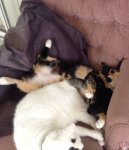
That is Shiloh. That was the first picture I ever saw of her. This is a recent one with her bestie Spuds. 10014955_10201698808612471_1324051461_o.jpg
 
@Brashworks Wow! Thanks so much for taking the time!

It is a dry food, the same food he has eaten all his life (I'm sorry to say).
I have tried to switch him to other dry foods previously and had very little success. He LOVES the taste, but has digestive issues with anything else I've tried.

I am currently giving him half of his food in the morning, immediately following his insulin and the same at night. I was giving just a tiny bit of food before checking his levels, but it didn't seem to make a difference. I think I may be expecting results too quickly and expecting things to stay relatively even. I don't think that'll be the case with such high carb food, in the meantime.

Unfortunately, with having two kitties, it's sometimes hard to tell if he's eating very little, half, or all of the food I am putting in the dish. I've considered splitting them up in the morning, but they both tend to graze, and I don't want to keep him locked in a room by himself all day. I'd feel terrible.

Aggie (Agapaw Christie after my favorite author lol) will eat anything and everything placed in front of her. You name it, she's already plucked it from your hand and taken off. She is the first cat I have taken in and taken care of on my own, so it'll be a relief to know I'll be feeding her good food as well.

I've also been considering getting an automatic feeder to have at home, so I can schedule a small meal just before the time of day when his BG would be the lowest. Do you think that's necessary or beneficial at all? Or am I just throwing money at it to make myself feel better? lol

Best wishes from Melty and I, to you, Genghis, Jet, and Picasso.
 
The auto-feeder has been great for me. Most days I come home and it is cleaned out. Don't know which cat is eating it, but it provides them both an opportunity. And I can see the results in Shiloh's BG.
 
The auto-feeder has been great for me. Most days I come home and it is cleaned out. Don't know which cat is eating it, but it provides them both an opportunity. And I can see the results in Shiloh's BG.

My only concern is that Melty might get a little aggressive with Aggie over the wet food, and I won't be here to call time out.
 
Is Melty normally food aggressive?

Honestly? Not at all.

They both share the bowl of dry food with no issues.
He was aggressive with her only maybe the first week I had brought him to the new house.
He LOVES wet food though, and I don't know if they'll both be able to fit their heads in the automatic feeder.
 
The poking gets easier and easier every time you do it. Use a warmed up sock full of rice to warm the ear up, makes it really easy. At +6 days now the whole thing is much much easier then it was at the beginning.

We also have 2 other cats, and I feed Luna separate from the others. I also pick their food up so she can't go eat it (she would, she's a scrounge).

Most important and easiest thing really is switching to low carb wet food for a diabetic. I use Friskies Pate which is cheap and 8-9% carbs, Fancy Feast is another good cheap one though a little more $.
 
You're more than welcome Nikki - this is a wild ride and I'm glad I can help at all.

I was also considering an automatic feeder just in case. If you do order one, I think the best price is on the Pet5 at Amazon.com and they will deliver to Canada. So far, even with exchange and shipping, it's cheaper than any price I've seen up here. And no, I don't think you're being paranoid. Once Melty's diet is moved over and you are working out the dosing, it will be important for you to "feed the curve" - I love this expression - just keeping some food available to keep him from crashing. I am finding Genghis to be totally ravenous and I'm feeding her as much as 4 cans a day - she needed to gain some weight back and I think her body is finally getting to use the food better. Melty doesn't really look over or underweight to me though and I'll bet that he and Aggie can work it all out.

Agapaw Christie - OMG that is too funny. It makes me think of TS Eliot and the Naming of Cats - such a clever name! She is a beauty!

Here are Picasso and Jet, they are definitely pals. I wonder about the story with Picasso's ear - he was at a rescue and it sort of made me love him instantly:

IMG_1976.jpg


@Shiloh & Rhonda - Shiloh sure has a lot of poses like that - OMG she is one relaaaaaxed kitty! She's gorgeous. LOL @ "dead roach pose".
 
When you have tried switching foods, did you do so gradually, 20-25% per day or two? Slow transitions tend to work better, especially with sensitive GI tracts.

If yes, ignore the following.
There are 2 dry foods in the US which are low carb:
Evo Cat and Kitten dry (turkey flavor)
Young Again 0 Carb (internet only; pricey, but they eat less so it may work out price wise)
 
Took BG this morning, 27.7!

I also took a reading at +4 last night (my alarm didn't go off for +6 and I'm very disappointed in myself) and he was at 10.8.
I can only assume that his food is making it spike so high? Might have to run to Wal-Mart this evening and start switching sooner rather than later.

Going to hold off his food until +1 today so he hopefully doesn't drop so drastically, as I have to go to work (and I worry).

Just looking for validation that I'm doing the right thing.
 
Nikki you're doing fine - the +6 is nice to have so you can find out just how low he's going but the +4 reading helps a lot.

Don't be in a rush - lots of folks spend months getting their cats regulated and his numbers could be a lot worse. You are on the money that he's better a bit high than too low - his reading this morning is probably a combination of the insulin wearing off under 12 hrs plus his diet - did he eat at all before you took that AMPS today? If he didn't, don't despair.

Perhaps in the next few days you can start shifting his food but be prepared to know if you have to adjust his dose back down.

It may be prudent to leave his diet and do a curve once he's been on a steady dose for 5 days to a week if you can't be around to test. Then, once you have the curve info you can change his food in conjunction with the dose. Doing both at once requires steady monitoring to make sure he doesn't drop too low.

Sorry if this is jumbled - shhh I'm at work!
 
@Jan and Katie.

I am well aware that his diet is in need of alteration, and want to do so as soon as possible.

Please do not respond in such an alarmist way, as I am doing my best, and understand the importance of what I am trying to accomplish. I would much rather keep him on the dry food a little bit longer in order to have a better understanding of what is going on so that I don't accidentally put him into hypo when I am not available to help him.

I appreciate your response, and will take all that you have said into consideration.
 
@Brashworks

He does usually eat whatever is left in the bowl in the morning before I'm even out of bed, so there is a good chance that his high numbers do have something to do with his eating habits. I will most likely be changing his food over slowly to EVO dry (just for convenience sake for tiny meals when I am not at home for 8+ hours) and a low carb wet food.

I am planning on taking readings at +1, +3 , and +5 tonight. I really don't want to change the food until I have a better idea of where his numbers are on 2u.

I'm also at work, haha double shhhhhhh.
 
Last edited:
Hi Nikki,
Welcome to FDMB! Sounds like you are doing great so far with testing and doing your research. I've never heard of the 24 hour detox approach that Jan mentioned. Since Melty has a sensitive tummy, you're right to transition slowly to wet food. Just be sure to monitor carefully once he's getting less dry food. It will definitely make a big difference in his numbers.

Joan
 
@Mitzelplik's Mom

Hello Joan,

Thank you for the kind words.
Despite feeling discouraged and a bit overwhelmed at times, with much support from members here and an excellent vet in my corner, I'm confident that I can get Melty to a point where his diabetes is regulated.

I've already had one emergency vet trip for a hypo event and have no interest in going again if I can help it! So rest assured when I do get to a point where I feel it is safe to start changing his food, I will be monitoring his levels very closely, especially at peak points, to make sure he isn't dipping too low.

Thanks for the advice :)
 
No diabetic cat should ever eat dry food, only wet low carb, 10% or less. The Special Kitty food you are feeding has 47% dry carbs! Consistent BG above 250 does damage to the internal organs, the liver and pancreas can heal however the kidneys cannot. It is important to your kitty's health that all dry food be taken away and a low carb wet diet implemented as soon as possible. Because your kitty is already on insulin any attempt to transition to a wet low carb diet (under 10%) has to be done after detox and very carefully. A 24 hour detox period will be required in which no dry food is given and no insulin is given. Feed low carb Fancy Feast Classic Pates, specifically Beef & Chicken, Chicken & Liver, Turkey & Giblets, Chopped Grill or Chicken and take BG readings every 2 hours for the entire 24 hour period so you can see how much the BG drops on an appropriate diet without insulin. Inform your vet and the experienced advisors on this forum of the BG readings and seek guidance to determine the appropriate insulin scale once the 24 hour detox period is over.

It is important that a diabetic cat always have wet food available as diabetes is literally starving the cat.

Jan (or Katie, not sure which one is the cat!) - Melty has a history of digestive issues and I'm sure some cats, like mine, can tolerate a 100% food switch but while of course it's true that a low carb wet diet is wholly beneficial to any cat (diabetic or not), the transition does not need to be overnight for successfully regulating diabetes. Slow and steady can win the race.

Nikki, you can decide for Melty what will be best for him and weigh out his tummy with his BG and his dose. I made the mistake with Genghis of going too fast and would like anyone in a similar situation to learn from it. I know you are doing everything you can to get Melty's numbers in line - your instincts for avoiding another hypo event are very good. Keep us posted with his progress!
 
I will most likely be changing his food over slowly to EVO dry

Hey, just FYI, speak to your food supplier about the EVO. @MrWorfMen's Mom has let me know that EVO (which she has fed to her cat) is being discontinued in Canada. She is a great resource for dry food suppliers and getting information out of manufacturers.
 
I will most likely be changing his food over slowly to EVO dry (just for convenience sake for tiny meals when I am not at home for 8+ hours) and a low carb wet food.
Nikki, a lot of us leave wet food out during the day and have had no problems with it spoiling, so that is an option if you wanted to eliminate the dry food entirely. I often give Mitz half her meal in one dish and leave the other half frozen in a 2nd dish and she'll eat it after it thaws. Other times I leave a small amount of freeze-dried raw food that I leave dry. She seems to like it for variety and it's another alternative to kibble.
 
@Brashworks

Thank you for being so attentive to my myriad of questions. :)

I did unfortunately call the Global Pet Foods nearby and they informed me that EVO has already been discontinued in Canada. It's a bit of a disappointment since it's such a good dry food option. I imagine I will pick up a bag of Wellness Core instead. I don't really plan on giving him much dry at all. Maybe just a very small meal before his low point, and then I can use as treats if he gets low and I need something to bring the numbers up quickly.

@Mitzelplik's Mom I've already ordered my automatic feeder and some small cube trays for freezing wet food!
 
@MeltyCat I'm glad I can help. And questions are good!

Now I have one for you.

You said Melty had already had a hypo event and his Dx was in May. Has he always been on Caninsulin i.e. since May? Just trying to undersand how long he's been on it.

I just took Genghis' reading and she is back up to over 20 again :arghh:

I am seriously going to talk to the vet about Lantus (I have two pens of it in my fridge care of my diabetic Dad since the end of June...).

Anyway my point is I guess that these patients can throw us curve balls all the time. I try not to get discouraged when the meter number comes up (honestly sometimes I feel like I'm at one of those slot machines and I've either won the jackpot or lost again :()

No, no, no, I will remain thinking positive thoughts!!!
 
@Brashworks

He has been on Caninsulin since diagnosis. They originally put him on 3u 2x a day and then upped it about 4 weeks later. Had only been doing the 4u dose for about two weeks when he had his hypo event. When we took him in the next day he was still testing very low, so we didn't give him anything for a couple of days. He seems to be responsive to the insulin, but anytime he eats his sugars just skyrocket. I think changing his food would make all the difference.

I can definitely relate to the Slot Machine analogy!! Just when I think I know what to expect on the meter, I'm completely off.

Gave the vet his current numbers today, and he suggested upping the dose again. I don't want to overdue it, so I'm going to keep monitoring and wait a couple more days.

You have all the information at your disposal to figure this out for you and Genghis! You have helped Melty and I immensely. I know you can do it. :)
 
@MeltyCat

Thanks for that info. Wow, 3u 2x up to 4u seems awfully high - I'm not surprised he had a hypo event I guess. How much does he weigh? Actually, I have read at the Vetsulin (US name for Caninsulin) site that the initial dose should be 1u and work from there. I'm a bit surprised he would be started so high but I don't know the circumstances of his diagnosis. I don't like to second guess a vet, but does your vet know about your proposed diet change and does he have an opinion on that? For sure his BG would rise as you have seen it on his current food - I'm guessing he's pretty "carb-sensitive". At the time of his first proposed increase (upping to 4u) was that based on a BG taken in the vet's office, or were you home testing then? And was that BG number a fasting BG or just a random sample, or a curve?

I'm afraid I don't know much about "bouncing" or the Somogyi effect - it looks something like this:
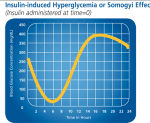
Screen Shot 2015-07-14 at 11.45.27 PM.png

So if, say his reading was taken at AMPS and PMPS, he'd just look "high" and "higher" which looks like it needs a dosage increase but actually, the Caninsulin Guide right here on FDMB says, though counterintuitive, a dosage decrease is in order:

Tip #4, Understand Rebound

Sometimes, even doing all of the above, we end up with numbers that have high preshots and lower swings or a curve that looks flat and high. You ask yourself...what is going on?

What may likely be happening is Somogyi Rebound. http://petdiabetes.wikia.com/wiki/Somogyi_rebound

When this happens it is important to take a step back, look at how your cat is doing in the 12 hour cycle and possibly do a "rebound check" ie:

Lower the dose for a couple of cycles, vigilantly test for ketones and allow the cat's body to normalize again from the crazy swings. It takes a few cycles for the stress hormones to settle and the blood sugar to even out again.

Ask questions...there are many here who have experienced this and can help, again cross post to health.

I think basically the body says "Holy crap, my BG is low. Better try to correct that" and you end up with progressively higher BGs (kind of like when you crash diet and your body goes into "fat preserve" mode to "save itself" - just ask my waistline!!)

So I also wonder, did your vet know Melty's nadir number (and not an artificially high vet-taken number) and peak time?


Dosage adjustments should be made on the following guidelines (warning, very long quote, but important info - keeping in mind this is for vets to follow so includes info about stress-induced glucose spikes):

Four values are important in interpreting the glucose curve (Table 2). They are as follows:

The highest blood glucose concentration, which is usually the one taken just before insulin is given. In some cases, the morning meal and the stress of riding in the car will cause the blood glucose concentration to rise slightly on the second sample, but it should decline from that point.

The nadir, which is the lowest blood glucose concentration.

The peak time, which is the time from the insulin injection until the nadir. It is expressed in hours.

The midpoint, which falls halfway between the highest and lowest blood glucose concentrations in the range.

Once these values are determined, they can be used to determine the dosing interval, the type of insulin, and the dose. The guidelines below are based on the assumption that insulin is being given twice daily.


To determine the dosing interval and the type of insulin, follow these steps:


If the peak time is less than five hours, a longer-acting insulin is given, or the current insulin is given more frequently, generally three times a day.

If the peak time is five to eight hours, the current insulin is continued on a twice-daily schedule.

If the peak time is greater than eight hours, the current insulin is continued, but is given once daily.

To determine the dose of insulin or if dysregulation problems exist, use these guidelines:


If the nadir is less than 5.6 (100 mg/dI), the dose should be decreased. You should assume that the nadir in the hospital is somewhat higher than what it will be at home because of stress. If this assumption is incorrect, you will err so that the blood glucose concentrations are too high. This is always the better way to err. Hypoglycemia can be fatal; mild to moderate hyperglycemia is not.

The ideal midpoint of the range is 11.1 (200 mg/deciliter) However, the midpoint is satisfactory if it is from 8.3 - 13.9 (150 to 250 mg/deciliter). If the midpoint is less than 8.3 mg/dI, the dose of insulin is too high and should be reduced. The nadir also should be below 5.6 (100 mg/dl) when the dose of insulin is too high.

If the midpoint is greater than 13.9 (250 mg/dI), several possibilities exist: 1) The cat may have been stressed when the glucose curve was performed. Recount the cat's attitude during the blood sampling process and the hospital stay. 2) The dose of insulin may be too low; if so, increasing it will solve the problem. 3) If increasing the dose does not bring the midpoint into the desired range, insulin problems should be considered. These include inactive insulin, insulin that is not mixed properly, poor injection technique, and poor absorption. 4) If this does not seem feasible, consider concurrent infectious disease. Many infectious diseases can cause temporary insulin resistance. A two-week course of a broad-spectrum antibiotic should be considered if your physical examination and other laboratory tests do not indicate a specific problem. 5) If these approaches are unsuccessful, you should consider insulin resistance due to hyperthyroidism, hyperadrenocorticism, acromegaly, or insulin-antibody formation.

Sorry that's so long but I have read it over and over trying to decide what to do with Genghis. She can have a peak time anywhere between +4 and +6 but her nadir seems to fall below 5.6 many times over many cycles. And yet her AMPS and PMPS have been pretty high for a few cycles now. Decisions, decisions.

If Melty were my cat, I'd try to hold off on any dose increases until his diet is sorted out. I'd also want to truly understand some pattern to his peak time and his nadir number on his current dose before I made any more changes. Of course, that is only based on my unique experience with Genghis, so take that as you will!

Weekend is coming up … think you can transition his food and do a curve?

PS Thanks for your encouragement about my girl. I needed that!! :bighug:
 
Bouncing, as we understand it here, is not Somogyi (which has never been convincingly reported in cats - just ask @Sienne and Gabby .
Bouncing is due to a sudden drop in glucose and/or a drop to a lower, unfamiliar number. This triggers compensatory hormones which release stored glucose (glycogen) that raises the blood levels for up to 3 day or so.
 
@BJM I actually quoted Tip # 4 from this site, on the Caninsulin Guide.

I'm gathering that rebound and bounce are not the same thing?

I see Somogyi Effect cited as:

Somogyi Effect
(Rebound Hyperglycaemia)

An insulin dose that is too high may bring about the Somogyi effect or rebound hyperglycaemia. This can also be produced if blood glucose concentrations fall too rapidly.

The body attempts to counteract the decline in the blood glucose concentration through a chain of reactions:

  • The blood glucose concentration falls rapidly or approaches hypoglycaemia (blood glucose concentrations of less than 5 mmol/l (90 mg/dl)) following the injection of insulin. The animal becomes hungry and either restless or lethargic.
  • In response to a declining blood glucose concentration in the CNS, adrenaline and subsequently cortisol, glucagon and growth hormone are released.
  • These hormones bring about an increase in the blood glucose concentration (through gluconeogenesis, release of glucose from hepatic glycogen and increased peripheral resistance to insulin).
  • The resultant hyperglycaemia produces polyuria and polydipsia. This can easily be misinterpreted as a result of an inadequate insulin dose.

That sounds like what you just said.
 
This is from a post I wrote a while ago:

"The topic of Somogyi came up some time before you joined the Board. Both Jill and I did a lot of lit searching. I have access to both a medical and veterinary library system. For a theory that has so many people convinced that it is a factor in human as well as in feline diabetes, there is an amazingly small amount of research on the topic. The earliest paper by Michael Somogyi, is from the 1930s and was not published in a widely recognized medical journal (i.e., it was in the Weekly Bulletin of the St. Louis Medical Society). Note that this was a report based on 5 human subjects and urine glucose, not blood glucose was measured. More recent reports note that Somogyi's observations have not been reliably reproduced under controlled conditions.

Gale said:
Although some patients had a very rapid fluctuation from hypoglycaemia to hyperglycaemia, we found no evidence that changes in counterregulatory hormone levels were responsible.The preceding interval of hypoglycemia was often prolonged, which implied defective homeostasis, and the difference between the patients with apparent rebound and those without could not be explained in terms of circulating levels of cortisol, growth hormone, or glucagon. Other workers have noted very variable changes in growth-hormone and cortisol levels after acute hypoglycsemia in unstable diabetics. We did not measure catecholamines and cannot rule out the possibility that they were partly responsible for the difference between our groups. However, the evidence presented here suggests that free insulin is the major factor involved.
The bold is mine.

In addition to the dearth of empirical research, there is even less that pertains to cats and none that addresses Somogyi phenomenon in the use of Lantus. Given that the presence of Somogyi is believed to be associated with doses that are raised in too large of an increment, it is surprising that this IM vet would not be an enthusiastic supporter of the Queensland/Rand tight regulation protocol. (FYI - there is another TR protocol and the vet may have assumed this was the one you were referring to.)

This is a link to info on Chronic Somogyi Rebound on Wiki. I would draw your attention to the section on Controversy:
Although this theory is well known among clinicians and individuals with diabetes, there is little scientific evidence to support it. Clinical studies indicate that a high fasting glucose in the morning is more likely because the insulin given on the previous evening fails to last long enough.[5] Recent studies using continuous glucose monitoring show that a high glucose in the morning is not preceded by a low glucose during the night.[6] Furthermore, many individuals with hypoglycemic episodes during the night fail to wake due to a failure of release of epinephrine during nocturnal hypoglycemia.[7] Thus, Somogyi's theory is not assured and may be refuted.
This information pertains to humans, not cats. However, the phenomenon was based on humans and extrapolated to felines so I'm going to presume the issues with the paucity as well as quality of the research are the same.
 
WOW! Thanks so much ladies.

@Brashworks,

I originally was not home testing. Once he had the hypo event it became pretty clear that I needed to have a better idea of what was going on in his system. All dosage changes up until that point were based off of middle of the cycle (so around +5 to +8) reading done at the vets office. When I originally took him in for diagnosis he was at about 26 and change. He weighs 15.6 pounds last time I checked. He hasn't seemed to put any more on, but definitely hasn't lost any either. He is not the lightest cat!

My accounts are bone dry but my (thankfully) supportive boyfriend will be depositing his cheque tomorrow and I'll immediately run out to Global Pet Foods to get some Wellness Core wet food. I'd like to start transitioning him Thursday night (I'll be able to keep a close eye on his levels that way) without changing his dose. I'd rather change his carb intake while his numbers are still high (as he is still hitting lows that are in the proper range).

I find all the information about the Somogyi effect a little confusing, but it certainly does make sense with the difference in levels being so high. He's been as high as 25 PMPS, and then dipped as low as 11 near nadir. (Test results from last night. SS is updated).

I really appreciate all the information and advice ladies. Hopefully changing his food will even him out a bit. Fingers crossed.
 
Bouncing is temporary and generally lasts up to 3 days or so.
If Somogyi existed in cats, it would be due to sustained overdose and you would not get low numbers until the stored glucose was exhausted and the cat couldn't eat enough to keep up with the insulin.the ensuing crash likely would be fatal.
 
@BJM

I'm hoping that his numbers will stabilize, they seem to have done so, albeit only slightly, in the past couple of days.
I'll do a couple more tests tonight, and hoping to get less low numbers so I'll be a bit more comfortable with the diet change tomorrow.

Do you think I could be overdosing him? Seems like his numbers are highest when he is eating, and with a 42% carb dry food, I'd imagine 2u shouldn't be an overdose? I'm certainly not planning on upping the dose yet as the vet suggested.

I'm so happy to be home testing.
 
I'm certainly not planning on upping the dose yet as the vet suggested.

I'd like to edit this to be fair to the vet. I did respond to his e-mail with my hesitance to change the dose with his levels showing such variance. He had read the spreadsheet wrong and said with so much, he would much rather continue on the current dosage (for at least a week), then consider changing insulin if necessary.

Since I'm planning on starting diet change it may come down a bit and even out (fingers crossed oh please oh please oh please). So another week as is seems like a prudent plan.
 
My guess is that both some bouncing and duration issues are happening.
You can check for duration issues by running a curve - testing every 2 hours from pre-shot to pre-shot to see when it goes lowest and when it starts wearing off.
The nadir for Caninsulin is often betwee +4 to +6 hours after the shot.
If duration is an issue, you'll see the glucose start rising quickly and be back to pre-shot levels before you reach the 12 hour mark. Around +10 seems to be when it happens if it has short duration. The work around is shooting evey 8 hours or so, using 1/3 of the total daily dose.
 
Update:

Tested as soon as I got home from work and he's 18.4 (at +10)! Down from 27 this morning. PMPS was 22.4.
Hoping this is the start of a more even trend. Will test more tonight before I get too excited.

20150715_193510_resized.jpg

Looking bright and purring. :)

Starting diet change tomorrow PM. Any suggestions on how much how fast.
He currently gets 1/3 cup dry in the am and 1/3 cup dry in the pm (assuming he shares fairly with our civie Aggie)
Not sure on the dry-wet conversion.
 
Okay so by that math, 25% of the recommended daily amount for the wet food split between am and pm. Gotcha. (and 25% less dry of course). :)
 
Status
Not open for further replies.
Back
Top