@MeltyCat
Thanks for that info. Wow, 3u 2x up to 4u seems awfully high - I'm not surprised he had a hypo event I guess. How much does he weigh? Actually, I have read at the Vetsulin (US name for Caninsulin) site that the initial dose should be 1u and work from there. I'm a bit surprised he would be started so high but I don't know the circumstances of his diagnosis. I don't like to second guess a vet, but does your vet know about your proposed diet change and does he have an opinion on that? For sure his BG would rise as you have seen it on his current food - I'm guessing he's pretty "carb-sensitive". At the time of his first proposed increase (upping to 4u) was that based on a BG taken in the vet's office, or were you home testing then? And was that BG number a fasting BG or just a random sample, or a curve?
I'm afraid I don't know much about "bouncing" or the Somogyi effect - it looks something like this:
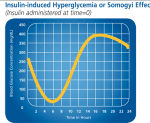
So if, say his reading was taken at AMPS and PMPS, he'd just look "high" and "higher" which
looks like it needs a dosage increase but actually, the Caninsulin Guide right here on FDMB says, though counterintuitive, a dosage
decrease is in order:
Tip #4, Understand Rebound
Sometimes, even doing all of the above, we end up with numbers that have high preshots and lower swings or a curve that looks flat and high. You ask yourself...what is going on?
What may likely be happening is Somogyi Rebound. http://petdiabetes.wikia.com/wiki/Somogyi_rebound
When this happens it is important to take a step back, look at how your cat is doing in the 12 hour cycle and possibly do a "rebound check" ie:
Lower the dose for a couple of cycles, vigilantly test for ketones and allow the cat's body to normalize again from the crazy swings. It takes a few cycles for the stress hormones to settle and the blood sugar to even out again.
Ask questions...there are many here who have experienced this and can help, again cross post to health.
I think basically the body says "Holy crap, my BG is low. Better try to correct that" and you end up with progressively higher BGs (kind of like when you crash diet and your body goes into "fat preserve" mode to "save itself" - just ask my waistline!!)
So I also wonder, did your vet know Melty's nadir number (and not an artificially high vet-taken number) and peak time?
Dosage adjustments should be made on the following guidelines (warning, very long quote, but important info - keeping in mind this is for vets to follow so includes info about stress-induced glucose spikes):
Four values are important in interpreting the glucose curve (Table 2). They are as follows:
The highest blood glucose concentration, which is usually the one taken just before insulin is given. In some cases, the morning meal and the stress of riding in the car will cause the blood glucose concentration to rise slightly on the second sample, but it should decline from that point.
The nadir, which is the lowest blood glucose concentration.
The peak time, which is the time from the insulin injection until the nadir. It is expressed in hours.
The midpoint, which falls halfway between the highest and lowest blood glucose concentrations in the range.
Once these values are determined, they can be used to determine the dosing interval, the type of insulin, and the dose. The guidelines below are based on the assumption that insulin is being given twice daily.
To determine the dosing interval and the type of insulin, follow these steps:
If the peak time is less than five hours, a longer-acting insulin is given, or the current insulin is given more frequently, generally three times a day.
If the peak time is five to eight hours, the current insulin is continued on a twice-daily schedule.
If the peak time is greater than eight hours, the current insulin is continued, but is given once daily.
To determine the dose of insulin or if dysregulation problems exist, use these guidelines:
If the nadir is less than 5.6 (100 mg/dI), the dose should be decreased. You should assume that the nadir in the hospital is somewhat higher than what it will be at home because of stress. If this assumption is incorrect, you will err so that the blood glucose concentrations are too high. This is always the better way to err. Hypoglycemia can be fatal; mild to moderate hyperglycemia is not.
The ideal midpoint of the range is 11.1 (200 mg/deciliter) However, the midpoint is satisfactory if it is from 8.3 - 13.9 (150 to 250 mg/deciliter). If the midpoint is less than 8.3 mg/dI, the dose of insulin is too high and should be reduced. The nadir also should be below 5.6 (100 mg/dl) when the dose of insulin is too high.
If the midpoint is greater than 13.9 (250 mg/dI), several possibilities exist: 1) The cat may have been stressed when the glucose curve was performed. Recount the cat's attitude during the blood sampling process and the hospital stay. 2) The dose of insulin may be too low; if so, increasing it will solve the problem. 3) If increasing the dose does not bring the midpoint into the desired range, insulin problems should be considered. These include inactive insulin, insulin that is not mixed properly, poor injection technique, and poor absorption. 4) If this does not seem feasible, consider concurrent infectious disease. Many infectious diseases can cause temporary insulin resistance. A two-week course of a broad-spectrum antibiotic should be considered if your physical examination and other laboratory tests do not indicate a specific problem. 5) If these approaches are unsuccessful, you should consider insulin resistance due to hyperthyroidism, hyperadrenocorticism, acromegaly, or insulin-antibody formation.
Sorry that's so long but I have read it over and over trying to decide what to do with Genghis. She can have a peak time anywhere between +4 and +6 but her nadir seems to fall below 5.6 many times over many cycles. And yet her AMPS and PMPS have been pretty high for a few cycles now. Decisions, decisions.
If Melty were my cat, I'd try to hold off on any dose increases until his diet is sorted out. I'd also want to truly understand some pattern to his peak time and his nadir number on his current dose before I made any more changes. Of course, that is only based on my unique experience with Genghis, so take that as you will!
Weekend is coming up … think you can transition his food and do a curve?
PS Thanks for your encouragement about my girl. I needed that!!







 )
)
