AMPS = 481

Status
Not open for further replies.

Melissa and Celle

Member Since 2011
I started the experiment before getting the advice not to, so I'm hoping to complete it now. I'd like to at least get 3 shots in at 0.85 unless things get even more out of control. I know this is against advice, but I just don't see how we can keep going up with things getting worse every step of the way. I know it is unlikely that 0.85 will be a good dose, but if we can at least stabilize her mostly under 400 that would seem like a success for now.

Obviously the +4 was not good, but I expected that coming off the 510 with so little insulin. The 481 I'd say is about the same as before, certainly no worse.

Just checking in. More thoughts would be welcome -- especially if anyone could point me to a spreadsheet where things got worse but then got better as dose increased.
 
you will not see an immediate change by decreasing the dose with levemir because of the shed. Once the shed has drained the excess, you will see the high flat BG numbers.
Please be sure to check daily for ketones now that you have lowered the dose.

Question: how are you measuring a .85u dose? What syringes are you using?
 
Melissa, you control the syringe. I understand what others are saying regarding the preshot values, that they don't mean squat with the longer-acting insulins, nadir is what determines dose increases/decreases. But unless someone can definitively tell you that what you are seeing is indicative of Acromegaly, I think you are right to at least try this lower dose.

But there is a possibility there is glucose toxicity going on. http://petdiabetes.wikia.com/wiki/Glucose_toxicity

In that case the dose should continue to be raised.

Just get the IAA test and then you will know what to do with the dose.
 
Gayle and Shadoe said:
Question: how are you measuring a .85u dose? What syringes are you using?
I'm using Monoject syringes that have half unit markings. I aim to put the stopper so the space between the half unit and full unit markings is half insulin and half stopper. It looks like 0.85 units to me based on pictures that were shared on FDMB.

Gayle and Shadoe said:
you will not see an immediate change by decreasing the dose with levemir because of the shed. Once the shed has drained the excess, you will see the high flat BG numbers.
And then what is supposed to happen? I thought that once you were high and flat increasing the dose would lower the whole curve or maybe lower the early part of the curve first and then the later part. I didn't think the ends of the curve were supposed to raise as the middle lowered. Basically we saw that for every bit that the nadir lowered the pre-shots increased even more so that we couldn't even say that her overall average for the day was improving. In fact, the average was getting worse beyond 1 unit as best as I was able to estimate it. Please let me know if my expectations were off.

I can see that if Celle really is an acrocat and needs 15 units then what we're seeing with 1 unit versus 2.75 units probably isn't that meaningful. But it wasn't that long ago we were able to get a flat curve in the 90s on 5 units of Lantus, so it's hard for me to believe she needs a really high dose unless (1) Lantus and Levemir are really different or (2) she has acro and it has gotten a lot worse. I know a number of people have used both Lantus and Levemir. How do the doses compare? And how rapidly do acrocats have their insulin needs increase? Do they tend to be high dose from the start, or does it sometimes start mild and then skyrocket?
 
Vicky & Gandalf said:
I understand what others are saying regarding the preshot values, that they don't mean squat with the longer-acting insulins, nadir is what determines dose increases/decreases.
Could you help me understand this better? I'm confused about why pre-shots wouldn't matter. It seems to me that they would matter all the more with a long-acting insulin because you expect to be having some effect through the whole cycle. And what about late cycle values? If it had only been the pre-shot that looked bad yesterday I don't think I would have been so upset, but we were over 500 already at +9. Is it really ONLY the nadir that matters? Is it just the nadir value or also the point where the nadir hits?
 
I was a little facetious when saying "preshot values don't mean squat," because that's the way I read what others are saying. They actually do mean something, because if you have a high preshot and then a huge drop, you're probably at too high of dose. But unless you are getting enough mid-cycle tests to determine how fast and how low the BG is going on that dose, you really can't make an a good determination of where you should go with dose. Does that make sense?

Nadir matters more in a couple different ways. The lowest point of the blood glucose in a cycle indicates how well the dose is working, however, the later the nadir is the better the dose is working, in my estimation, because of how Levemir likes a steady BG. So when the nadir is later in the cycle, the next preshot will be or should be at a level that allows Levemir to maintain that steadiness. The shed is what makes that possible.

But if you have an early or fast drop to nadir in a cycle, that can mean too much insulin and result in a bounce or rebound which shows up either in the next preshot or even the one following that.

If you have the data, seeing what a whole cycle looks like is more informative than just looking at nadir or just looking at preshot. But rarely do we see anyone do what you've done with your graph of preshots, so when you get this figured out, that will actually be good info to have.

See this sticky from lantus: http://felinediabetes.com/FDMB/viewtopic.php?f=9&t=46013&p=540198&hilit=tickee#p493526

And here's a good discussion on Acro http://felinediabetes.com/FDMB/viewtopic.php?f=9&t=45324
 
Every single cat is different. There was an acrocat who always had bg numbers in the 200s, from low dose and it stayed the same up to 30u, 40, 50u, 60u, ..... always 200s.
One of my acros shortly after I adopted him, on a dose of 3u Lantus, one shot started at 403, dropped to 113 at mid cycle and then was up to 445. People accused me of giving him too much insulin, claiming rebound, so I dropped to 1u and started over, but the numbers just got worse with 500s for ps values. His dose tonite was 25.5u - he tested positive for acro and IAA.
My other acro had 513, 169, 414 on a shot of 3.75u. She tested positive for acro and her dose tonite was 15.75u.

It is for this reason that I suggested you increase the dose.

Some cats fight the lower numbers - think of putting your shoes on the wrong feet and being told that is how you should have been wearing your shoes all the time. It feels wrong and it would take some time to get used to the new way. Your cat has grown used to the high BG, so when you give insulin and it pulls down to decent numbers, your cat feels that something is wrong very wrong. In time, the more your cat spends in the lower numbers, it will feel better and you will see less resistance.

Your nadirs are far from a big low, so you have room to increase the dose. if you are concerned about the drops being too steep in the front of the cycles, try food to slow the drop. If you give a spoon of food at +1, +2, +3, you may see a slower drop as you are steering the curve with food.

Above is my reply from the other post of yours in the acro/IAA forum asking for dosing advice.
As you can see, I was getting quite a few extreme curves, but then it would seem like the BG numbers were high and flat. Other days I could see a good run of numbers and think I had found a good dose, but it was not to be.

High dose / insulin resistance cats are always changing. Just think about being in a boat on the water - sometimes there are choppy waves but other times,the water is calm. Compare that kind of fluctuation to normal diabetes where cats need help and that need is pretty constant or it may even improve as the pancreas or other health issues are resolved.

It has been suggested that you increase the dose, maybe go back to 1.25u BID and stick to a 12/12 schedule, plus get more tests done so that you know when nadir is falling for Celle. As it is now, you have changed doses here and there, but need to test more to justify the changes.

Nadir is more important than ps but both are important. I have one cat whose nadir is just before or right at ps time, so if his ps is 125, I may be safe to shoot because his numbers rise for at least 4hrs, but if my other acro is 125 at ps, I will wait and test again to be sure she is rising because her nadir is around +5 so she starts dropping shortly after shots.

I can't see where you have any tests to support the .85 dose as last good dose. I would think you could give the 1.25u and do a curve with tests every 2-3 hrs to see how that dose is working.
 
Melissa and Celle said:
it wasn't that long ago we were able to get a flat curve in the 90s on 5 units of Lantus, so it's hard for me to believe she needs a really high dose unless (1) Lantus and Levemir are really different

I have a copy of a paper presented to the ACVIM by some U of Queensland vet school researchers on Lantus & Levemir. In a paragraph on remission, they state, "Detemir results in similar remission rates and time to remission as glargine, but the median maximum dose used (1.75 IU/cat BID) is about 30% less than with glargine (2.5 IU/cat BID)."

I have used both insulins and I have found the difference held true for my cat. It takes a smaller dose of Levemir to achieve similar results that you would see from Lantus. So, I think, in effect, you were raising your dose of insulin when you gave the same amount.

This paper has some recommendations for raising and lowering doses which you might find useful. I can scan the paper and email it to you if you like -- email Lana dot H dot Nelson at gmail dot com.

Lana
 
Lana & Yoyo said:
I have used both insulins
Lana, can you share why you switched back to Lantus from Levemir?

Gayle and Shadoe said:
As you can see, I was getting quite a few extreme curves, but then it would seem like the BG numbers were high and flat. Other days I could see a good run of numbers and think I had found a good dose, but it was not to be.
Gayle, do you have a spreadsheet I could look at?
 
Melissa,
Yes, I have a ss for both of my acros. I believe there are other acros on the board that you can view as well.
Julie/Punkin, Bev/Gus, Lisa/DoLou (IAA), Norma/Tony, and even Libby/Jazzy.
Looking at any acro ss will show you the tug and pull of insulin resistance.
 
Melissa and Celle said:
Lana, can you share why you switched back to Lantus from Levemir?

I had a diabetic friend whose doctor and given her a couple of Levemir pens to try. The Levemir had not worked for her at all. She was going to toss the second pen so I asked for it. I told my vet that I wanted to try the Levemir. I had read very good reviews about its use with cats. I was very pleased with it. But there was one thing that bothered me. On Levemir, if Yoyo's BG was not practically normal, he would walk around the house crying out pathetically. It would only stop when his BG started falling into normal numbers. On Lantus, he might have done that on numbers in the 400s and 500s but not for pink numbers.

I switched back to Lantus when I used up the pen. For about two months he was fine on Lantus. He could tolerate those frequent 300's at the beginning of the cycle and ride them out as his BGs fell. Then, the same behavior started up on Lantus. If he is above, say 220, he will walk around wailing loudly. He will go into the bathroom and hug the base of the toilet, no doubt wanting me to come flush so all that fresh water will flow into it. It is maddening. He is in absolute misery. There is nothing I an do about it.

I am thinking about switching back to Levemir. I got a dependable rise the first 3 hours after a shot so shooting low numbers was a whole lot more comfortable than with Lantus. There is a rise with Lantus but I can never be sure how much and for how long. On Levemir I could depend on hour 3 being the high point of the 12 hour cycle. I miss that. Both Lantus and Levemir are very gentle and level out well when BGs start falling into low numbers. The few times I have gotten very low numbers (in the 30's), Yoyo has not shown any symptoms of a hypo. That was certainly not true with Vetsulin.

Lana
 
Thank you everyone for the information. It's all helpful for deciding what to do.

Gayle and Shadoe said:
Yes, I have a ss for both of my acros.
.
Gayle, where do I find your spreadsheets? I only know to look in the signature line but don't see them there
 
Gayle and Shadoe said:
I can't see where you have any tests to support the .85 dose as last good dose. I would think you could give the 1.25u and do a curve with tests every 2-3 hrs to see how that dose is working.
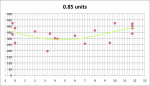
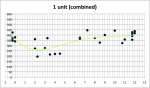
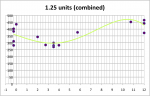
I meant to show how I decided on 0.85. In addition to having the best pre-shot values on 0.85, I've taken to looking at the data on a graph that helps me to see through the day-to-day variation to determine where things are falling. Here's 0.85, 1 and 1.25 units. I think 1 looks OK, but already by 1.25 it starts to look worse to me because the ends are creeping up -- a trend that continued, even while the nadir didn't get much better at all.
 

Attachments

  • 0.85.png
    0.85.png
    62.3 KB · Views: 1,119
  • 1(all).png
    1(all).png
    73.2 KB · Views: 1,113
  • 1.25(all).png
    1.25(all).png
    63.4 KB · Views: 1,114
With the shed involved when using Lantus and Levemir, you must consider NDW with every dose change.
There is overlap so each shot is not separate from the one before or one after. In order to see how a dose sits with a cat, you likely need to hold that one dose for 4 to 6 shots because the true reaction to a dose takes time.
One graph for one day at a certain dose will not give you a full picture of that dose. Shot #1 at 1.25 will not give you the same curve as shot #5 at that same dose.
Please read the link info on Storage shed.


Tight Regulation Protocol
Lantus & Levemir – Insulin Depot –AKA- Storage Shed
Lantus & Levemir – Data Ready to Shoot Low Numbers
 
Gayle and Shadoe said:
With the shed involved when using Lantus and Levemir, you must consider NDW with every dose change.
What is NDW?

Gayle and Shadoe said:
There is overlap so each shot is not separate from the one before or one after. In order to see how a dose sits with a cat, you likely need to hold that one dose for 4 to 6 shots because the true reaction to a dose takes time.
But that's what I've been doing for the most part. At this point I'm actually thinking that 6 shots was probably not enough time for Celle to get used to the dose and maybe I need to move up more slowly or in smaller increments next time.

Gayle and Shadoe said:
One graph for one day at a certain dose will not give you a full picture of that dose. Shot #1 at 1.25 will not give you the same curve as shot #5 at that same dose.
Just to be clear, the graphs aren't one day's data, they are all the data from that dose combined.
 
For your graphs being an average, you are not able to see if the dose is getting better numbers each day or worse; you want to be able to see some progress in the numbers. Just like having a fructosamine test at the vet, it's just an average. Averages are not much use to a person who is home testing - you could have ps numbers of 500, then 300, then 100, but your graph would give you an average of 300 - kind of misleading, so it's best to use the ss and watch for trends in the numbers, day by day.

NDW is new dose wonkiness.
When you increase the dose, you will have to top up the shed and so you will see a temporary higher BG until the shed has been filled.
When you decrease the dose, you will not see the change/effects of a lesser dose until the shed has dumped the excess.
 
Status
Not open for further replies.
Back
Top