
A new member

Status
Not open for further replies.

thechazza

Member Since 2013
Hello fellow FDMBers
Please allow me to introduce myself and my precious 11 year old cat who was diagnosed about 14 hours ago with having diabetes. So I took to the net to research this condition and found this wed site, hence my registration.

My name is Charles and I live in Cairns, Queensland, Australia. I have retired from the workforce having dedicated over 40 years of my working life to the information technology industry - specializing in programming, data base design, systems analysis and strategic planning.

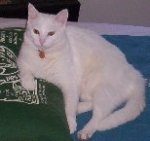
My cat's name is Snowball aka Schlemiel aka Schlemmie (a desexed male tabby of unknown breed - I have been told that he has some Burmese in him).

I have never been a cat lover (having had a dog/s as a pet for most of my teenage life - sigh a long time ago) until I was given a 3 month old bundle of white fluff and was suddenly converted.

For the first 3 years of Schlemmie's life all he wanted to eat was Friskies dry food and (never having had a cat before) I pandered to his demands (soon found out that cats have slaves). When I moved to Cairns (about 9 years ago) i discovered to my dismay that he was having trouble urinating, and after a visit to the vet, discovered that he had developed crystals in his bladder and suddenly I had a cat with FLUTD. He was placed on the Hills C/D diet and after a few months his system normalized. A couple of months ago my vet suggested I increase his fluid intake and I started to give him a selection of dry and wet C/D product (no treats nor any other food).

For a few months all seemed quite normal until 3 days ago when I began to notice that he was drinking a lot more water than usual and his litter tray was being inundated with huge clumps, so I decided to get him checked out and shock, horror, my vet advised me that I now had a diabetic cat (his blood sugar level gave a reading of 26.1 - I think that is mmol/l - Australian measurement) but no ketones were discovered in his urine sample. He was given an insulin injection and I will be taking him back to the vet at 9am Aussie time (in 6 hours time - needless to say I am having a rather sleepless night so I decided to register and introduce myself)

So I guess I am going to have to learn to inject him (I found it tough enough giving him any tablets - until i was shown how to grab him by the scruff of his neck to almost immobilize him) but as he is the last one I see retiring and the first one I see when waking (except when he decides in the middle of the night to leave his futon and curl up besides me) he will continue to receive my devoted attention.

I am hoping that the vet, he and I will handle his diabetes as we handled his FLUTD and that he will be live a long and happy life with me until it is time for him to go.

Thank you for this site and giving me this opportunity to share my story.

Thechazza
 

Attachments

  • schlemiel1c.jpg
    schlemiel1c.jpg
    5.8 KB · Views: 2,181
Welcome to FDMB!

One of the international experts in feline diabetes is at the University of Queensland's Centre for Companion Animal Health - Dr Rand. She worked with the German Diabetes Katzen internet forum to develop the Lantus protocol which was the basis for our tight regulation forum.

We strongly advocate a high protein, low carb, canned or raw diet, for all cats, not just diabetics. Dr Lisa Pierson DVM has a website Cat Info explaining why., There's a specific section on Urinary Tract Health you may find interesting, since you mention crystals.

We believe home blood glucose testing is vital for the safety of your cat, as well as for monitoring the insulin's effectiveness. A human glucometer may be purchased at your local pharmacy/chemist. Also pick up some urine ketone test strips, as ketones can develop as a by-product of fat breakdown and too many may indicate diabetic ketoacidosis, a potentially fatal, expensive to treat, complication of diabetes.

My signature link Secondary Monitoring Tools has tips on the urine testing, as well as some other assessments you may wish to track.
 
Welcome to the board!

Good news! Insulin injections are way way easier than giving a cat a pill. The needle is short and they barely notice it - especially if you do it when eating. What kind of insulin is it? Some are better than others - you want Lantus, Levemir or Prozinc.

Read the stuff BJ provided.. since a key factor in diabetes in cats is the % carbohydrates in their food. They just cant handle it and as soon as you reduce the carbs in their food many cats go into remission. As many as 84% of cats go into remission with insulin and a low carb diet and home testing. Dry food has way more carbs than most wet so it would be a good start to stop feeding the dry food.

However as I said, the cats blood sugar will drop with a food change, so its important first you home test the blood. We can help advise on that.

Wendy
 
Hi Wendy, DJM and Deb

Thank you for the info you posted. I am seeing the vet early this morning as she and her colleague have been treating and monitoring my cat for the past 6 years.

I need to get as much info on treating this disease as I possible can.

Once again thank you. :smile:
 
After you have seen the vet, come back here and ask questions. We have a broad base of knowledge on the day to day management of feline diabetes.

There is so much information, it can be overwhelming. Hang in there, we will get you through this. We've all been there and understand.
 
Hi Deb and other members
Well i have now been shown how to administer Schlemmie's insulin injections (the vet got me to practice using a syringe with distilled water) so now on with the real task. His blood glucose level seems to be dropping, it was 19mmol/L after his 2nd insulin injection. I will continue to treat him twice a day and will see the vet next week for a follow up visit. It appears that I will not have to monitor him as closely as I first imagined.

I spoke to my vet about a low carb diet, but as he suffered from FLUTD they suggested he stays on the Hills wet and dry c/d regimen, so as his weight seems fine (and seeing that he loves the food) I guess I will keep giving it to him, but thank you so much for all your advise.
 
Hi Charles,

I live in Melbourne, if you need any Australia specific advice, I'll do what I can to help. Sometimes the board is quiet in our evenings because of the time difference when all the Northern hemisphere members are sleeping.

My vet also put my cat Angie on Hills Science Diet. She was on it for about 7 months but I wasn't happy with her health so I started searching the internet for nutritional information for diabetic cats and through that eventually found FDMB. A lot of research has been done on low carb diets being important for all cats and vital for diabetic cats.

I'm sure that your vet is helping to the best of their ability but unfortunately vets are given their nutritional information by pet food companies. I asked my vet about her level of nutritional study and she said that they got classes over two weeks on nutrition over all species of animals and any further information came from pet food companies, particularly Hills. I would highly recommend looking at the links BJ provided.

Angie was on insulin for 7 months and on Hills Science Diet for diabetic cats. I switched her from Hills diabetic formula to Whiskers loaf varieties after my research and she came off insulin within 10 days. Since then I've been feeding her better quality food than Whiskers but from my experience (and the research of vets and others on this site) Hills food is worse quality than the Whiskers loaf varieties.

There is an awful lot to take in here but people are very supportive. Some members have had diabetic cats for years and have developed a wealth of expertise in treating diabetes.

What dose is Schlemmie on?

Grace
 
I just thought I should add - now that you're already giving him insulin it's important to start home testing before you switch to low carb food. Their blood sugar can drop so quickly (because they're eating less sugars) and you can overdose them on insulin if you don't notice the drop.
 
GraceAndAngie said:
...Angie was on insulin for 7 months and on Hills Science Diet for diabetic cats. I switched her from Hills diabetic formula to Whiskers loaf varieties after my research and she came off insulin within 10 days.

Crikey! That's a heck of an endorsement for low carb wet food! :shock:
 
Wink took a bit longer to go OTJ once I started to foster him. Took 3 weeks to transition him from high carb to low carb food and it was more like 5 weeks to better numbers. That was after Hill's w/d and other high carb foods at the shelter for 4.5 months.

You may find this article by vet Dr. Lisa Pierson informative about urinary tract health

Perhaps, after reading this,you will see why we recommend eliminating the dry food.
 
Hi Grace (fellow Aussie) and Deb :smile:
Thank you for your advice. There is so much I need to consider and remember in order to ensure Schlemmie's well being. I can only hope that I am administering the insulin correctly as this is all new to me, but he does not seem to mind the thin needle at all. I do however have to remember to close all the upstairs room doors once he has been given his breakfast, making it a bit easier for me to catch him an hour later to treat him. Somehow he seems to sense that something is going to happen when I take the insulin out of the fridge.

@Grace, the vet has put Schlemmie on 4 units twice a day.

@Deb, I will be taking Schlemmie back to the vet in 6 days time, when they will keep him for the day whilst they monitor his blood glucose level. My vet did not seem overly concerned about my not monitoring his blood glucose level at this stage (which went from 26.1 to 19 over a course of 2 injections), perhaps after next weeks visit that may change. However, just for the record, what signs should I look out for just in case his blood glucose level does drop to around 5 - 9 over the course of the next 12, 4 unit injections?

With regards to wet and dry Hills c/d food: I will over the next few days consider increasing the serving of the Hills wet c/d (currently 1 teaspoon twice a day to 2 teaspoons twice a day) and reduce that of the dry c/d (currently 2 and a half tablespoons twice a day to 1 and a half twice a day), however he may complain a lot but i guess i will have to live with his moaning :!: He does however seem to be drinking the water I leave for him and the size of clumps in his litter tray have diminished quite considerably since starting on the insulin injections.

Once again thank you all for all your wonderful advice.

Chaz and Schlemmie
 
4 units is a lot.

I realize he's still on higher carb food, but I am concerned about possible hypoglycemia (hypo)
- Please read and print out this so you can monitor for symptoms and be prepared if you see them

Good insulins are Lantus, Levemir, PZI (Europe, not sure about Australia), ProZinc (US, not sure about international availability).

What insulin are you using?
 
Levamir isn't available here. I don't think PZI or ProZink are either.

Lantus seems to be what most vets put cats on here.
 
Hi BJH
I can only surmise that the reason my vet decided on 4 units twice a day would be to compensate for the high carb content of the Hills c/d diet (used to control the FLUTD). I will be taking Schlemmie back to the vet next Wednesday for another checkup. But so far so good.

Thank you for the info on the symptoms to look for caused by an overdose (hopefully this will not happen), but at least I now know.

The insulin the vet has provided me is Lantus.

Chaz & Schlemmie
 
Lantus has a cummulative effect due to the overlap of doses. Dose adjustments are typically made based on the nadir, the lowest point between 2 shots. For Lantus, this is somewhere between +5 to +7 hours after the shot. It takes about 5 full days on the 1st dose before its adequacy can be measured.

The link to Cat Info's section on Urinary Tract Health given previously will give you some insight into crystals you might not have had. And it may show that the specialty diet is not needed - print out that section and discuss with your vet. For example, 30 minutes after a sample is taken with a cystocentesis, crystals may form spontaneously - they weren't formed inside the cat.
 
Even with the higher carbs of the Hill's C/D, that 4U, twice a day is an extremely large dose to start.

If I were you, I'd ask why such an extremely high starting dose. Ask him what protocol your vet based the dose on.

Once the insulin is in, you can't take it back out. Lantus is a depot insulin so the effects are cumulative as it builds up that depot or storage area under the skin.

It's better to start low and go slow, increasing the insulin as needed, in 0.25U increments.

Most cats only need a 1U starting dose unless they have ketones or have had DKA (diabetic ketoacidosis).

I would be really cautious and only give that much insulin if you will be around to monitor for several days.

You definitely need to be home testing with that high dose. Please, please buy yourself a glucometer and test your cat. The only symptoms my foster cat Wink showed, were extremely dilated pupils, unreactive to light. Add that to the list of hypo symptoms BJM gave you.

Just my 2 cents worth.

ETA: I strongly recommend you read this post, from a member trying to rehab her cat after a severe hypo. http://www.felinediabetes.com/FDMB/viewtopic.php?f=28&t=99179
 
I agree with the others on home testing, it's a very high starting dose, even for a cat on high carb dry. If you don't home test I wouldn't be switching over to wet either since that will reduce the blood sugar and could set him up for a hypo.

With no home testing and 4 units I still think you are playing Russian roulette every time you shoot.

Wendy
 
Hi Wendy, Deb and BJM
It suddenly occurred to me that I may have misreported how many units I was giving Schlemiel. The applicator says it contains 100u/l and that there are 3ml per in each unit making the total number of doses per applicator equal to 300.

Now as I am dialing 4 doses on the applicator dial this should equate to me dispensing 1 and a third units per treatment. I am sorry for the confusion and you had every right to be concerned, so thank you for getting me to re-think how much I was injecting. I certainly do not want to cause my precious Schlemmie any further complications.

It is now day 6 since he was started on insulin and so far (apart from him trying to hide each time i walk towards him with the applicator), he seems to be behaving his usual self. His urine output and food intake are almost back to what they were prior to my noticing the excess and he is not drinking nearly as much water.

I will be taking him back to the vet in 2 days time and am hoping for an improvement in his bg level. I guess it will be then that the vet will instruct me as to when I should start to monitor his bg levels myself (a task I am not really looking forward to, but neither was I enthusiastic about giving him the injection, but I guess I will soon get the hang of that too).

I will of course do all in my power to keep Schlemmie healthy for whatever lifespan he gives me.

Once again thank you for all the information and advice you have given me.

Regards
Chaz
 
what do you mean "dialing" and "applicator"? are you using the Lantus pens with the tips that come with them?

Those are very inaccurate for cats where a 0.25 dose error can make a huge difference. Many of us do use the pens here but we dont buy the syringe tips. We buy separate 1/2 unit marked syringes and withdraw the insulin from the pen through the rubber tip at the end.

Wendy
 
Yeah, you need to use insulin syringes to draw out those tiny dose cats need from the insulin pen. Are you using the Lantus Solostar pens?

Would you please update your user control panel with some information?

Would you please provide us with some more information and put this in your user control panel? It helps us to help you better. This will take about 5 minutes of your time.
Think of this as having some very useful information at our finger tips for those that are replying to your posts. One reason we like to see this information in your signature is because if there is ever an emergency situation like a possible hypoglycemic episode, we don’t have to ask a lot of questions like what meter you are using to give you the best advice. Doing this signature update is totally optional, but it does help us to help you better.
If you are willing to do this, would you please do those updates when you get a chance? Thanks.
Go to the upper left corner of your screen and click on the words, User Control Panel
On the next screen, a row of tabs is presented. Select the Profile tab
On the next screen, there are a number of choices along the left hand side. Select Edit Profile.
Go down to the location field and enter your country, state/province, and city if you are willing to share that info.
Click on submit to save this change.

Still in the User Control Panel, Profile tab, this time select Edit Signature from the left hand list of options.
A free form text box appears.

We like to see information like your first name, your cats name age and sex, the diagnosis date for the diabetes like this (DX 4/30/13), what meter you are using for testing, what insulin you are using , what you are feeding (wet or dry, what brands/style of food), any complicating health issues your cat may have, any additional medications your cat is receiving. If you are using a pet specific meter like an Alphatrak or Ipet, please change the font size on that text from Normal to Large (using the drop down arrow list in the middle of the editing commands)

Click on submit to save this information. Now, this will appear at the end of every post you make. You can update the info when you need to.

There is an additional document you can create to provide even more information about your cat. This is also optional to create this google document and link it into your signature. The profile is in addition to the synopsis info in your signature. See this link on the how to's of profile creation. http://felinediabetes.com/FDMB/viewtopic.php?f=6&t=79123
 
Hi again Deb & Wendy
Thank you for your response it is always appreciated.

I am using the Lantus Solostar pen and using the pen as instructed on the information provided to me by my vet and on the pamphlet I was given. Currently I am not using a separate syringe.

I have updated my profile as suggested.

Regards

Chaz
 
Please get 3/10, short or long needle, U-100 syringes with half unit markings to use in withdrawing the insulin. With some cats, 0.5 unit increases or decreases miss the optimal dose. It is possible to finesse the doses using the syringes, adjusting by quarter units, or even slightly reducing or increasing from a marked level.
 
I agree with BJ - those pens on their own aren't accurate enough. Its better to use the pen but withdraw the insulin using a syringe. You insert the syringe through the rubber end of the pen using an insulin syringe such as the Relion 3/10cc 30 & 31 gauge short or BD Ultra fine 3/10cc short or Terumo Thinpro Insulin Syringe 31G 3/10cc.

Wendy
 
Hi Chaz & Schlemmie,

Lantus SoloStar Pen is actually very accurate. The only problem with the pen is you can only dose in 1 unit increments, which isn't always appropriate. There are no syringes with half unit markings available in Australia.

We injected with Lantus SoloStar Pen with no problems whatsoever, but our cat did not require more than 1 unit. If you dial to 4, that is 4 units, and is a very high dose if you don't monitor at home. Sometimes, cats will appear okay on a high dose due to constant rebound from low levels. Monitoring at home is the key to success. You don't need to be excessive about it and anything you can manage is better than nothing.
 
Clarification - accuracy as defined by ability to dose half and quarter units. Many cats require doses that are not whole unit counts.
 
Status
Not open for further replies.
Back
Top