Critter Mom
Member Since 2014
Oh, dear. Poor Brady. Poor you! 
Did you ask whether they're giving nausea and appetite stimulant meds?
.
Did you ask whether they're giving nausea and appetite stimulant meds?
.



Cerenia can be injected. So can famotidine. Right now just let the vets worry about the administration of the meds but to reassure you a little, I give Saoirse two doses of ondansetron (another anti-nausea med) every day. I crush the dose and mix it up in her food. Sometimes she gets a hint of the taste and wobbles a bit but if I crumble a freeze-dried chicken treat on top of her grub she eats it fine. Also, other members here may know where to get meds compounded into a form that is easier to administer than a pill.Thank you! I'm grateful for all the advice. I am going to see Brady this afternoon and I will talk to the Internal Med vet on staff. Note: I have not been good at giving pills. I can only hope that some of your suggested drugs come in liquid form.
Is that Pepcid AC, Shane? I know that there are different Pepcid formulations in the States but I'm never sure which one is the OK formulation for pussy cats. (Over here, I have to get generic famotidine for Saoirse.)You can get OTC Pepcid

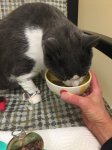
[Emphasis mine.]but ate the smelly tuna tiki cat I had in my arsenal of foods. Maybe it was the familiarity of his bowl or the strong smell but I was happy he ate.
There can be a world of difference between vets testing a cat and you doing it at home. Saoirse was terrified of the vet techs testing her after she was first diagnosed. When I think of how their 'technique' compared to how I test her I can't say I blame her; it took two of them forever and a half to get a sample from her, but I can do it in minutes and she purrs contentedly the whole way through. If you use positive reinforcement - lots of fusses and protein treats - Brady might surprise you. Even if you decide you can't manage regular testing, Kristina, I can't emphasise strongly enough how valuable it is to have a glucometer and test strips at home for emergencies.They showed me how to do blood glucose, but to be honest, I do not think I can do it at home.
Yes, Pepcid AC is the standard OTC/over-the-counter Pepcid we use for kitties in the US. Or you can buy generic famotidine which is a little cheaper.Is that Pepcid AC, Shane? I know that there are different Pepcid formulations in the States but I'm never sure which one is the OK formulation for pussy cats. (Over here, I have to get generic famotidine for Saoirse.)
Mogs
.
You're right, there are other formulations but I only ever bought it for Marshmallow so I don't even know what those ones are!
Pepcid AC isn't available over here any more. Ironically, the generic famotidine is the most expensive med that Saoirse is on. I don't know why it costs as much as it does.
You know, there's something I've been thinking about...Have you possibly changed any cleaners in the house? Or started using a new fabric softener? Something that might cause an allergic reaction and cause your cat's nasal passages to gunk up? He wouldn't necessarily have a runny nose..he might have the cat equivelent of a post-nasal drip. That would irritate his stomach, and sometimes actually make an animal gag..especially when trying to eat, because his airway isn't clear and creates a sort of mini-vaccuum at the back of his throat.
Just sayin..my poor old BarneyBob got his first nasal infection when he snorted a piece of catnip up his nose..a larger chunk. He pressed his face against the dusting of nip on the floor, and inhaled a tiny piece, which then lodged in his nose and he developed an infection.
From that time on, he had trouble, and when presented with anything strong smelling, even food, he would GAG. I almost forgot this..knew something was nagging at me.
So think about that, he might even have backsnorted some food into his nose, and also think if you have added new cleaning substances, aerosol sprays like lysol, (which can make a cat seriously ill all by themselves), and even tiny bits of 'salt' like the crystalline stuff used to get traction on the roads and sidewalks in winter. Folks bring that stuff in on their boots, and little chunks of it fling into corners and embed in carpets.

Delighted to hear that Brady ate something for you, Kristina, and lovely to see his picture.
[Emphasis mine.]
Just wondering whether Brady might have some nasal congestion with his nose being sore at the moment? Worth asking the vets to check; cats won't eat things they can't smell.
There can be a world of difference between vets testing a cat and you doing it at home. Saoirse was terrified of the vet techs testing her after she was first diagnosed. When I think of how their 'technique' compared to how I test her I can't say I blame her; it took two of them forever and a half to get a sample from her, but I can do it in minutes and she purrs contentedly the whole way through. If you use positive reinforcement - lots of fusses and protein treats - Brady might surprise you. Even if you decide you can't manage regular testing, Kristina, I can't emphasise strongly enough how valuable it is to have a glucometer and test strips at home for emergencies.
I bet Brady is thrilled to have you there with him. Be sure to give him some scritches from all of us here at FDMB.
Mogs
.
Just dragged this post down for easy reference re possible respiratory issue.
.
Kristina noticed that Brady was limping but the vets seem not to have given any weight to this problem.nerve compression/spinal disorder
The symptoms sound consistent with a condition called Ileus where the musculature of the bowel for one reason or another cannot contract enough to move things through. In ileus, you'll have symptoms such as dry heaving, vomiting, diarrhea followed by no BM, abdominal distension, and bowel dilation with no obvious obstruction on imaging scans. Many things can cause this, so it's important to look at all angles.
Here are some common issues that can lead to ileus:
medications - esp. narcotics
anesthesia
nerve compression/spinal disorder
blood vessel compression
IBD
Infectious colitius, especially C. Diff
Cancer
Twisted bowel
Electrolyte imbalance (Esp. Low potassium)
Treatment for ileus depends on the cause, but non-stimulating/irritant and non-fiber based laxatives such as miralax are commonly used.
@Critter Mom - Good advice on the insulin dosing/DKA prevention. I have been working a ton lately, and haven't been able to check messages every day.
**If you can, ask your vet to print out all the labs and imaging reports that you had done, and post them here. It might help to narrow down the cause.
Hi Meya,
Thank you for responding to my tag.
Kristina noticed that Brady was limping but the vets seem not to have given any weight to this problem.
.

If it is respiratory/herpes infection then this may be of interest (no experience of using this myself):
https://www.vetinfo.com/controlling-cat-herpes-l-lysine.html
Saoirse had problems with sneezing last year and our vet prescribed Piriton for her (antihistamine).
Kristina, particularly in light of Meya's post above I suggest that before you depart the vets you bring up the issue of Brady's limp again (to be on the safe side).
Mogs
.
EDITED TO ADD:
Not used l-lysine for a cat, but I have taken it myself and it works very well for herpes inflammation. (I've had cold sores in the past and when I was going through antidepressant withdrawal hell the dormant virus flared up. I had really severe, painful inflammation of the trigeminal nerve in my face. The l-lysine started to help straight away.)

 Yes, that looks like a pinched spine, and that could mean a very ouchy back. See how the two vertebrae are compressed? Leaning over a low food dish would definitely make Brady's eating a painful process.
 ) as well as keeping them from bending their neck too much while eating..important in a senior cat who might have arthritic problems.
 Dunno why I didn't spot it before! I guess all dishes look alike after a while, lol.
Hi @Meya14 - the radiologist that did the ultrasound said there was no obstruction. I intend to get his entire medical record from the hospital today. Yesterday when I asked for all the meds that Brady was given in the hospital, it took forever to get an answer. It was like they didn't have all that information available! Anyway, the good news is that he is eating and I have several directions to get him healthy again, thanks to yours and others experience.So, the labs look very good, except for the WBC/neutrophil which is an indicator of infection. So perhaps that's a UTI or colitis? Looks like the vet gave covenia and flagyl to cover those possible infections. Did the vet mention anything about starting her on a laxative? In people, miralax is used or lactulose in more stubborn cases of ileus. Also, you might want to ask the vet if she ruled out an actual obstruction. She might not have gotten a good view from the x-ray, and cats can get pretty severe obstructions from things like hair/plants/string/etc.
Also pleased to hear that you've secured a glucometer. When you're getting the test strips for the glucometer be sure to pick up some ketone test strips if you haven't already done so.
Thank you for that valuable information, Meya. Do you know whether slippery elm bark has a similar effect on intestinal peristalsis? (Gut motility and bile acid levels are hot issues for me with Saoirse.)One caveat with anti-acid medications to be aware of: The acid dump from the stomach to the small intestine is part of the process that initiates the bile release and muscular contractions of the small intestine. Anti-acid medications can slow down peristalsis in some cases so should be used carefully in ileus. I'd start with anti-nausea meds first.
Indeed it does muck up the dopamine system. Our vet prescribed metoclopramide (aka Reglan) for Saoirse when she had the bad pancreatitis flare as he was reluctant to prescribe the ondansetron I had requested after getting the steer from Elise and Hellen. She was on it for a couple of weeks till I could persuade the vet to give me an Rx for ondansetron (which I was not one bit happy with, given its side effect profile and the fact that cats don't have many of the receptors it targets.Metoclopromide PRN is used in people with delayed stomach emptying and intestinal motility as it increases peristalsis, but it has nasty neurologic effects .
 ) Part of his reluctance to prescribe was that none of his patients had been treated with it before, and the rest was down to price. He could only get Zofran from their wholesaler - retail of nearly £100 for 30 4g tablets. I was a bit annoyed about the latter because Saoirse's well-insured (plus I'd have found a way to pay for it if she hadn't been). Thanks to Tanya's Site I got in touch with a pharmacist who advised that cats tend to do better on the Bristol Laboratories generic than the branded drug anyway. I now get the Rx filled at a human pharmacy - vet's written Rx and the 30 tablets set me back less than £20.
  The other worrying thing is that metoclopramide can lower the seizure threshold. My vet reassured me that none of his other patients had had such a problem but the prospect of having a drug with such a side effect on top of giving insulin (and Caninsulin at that!) made me deeply, deeply uneasy. I was very relieved when I switched her to ondansetron. She did great on it; and it saved her life.
  )
)

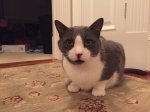
Here is one happy kitty (with scabby nose) finally at home. The steroids are working, but my work is undone - need to read and study all the information to make sure he doesn't relapse.I can see your smile from way over here!