LindaMS
Member Since 2013
So after 15 hours of starting antibiotic she is holding her BG down enough this morning that I am not going to shoot. She was at 122 5 hours ago, so not rising very fast, and she is mad at the kitten who is in full on Mario Andretti mode here today.
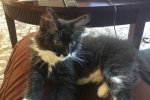
Gosh, I forgot how annoying teething kittens can be! she is biting on everything. Did I tell you guys what breed she turns out to be? She is a Norwegian Forest Cat. Interesting little creature, I say she is half cat and half squirrel.
Known as the Skogkatt in its native Norway, the Norwegian Forest Cat is a large, semi-longhaired cat whose rugged appearance fits its name. Despite the hardy facade, this breed is very much a homebody that enjoys the company of other pets and particularly their human companions. Their relationship with you can best be described as “on their own terms.” Yes, Forest Cats can be lap cats, but THEY will decide when to get on or off that lap. At a minimum, Forest Cats insist on being near their people in a place of their choosing: chair, bed, or desktop. A scratching post and a cat tree, preferably tall, are musts for the Norwegian Forest Cat home. These are moderatley active cats; there will be bursts of energy followed by long naps. Sensitive yet social, you will find them to be intelligent cats that adapt readily to change. Breeders are often asked if these cats need to be outside. As with all cats, inside the home is quite suitable and is certainly the safest environment. Providing interesting toys, perches with outside views, and most importantly, regular one-on-one time will result in a well-adjusted cat.
To the inexperienced eye, the Norwegian Forest Cat may resemble other semi-longhaired breeds such as the Maine Coon or even some random bred longhaired cats. In fact, there is considerable difference. Without a doubt, the expression of the Norwegian Forest Cat is striking and distinctive among pedigreed cats. Large, almond-shaped eyes with their oblique set and the equilateral triangle-shaped head contribute to the unique appearance of this breed. Viewed from the side, the Forest Cat has a straight profile, i.e. straight from the brow ridge to the tip of the nose. Heavily furnished ears that fit into the triangle finish the look.
The Norwegian Forest Cat has an insulated, waterproof double coat that was designed to withstand the Scandinavian winters of its origin. The texture of this coat also matches that environment – longer, coarse guard hairs over a dense undercoat. A full frontal ruff, bushy tail, rear britches, and tufted paws help to equip this feline for life in a region that borders the Arctic. Surprisingly, this coat does not require the care of some of the longhair breeds: weekly combing along with a little more attention in the springtime should cover it. Often identified by their brown tabby and white coats, Norwegian Forest Cats actually come in most colors, from pure white to deepest coal black, with every possible coat pattern and color combination in between, with the exception of the colorpoint colors as seen in the Siamese or Persian-Himalayan, such as seal point or chocolate point.
Gosh, I forgot how annoying teething kittens can be! she is biting on everything. Did I tell you guys what breed she turns out to be? She is a Norwegian Forest Cat. Interesting little creature, I say she is half cat and half squirrel.
Known as the Skogkatt in its native Norway, the Norwegian Forest Cat is a large, semi-longhaired cat whose rugged appearance fits its name. Despite the hardy facade, this breed is very much a homebody that enjoys the company of other pets and particularly their human companions. Their relationship with you can best be described as “on their own terms.” Yes, Forest Cats can be lap cats, but THEY will decide when to get on or off that lap. At a minimum, Forest Cats insist on being near their people in a place of their choosing: chair, bed, or desktop. A scratching post and a cat tree, preferably tall, are musts for the Norwegian Forest Cat home. These are moderatley active cats; there will be bursts of energy followed by long naps. Sensitive yet social, you will find them to be intelligent cats that adapt readily to change. Breeders are often asked if these cats need to be outside. As with all cats, inside the home is quite suitable and is certainly the safest environment. Providing interesting toys, perches with outside views, and most importantly, regular one-on-one time will result in a well-adjusted cat.
To the inexperienced eye, the Norwegian Forest Cat may resemble other semi-longhaired breeds such as the Maine Coon or even some random bred longhaired cats. In fact, there is considerable difference. Without a doubt, the expression of the Norwegian Forest Cat is striking and distinctive among pedigreed cats. Large, almond-shaped eyes with their oblique set and the equilateral triangle-shaped head contribute to the unique appearance of this breed. Viewed from the side, the Forest Cat has a straight profile, i.e. straight from the brow ridge to the tip of the nose. Heavily furnished ears that fit into the triangle finish the look.
The Norwegian Forest Cat has an insulated, waterproof double coat that was designed to withstand the Scandinavian winters of its origin. The texture of this coat also matches that environment – longer, coarse guard hairs over a dense undercoat. A full frontal ruff, bushy tail, rear britches, and tufted paws help to equip this feline for life in a region that borders the Arctic. Surprisingly, this coat does not require the care of some of the longhair breeds: weekly combing along with a little more attention in the springtime should cover it. Often identified by their brown tabby and white coats, Norwegian Forest Cats actually come in most colors, from pure white to deepest coal black, with every possible coat pattern and color combination in between, with the exception of the colorpoint colors as seen in the Siamese or Persian-Himalayan, such as seal point or chocolate point.