? 6/10 Yum: shot placement and improved AMPS number?

Status
Not open for further replies.

MJW

Member Since 2017
I've been trying to get Yum's AMPS number down into the alpha trak2 normal range (below 159 or 170) for a while now. I've tried getting up and feeding her at PMPS+9. I've tried putting out a lot of food at bedtime. I've tried keeping her more active in the evening. Nothing has helped.

Yesterday I was thinking about what else is different between day and night besides activity and feeding habits. Well, I shoot her insulin on the side of the chest in the morning and on the flank in the evening. Last night I shot her on the side of the chest instead, as an experiment. I went to bed disappointed at her evening numbers, but this morning she had her lowest AMPS in 3 weeks. At 155 it is in the normal healthy range for an AlphaTrak2 meter.

I'm not jumping up and down yet (the darn sugar dance is so unpredictable and frustrating) but I have a smidgin of hope that maybe shot location has been part of the problem in getting her AMPS numbers down.

Any experience out there with the importance of shot location?
 
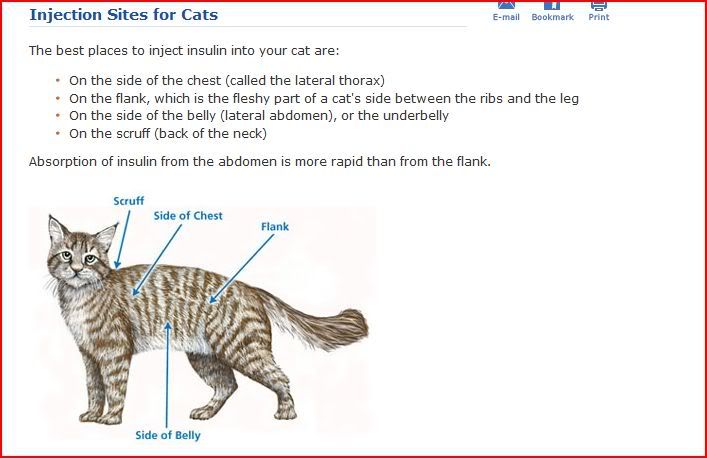
I have heard its better absorbed from the flanks or side of chest than the scruff of the neck. I think it absorbs quicker if shot is given in abdomen area. I give Lily her shots on the side of her torso, aka flank area, and I move the shot site each time too so as to not give in the same area all the time.

injsitesforcats1.jpg
 
Usually a +9 meal is not going to help unless a kitty is on a tiny dose and about to go into remission so I wouldn't bother with that right now....get your sleep :)

For well over five years, I rotated shot sites and annotated them on Gracie's SS. Theoretically, absorption is slower in the scruff. I never noticed a difference but ECID. However, I wouldn't base it on one test :):)

It's possible Yum is just starting to settle into this dose. Also, absorption.... no matter where you shoot...can vary up to 50% from cycle to cycle.

I do think that it's wise to rotate injection sites to keep from building up scar tissue or fatty deposits.
 
  • Like
Reactions: MJW
I finally got a green nadir last night with the new PM shot location. (Both morning and evening are now on the side of the chest--slightly shifted---instead of rotating between side of the chest and the flank). Could be a coincidence, but I'm not going back to the flank. Could be due to poor technique at the flank on my part. I am so relieved to see some symmetry again between the AM and PM curves. And NORMAL AMPS numbers. She is drinking a lot of water. I am worried the high phosphorus Fancy Feast is doing a number on her kidneys. I will take her in for testing this week.
 
I finally got a green nadir last night with the new PM shot location. (Both morning and evening are now on the side of the chest--slightly shifted---instead of rotating between side of the chest and the flank). Could be a coincidence, but I'm not going back to the flank. Could be due to poor technique at the flank on my part. I am so relieved to see some symmetry again between the AM and PM curves. And NORMAL AMPS numbers. She is drinking a lot of water. I am worried the high phosphorus Fancy Feast is doing a number on her kidneys. I will take her in for testing this week.
Sorry to piggyback on your response, but could you say more about the link between phosphorus and kidney disease? I feed Samba Fancy Feast and am not aware of him having kidney issues now, but his diabetes is still unregulated, so I am curious...

Happy to hear that changing up the injection site worked out for you!
 
There is a web page for feline chronic renal failure---felinecrf.org run by someone named Tanya.
I don't know what exactly causes kidney disease (besides poisoning), but high phosphorus foods definitely aggravate it. You will see the food lists on the main sticky list low carb foods and low phosphorus foods, for those kitties with diabetes and CKD (chronic kidney disease). It's tough to deal with both because diabetics need high protein/low carb foods and CKD cats need low protein/low phosphorus food. Phosphorus generally rises and falls with protein content.

Kidney disease is common in elderly cats. Samba is young. Yum's mother had CKD, although it was not the cause of her passing. I spent a lot of time agonizing over food choices, throwing away a lot of rejected food. Maybe Yum got diabetes because I had her on a high carb, low protein Science Diet "senior cat" food, along with her mother's veterinary prescription CKD food. I found out Yum was diabetic when I took her in repeatedly for blood tests to make sure she didn't have kidney disease. She was okay at the last test, but I am a worrier. Her water intake should have dropped when her BG was regulated, but it has increased slightly. I measure her water dishes every day. Excessive thirst can be a sign of kidney disease. (They don't recommend measuring water intake as a proxy for BG, but I measure it anyways.)
 
Sorry to piggyback on your response, but could you say more about the link between phosphorus and kidney disease? I feed Samba Fancy Feast and am not aware of him having kidney issues now, but his diabetes is still unregulated, so I am curious...

Happy to hear that changing up the injection site worked out for you!
Please forgive the condo hijack.

Sarah....chronic kidney disease does usually affect older kitties but not always. There are certain reasons why CKD can develop in younger cats and it’s not all related to toxins. However, the majority of cats with CKD are over ten.

I’ve had several elderly cats with CKD and I have found that control of the phosphorus level is likely one of the biggest predictors of QOL and longevity CKD cats. Phosphorus is important for the health of the cat and healthy kidneys keep the correct balance of P by excreting the excess. However, compromised kidneys are not able to do this and so the level of P in the blood increases and can make the kitty very nauseous and inappetent, can cause tummy and mouth ulcers, lose weight, grind teeth, stumble....a whole list of unsavory symptoms.

Normally, it is not necessary to get too terribly concerned about the levels of P in a food as long as the kitty is healthy. Kittens need higher levels of P in their food as they develop bone. Having said that, I think many commercial food companies are going way overboard in the amount of P in their food. There is no reason to have a food that has more than 350-400 mgP/100 kcal in it. IMHO.
 
@Marje and Gracie : I never understood one CKD point: does minimization of phosphorus improve the health of the damaged kidneys? Yum's mother's kidney numbers did improve when I reduced the phosphorus in her diet, but I'm not sure I can attribute that to her diet. Thanks!
 
@Marje and Gracie : I never understood one CKD point: does minimization of phosphorus improve the health of the damaged kidneys? Yum's mother's kidney numbers did improve when I reduced the phosphorus in her diet, but I'm not sure I can attribute that to her diet. Thanks!
You don't typically see the creatinine drop too much as the P comes down. With CKD, once a certain percentage of kidney function is lost, it doesn't usually result in an improvement to the kidney itself. In other words, if you think of a kidney in Stage 2 with a 66% loss of function, you won't see that percentage drop to, for example, 50% loss of function. You might see a very slight improvement in the creatinine but creatinine is a good indicator of kidney function because it is not affected by diet.

Feeding a low P diet, puts less stress on the kidneys to excrete excess P and less P in the blood so the kitty feels much better.
 
There is a web page for feline chronic renal failure---felinecrf.org run by someone named Tanya.
I don't know what exactly causes kidney disease (besides poisoning), but high phosphorus foods definitely aggravate it. You will see the food lists on the main sticky list low carb foods and low phosphorus foods, for those kitties with diabetes and CKD (chronic kidney disease). It's tough to deal with both because diabetics need high protein/low carb foods and CKD cats need low protein/low phosphorus food. Phosphorus generally rises and falls with protein content.

Kidney disease is common in elderly cats. Samba is young. Yum's mother had CKD, although it was not the cause of her passing. I spent a lot of time agonizing over food choices, throwing away a lot of rejected food. Maybe Yum got diabetes because I had her on a high carb, low protein Science Diet "senior cat" food, along with her mother's veterinary prescription CKD food. I found out Yum was diabetic when I took her in repeatedly for blood tests to make sure she didn't have kidney disease. She was okay at the last test, but I am a worrier. Her water intake should have dropped when her BG was regulated, but it has increased slightly. I measure her water dishes every day. Excessive thirst can be a sign of kidney disease. (They don't recommend measuring water intake as a proxy for BG, but I measure it anyways.)
Sorry to hear about Yum's mother, and thanks for explaining this...I had a cat die of CKD when she was only 8. I was in high school and remember my mom caring for her. We all took it pretty hard. Since Samba is older than that, the worry is always just a little in the back of my mind, and I just recently realized how high the P levels are in the food that I feed him, so was hoping I wasn't doing him a disservice. It's unfortunate that we have to worry about the food we're feeding them causing them health complications down the road...I'm sure I would have done the same as you with Yum and fed a diet healthy for kidneys as a preventative measure...just like I will probably always be conscious of the carb content in foods now. Thanks for your response!! Hope it's been a good day for you 2
 
And when you do find a food that is good for them, they won't eat it! Cats!
I had Yum's vet send her March labs to me today---we only discussed her BG at the time. Her kidneys looked really good then, so my worries over her water consumption are probably silly.
 
And when you do find a food that is good for them, they won't eat it! Cats!
I had Yum's vet send her March labs to me today---we only discussed her BG at the time. Her kidneys looked really good then, so my worries over her water consumption are probably silly.
I think it's smart of you to measure and keep an eye on her habits...it sounds like you are really attuned to what's going on with her, which means that you will most likely catch any problems very early. Yum sounds like a lucky lady to me! :)
 
Status
Not open for further replies.
Back
Top