This is some great news....hoping that there is continued improvement today!!!
Oh the Libre— I have a love affair with CGM—hey, I am VERY honest

about it!! I will post a more detailed post about our CGM journey either in Think Tank or the Main Forum in hopes that it may help people feel more comfortable, knowledgeable about it and understand what a valuable tool it is.
Like it or not, CGM is going to be used and recommended a lot more moving forward, including with newly diagnosed cats, helping with getting a cat into remission, determining remission, determining duration of action or lack of duration (key issue) of some insulins in some cats....including Lantus, monitoring in the hospital, monitoring outside the hospital when multiple factors like inflammation, pain, medications and insulin adjustments in play. The technology has been proven to provide much needed insight into feline DM.
First, I think there are a few misconceptions about CGM that need to be addressed in order for some to be more open to this additional and very valuable tool
:
1) It is not “just” another way to obtain static glucose measurements like the blood glucose monitors do and it is not a temporary replacement for BG.
Think
additional tool and
different data vs essentially the same tool and same data.
2) It is not being recommended because the vet does not trust you or does not realize or know that you are doing extensive blood glucose testing (although when there is that question, CGM is certainly helpful!)
3) It is going to bother or be painful for your cat. IF applied (& removed) correctly, it does not bother the majority of cats. ** This is key and unfortunately, one of the reasons people may have had or will have a less than satisfactory experience with it. It is like getting your blood drawn from someone who is just learning

..... might not go very well.
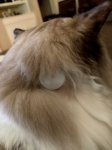
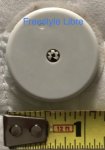
The Libre is literally slightly larger than a quarter—tiny footprint
. It is THIN. T had it on his neck and just went about his business. I was concerned that the Kitty Kollar over it may be an issue since he has never worn a collar but he was fine. BTW, it is important to know that my T is a super sensitive and easily upset guy, so it was telling that he wasn’t bothered in the least. And yes...I worried that it would bother him and would cause a flare, be stressful, be world ending (drama)

....then it was on him and I had to laugh at myself. I then had to kick myself once I saw how much info it provided and how helpful it was...should have done it from the get go!
SO....how is it different/how can it help/what can it tell you that your current BG testing cannot tell you?.......Especially with a sick cat?
I think everyone here agrees and believes in the power of data. By getting data, you are trying to see the trends so that you are then able to make the best decisions regarding dosing, insulin, etc.
CGM is all about data but MORE data & more importantly, measuring the
dynamic glucose vs the static glucose. Right now, using BG testing, you may know what happens pre shot and let’s say you check every hour, you know what is happening for 24 static data points. Based on the static data points you hypothesize what has happened along the way and try to connect the dots to see the trend. With the CGM, you have 1440 readings of glucose.
This is the game changer and why the CGM is a valuable tool to use. By having the ability to obtain that much data, you are, for the first time, able to get both the
direction and the speed of those changes—-aka the “dynamics “of glucose. You get the “video” of glucose
in motion vs 24 “snapshots” of glucose that are static. You will be amazed how fast it can change...I was shocked. Some transient lows I would never had caught unless I happened to get lucky and it happened during a check.
Will you throw away your glucose meter

....not quite yet! In fact, you will use it WITH the Libre vs tossing either one out! Albeit, you won’t have to do the amount of checking you do if relying on BG alone AND you won’t miss the data while you sleep, go to work, have a life. Right now, CGM is an
additional tool to again, see the dynamic vs static data. By seeing the dynamic trends, you are able to learn about the consistency (or inconsistency) of both the insulin and the glucose for your specific cat. You will also get answers to the common questions “Did they/do they bounce?” “ How does the food effect them and how quickly, slowly, consistently or inconsistently?” “Was that low glucose a one time, transient event or are there several I am missing?””Is the insulin I’m using not having consistent duration of action?”
I have done the BG testing and still do, but I have also learned about the CGM and have used it (and will continue to use it along the way). I can say from experience that I understand why CGM is becoming the standard of care, especially among IMs. It is an extremely valuable tool
!!
APPLICATION AND PLACEMENT:
I saw a lot of pics on this board and the internet of placement on the backs of the cats and while it may work with some cats, it has been found to be a less successful area for keeping the sensor on a cat.
After putting it on probably 1000s of cats at this point, the endos who validated the Libre, recommend placement on the dorsal to dorsalateral neck area. It is also recommended to avoid or to use just a couple of drops of Vetbond glue because the VetBond glue has been found to be, more often, the irritant for the skin (when it occurs) vs the adhesive that is already on the CGM. Put a Kitty Kollar over it to give it a little extra protection (loose not very tight so it doesn’t press down on the sensor)
Alarms- Libre2 does have alarms, however, given the fact that it hasn’t been used extensively in cats yet, it is best to work with the known (Libre) vs the unknown (Libre2), especially if you are using it in Butters situation. You want the device that the vets have validated and understand how to read the data.
Storage - Libre sensor is able to record and store data for up to 8 hours (I found this to be an advantage vs other CGMs) As long as you scan
Within 8 hours of your previous scan, you get all the data. No lost data—not one minute.
I hope this helps! The CGM will help see what is happening with Butters glucose and then easily and safely adjust the insulin as needed while managing all the variables effecting it right now.
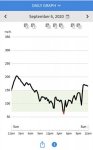
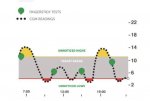
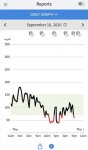
I have attached some pics of the Libre, placement of Libre on T and his Kitty Kollar. I have also attached some examples of just some of the data you are able to get from the CGM. One showing a transient low point. I liked that I knew exactly how much time he spent lower, in range, high and that it determines glucose variability on the LibreView Report. The report for one sensor is 22 or 23 pages
.