1/4 Leo - PMPS 501. +3 309. AMBG 87

Javier and Leo

Member Since 2020
Hi all,


We're still having some issues controlling Leo’s BG. He's still getting fed via e-tube and has a Libre sensor that we use to control his BG.

  • On Jan. 2 at 9PM we gave 0.5 units of Lantus (trying to give less but it's really hard with the syringe). PMPS was 344.

  • During the night, the BG decreased slowly down to 177 at 8:23 am. We gave him 35g of food at that time but BG kept dropping (it's like the food didn't do anything). At 10:30, his BG was <60 so we gave maple syrup and more food until BG started increasing 15min later.

  • The morning shot of insulin was due at 9am but because his numbers were low, we had to skip.

  • The rest of the day we fed him lunch at 13:30. His BG kept increasing.

  • At 20:30 we gave him another 0.5 units of Lantus with food. PMPS was 501.

  • During the night, his BG dropped to 150 at 4AM. We fed him 20ml of food but his BG didn't go up.

  • Since then, we fed him small amounts at 6am, 7am and 8am. BG is still around 70 and not increasing so we'll likely need to skip the morning shot again :(
Do you have any idea why the food doesn't do anything when he's dropping? Should we give more? Or does it take a while for him to process it? We're usually giving 35ML of Hills A/D hills through the tube as per vet's recommendation.


It feels like the insulin lasts for 14h+ which means that by the time his BG has raised enough (>250), it's too late to give the morning shot. Any advice?


I did my best to add some numbers to the spreadsheet, I'm learning with every post.


Thank you
 
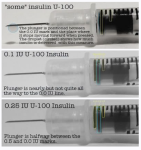
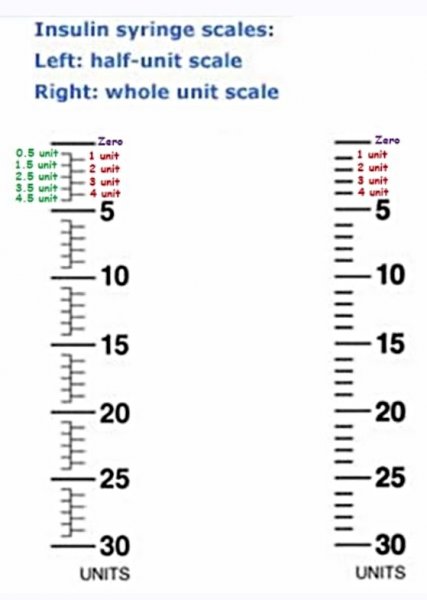
Hi Javier, what brand of syringe are you using? Do they have half-unit markings? If they do not, it's really important that you try to get some with the half units so that you can get a dose smaller than .5 units.

Here are some photos that can help you with smaller doses:

Screen Shot 2021-01-04 at 11.48.51 AM.png

I know this is all very overwhelming but once you start doing small doses it might be worth it for you to think about using digital calipers to measure doses. I use them because my Ruby takes .5 units of insulin and is very sensitive to even the slightest increases or decreases, and sometimes the printing on syringes is very inaccurate. It's really made a difference in creating more consistent glucose levels. Here is a thread on using calipers should it be of interest to you.
 

Attachments

  • Screen Shot 2021-01-04 at 11.48.51 AM.png
    Screen Shot 2021-01-04 at 11.48.51 AM.png
    322 KB · Views: 98
I'll consider the digital calipers most definitely. I need to check on the brand but the syringes only have 1 unit marks I'm afraid.
 
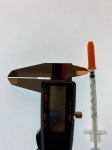
I use the same ones with the ½ unit markings. I don't recommend them if you want to use them with the calipers as they have a little lip around the top that makes measuring with the calipers difficult (see photo). The ones that Bhooma recommended by Relion are easier to work with. I am using the BDs still because I have a lot of them and don't wish to waste.

IMG_1950.jpeg
 

Attachments

  • IMG_1950.jpeg
    IMG_1950.jpeg
    21 KB · Views: 105
I'm sorry, I need you to do some changes to the spreadsheet for me before I can comment on dosing. The numbers in the current spreadsheet don't correspond to what you've written out in the first post. Also, there are multiple lines per calendar day in the spreadsheet. We use one line per day. So I'm having a hard time visually seeing the dosing and corresponding BG numbers.
 
I'll work on the spreadsheet numbers so they are the source of truth. Apologies if the other posts are confusing, I'm learning as I go.
 
Great and thanks! No worries on learning as you go, we all did and know there's a lot to learn at first. Nice to see Leo's picture there too. Love those tuxies. :)

As for dosing, I think you should try either 0.1 or 0.25 units to start. If you haven't got the 0.5 unit syringes yet, the 0.1 unit dose maybe easier to get. The calipers will really help with the BD's. One thing you should check when you are about to load the syringe, is how much room there is between the zero line, and the bottom of the syringe that the plunger goes to when you push it all the way in. I used BD's that with a bad lot had as much as 1/3 of a unit below the zero line. :eek: Since Leo wants to be a small doser, that can make a big difference in the amount of insulin he gets.
 
Could any of the other BD semi syringe and calipers users share what they use as the insulin unit to mm conversion please?

Sorry for highjacking your thread, Javier, but I figure this information might be useful to you too :oops: I have strated using calipers with the BD syringes and still running into some teething problems....
 
One thing you should check when you are about to load the syringe, is how much room there is between the zero line, and the bottom of the syringe that the plunger goes to when you push it all the way in. I used BD's that with a bad lot had as much as 1/3 of a unit below the zero line. :eek: Since Leo wants to be a small doser, that can make a big difference in the amount of insulin he gets.

Oh I didn't think about that. I'll make sure I'll check tonight. I also ordered the 1/2 unit syringes. Hopefully that's help controlling the dose.


Right now, Leo's BG is high (>500) because I had to skip the morning shot (AMPS was 100 and the vet told us not to give him if he's below 200). Is there anything to be done? It's 5PM now and his evening shot is not supposed to be before 9PM. :(
 
Spreadsheet looks great. Since you didn't shoot this morning, you can actually shoot anytime now. It just has to be about 12 hours since the previous shot. So no harm giving it "early". It just means tomorrow's shot has to be 12 or more hours after this one. Be interesting to see what happens if you go longer between shot times.
 
If you are going to use the 1.5mm per unit measurement on your BD's too, Javier, then you might find the attached file helpful. Lyane, another FDMB member, created it based on using 1.5mm per unit, and it gives the measurement of each quarter unit dose up to 14.50 units of insulin.
 

Attachments

Back
Top