12/16, Sam, AMPS 193, +2 99, +4 101, +6 112, PMPS 229


Sam sure is being a bit of a diva, isn't he? Skyrocket to the moon, then plunge back to earth, all in one cycle....LOL

Just a housekeeping note...On your spreadsheet for 12/15, the number you actually shoot is always the Pre-shot....so the 130 would be his PMPS. The way most of us enter it would be to enter 130 @ +14 in the PMPS cell....that way, the + cells still correspond to the number of hours since the SHOT.

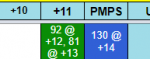
You can either "stack" the other tests in the PMPS cell too (like 92 @ +12, 81 @ +13, 130 @ +14.....but you will have to color code it manually....in this case, the blue since that's the color that goes with the 130) OR you can put the 92 and 81 in the +11 cell like 92@+12, 81@+13 (and color code it the green) like this:
upload_2022-12-16_17-38-42.png
 

Attachments

  • upload_2022-12-16_17-38-42.png
    upload_2022-12-16_17-38-42.png
    3.7 KB · Views: 233
+4 101, surfing nicely today. Giving a little bit of LC wet to make sure he doesn't get too low and bounce. I'm waiting for him to pee one more time so I can do one more ketone test, but the last one I did was almost negative, it was a little darker than the negative color, but lighter than the trace color. I think he just bounced super hard the other day.
 
Sam sure is being a bit of a diva, isn't he? Skyrocket to the moon, then plunge back to earth, all in one cycle....LOL

Just a housekeeping note...On your spreadsheet for 12/15, the number you actually shoot is always the Pre-shot....so the 130 would be his PMPS. The way most of us enter it would be to enter 130 @ +14 in the PMPS cell....that way, the + cells still correspond to the number of hours since the SHOT.

You can either "stack" the other tests in the PMPS cell too (like 92 @ +12, 81 @ +13, 130 @ +14.....but you will have to color code it manually....in this case, the blue since that's the color that goes with the 130) OR you can put the 92 and 81 in the +11 cell like 92@+12, 81@+13 (and color code it the green) like this:
View attachment 65876

Fixed; can you please take a look and let me know if I've done it correctly? And thanks for letting me know, I'll make sure to stack them in the future.
 
Fixed; can you please take a look and let me know if I've done it correctly? And thanks for letting me know, I'll make sure to stack them in the future.

Almost purrfect! Just add @+14 to the PMPS cell. Sometimes people skim too fast and don't notice the other tests.

While I'm thinking about it, did you wait until it had been 12 hours since last night's shot this morning? Or did you shoot at your regular AMPS time?

When you stall, (like you did last night), you should work your way back to your chosen shot time by shooting 15 minutes earlier per cycle or do one 30 minute adjustment per day until you're back to where you wanted to be.

If you shot at your usual time, then his AMPS would have only been 10 hours since last night's shot and you need to keep the shots as close to every 12 hours as possible. An early shot can sometimes act like a dose increase.
 
Almost purrfect! Just add @+14 to the PMPS cell. Sometimes people skim too fast and don't notice the other tests.

While I'm thinking about it, did you wait until it had been 12 hours since last night's shot this morning? Or did you shoot at your regular AMPS time?

When you stall, (like you did last night), you should work your way back to your chosen shot time by shooting 15 minutes earlier per cycle or do one 30 minute adjustment per day until you're back to where you wanted to be.

If you shot at your usual time, then his AMPS would have only been 10 hours since last night's shot and you need to keep the shots as close to every 12 hours as possible. An early shot can sometimes act like a dose increase.

No, I shot quite late this morning. He got his shot last night at around 11 I believe, I gave it at 10:45 ish this morning I believe? I can change it by 15 minutes per dose, so it'll take me a few days to get back down to where I was
 
How could he have ketones though? Thats what i’m not getting; is one night in red enough to have ketones?

Even a cat with normal blood glucose levels can have ketones (although it's less common).

Ketones are produced when the body isn't getting the glucose the cells need to survive so it starts to burn fat in an attempt to "feed" the cells. The burning of that fat creates ketones (it's the idea behind humans being on a "keto diet"...they purposely restrict food to the point where their body starts to burn fat but they also check their ketone levels often to keep them at a safe level)

To help understand, think of insulin like it's a key and on every cell in the body there's a lock. The cells only eat one thing...glucose...but because there's a lock on each door and not enough keys, the cells continue to starve. In an attempt to get that glucose, the body starts to burn fat. This causes a buildup of acids in the bloodstream called ketones. Too many and they can go into acidosis and then you can get DKA.

The usual "recipe" for DKA is Not enough insulin + not enough food + infection/inflammation so it's important to make sure he's eating enough food, keeping a close eye on common problems like dental disease and urinary tract infection (as well as any condition that could cause inflammation like arthritis) and making sure he gets his insulin.
 
Even a cat with normal blood glucose levels can have ketones (although it's less common).

Ketones are produced when the body isn't getting the glucose the cells need to survive so it starts to burn fat in an attempt to "feed" the cells. The burning of that fat creates ketones (it's the idea behind humans being on a "keto diet"...they purposely restrict food to the point where their body starts to burn fat but they also check their ketone levels often to keep them at a safe level)

To help understand, think of insulin like it's a key and on every cell in the body there's a lock. The cells only eat one thing...glucose...but because there's a lock on each door and not enough keys, the cells continue to starve. In an attempt to get that glucose, the body starts to burn fat. This causes a buildup of acids in the bloodstream called ketones. Too many and they can go into acidosis and then you can get DKA.

The usual "recipe" for DKA is Not enough insulin + not enough food + infection/inflammation so it's important to make sure he's eating enough food, keeping a close eye on common problems like dental disease and urinary tract infection (as well as any condition that could cause inflammation like arthritis) and making sure he gets his insulin.

My vet said he had some gingivitis, but nothing serious or unusual in a cat his age. I'll keep an eye out for signs of a UTI, but he's on an all wet diet now, so hopefully that should reduce the risk of that. Thanks for the info and help by the way; I really appreciate it.
 
Bit of a random tidbit; but I have been thinking that sam has been going through a 2 day cycle of hypoglycaemia and hyperglycaemia.

To test this I looked at his spreadsheet, and calculated the average blood sugar across all readings for the day. I then have 17 days.

Then I calculate the so called "lag 1" autocorrelation coefficient. In other words; it measures the correlation between the average blood sugar on a given day with the next days average blood sugar. This correlation coefficient was, rounded to 2 digits, -0.56. What this means is that there is a fairly large relationship between today's average blood sugar and tomorrows average blood sugar. This is telling us that when it's above average one day, it becomes below average the next, and visa versa.

Being someone into stats this gives me a T value of -2.52. For a 2 tailed T test on population correlation coefficients this gives us a P-value of about 2.47%; indicating a statistically significant correlation between today's blood sugar and tomorrows blood sugar. In particular; the correlation indicates that if today's blood sugar is high, tomorrows will be low, and vice versa.

There’s also a positive trend in the intraday variance that is significant to a 4% confidence level, indicating less bouncing as time has gone on.
 
I see your spreadsheet is missing the +4 from last night. Patterns are easier to spot with data in each cycle.
 
I see your spreadsheet is missing the +4 from last night. Patterns are easier to spot with data in each cycle.

Thanks, I'll try to enter it in as soon as I test. Forgot about it, went to bed! Need to read up on the TR protocol and figure out when I can bump him up to 1.25. I will be able to get a Nadir test on the AMPS cycle for the next 9 days.
 
So he's been on TR now for 4 cycles; so in 6 more cycles I can raise the dose at the most conservative as he's seeing nadirs under 100, but I don't think today would really count; he just dropped low but it wasn't at his nadir. If we don't think his actual nadir's are under 100 then i'd be good to raise after 6 cycles.
 
I don't think today would really count; he just dropped low but it wasn't at his nadir.

The nadir is the lowest point in the cycle, no matter when it comes.

Being someone into stats this gives me a T value of -2.52. For a 2 tailed T test on population correlation coefficients this gives us a P-value of about 2.47%; indicating a statistically significant correlation between today's blood sugar and tomorrows blood sugar. In particular; the correlation indicates that if today's blood sugar is high, tomorrows will be low, and vice versa.

There's just one variant you didn't consider....Sam is a cat and they didn't read the books you did or take a statistics class....LOL
 
The nadir is the lowest point in the cycle, no matter when it comes.


There's just one variant you didn't consider....Sam is a cat and they didn't read the books you did or take a statistics class....LOL


LOL. Of course! But it does prove that what I'm thinking is correct to a high degree of confidence; he has historically been bouncing between hypo and hyper. He doesn't know that, but now I do. Stats is a good tool honestly. Let's you determine the signal from the noise.

Basically the data tells me that a.) Sam has been bouncing from hypo to hyper every 2 cycles, and b.) This bouncing has reduced as we've lowered his dose. Tells me we're not just going off of noisy random data, there's an actual effect we are seeing in the data. Kind of cool.
 
Back
Top