
Help With Home Testing BG

Status
Not open for further replies.

KD and Bandit

Member Since 2022
Hi! This is my first post about my diabetic kitty Bandit. She was diagnosed almost a year ago. All testing at the vet shows BG in the 500s! She gets tested every few months, she's on 4 units of Prozinc, vet keeps increasing by 1 unit and we haven't been able to regulate. Going to the vet stresses her out so much I have to give her gabapentin(??) just to get her there and that stresses me out!
She's a good kitty, doesn't deserve this, and I'm ready to start over to help improve her quality of life, I feel vet is not helping, that's why I came here. She's 13, has the broad face, weak back legs, and her coat is clumpy/hair falling out. She drinks water ALL the time and pees all the time. She has a strong appetite but is losing weight! I currently keep dry food out, but give her can food twice a day with her insulin. I've been reading here that I shouldn't remove dry until I get true BG levels. I'm confused on what items I need to test and how to chart numbers. Do I need a "cat" glucose monitor ($75 at Chewy) or can I use a human one ($19 at Walmart)? What are the lancets for? Is Friskies and Fancy Feast pate all I need for low carb food? What about supplements?

Thank you!
 
Last edited:
Hi and welcome. Can I ask you to please remove the 911 from your post? We reserve that for emergencies like when a cat bg is dropping too low. I’ll be back in a minute. Thank you!
 
Prozync is a great insulin for cats but I have a feeling the combo of dry food and not home testing is why she’s on a high dose right now. First, let me say this is exactly what happened with Minnie and me. Going to the vet once a month and going up 1 unit each time based on her spot check there. It didn’t work and Minnie was never regulated until I found this forum and the amazing folks here and was able to get some real guidance.

so, great news that you’re ready to start home testing! You don’t need a pet meter. Most of us use human meters and Walmart’s ReliOn works great. The lancets are what you use to prick the ear and get the blood droplet. You insert the test strips into the meter and scoop up the blood to get a reading.

The reason she’s always hungry and losing weight is because diabetic cats can’t process the nutrients in food efficiently so they eat but are always hungry and still lose weight. They also lose weight just by peeing since there’s sugar in their urine. You should feed her as much as she wants right now. Once you start testing, but not before, you’ll want to phase out the dry food and only feed her low carb wet food, 10% carbs or less. Most of us feed Friskies or fancy feast pate, so yes, those are fine.
The back leg issue could be neuropathy which is a common side effect of diabetes but it’s totally reversible once she’s regulated.

here’s a link with a lot of useful information to get you started helping us help you

keep the questions coming!
 
Last edited:
We also have a ton of testing tips to make it easier on you and her, like warming up the ear so it’s easier to get a decent size droplet and using good lighting like a flashlight or a lamp to clearly see the spot in the ear you’re aiming for. You also want to always give her a treat after to build positive association.
 
I took care of removing the 911. (We use that for a medical emergency.)

Welcome to FDMB.

First, take a few deep breaths. You came to a good place for help and the members here are very generous with their knowledge and support.

I'm going to guess we do things a bit differently than your vet. First and foremost, we'd be as unhappy as you are to have a cat in high numbers for so long of a time. The good news is that your cat is on an appropriate insulin. Prozinc is one of only a handful of insulins that are recommended for use with cats.

Most people here use a human meter. The strips are far less expensive than strips for an AlphaTrack. In addition, all of our information on dosing is based on human meters. (Animal meters were not available 25 years ago when FDMB started. Even some of the published research on dosing methods rely on human meters.) In addition, if you run out of strips and you're using an AlphaTrack, there's likely no place that you can buy strips other than online. With a human meter, there are many places to source strips.

There are a few basics I'm going to recommend to get you started. This is homework and it's going to be a bit overwhelming. Don't panic! Everyone feels overwhelmed. You're a bit ahead of the game by already knowing how to give an insulin shot.
  • Please look over this post on helping us to help you. There are instructions on how to set up your signature and a spreadsheet. The signature gives us some information about you and your kitty so we don't keep pestering you for the information. A spreadsheet will help you to keep track of Bandit's progress. It will also let us follow along so we can offer informed suggestions. You'll notice that all of us have our spreadsheets attached to our signature.
  • What you feed a diabetic cat is important. It's no different than what a diabetic human eats. Carbohydrates are the enemy. Most dry food, even the diabetic formula dry food, is typically wildly high in carbs. It would be like feeding your diabetic child a diet of candy, cookies, and ice cream and expecting their blood glucose to be in a normal range. It won't happen. You want to look at transitioning Bandit to a diet of low carb canned food. Fancy Feast and Friskies pate styles are used by many people here but there are lots of options. Make sure you're using the low carb varieties of these foods -- they are not all low carb. This is a link to a ton of information on feline nutrition. On the same website is a chart that contains a list of the nutritional values, including carbs, of most of the canned food available in the US. We consider low carb as under 10% carbohydrate. However, most of the members here feed their cats in the 5% range. You will also want to keep some cans of high carb food in the house in case you need higher carbs to bump up lower numbers.
  • You will likely want to read up on Prozinc. This is a link to the Prozinc forum. There are several sticky notes at the top of the board that contain information about Prozinc, dosing methods, etc.
You don't really need supplements. However, if Bandit is having problems with diabetic neuropathy (the weak back legs), methylcobalamin (methyl-B12) can be helpful. Zobaline is formulated for cats and is available on Amazon. You can crush the pill into Bandit's food. It's tasteless.

Lancets are what you use to poke Bandit's ear in order to get a droplet of blood to test using your meter. This is a link to lots of information on home testing, including videos. Initially, you want to get lancets that are 28 or 29 gauge. This is a relatively thick lancet. Once you master testing, you can switch to a 30 gauge which is much thinner. It will take a few weeks to get the capillary bed in Bandit's ear(s) to develop and make it easier to get blood.

Please let us know if you have questions. It's going to take more than a minute for you to get a solid handle on all of the information we're dumping on you. Please ask if you need information. We've all been in your shoes and we can be a bit overzealous in trying to help.
 
Hi, how do I remove the 911? Thanks!
I took care of removing the 911. (We use that for a medical emergency.)

Welcome to FDMB.

First, take a few deep breaths. You came to a good place for help and the members here are very generous with their knowledge and support.

I'm going to guess we do things a bit differently than your vet. First and foremost, we'd be as unhappy as you are to have a cat in high numbers for so long of a time. The good news is that your cat is on an appropriate insulin. Prozinc is one of only a handful of insulins that are recommended for use with cats.

Most people here use a human meter. The strips are far less expensive than strips for an AlphaTrack. In addition, all of our information on dosing is based on human meters. (Animal meters were not available 25 years ago when FDMB started. Even some of the published research on dosing methods rely on human meters.) In addition, if you run out of strips and you're using an AlphaTrack, there's likely no place that you can buy strips other than online. With a human meter, there are many places to source strips.

There are a few basics I'm going to recommend to get you started. This is homework and it's going to be a bit overwhelming. Don't panic! Everyone feels overwhelmed. You're a bit ahead of the game by already knowing how to give an insulin shot.
  • Please look over this post on helping us to help you. There are instructions on how to set up your signature and a spreadsheet. The signature gives us some information about you and your kitty so we don't keep pestering you for the information. A spreadsheet will help you to keep track of Bandit's progress. It will also let us follow along so we can offer informed suggestions. You'll notice that all of us have our spreadsheets attached to our signature.
  • What you feed a diabetic cat is important. It's no different than what a diabetic human eats. Carbohydrates are the enemy. Most dry food, even the diabetic formula dry food, is typically wildly high in carbs. It would be like feeding your diabetic child a diet of candy, cookies, and ice cream and expecting their blood glucose to be in a normal range. It won't happen. You want to look at transitioning Bandit to a diet of low carb canned food. Fancy Feast and Friskies pate styles are used by many people here but there are lots of options. Make sure you're using the low carb varieties of these foods -- they are not all low carb. This is a link to a ton of information on feline nutrition. On the same website is a chart that contains a list of the nutritional values, including carbs, of most of the canned food available in the US. We consider low carb as under 10% carbohydrate. However, most of the members here feed their cats in the 5% range. You will also want to keep some cans of high carb food in the house in case you need higher carbs to bump up lower numbers.
  • You will likely want to read up on Prozinc. This is a link to the Prozinc forum. There are several sticky notes at the top of the board that contain information about Prozinc, dosing methods, etc.
You don't really need supplements. However, if Bandit is having problems with diabetic neuropathy (the weak back legs), methylcobalamin (methyl-B12) can be helpful. Zobaline is formulated for cats and is available on Amazon. You can crush the pill into Bandit's food. It's tasteless.

Lancets are what you use to poke Bandit's ear in order to get a droplet of blood to test using your meter. This is a link to lots of information on home testing, including videos. Initially, you want to get lancets that are 28 or 29 gauge. This is a relatively thick lancet. Once you master testing, you can switch to a 30 gauge which is much thinner. It will take a few weeks to get the capillary bed in Bandit's ear(s) to develop and make it easier to get blood.

Please let us know if you have questions. It's going to take more than a minute for you to get a solid handle on all of the information we're dumping on you. Please ask if you need information. We've all been in your shoes and we can be a bit overzealous in trying to help.
Thank you for all the quick responses! It is overwhelming, lol, but I'm going to take it 1 day at a time, and I'll post updates to let you guys know how we're doing. I thought she was a goner, and I knew I couldn't afford to keep spending thousands of dollars on useless tests just to have no improvement. I have some hope now...
 
Welcome KD and Bandit. We can help you learning how to test and to get Bandit's glucose levels under control. You have already received some great advice. If you have any questions, please ask anything you want to know. You have a lot of experienced members on this board and we are here to help you.

One thing I want to warn you about is don't be surprised if your vet discourages home testing. A lot of vets do that. I am not sure if they don't feel their pet owners are capable of doing it or feel threatened that they will make dosage changes without their permission. First, you do not need your vet's permission. You are Bandit's owner and responsible for his care. Also, glucose tests in a vet's office are rarely accurate since stress can easily raise a cat's glucose levels. Because of this, you may find that you need to reduce Bandit's dose instead of increasing it. Most likely, you may have missed his optimal dose. Don't worry, we can help guide you and help you learn everything you need to know.
 
You don't really need supplements. However, if Bandit is having problems with diabetic neuropathy (the weak back legs), methylcobalamin (methyl-B12) can be helpful. Zobaline is formulated for cats and is available on Amazon. You can crush the pill into Bandit's food. It's tasteless.

The Zobaline has really gone up in price in the past few years. You can get the Methyl B-12 from Amazon too. You use them the same way. These contain 5000mcg (5mg) instead of the 3000mcg (3mg) in Zobaline, but B-12 is a water soluble vitamin so any the body doesn't use just gets peed out. You'd only need 1 per day.

https://smile.amazon.com/Vitamin-B1...3-46e5-8c43-a2622edc310f&ref_=pd_gw_ci_mcx_mi

These would last you 4 months for $25 so it's a lot more affordable than the Zobaline which is $34 + $6 for delivery for 60 tablets (2 months)
 
The Zobaline has really gone up in price in the past few years. You can get the Methyl B-12 from Amazon too. You use them the same way. These contain 5000mcg (5mg) instead of the 3000mcg (3mg) in Zobaline, but B-12 is a water soluble vitamin so any the body doesn't use just gets peed out. You'd only need 1 per day.

https://smile.amazon.com/Vitamin-B1...3-46e5-8c43-a2622edc310f&ref_=pd_gw_ci_mcx_mi

These would last you 4 months for $25 so it's a lot more affordable than the Zobaline which is $34 + $6 for delivery for 60 tablets (2 months)
You can also get them from Vitacost. They had the best prices back when I was giving it to Minnie
 
The Zobaline has really gone up in price in the past few years. You can get the Methyl B-12 from Amazon too. You use them the same way. These contain 5000mcg (5mg) instead of the 3000mcg (3mg) in Zobaline, but B-12 is a water soluble vitamin so any the body doesn't use just gets peed out. You'd only need 1 per day.

https://smile.amazon.com/Vitamin-B1...3-46e5-8c43-a2622edc310f&ref_=pd_gw_ci_mcx_mi

These would last you 4 months for $25 so it's a lot more affordable than the Zobaline which is $34 + $6 for delivery for 60 tablets (2 months)

Is there any literature on either of these showing it helps neuropathy in cats? Just wondering; or is it more anecdotal (anecdotal evidence is evidence to be fair). Wondering as Sam has neuropathy; he slides on the floor and walks with his feet at an angle sometimes. On carpet he’s fine.
 
Is there any literature on either of these showing it helps neuropathy in cats? Just wondering; or is it more anecdotal (anecdotal evidence is evidence to be fair). Wondering as Sam has neuropathy; he slides on the floor and walks with his feet at an angle sometimes. On carpet he’s fine.
Within a month of being on Zobaline m boy was not only walking normal but he was getting on top of the refrigerator :smuggrin:so it definitely helps with neuropathy.
 
It's pretty much anecdotal, but with the thousands of cats we've had here, our anecdotal evidence is pretty darned reliable.

This is a video showing severe neuropathy
 
Is there any literature on either of these showing it helps neuropathy in cats? Just wondering; or is it more anecdotal (anecdotal evidence is evidence to be fair). Wondering as Sam has neuropathy; he slides on the floor and walks with his feet at an angle sometimes. On carpet he’s fine.
Also once he is regulated & you are following the dosing protocol correctly the insulin helps with neuropathy.
 
Also once he is regulated & you are following the dosing protocol correctly the insulin helps with neuropathy.

He's not that bad honestly; he can jump up on my bed and couch if he wants, he can even stand straight up to eat treats from the top of his cat post. I think the fact I have the fake hardwood flooring doesn't help. It's super smooth, he sometimes just slides on it as there's nothing to get his claws into.
 
It's pretty much anecdotal, but with the thousands of cats we've had here, our anecdotal evidence is pretty darned reliable.

This is a video showing severe neuropathy

Fair enough. I would love to see an actual study done on it though. From my time at uni with my psych degree I learned a lot about statistics, experiments, etc. It's actually an area I really like to learn more about.

Anecdotal evidence is helpful still though. It's the best we can get unless we had, say, 100,000 dollars and actually did a study on it. Thinking on it actually I doubt 100k would be enough. You would need a very VERY large sample size, and you'd also need an objective measure of diabetic neuropathy in a cat with high test-retest reliability (you get the same results if you re administer the test to the same cat with the same level of neuropathy) and with high internal validity (meaning it actually measures neuropathy, and not, say, the degree to which a cat doesn't like you touching their feet).

I don't know if you could actually do that to be honest. In people it's easy enough; ask them to rate their nerve pain on a scale from 0 to 10. For a cat you'd have to rely off of their behavior, you'd need to devise some type of test to measure how much nerve pain they had. And cats tend to be stoic to pain, so that'd be hard. You'd need to do an entire study to determine whether your metric of neuropathy in felines was test-retest reliable and internally valid.

EDIT: Nevermind, I lied. It is totally possible https://academic.oup.com/jnen/article/61/10/872/2916290. This study looks at diabetic neuropathy using an EMG test (measuring electrical activity in the nerves controlling muscles), along with biopsies of muscles, nerves, etc. They actually were able to take biopsies of nerves and measure their conduction speed, finding that in diabetic cats the speed that the signals moved along nerves (conduction speed) was significantly lower, and lower still in cats with more symptoms of neuropathy.

EDIT2: sorry for nerding out. I do that sometimes. Helps me unwind.
 
Last edited:
EDIT2: sorry for nerding out. I do that sometimes. Helps me unwind.

Nerd out all you want! One of the strengths of this board is members in all kinds of different jobs, with different interests and skills.....and unlike most of our vets, we have the time to search for new treatments, new studies, new drug trials, etc.

It was a very interesting study you found! Would have been great if they'd studied the effects of B-12 on those cats too. (there may be something out there ....maybe you'll find it!)
 
Nerd out all you want! One of the strengths of this board is members in all kinds of different jobs, with different interests and skills.....and unlike most of our vets, we have the time to search for new treatments, new studies, new drug trials, etc.

It was a very interesting study you found! Would have been great if they'd studied the effects of B-12 on those cats too. (there may be something out there ....maybe you'll find it!)

Thanks! My parents hate it when I start spouting off about science; don't really have an outlet right now, should probably try to find friends who enjoy that kind of stuff. I also like physics; taught myself quantum mechanics, calculus, and a basic understanding of quantum field theory (I find it amazing how nature is built from symmetries, exact and approximate, layers upon layers of mathematical symmetry groups).
 
We also have a ton of testing tips to make it easier on you and her, like warming up the ear so it’s easier to get a decent size droplet and using good lighting like a flashlight or a lamp to clearly see the spot in the ear you’re aiming for. You also want to always give her a treat after to build positive association.

OK, I have all my tools, created her spreadsheet. When do I test the BG? Before insulin or after? She gets one shot every 12 hours (2 x day). And do I test every day?
 
OK, I have all my tools, created her spreadsheet. When do I test the BG? Before insulin or after? She gets one shot every 12 hours (2 x day). And do I test every day?

You need to test pre shot, and at 6 hours after the AM shot. That’s the minimum, and yeah it needs to be daily. We adjust doses based on the nadir numbers (the numbers at 6 hours). Are you using a meter calibrated for pets or a human one? Human one is cheaper and ideal, as that’s what all the protocols are based around.

Can you please add which protocol you’ll be following to the spreadsheet and signature? Also if you can add your cats diet, dose of insulin, type of insulin as well that’d be awesome.

So bare minimum: AM pre shot test, test at +6 and PM pre shot test. Ideally you’d want a test at +2 if on prozinc or lantus, as it takes 2 hours to kick in usually. If you see a big drop then it means the blood sugar was already dropping when you shot, so you might risk your cat getting too low and bouncing back to abnormally high levels (or dying in severe cases from being hypoglycaemic). That +2 drop is your sign to monitor and retest in an hour.
 
For the pre shot tests, make sure you withold the food for at least 2 hours prior so the numbers are not food influenced.

Warming the ear really helps getting a decent size blood droplet. Most of us use an old sock filled with rice that we nuke for a few seconds and hold against the ear. When it’s warm to the touch, you prick. What size lancets did you get?
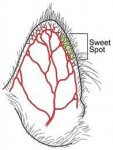
here’s the spot you’re aiming for
upload_2022-12-18_8-37-16.jpeg
 

Attachments

  • upload_2022-12-18_8-37-16.jpeg
    upload_2022-12-18_8-37-16.jpeg
    19.9 KB · Views: 153
Status
Not open for further replies.
Back
Top