First Day on Site Intro

Status
Not open for further replies.

Kailey and Jester

Member Since 2022
Hello! My name is Kailey. My 13 year old cat, Jester, was diagnosed with diabetes on April 22nd, 2022. He is my pride and joy! The love of my life! He is my “family cat” who I took in when I moved out of state back in October of last year.

When he came to live with me he was 13lbs. By April he was down to 8lbs. We thought the initial weight loss was due to not feeding him as much treats/food as he was probably used to growing up. After a vet visit to a new vet in my new state, we were told it was due to diabetes. His BG levels ranged between 550-600 when they did the first curve test.

Our vet suggested 1 unit of ProZinc insulin every 12 hours to start + Hill’s diabetic wet food + Hill’s M/D Blood Glucose Support dry food. Between April - start of July he went from 1 unit of ProZinc insulin every 12 hours to 5 units of insulin every 12 hours as directed by our vet. His BG levels, however, remained the same (between 400-500). This was even with switching him to diabetic food. At first we were told to only feed him half of a can of wet food twice per day before his shots, but then were told to allow him to free-eat the dry food in case his levels made him want to eat. Unfortunately, after a few days, Jester started rejecting the Hill’s diabetic wet food. We tried a bunch of different low-card options before we finally have become successful with Blue Buffalo Wilderness Turkey/Chicken wet food.

[The Hill’s dry food is incredibly hard to come by. It’s always sold out and inconsistent + a lot of $ for only 4lbs worth of food that he goes through quickly. I am hoping to find an alternative that can be more reliable.]

His last curve test was in June where his levels were still between 400-600. Our vet said he may have a “cat cavity” and that could be the cause of continuous high levels. We took him to another vet to treat his teeth where they said we should be looking at the insulin we’re giving him first because cleaning his teeth would cost a lot of $ for very minimal results. The new vet wrote a prescription for the Lantus Solostar pen where we are back to giving him 2 units every 12 hours with all other components remaining the same (feeding him wet food before each shot + free eating dry food).

His new curve test will be next week.

This has been quite a journey so far. What keeps me calm is seeing he is still his happy, crazy self! I just want to be as educated moving forward as I possibly can be. I am so happy I found this site and plan on spending so much time reviewing it’s different resources. I want a happy, healthy life for my Jester boy and want to make sure I am doing what I’m supposed to be doing to keep him safe and feeling better! Any and all suggestions/help/recommendations/guidance to certain resources would be incredibly helpful!


Thank you for reading our story!
 
Last edited:
Hi and welcome to you and Jester! What an adorable kitty, I love the picture. This is going to be a little overwhelming, there's a ton of info about to be thrown your way and also requested from you. Take it slow! There's a learning curve but you are already doing great just by being here and posting.

Good news -- in the near future you can stop feeding the Hill's dry food, it is no good for diabetic cats. There are almost no dry kibble varieties that are good for diabetic cats, as a matter of fact. We used to free feed regular kibble to all our cats, before Hendrick was diagnosed. We got rid of all the dry food and now feed 3-4 times a day with canned, raw, or homemade food only -- two larger meals in the morning and evening, and a couple smaller meals during the day. This is very good for a cat's little pancreas.

Being allowed to free feed on the dry kibble has almost definitely kept his BG (blood glucose) numbers so high. Unfortunately, most vets are not very well versed in how to manage feline diabetes and to this day, we see it time and time again on this forum where people are feeding what their vet said to feed, and can't understand why the BG numbers are still so high.

About making a food change however: this is something that must be done very very carefully in conjunction with home testing of the BG because removing the kibble can mean the insulin dose needs drastically reduced. If Jester were being fed a low carb all canned or raw food diet, there is a strong chance he would need less insulin. Don't change the food yet!

The experts here at this forum are very numbers driven, I love it! But it is important for the caregiver to be all in on the process. My boy Hendrick was diagnosed 1/5/22 and by following the guidance of the experts here, he went from almost dying in the hospital (diabetic keto-acidosis) to being in diabetic remission on June 22nd! He is now a "diet-controlled diabetic feline" who must be kept on a canned or raw diet, always low carb, for the rest of his life. But no longer needs insulin injections!

Lantus is great, that is the insulin that got my boy into remission. Yes, if there is any infection or inflammation, dental or otherwise, it can drive the BG numbers higher in a diabetic cat.

In order to get help from the experts here you will need to provide some info and setup a dosing spreadsheet (to be clear, I am not an expert, just a layperson who has been through it with my kitty this year). You are going to need a home BG test kit and a way to check for ketones. Either ketostix or a blood ketone meter like the Nova Max.

Check these links here:

https://www.felinediabetes.com/FDMB/threads/new-how-you-can-help-us-help-you.216696/


https://www.felinediabetes.com/FDMB...and-diabetic-cats-a-primer-on-ketones.239971/


Make sure your signature is up-to-date.
  • On the left, under Settings, Click on Signature. This is where you will put information that helps us give you feedback. There is a limit of two lines which may include two links; you may separate pieces with commas, dashes, | etc. This is where you paste the link for your spreadsheet, once it is set up.
  • Add info we need to help you:
    • Caregiver & kitty's name
    • DX: Date
    • Name of Insulin (do not include dose or frequency)
    • Name of your meter
    • Diet: "LC wet" or "dry food" or "combo"
    • Dosing: TR or SLGS or Custom (if applicable)
    • DKA or other recent health issue (if applicable)
    • Acro, IAA, or Cushings (if applicable)
    • Spreadsheet link. Please put the signature link on the bottom line of your signature information, on its own, so it is easy to find.
    • Please do not put any information about your location in the signature for security reasons. If you wish to add your country location, please add it to your profile.
Be sure to click the 'Save Changes' button at the bottom. If you need help urgently it is important we know these things at a glance. We don’t want to waste valuable time finding out information.

Thank you!
 
Last edited:
You already got such great info and advise from
@Hendrick Cuddleclaw that the only thing I’d like to ask is how the insulin was increased. Did he go from 1 unit and then up one additional unit until you got to 5? I’m hoping he didn’t go straight from 1 to 5 because that’s a huge increase. We tend to prefer Lantus but prozync is also a very good insulin for cats and some members here swear by it. Lantus also can sting at higher doses like the one he’s on, although my Minnie was at 5.5-6 and she didn’t mind it. Every cat is different is one of the main lessons you’ll learn here

welcome, you couldn’t have found a better support group for you and Kailey :bighug::bighug::bighug:
 
You already got such great info and advise from
@Hendrick Cuddleclaw that the only thing I’d like to ask is how the insulin was increased. Did he go from 1 unit and then up one additional unit until you got to 5? I’m hoping he didn’t go straight from 1 to 5 because that’s a huge increase. We tend to prefer Lantus but prozync is also a very good insulin for cats and some members here swear by it. Lantus also can sting at higher doses like the one he’s on, although my Minnie was at 5.5-6 and she didn’t mind it. Every cat is different is one of the main lessons you’ll learn here

welcome, you couldn’t have found a better support group for you and Kailey :bighug::bighug::bighug:


I had to edit my post because I realized I missed the part where they are no longer shooting 5.0 U of PZ but instead, 2.0 U of Lantus. Not sure how long they have been shooting that though.

That is a good question: @Kailey and Jester when did you begin the 2.0 U of Lantus?
 
Welcome I would suggest that you start home testing , it's the only way to keep Jester safe. Lantus is a good insulin.
If you live in the US you can go to Walmart or order it on line
The Relion Premier Classic Meter it's 9 dollars
17.88 for 100 test strips
Get 26 or 28 gauge lancets any brand
Some cotton rounds


Always aim for the sweet spot warm the ears up first, you can put rice in a sock and put it in the microwave, test it on the inside of your wrist to be sure it's not to hot, like you would test a babies bottle. You can fill a pill bottle with warm water and roll it on the ears also.Just keep rubbing the ears with your fingers to warm them up
c2b8079a-b471-4fa6-ac36-9ac1c8d6dcca-jpeg.57072
fec17d29-5ab4-44a8-912b-3a91944c3954-jpeg.57073

6. As the ears get used to bleeding and grow more capilares, it gets easier to get the amount of blood you need on the first try. If he won’t stand still, you can get the blood onto a clean finger nail and test from there.
When you do get some blood you can try milking the ear.
Get you finger and gently push up toward the blood , more will appear
You will put the cotton round behind his ear in case you poke your finger, after you are done testing you will fold the cotton round over his ear to stop the bleeding , press gently for about 20 seconds until it stops
Get 26 or 28 gauge lancets
Take a look at the lancets ,you will see one side points up, that's the side you want to poke with
A lot of us use the lancets to test freehand
I find it better to see where I'm aiming
You can also put a thin layer of vaseline on the ear ,to help the blood bead up
Hendrick made a video showing how to test your kitty at the end of his signature
 
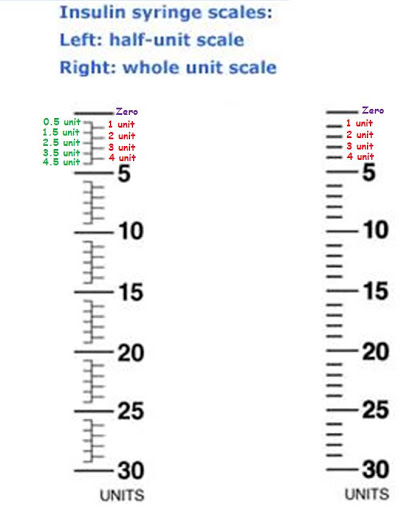
With the Lantus pen you can only increase or decrease by whole units
We increase by 0.25 units at a time
That's why we use U-100 syringes with half unit markings such as
https://www.adwdiabetes.com/product/1316/surecomfort-u100-syringes-half-unit-31g-3-10cc-5-16in-100ct

Walmart also sells the relion syringes
We use syringes and insert the syringe in the gray rubber stopper that's on the pen
You can buy these


If you have a Walmart by you this was posted by one of our members , but you need to go into the store to buy them , they are not sold on their site

As for syringes, if you have a Walmart near you, you can get U100, 3/10ml, 30 or 31 gauge insulin syringes (the 3/10ml syringes ALL have half unit marks no matter what they might tell you). They should hold a maximum of 30 units. Either one of these is fine (and can be 30 gauge or 31) They are $12.58/100


upload_2022-7-12_20-33-38-jpeg.64779


30-unit-insulin-syringe-markings.jpg
 
Here is the link so you can read all about Lantus , read all the yellow stickys
https://felinediabetes.com/FDMB/forums/lantus-levemir-biosimilars.9/

Just keep asking all the questions you want :cat:
We also use a spreadsheet where we track of cats BG numbers to see how the insulin is working and how low it's dropping
About the spreadsheet
AMPS - means AM Pre Shot the first test you take in the AM ,you need to withhold food 2 hours before testing so it's not food influenced

Units is where you would put how much insulin you gave
+1 is one hour after giving insulin if you were to test then that's where you enter his _BG number
+2 two hours after giving insulin. ditto
+3 and so on until you get to PMPS - PM pre shot withhold food 2 hours before testing

+1 same as you do for AM cycle

We don't give times because we are all in different time zones that's why we use the + numbers
We also get some more tests in after AM and PM to see how the insulin is working and how low Jester is dropping
We don't increase or decrease by going by the Pre Shots we go by how low Jester is dropping

We adjust the doses by 0.25 units at a time
Also insulin should be given the same time for the AM and PM shots

Here is the link to set up your spreadsheet , if you need help setting it up just ask we have a member that will be happy to set it up for you
https://felinediabetes.com/FDMB/threads/how-to-create-a-spreadsheet.241706/

Take a look at other members spreadsheets to see what it looks like , it will be at the end of everyone posts
 
Last edited:
Hi and welcome to you and Jester! What an adorable kitty, I love the picture. This is going to be a little overwhelming, there's a ton of info about to be thrown your way and also requested from you. Take it slow! There's a learning curve but you are already doing great just by being here and posting.

Good news -- in the near future you can stop feeding the Hill's dry food, it is no good for diabetic cats. There are almost no dry kibble varieties that are good for diabetic cats, as a matter of fact. We used to free feed regular kibble to all our cats, before Hendrick was diagnosed. We got rid of all the dry food and now feed 3-4 times a day with canned, raw, or homemade food only -- two larger meals in the morning and evening, and a couple smaller meals during the day. This is very good for a cat's little pancreas.

Being allowed to free feed on the dry kibble has almost definitely kept his BG (blood glucose) numbers so high. Unfortunately, most vets are not very well versed in how to manage feline diabetes and to this day, we see it time and time again on this forum where people are feeding what their vet said to feed, and can't understand why the BG numbers are still so high.

About making a food change however: this is something that must be done very very carefully in conjunction with home testing of the BG because removing the kibble can mean the insulin dose needs drastically reduced. If Jester were being fed a low carb all canned or raw food diet, there is a strong chance he would need less insulin. Don't change the food yet!

The experts here at this forum are very numbers driven, I love it! But it is important for the caregiver to be all in on the process. My boy Hendrick was diagnosed 1/5/22 and by following the guidance of the experts here, he went from almost dying in the hospital (diabetic keto-acidosis) to being in diabetic remission on June 22nd! He is now a "diet-controlled diabetic feline" who must be kept on a canned or raw diet, always low carb, for the rest of his life. But no longer needs insulin injections!

Lantus is great, that is the insulin that got my boy into remission. Yes, if there is any infection or inflammation, dental or otherwise, it can drive the BG numbers higher in a diabetic cat.

In order to get help from the experts here you will need to provide some info and setup a dosing spreadsheet (to be clear, I am not an expert, just a layperson who has been through it with my kitty this year). You are going to need a home BG test kit and a way to check for ketones. Either ketostix or a blood ketone meter like the Nova Max.

Check these links here:

https://www.felinediabetes.com/FDMB/threads/new-how-you-can-help-us-help-you.216696/


https://www.felinediabetes.com/FDMB...and-diabetic-cats-a-primer-on-ketones.239971/


Make sure your signature is up-to-date.
  • On the left, under Settings, Click on Signature. This is where you will put information that helps us give you feedback. There is a limit of two lines which may include two links; you may separate pieces with commas, dashes, | etc. This is where you paste the link for your spreadsheet, once it is set up.
  • Add info we need to help you:
    • Caregiver & kitty's name
    • DX: Date
    • Name of Insulin (do not include dose or frequency)
    • Name of your meter
    • Diet: "LC wet" or "dry food" or "combo"
    • Dosing: TR or SLGS or Custom (if applicable)
    • DKA or other recent health issue (if applicable)
    • Acro, IAA, or Cushings (if applicable)
    • Spreadsheet link. Please put the signature link on the bottom line of your signature information, on its own, so it is easy to find.
    • Please do not put any information about your location in the signature for security reasons. If you wish to add your country location, please add it to your profile.
Be sure to click the 'Save Changes' button at the bottom. If you need help urgently it is important we know these things at a glance. We don’t want to waste valuable time finding out information.

Thank you!

Hello! Thank you so much for taking the time to provide this information! I have hit a point where I feel like I am getting lost in this process. My Jester's levels are not improving and I am desperate to find solutions. I am so happy I found this site and will take the time to read up on all of the resources.

I am so happy to hear about Hendrick! I wish that for Jester in the near future.

I had no idea that was the case with Hill's dry food, or any dry food really! It was prescribed by our former vet and I have been letting him free-eat that since he was diagnosed. I am more than thrilled to know I can eventually and carefully ween him off of that food. Through trial and error we found he likes Blue Buffalo Wilderness, both the chicken and turkey pate recipe (but more so the turkey). I could not find the carb % on their website, so I called today to confirm the information. The rep told me the chicken is 1.93% and the turkey is 0.6%.

If fed canned food 3-4 times a day, would half a can be a good amount for the larger portions? I never know how much of the canned food is considered a good amount. Also, if you were ever away from home for the day, would you give Hendrick even more in the morning/night? If this were to happen to me, would this a case where I can leave out low carb dry food until I get home?

I have never home tested him before and was not aware us cat parents/siblings were able to do so! Thank you for providing the home testing links! I will read into that.

I cannot thank you enough!
 
Last edited:
You already got such great info and advise from
@Hendrick Cuddleclaw that the only thing I’d like to ask is how the insulin was increased. Did he go from 1 unit and then up one additional unit until you got to 5? I’m hoping he didn’t go straight from 1 to 5 because that’s a huge increase. We tend to prefer Lantus but prozync is also a very good insulin for cats and some members here swear by it. Lantus also can sting at higher doses like the one he’s on, although my Minnie was at 5.5-6 and she didn’t mind it. Every cat is different is one of the main lessons you’ll learn here

welcome, you couldn’t have found a better support group for you and Kailey :bighug::bighug::bighug:

Hello and thank you so much for the warm welcome!

Yes, ever since Jester was diagnosed on 4/22 we were told to go to the vet once every 3-4 weeks to conduct the glucose curve. After each time, our vet instructed us to increase his dosage by 1 unit; so every 3-4 weeks we increased it by 1. I was concerned as to why he was getting 10 units total a day with no sign of improvement. We have found a new vet who recommended and prescribed Lantus, which I have heard great things about! He just started getting 2 doses of Lantus about 3.5 weeks ago, so we are back to 4 units total a day.

My concerns now are making sure he gains back his weight and how much he's shedding. I was just made aware that the Hill's dry food I am letting him free-eat is no good for him. I hope to ween him off of that safely and soon. I made a vet appointment for this Friday to discuss my concerns and to do a new glucose curve professionally. I am hoping with this insulin change and better food as I continue to learn will help him more now than it ever has!
 
Last edited:
Welcome I would suggest that you start home testing , it's the only way to keep Jester safe. Lantus is a good insulin.
If you live in the US you can go to Walmart or order it on line
The Relion Premier Classic Meter it's 9 dollars
17.88 for 100 test strips
Get 26 or 28 gauge lancets any brand
Some cotton rounds


Always aim for the sweet spot warm the ears up first, you can put rice in a sock and put it in the microwave, test it on the inside of your wrist to be sure it's not to hot, like you would test a babies bottle. You can fill a pill bottle with warm water and roll it on the ears also.Just keep rubbing the ears with your fingers to warm them up
c2b8079a-b471-4fa6-ac36-9ac1c8d6dcca-jpeg.57072
fec17d29-5ab4-44a8-912b-3a91944c3954-jpeg.57073

6. As the ears get used to bleeding and grow more capilares, it gets easier to get the amount of blood you need on the first try. If he won’t stand still, you can get the blood onto a clean finger nail and test from there.
When you do get some blood you can try milking the ear.
Get you finger and gently push up toward the blood , more will appear
You will put the cotton round behind his ear in case you poke your finger, after you are done testing you will fold the cotton round over his ear to stop the bleeding , press gently for about 20 seconds until it stops
Get 26 or 28 gauge lancets
Take a look at the lancets ,you will see one side points up, that's the side you want to poke with
A lot of us use the lancets to test freehand
I find it better to see where I'm aiming
You can also put a thin layer of vaseline on the ear ,to help the blood bead up
Hendrick made a video showing how to test your kitty at the end of his signature

This is incredible! Thank you so much for taking the time to walk me through the steps. Your tips and pointers are incredibly helpful!! Thank you! I am still at the beginning of my research regarding the home tests, and I hope to find information on how often to do a home test, how often to draw from the ear to test the blood in a given day, and what exactly I am looking for.

Thank you!
 
Here is the link so you can read all about Lantus , read all the yellow stickys
https://felinediabetes.com/FDMB/forums/lantus-levemir-biosimilars.9/

Just keep asking all the questions you want :cat:
We also use a spreadsheet where we track of cats BG numbers to see how the insulin is working and how low it's dropping
About the spreadsheet
AMPS - means AM Pre Shot the first test you take in the AM ,you need to withhold food 2 hours before testing so it's not food influenced

Units is where you would put how much insulin you gave
+1 is one hour after giving insulin if you were to test then that's where you enter his _BG number
+2 two hours after giving insulin. ditto
+3 and so on until you get to PMPS - PM pre shot withhold food 2 hours before testing

+1 same as you do for AM cycle

We don't give times because we are all in different time zones that's why we use the + numbers
We also get some more tests in after AM and PM to see how the insulin is working and how low Jester is dropping
We don't increase or decrease by going by the Pre Shots we go by how low Jester is dropping

We adjust the doses by 0.25 units at a time
Also insulin should be given the same time for the AM and PM shots

Here is the link to set up your spreadsheet , if you need help setting it up just ask we have a member that will be happy to set it up for you
https://felinediabetes.com/FDMB/threads/how-to-create-a-spreadsheet.241706/

Take a look at other members spreadsheets to see what it looks like , it will be at the end of everyone posts

This is perfect! This answered most of my questions on my last response to you! If I am doing a curve test at the vet on Friday 8.12, how long should I wait to do my own home test? Another 3-4 weeks?

Thank you!!!
 
This is perfect! This answered most of my questions on my last response to you! If I am doing a curve test at the vet on Friday 8.12, how long should I wait to do my own home test? Another 3-4 weeks?
Doing a curve at the vets can raise their BG because of stress
You actually should start to home test now. You need to first test to see him Jester's BG is a safe number to shoot, then get some tests in after that to see how the insulin is working and how low he's dropping. Same with the PM shot.
God forbid he dropped to low and had a hypo incident.
We adjust the dose by how low he drops ,not by the Pre Shots
Also you need to withhold feeding 2 hours prior to testing so the BG number is not food influenced.
If you need help with setting up your spreadsheet just ask.We have a member who will be glad to do it
 
Last edited:
When I first joined, we were getting curves done at the vet but it turns out that if you can home test there is no need to spend the time, money and put added stress on the cat by getting a curve done at the vet. I'll be honest though, when the experts here first told me that I resisted, it seemed impossible that I could do without the vet curves.

But the truth is, if you can just do some home testing a few times each day it is actually better than a curve. A curve only gives information about how the cat's BG was on that one particular day, while at the vet -- and almost all cats have higher BG at the vet due to stress. If you are home testing every day it gives a much broader picture of how the insulin is working and what the levels are doing than just a single vet curve. Most folks here test at least 4 times a day -- before each shot, known as AM Pre-shot and PM Pre-shot (AMPS / PMPS) and also two other tests, each one usually a few hours after the shot was given, known as a +2 or +3 test. As in 2 or 3 hours after insulin shot.

As Diane said, there is no reason to wait to start home testing, the time to start is when you are giving insulin and you already are. Home testing allows you to know what the levels are before you inject the insulin so you know you are not putting kitty in danger of a hypoglycemic event. Parents of a diabetic child do not shoot insulin without checking the blood first, and neither should fur-parents.

I work from home most days since the pandemic so it helps me do the small meals several times a day thing. For those that are not home as much there are some good options, one is the PetSafe 5, it is a timed feeder you can load with food and set to open at certain times. It can take wet or dry food and has a spot for a ice pack if needed to the food from going bad.
 
Same here. I was luck enough to find a new vet who asked me if I’d be willing to test her at home and do the curves myself. Testing needs to happen everyday independent of the curves as Diane explained. You test in the morning and at both before each shot and ideally, at least 2 more times throughout the day. It can seem overwhelming but you get the hang of it and it becomes part of the routine line feeding them
 
Here is the link so you can read all about Lantus , read all the yellow stickys
https://felinediabetes.com/FDMB/forums/lantus-levemir-biosimilars.9/

Just keep asking all the questions you want :cat:
We also use a spreadsheet where we track of cats BG numbers to see how the insulin is working and how low it's dropping
About the spreadsheet
AMPS - means AM Pre Shot the first test you take in the AM ,you need to withhold food 2 hours before testing so it's not food influenced

Units is where you would put how much insulin you gave
+1 is one hour after giving insulin if you were to test then that's where you enter his _BG number
+2 two hours after giving insulin. ditto
+3 and so on until you get to PMPS - PM pre shot withhold food 2 hours before testing

+1 same as you do for AM cycle

We don't give times because we are all in different time zones that's why we use the + numbers
We also get some more tests in after AM and PM to see how the insulin is working and how low Jester is dropping
We don't increase or decrease by going by the Pre Shots we go by how low Jester is dropping

We adjust the doses by 0.25 units at a time
Also insulin should be given the same time for the AM and PM shots

Here is the link to set up your spreadsheet , if you need help setting it up just ask we have a member that will be happy to set it up for you
https://felinediabetes.com/FDMB/threads/how-to-create-a-spreadsheet.241706/

Take a look at other members spreadsheets to see what it looks like , it will be at the end of everyone posts

Could you possibly direct me to a link that will provide more information on the home testing and how to do it/what to look for? When you say to first test to see if his BG is a safe number to shoot - what is that number? At what number should I not shoot and at what number should I shoot? Also, am I to adjust the insulin units on a day to day basis based on his numbers for ex. start with 2 units in the AM and then see where he is and possibly only give him 1 at night? I guess my question is how do I know how much insulin he needs based on his numbers?

Thank you so much for your continued help! This is a lot to take in and I want to make sure I am doing everything correctly :) Thank you!!
 
Could you possibly direct me to a link that will provide more information on the home testing and how to do it/what to look for?

Diane's post above is the information you need on how to do an ear poke and get a blood droplet for a test. Post #6 in this thread, with the picture of the kitty's ear


When you say to first test to see if his BG is a safe number to shoot - what is that number? At what number should I not shoot and at what number should I shoot?

As a general rule of thumb for NEW diabetic kitties where you do not have much data in the spreadsheet, it is recommended that if your pre-shot test shows a BG under 200mg/dl you hold off on shooting, don't feed anything yet either, and post on the forums for guidance.

After you get more data and are further along in the process, the shoot/no shoot number depends on the dosing method you choose.


Also, am I to adjust the insulin units on a day to day basis based on his numbers for ex. start with 2 units in the AM and then see where he is and possibly only give him 1 at night?

No, Lantus works best with consistent dosing, same dose every 12 hours. The only reason you would adjust the dose like that is if the BG tests showed it was way too much insulin and needed reduced immediately by an entire unit. That is fairly rare. For the most part, you always shoot the exact same dose every 12 hours.
 
Last edited:
And we recommend adjusting doses by 1/2 unit only. Most likely you wouldn’t do that more often than every 2 weeks and only as you’re trying to find the optimal dose, which can take some time in the beginning. You can go on the Lantus forum and read the sticky notes. That’s where all the instructions for everything lives. I think Diane posted the link above. You pick one of the 2 protocols and follow those guidelines for dosing, shooting not shooting, feeding and staling then retesting, etc
 
Status
Not open for further replies.
Back
Top