Hello and question about transitioning to wet food

Status
Not open for further replies.

Manuel

Member Since 2022
Introduction
Hello! I'm Manuel in Canada and I have a wonderful 9yo grey domestic shorthair named Emma who was recently diagnosed with diabetes. Since diagnosis I have been trying to learn as much as I can to make sure my kitty lives a good and happy life; to this end, I was delighted to come across the wealth of information this community represents and the sense of camaraderie you all have created.

Emma probably became diabetic at the start of this year. The symptoms were steady weight loss, which I mistook for regular weight loss since we put her on a diet at the end of 2021—the periods coincided perfectly. I only knew to get a blood test in April after she peed much more, and only was able to get an appointment for June, which is when we got the diagnosis. Upon bloodwork, the glucose was 26.6 mmol/L, or 478.8mg/dL. Her weight is now 13.6lb, down from 19.5 last year and 15 in April.

The medical context here is that Emma has, for 4 years, had IBD, and was prescribed to take prednisolone (half of a 5mg tablet every two days) and Royal Canin hypoallergenic hydrolyzed protein dry food. This prevents her from vomiting, but also contributes to increased risk of diabetes and her obesity: she was constantly hungry due to the pred, and we could hardly reduce more calories without her being absolutely wretched. The vet has discouraged us from switching to other food, and though we've tried to wean her off pred she simply goes back to vomiting.

Questions
The vet initially prescribed 2.5u of Lantus twice a day, which we did until last week, when the vet ran a gluclose curve and found her levels still high (425mg/dL 8 hours after insulin). So now it's been increased to 3u twice a day.

I have two questions.
1/ First, how important is it that the cat eats only twice a day during treatment? She has the exact same amount of food (56g daily/ 220 kcal), but Emma used to eat 5 smaller meals to prevent hunger and regulate her stomach. Switching to 2 meals per day means she is begging for food 2 hours before feeding, so a total of 4 hours a day. She's miserable.
2/ Second, given the consensus here that wet food is far superior than any dry food, how should I approach potentially switching to a wet food like Fancy Feast pate? The complicating factor here is the IBD, which is under control with the prednisolone and HP dry food. I honestly suspect that it's the pred that prevents her from vomiting (one time I ran out of dry food for 2 days during the vet food shipment shortages of the pandemic and gave her FF instead and there was no problem) but I'd have to actually test it. The vet didn't dismiss this out of hand when I mentioned it, but I suspect I will need to get her OK before making any switch.

Thanks so much for this forum and for your thoughts.
 
Last edited:
1/ First, how important is it that the cat eats only twice a day during treatment? She has the exact same amount of food (56g daily/ 220 kcal), but Emma used to eat 5 smaller meals to prevent hunger and regulate her stomach. Switching to 2 meals per day means she is begging for food 2 hours before feeding, so a total of 4 hours a day. She's miserable.

I'll let others come answer your other question but many many members here let their cats each multiple meals throughout the day so it sounds like you were doing it right! Go ahead and feed her the 5 smaller meals, just not two hours before AMPS or PMPS so the number isn't influenced by food. But yes, you don't only need to give her two meals a day. That's old school thinking, as the saying around here goes.
 
I'll let others come answer your other question but many many members here let their cats each multiple meals throughout the day so it sounds like you were doing it right! Go ahead and feed her the 5 smaller meals, just not two hours before AMPS or PMPS so the number isn't influenced by food. But yes, you don't only need to give her two meals a day. That's old school thinking, as the saying around here goes.
Thank you for your reply! I suppose, then, it would be possible to give her 80% of her food in the two meals (40/40) and then a small snack in between? I'd be worried about a glucose spike with the food, but it sounds like that isn't too much of a problem.
 
Thank you for your reply! I suppose, then, it would be possible to give her 80% of her food in the two meals (40/40) and then a small snack in between? I'd be worried about a glucose spike with the food, but it sounds like that isn't too much of a problem.

I honestly would stick to the five meals. That's what many members do. I'm sure someone else will come and comment about a glucose spike because I'm not an expert on that but I know I feed my cat multiple meals a day. It's better on their pancreas, or so I'm told.
 
I honestly would stick to the five meals. That's what many members do. I'm sure someone else will come and comment about a glucose spike because I'm not an expert on that but I know I feed my cat multiple meals a day. It's better on their pancreas, or so I'm told.
Thanks again for your thoughts on this -- certainly it would make Emma less anxious to eat 4-5 meals a day again! I'll be curious to hear more from others and will speak to my vet about it!
 
Thanks again for your thoughts on this -- certainly it would make Emma less anxious to eat 4-5 meals a day again! I'll be curious to hear more from others and will speak to my vet about it!

I know the others will agree! But the vet probably won't. That is a whole other issue!! Good luck and welcome!
 
I know the others will agree! But the vet probably won't. That is a whole other issue!! Good luck and welcome!
Welcome Manuel and Emma
April is right we feed our cats the bigger meals at AMPS ( first meal in the morning after testing them and giving insulin) the maybe 2 smaller meals after that such as +2 ( 2 hours after shooting ) and maybe + 4 or +5
Same goes for PMPS

I don't know anything about IBD but I can tag a few members for you
Are you home testing Emma ?
We highly encourage it, it's the only way to keep Emma safe
We also gave a spreadsheet we use to track our cats progress and see how the insulin is working and how low they are dropping
We increase or decrease by 0.25 units at a time
Do you have the syringes with half unit markings , they make it easier to do this

If you can set up what we call your signature that would be great

To set up your signature which you will see is at the end of everyone's post in gray, click on your name up top and then tap on the word signature and add this information
  • Add info we need to help you:
    • Caregiver & kitty's name
    • DX: Date
    • Name of Insulin (do not include dose or frequency)
    • Name of your meter
    • Diet: "LC wet" or "dry food" or "combo"
    • Dosing: TR or SLGS or Custom (if applicable)
    • DKA or other recent health issue (if applicable)
    • Acro, IAA, or Cushings (if applicable)
    • Spreadsheet link. Please put the signature link on the bottom line of your signature information, on its own, so it is easy to find.
    • Please do not put any information about your location in the signature for security reasons. If you wish to add your country location, please add it to your profile.
Be sure to click the 'Save Changes' button at the bottom. If you need help urgently it is important we know these things at a glance. We don’t want to waste valuable time finding out information.

We also have a spreadsheet where we track our cats/BG to see how the insulin is working and how low they are dropping

If you need help setting up the SS just ask ,we have a member that can do it for you in no time
Here is the link if you want to give it a go it will also explain how the spreadsheet works
https://felinediabetes.com/FDMB/threads/how-to-create-a-spreadsheet.241706/
@Manuel


If you plan to change to an all low carb diet you need to be Home Testing for sure because taking away the dry food can drop Emma's BG by 100 points
TRANSITIONING FROM DRY TO WET FOOD
 
Last edited:
Introduction
Hello! I'm Manuel in Canada and I have a wonderful 9yo grey domestic shorthair named Emma who was recently diagnosed with diabetes. Since diagnosis I have been trying to learn as much as I can to make sure my kitty lives a good and happy life; to this end, I was delighted to come across the wealth of information this community represents and the sense of camaraderie you all have created.

Emma probably became diabetic at the start of this year. I noticed she was peeing more in January, and it was very noticeable by March. Unfortunately I thought it must have been a change in the litter to clump more. Since late last year the vet had asked us to put Emma on a diet (she was 19-20lb) the weight loss coincided with what was probably the diabetes getting worse. When we were able to get a vet appointment for April (for vaccines, etc., new weight 15lb) it was with a new vet (our old one had moved); she recommended blood work, but only at the next appointment since the cat had a cold/virus and would need to return to get her vaccines anyway. This we were finally able to do in June, and that's when we got the diagnosis. Upon bloodwork, the glucose was 26.6 mmol/L, or 478.8mg/dL. Her weight is now 13.6lb.

The medical context here is that Emma has, for 4 years, had IBD, and was prescribed to take prednisolone (half of a 5mg tablet every two days) and Royal Canin hypoallergenic hydrolyzed protein dry food. This prevents her from vomiting, but also contributes to increased risk of diabetes and her obesity (she was constantly hungry due to the pred, and we could hardly reduce more calories without her being absolutely wretched). The vet has discouraged us from switching to other food, and though we've tried to wean her off pred she simply goes back to vomiting.

Questions
The vet initially prescribed 2.5u of Lantus twice a day, which we did until last week, when the vet ran a gluclose curve and found her levels still high (425mg/dL 8 hours after insulin). So now it's been increased to 3u twice a day.

I have two questions.
1/ First, how important is it that the cat eats only twice a day during treatment? She has the exact same amount of food (56g daily/ 220 kcal), but Emma used to eat 5 smaller meals to prevent hunger and regulate her stomach. Switching to 2 meals per day means she is begging for food 2 hours before feeding, so a total of 4 hours a day. She's miserable.
2/ Second, given the consensus here that wet food is far superior than any dry food, how should I approach potentially switching to a wet food like Fancy Feast pate? The complicating factor here is the IBD, which is under control with the prednisolone and HP dry food. I honestly suspect that it's the pred that prevents her from vomiting (one time I ran out of dry food for 2 days during the vet food shipment shortages of the pandemic and gave her FF instead and there was no problem) but I'd have to actually test it. The vet didn't dismiss this out of hand when I mentioned it, but I suspect I will need to get her OK before making any switch.

Thanks so much for this forum and for your thoughts.

@tiffmaxee

@Wendy&Neko

@Bron and Sheba (GA)

@Sienne and Gabby (GA)

Hi Ladies I asked @Manuel to set up his signature and SS
I guess he's concerned with the IBD diagnosis that she has for 4 years could he take her off the dry food he's giving now and switching to FF Pate which he has given once and no problem with vomiting
I guess you really need to read his entire post

Thank you :cat:
 
Last edited:
Welcome Manuel and Emma
April is right we feed our cats the bigger meals at AMPS ( first meal in the morning after testing them and giving insulin) the maybe 2 smaller meals after that such as +2 ( 2 hours after shooting ) and maybe + 4 or +5
Same goes for PMPS

I don't know anything about IBD but I can tag a few members for you
Are you home testing Emma ?
We highly encourage it, it's the only way to keep Emma safe
We also gave a spreadsheet we use to track our cats progress and see how the insulin is working and how low they are dropping
We increase or decrease by 0.25 units at a time
Do you have the syringes with half unit markings , they make it easier to do this

If you can set up what we call your signature that would be great

[...]

If you plan to change to an all low carb diet you need to be Home Testing for sure because taking away the dry food can drop Emma's BG by 100 points
TRANSITIONING FROM DRY TO WET FOOD

Thanks so much, Diane. I'll try splitting up the food to give her at least one snack after each main meal. We have an automatic feeder so it will be no problem once we're home. As long as it doesn't cause BG spikes I'm sure my cat will be much happier and healthier that way. She has no problem eating wet food and in fact prefers it.

I have not yet started home testing, since we got the BG curve done by the vet a day before we needed to travel for a wedding (the diagnosis came upon us unexpectedly). We brought Emma with us but not the home test kit; the vet told us that we could test after switching from 2.5u to 3.0u two weeks after, which is when we return from travel. Certainly I will learn to do the testing at home, and if I knew about the forums before going to the vet, I would have declined the AlphaTRAK 2 and used the human kit instead. I do have the syringes with the half-unit markings.

The glucose curve they tracked before changing prescription was, in mmol/L:
AMPS (not measured), +2 (7.8), +4 (11.8), +6 (15), + 8 (23.6), and then they stopped testing since it was high.

In 11 or so days when I am able to do my own curves I will figure out and post the spreadsheets.

And thanks in advance for anyone who might have thoughts about managing the IBD apart from the HP dry food. I figure the only safe way to do it is to observe her BG now she's at 3u, and see what happens. Then I suppose I could transition to wet food and see how much lower the BG is and whether 3.0u remains a safe dosage.
 
The medical context here is that Emma has, for 4 years, had IBD, and was prescribed to take prednisolone (half of a 5mg tablet every two days) and Royal Canin hypoallergenic hydrolyzed protein dry food. This prevents her from vomiting, but also contributes to increased risk of diabetes and her obesity: she was constantly hungry due to the pred, and we could hardly reduce more calories without her being absolutely wretched. The vet has discouraged us from switching to other food, and though we've tried to wean her off pred she simply goes back to vomiting.


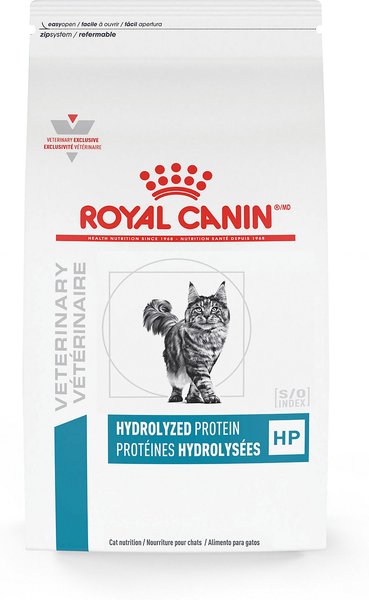
Is this the dry food you are feeding? Looks like it's pretty high in carbs
I just looked up the carbs that Chewys posted
What is the carbohydrate amount in 1 cup of food?
This formula has 29.52 grams of Carbohydrates per cup.

By on Feb 18, 2019

Is this the one

Also found this on our site posted by another member

Royal Canin Hypoallergenic Adult Dry Cat Food 4.5kg
Ingredients

Rice, hydrolysed soya protein isolate, animal fats, vegetable fibres, minerals, hydrolysed poultry liver, soya oil, beet pulp, fish oil, Fructo-Oligo- Saccharides (FOS), borage oil, marigold extract (source of lutein).
Analysis
Crude ash: 6.3%. Crude fibre: 3.6%. Crude oil fats: 20%. Moisture: 5.5%. Protein: 25.5%.

This nifty calculator (link below) makes it 34.55% calories from carbs. (And I just double checked that on another calculator, same result.)
https://secure.balanceit.com/tools/_gaconverter/index.php

Is this what you are feeding
50318_MAIN._AC_SL600_V1596567095_.jpg
 
Last edited:
Hi and welcome to the forum.
I have to say that 3 units is a lot of insulin for a newly diagnosed cat. I am going to tag @FrostD as she uses Prozinc and I don’t.
Do you have a hypo kit set up?if not I would do that straight away because you don’t want to be looking for something to give if your kitty has a symptomatic hypo. Please print THIS hypo information off and put on the fridge and get the kit set up. :). By the time that symptoms of a hypo appear, the BG is Very low.

I would seriously look at hometesting the BG now. Don’t wait for 3 weeks. A lot can happen in that time. I’m not sure where you live but if it is in the US you can buy a ReliOn premier meter for $9 and 100 test strips for $17.88. You will also need a box of 100 lancets size 26 or 28 and some cotton rounds to hold behind the ear to test and then to hold over the prick afterwards.
HOMETESTING HINTS AND LINKS

You might want to also look at maybe feeding a raw diet of a novel protein for the IBD. Vets do not get a lot of training on diets and a lot of what they get is from the big manufacturers who promote their own products, so please be aware of that when you talk to the vet about diets.
But before you do anything with the diet I would start hometesting the BG because a low carb diet will drop the blood glucose levels up to 100 points and you will probably need to adjust the dose so testing the BG is issential.
 
I have not yet started home testing, since we got the BG curve done by the vet a day before we needed to travel for a wedding (the diagnosis came upon us unexpectedly). We brought Emma with us but not the home test kit; the vet told us that we could test after switching from 2.5u to 3.0u two weeks after, which is when we return from travel. Certainly I will learn to do the testing at home, and if I knew about the forums before going to the vet, I would have declined the AlphaTRAK 2 and used the human kit instead.
I agree with Bron you should start testing Emma now , go out and buy a human meter and test strips , 26 or 28 gauge lancets
Some cotton rounds

Just found this posted by one of our members about getting human meters in Canada

Human meter strips are much cheaper and easier to get if you have a sudden need for them. You also want to get a meter with the smallest blood drop requirement you can get. The Freestyle is a common one for that reason - available in practically any pharmacy. The Bravo meter has one of the cheapest test strips prices in Canada. It's on line ordering so not as convenient, meaning you just need to keep more in stock and order earlier.
 
Last edited:
Thanks very much, Bron and Diane. Yes, that is the HP food assigned to me by the vet. Since it, along with the prednisolone, have put the vomiting under control, I have grudgingly kept feeding using it. It's fairly expensive and high in carbs, compared to the wet food I used to feed Emma before her IBS showed up.

We have indeed prepared for hypo reactions and I just now reviewed the document. I can print out the info just in case -- thank you. I figured 3u of Lantus is high, but I assume the vet knows what she's talking about, having run a curve. I will look for the Bravo or Freestyle in store and if not, I'll place an order for the Bravo meter and test when it arrives. I won't switch food before I have a very good sense of how she's responding to the insulin with dry food.

Thanks again!
 
but I assume the vet knows what she's talking about, having run a curve.
Glad you're going to pick up a human meter
Sorry to say but most of us assumed our vets knew what they were talking about
Running a curve at the vets office can actually stress a cat out and cause their BG to read higher
Even doing a curve at home is not necessary if you are testing your cats AM and at least getting 2 more tests in during the cycle , same goes for PM

You just need to be testing everyday
Sure running a curve every now and then is fine
When you get a chance take a look at the 2 dosing methods to choose one to follow, they will tell you when an increase or decrese is needed
Good luck with everything :cat:

https://www.felinediabetes.com/FDMB...-low-go-slow-slgs-tight-regulation-tr.210110/

The sad truth is that vets get less than 1 day of education on diabetes in school and that covers all species. Vet schools only have 4 years to teach everything so they can't spend weeks on each disease, the different types of treatment for that disease, how it differs in different species, etc.

One last thing if it wasn't for the members here , some with over 30 years of experience my Tyler wouldn't be in remission today since 1-24-21 if I had followed my vets advice and I know other members will say the same thing . I actually taught my get a few things about diabetes that I have learned from the members here.

I gave her the link to this group and she was amazed about how experienced the members were and actually learned a few things herself.
She's an excellent vet when it comes to other things , she worked with me on how I wanted to treat Tyler and let me do what I wanted to. When I showed her Tyler's SS she was amazed on how good he was doing and then finally went into remission
 
Last edited:
Hello and welcome from BC. Answers to your other questions later, this is more important.
The glucose curve they tracked before changing prescription was, in mmol/L:
AMPS (not measured), +2 (7.8), +4 (11.8), +6 (15), + 8 (23.6), and then they stopped testing since it was high.
OK, this is the most important problem. We determine how to change the Lantus dose based on how low it takes the cat, not how high the cat goes. You know she was as low as 7.8 (140), and I bet even lower than that at AMPS or overnight. And then she did what we call bouncing.
Definition of bouncing: Bouncing is simply a natural reaction to what the cat's system perceives as a BG value that is "too low". "Too low" is relative. If a cat is used to BGs in the 200's, 300's, or higher for a long time, then even a BG that drops to 150 can trigger a "bounce". Bouncing can also be triggered if the blood glucose drops too low and/or too fast.The pancreas, then the liver, release glucogon, glycogen and counter-regulatory hormones. The end result is a dumping of "sugar" into the bloodstream to save the cat from going hypoglycemic from a perceived low. The action is often referred to as "liver panic" or "panicky liver". *Usually*, a bounce will clear kitty's system within 3 days (6 cycles).

If a cat is seeing numbers under 150, and being fed dry food, we do NOT increase the dose. Also, increases are by 0.25 units at a time, not 0.5 units. Please be very careful now, I suspect your cat is now being overdosed having since increased her to 3.0 units. The begging for food could have been her telling you her numbers were low and she needed food to bring her numbers up. Who knows where her blood sugars were at AMPS - 2 hours when she was begging.

Don't assume the vet knows what they are doing, unfortunately.

Next step - buy a glucometer ASAP. You want one that takes the smallest blood drop possible. Freestyle Lite is one such option, but Aviva and Bayer also makes ones people here use. You want to try to get a meter than has as cheap a test strips as possible, that's what you'll be going through. Often you can get test strips on eBay. One online option is the Bravo test meter, but you have to wait for it to arrive, or buy lots to keep some in stock. There is something to be said for having a meter where you can buy test strips within a couple hours at the store if needed.

OK - next topic is IBD. Most important thing, do NOT change food until you are comfortable testing. It's that high carb food that might be keeping her safe now (at least before the Lantus dose increase). Another option to prednisolone that diabetics often try is budesonide. It's also a steroid, but locally acting on the GI system and for many cats does not impact their blood sugars. My girl Neko was on budesonide without impact on her blood glucose (BG). Treatment for IBD (got one of those at home now) can be novel proteins and a good probiotic. Visbiome is one such probiotic made especially for IBD. A novel protein is just a protein she might not have eaten before. Lamb, duck, rabbit, venison, quail, kangaroo are some examples. There are many commercially available options with those proteins. Do check the ingredients list on the can, you'll often find chicken as a cheaper protein on the list, but chicken is a common allergen. This website has some good information https://www.ibdkitties.net/ and this one https://www.rawfeedingforibdcats.org/
 
Hello and welcome from BC. Answers to your other questions later, this is more important.

OK, this is the most important problem. We determine how to change the Lantus dose based on how low it takes the cat, not how high the cat goes. You know she was as low as 7.8 (140), and I bet even lower than that at AMPS or overnight. And then she did what we call bouncing.
Definition of bouncing: Bouncing is simply a natural reaction to what the cat's system perceives as a BG value that is "too low". "Too low" is relative. If a cat is used to BGs in the 200's, 300's, or higher for a long time, then even a BG that drops to 150 can trigger a "bounce". Bouncing can also be triggered if the blood glucose drops too low and/or too fast.The pancreas, then the liver, release glucogon, glycogen and counter-regulatory hormones. The end result is a dumping of "sugar" into the bloodstream to save the cat from going hypoglycemic from a perceived low. The action is often referred to as "liver panic" or "panicky liver". *Usually*, a bounce will clear kitty's system within 3 days (6 cycles).

If a cat is seeing numbers under 150, and being fed dry food, we do NOT increase the dose. Also, increases are by 0.25 units at a time, not 0.5 units. Please be very careful now, I suspect your cat is now being overdosed having since increased her to 3.0 units. The begging for food could have been her telling you her numbers were low and she needed food to bring her numbers up. Who knows where her blood sugars were at AMPS - 2 hours when she was begging.

Don't assume the vet knows what they are doing, unfortunately.

Next step - buy a glucometer ASAP. You want one that takes the smallest blood drop possible. Freestyle Lite is one such option, but Aviva and Bayer also makes ones people here use. You want to try to get a meter than has as cheap a test strips as possible, that's what you'll be going through. Often you can get test strips on eBay. One online option is the Bravo test meter, but you have to wait for it to arrive, or buy lots to keep some in stock. There is something to be said for having a meter where you can buy test strips within a couple hours at the store if needed.

OK - next topic is IBD. Most important thing, do NOT change food until you are comfortable testing. It's that high carb food that might be keeping her safe now (at least before the Lantus dose increase). Another option to prednisolone that diabetics often try is budesonide. It's also a steroid, but locally acting on the GI system and for many cats does not impact their blood sugars. My girl Neko was on budesonide without impact on her blood glucose (BG). Treatment for IBD (got one of those at home now) can be novel proteins and a good probiotic. Visbiome is one such probiotic made especially for IBD. A novel protein is just a protein she might not have eaten before. Lamb, duck, rabbit, venison, quail, kangaroo are some examples. There are many commercially available options with those proteins. Do check the ingredients list on the can, you'll often find chicken as a cheaper protein on the list, but chicken is a common allergen. This website has some good information https://www.ibdkitties.net/ and this one https://www.rawfeedingforibdcats.org/

Thank you very much. I'm actually in BC, visiting from QC where I now live. I'll look to pick up a Freestyle Lite at London Drugs or something - they don't appear to carry it at SDM/Pharmaprix, which is too bad since those are available in Montreal, but at least the test strips are available online. Is that the one you'd recommend? I see Aviva is being discontinued, but Bayer's Contour Next seems good too - I'll see what I find.

Thanks for the warning re: bounce. I wondered about that, but if Emma has been hypoglycemic, she has been so asymptomatically - she's definitely sleepy after the big meal, but she almost always is after eating. Maybe out of caution I'll reduce back to 2.5u. I'm a bit alarmed that a vet wouldn't know to be on the lookout for a bounce, or know guidelines like the <150 + dry food means not increasing. I guess I'll have to really take things they mention with a grain of salt.

And thank you so much for the IBD comments, too. I'm certain Emma will be doing much better if only we could get her on wet food; I'll worry about this later, when a potential transition can be done safely.

Thank you all for your time and solicitude!
 
Thank you very much. I'm actually in BC, visiting from QC where I now live. I'll look to pick up a Freestyle Lite at London Drugs or something - they don't appear to carry it at SDM/Pharmaprix, which is too bad since those are available in Montreal, but at least the test strips are available online. Is that the one you'd recommend? I see Aviva is being discontinued, but Bayer's Contour Next seems good too - I'll see what I find.

Thanks for the warning re: bounce. I wondered about that, but if Emma has been hypoglycemic, she has been so asymptomatically - she's definitely sleepy after the big meal, but she almost always is after eating. Maybe out of caution I'll reduce back to 2.5u. I'm a bit alarmed that a vet wouldn't know to be on the lookout for a bounce, or know guidelines like the <150 + dry food means not increasing. I guess I'll have to really take things they mention with a grain of salt.

And thank you so much for the IBD comments, too. I'm certain Emma will be doing much better if only we could get her on wet food; I'll worry about this later, when a potential transition can be done safely.

Thank you all for your time and solicitude!


Hello, I am still really new to all this but I thought would chime in that 3 of the 4 times I’ve bought testing strips the pharmacist has given me a free glucometer. I am in Ontario but I believe this may be a CANADA wide program. 1 of the 4 times the pharmacist said I needed a prescription but the other three times the pharmacist (from various pharmacies including Shoppers and Walmart) gladly gave me a free glucometer …even when I said it was for my cat (which i probably should have kept to myself !). So it’s worth asking. I have the Contour Next, I have nothing to compare it to as I am new to all this but at the very least I can say it’s easy to use and I’m happy with it. I’ve checked around my local pharmacies and found the lancets that work with the lancing pen that comes with the Contour Next do not appear to come in 26-28 gauge so you’d need to buy a different lancet brand if that lower gauge is needed and use without the lancing pen. Good luck.
 
I'm a bit alarmed that a vet wouldn't know to be on the lookout for a bounce, or know guidelines like the <150 + dry food means not increasing. I guess I'll have to really take things they mention with a grain of salt.
That is just the guideline we use here on FDMB. It may not be something the vet has heard of. It might be interesting to ask the vet what dosing protocol they do use. What was more concerning to me is that the vet didn't test at shot time, got a decent number at AMPS+2 and saw the numbers climb after that. But didn't ask the question "how low she was before the curve started". We are so focused on spreadsheets here, that we've become quite familiar with blood sugar patterns over time. Not something a vet might be.

I got my first free glucometer from London Drugs. As for lancets, I just free handed the lancets, so it doesn't matter what brand you use if you do that. It was either London Drugs or Save on Foods Pharmacy that once gave me a free lancing device for a different brand. Been too long to remember now which store. I ended up not using it. In BC, I found Safeway Pharmacy had better prices for many diabetic supplies. But the pharmacist at Save On Foods had many kitty clients, she was very knowledgeable about Lantus and supplies for cats.
 
Hi and welcome to the club. Glad you found us, this is literally the best place on the entire planet to get good advice on how to manage your cat's diabetes. Decades of knowledge and experience flow from the fingertips of the experts here -- specialized knowledge about feline diabetes in particular.

It is pretty horrifying when you realize that most vets have only a small amount of knowledge or experience with feline diabetes. But like others have mentioned, the truth is they are a general practitioner, they have to know about all sorts of animals and ailments and it is not really realistic to expect a vet to have the same granular level of expertise with feline diabetes as you can find here where people have dealt with it for years on end, and seen first-hand all sorts of scenarios and situations surrounding FD (feline diabetes).

my very first post, I too wondered about what my vet said "FEED ONLY ONCE EVERY 12 HOURS" -- so I know how you feel. Btw are you testing for ketones? With Ketostix or a blood ketone monitor? Not a bad idea to check on ketones esp considering you think your kitty has had FD for months.
 
Welcome from a fellow Canadian!

I agree with everything being said regarding vets and their knowledge. It's limited at best due to the "General Practitioner" nature of most vets, and in addition to that, I personally find it challenging to find vets that are well versed in felines - in my opinion, I feel that there are a lot of people out there that own cats that maybe don't want to (or are unable to) fork out the money, which leads to less studies, and overall less general/accessible knowledge of how to help our kitties. Even the vet I'm using now, who has champion cats, does not have a lot of knowledge when it comes to feline diabetes. She was going to set Tubbs up on Caninsulin/Vetsulin, but thankfully, I found this group before she did and I was able to request Lantus.

In addition to that, the plan was to start 1.5U twice daily of Lantus and come back in 3 weeks to check on her, no mention of testing or signs to watch out for in the case of low blood sugar. Had we done this, Tubbs could have gone hypo and I would have potentially had an expensive vet/ER visit for her, not to mention, I may not have had my girl still if it was a bad enough event, as it's been just under 3 weeks and Tubbs is in the green now on her pre-shots - which means a full, non-monitored shot of 1.5U over the last 3 weeks would most certainly have sent her into hypo before our appointment.

I treat this as a learning curve for the vet - the vets are doing their best based on what's available to them, and I'm just so thankful that we live in a world where groups like this exist, and can provide support where professional services simply can't! I'll be sharing all of this (FB group, this forum, and Tubb's spreadsheet) with my vet and hope that she's open to learning more from this group about something that seems to be a problem affecting a lot of cats (hopefully, Tubbs' amazing numbers in such a short amount of time will help). I hope others do the same, in the interest of all cats everywhere!

Meters - I strongly recommend the FreeStyle Lite (small amount of blood required and I never have to poke again for a bigger blood draw), $90 CAD at Shoppers Drug Mart for 100 strips, and you get a free meter with that (make sure you mention the free meter). The meter itself comes with a little carrying case, a lancing device, and 10 lancets (you can buy 100 for about $10 CAD I believe at SDM).
 
Thank you everyone for all this help! I was able to start testing yesterday night and today; see spreadsheet.

I was surprised that it was at 211 PMPS, but as per what I understood of the SLGS instructions I kept it at 2.5u yesterday at 10pm.

This morning, just now, she tested 140 AMPS. So, do I understand correctly that I should withhold insulin, since it's <150? I gave her her food but kept some apart so I can feed her with insulin still if needed.

Tonight I won't be able to be home to give her the shot at the usual time (wedding...) but it seems like it would't be the end of the world to withhold some insulin anyway today. Or perhaps I can give her the morning dose late and give her the PM dose late, too, when I return hoome from the wedding?

I'm glad to have followed your advice and be testing. I am pretty sure if I just continued at 3.0 as the vet suggested probably the cat would risk going too low!
 
Last edited:
Thank you everyone for all this help! I was able to start testing yesterday night and today; see spreadsheet.

I was surprised that it was at 211 PMPS, but as per what I understood of the SLGS instructions I kept it at 2.5u yesterday at 10pm.

This morning, just now, she tested 140 AMPS. So, do I understand correctly that I should withhold insulin, since it's <150? I gave her her food but kept some apart so I can feed her with insulin still if needed.

Tonight I won't be able to be home to give her the shot at the usual time (wedding...) but it seems like it would't be the end of the world to withhold some insulin anyway today. Or perhaps I can give her the morning dose late and give her the PM dose late, too, when I return hoome from the wedding?

I'm glad to have followed your advice and be testing. I am pretty sure if I just continued at 3.0 as the vet suggested probably the cat would risk going too low!
I would skip the AM dose since it was low and you just started to test
Can you go to your spreadsheet and put NS for No Shot in the unit cell , I am assuming you did not give any insulin
Hopefully some of the experienced members I tagged will give you some advice
When will you return home to Canada?
Glad you started testing
I know you are still away for a wedding , what will be your Shooting times ?
Lantus should be given every 12 hours
You can be 30 minutes late giving it just once
I'm going to tag a few members about the dose that have already replied back to you and if they can re read some of your posts just to refresh their memory what's been going on

You need to get additional tests in during each 12 hour cycle to see how low she's dropping for instance last night
@tiffmaxee

@Wendy&Neko

@Bron and Sheba (GA)

@Suzanne & Darcy


@Manuel
I would suggest reading all about Lantus , I'll give you the link , read all the yellow stickys especially the Dosing Methods to follow
Since you are still feeding Dry Food you will have to follow the SLGS Method
Can you add that to your signature and spreadsheet
https://felinediabetes.com/FDMB/forums/lantus-levemir-biosimilars.9/
 
Last edited:
Thanks, Diane. I did indeed give no insulin, but gave a shot in the late evening. My usual shot times while away are 10am and 10pm. I plan on going back to 8am and 8pm when I return home in a week.

Q1: what would you say are the most important times for additional tests? (E.g., AMPS +2) Frankly I am still not terrific at doing the tests and I don't want to give Emma more than she can handle; I prefer to be selective if at all possible.

Q2: what would be the safest thing to do if I want to transition to wet food sooner rather than later? @Wendy&Neko mentioned that since Emma has IBD, a novel protein might work best. Since Emma has tried and liked FF classic chicken, is it worth trying that first?

Emma and I give you our deepest thanks.
 
Since Emma has tried and liked FF classic chicken, is it worth trying that first?
Has she ever in her life eaten chicken before? If yes, then it's not novel or a new protein to her. I was thinking something like rabbit, lamb, venison, duck, kangaroo, or something like that she might not have ever eaten before. Chicken Feast also contains the mystery "meat by products" and "fish", so not a good novel protein option. You want to check label ingredients and know that all the meat she is getting is novel protein.

As for dose, I think I'd go back to 2.0 units as you are having to skip doses on 2.5 units. How about trying tests anywhere in the 4-7 hour range after her shot. Lantus averages low points, or nadirs, around 6 hours after, but cats cat vary that. Are you feeding a treat to Emma after every test, whether or not you succeed? She will learn that test = treat and will soon look forward to it. You can also get novel protein treats. Any all meat freeze dried treat will be low carb. Try to get one that is novel protein too.
 
Has she ever in her life eaten chicken before? If yes, then it's not novel or a new protein to her. I was thinking something like rabbit, lamb, venison, duck, kangaroo, or something like that she might not have ever eaten before. Chicken Feast also contains the mystery "meat by products" and "fish", so not a good novel protein option. You want to check label ingredients and know that all the meat she is getting is novel protein.

As for dose, I think I'd go back to 2.0 units as you are having to skip doses on 2.5 units. How about trying tests anywhere in the 4-7 hour range after her shot. Lantus averages low points, or nadirs, around 6 hours after, but cats cat vary that. Are you feeding a treat to Emma after every test, whether or not you succeed? She will learn that test = treat and will soon look forward to it. You can also get novel protein treats. Any all meat freeze dried treat will be low carb. Try to get one that is novel protein too.
Thanks! I'll look into good long term options over the next week weeks. Emma has eaten FF chicken (before and actually appeared to be fine for a few days in a row during a crunch where we didn't have the HP dry food. Dosage summary: when we started her on insulin, she was assigned at 2.5 by vet; a week later, vet increased to 3.0; after advice here, I dropped back down 2.5. Should I therefore drop now down to 2.0, especially if I want to put her on wet food in a day or two?

I'll test at the 4-7 range today. :) I picked up some freeze-dried treats (with novel protein meats) yesterday and she loved them after test, though she was still anxious. I think this absolute glutton of a cat—or, more politely, this foodie—will get used to the testing in time!
 
My usual shot times while away are 10am and 10pm. I plan on going back to 8am and 8pm when I return home in a week.
@Manuel
Hi Manuel, do you know how work your way back to shooting at 8AM and 8PM?
If so great if not I am going to tag a few members to post it here for you so you have it before you get back home. I totally forget how to do it

I think you may have to start before you get home
Exactly what day will you arrive home

@tiffmaxee

@Bron and Sheba (GA)

@Bandit's Mom

@Wendy&Neko

Thanks ladies
 
The 3h time zone difference will actually make it easier to adjust back. Thanks all for the tips and advice -- the thorough post linked above conforms with what I've read elsewhere on this forum and the principle that shooting early acts in practice like an increased dose and shooting late like a decreased one.
 
A question of my own: I have noticed now that in the mornings the AMPS tends to be a bit low if the night before Emma was in the 200s. I've twice had to give a low or skipped dose in the mornings. Is this a sign that I should be reducing the dose?

EDIT: AM +4 today Emma was at 121.
 
Last edited:
In previous post, I suggested going back to 2.0 units. We have no idea how low Emma is going at night, but I rather suspect it's even lower than what you are seeing at AMPS. Try going back to 2.0 units. And unless you need 12 hours sleep overnight, try getting a test sometime in the PM cycle, whether it's just before bed or when you wake up. Many kitties go lower at night, and we dose based on how low the cat is going, hence the importance of night time tests.
 
In previous post, I suggested going back to 2.0 units. We have no idea how low Emma is going at night, but I rather suspect it's even lower than what you are seeing at AMPS. Try going back to 2.0 units. And unless you need 12 hours sleep overnight, try getting a test sometime in the PM cycle, whether it's just before bed or when you wake up. Many kitties go lower at night, and we dose based on how low the cat is going, hence the importance of night time tests.
Thanks. I was thrown off by "back to 2.0" (she was never on 2.0) and didn't want to change without confirmation. When I am able to do an earlier evening dose back home, and complete a BG test without the help of a second person, I'll be able to test in the PM cycle more regularly. Certainly that night-time nadir will be important to gauge. Cheers.
 
Status
Not open for further replies.
Back
Top