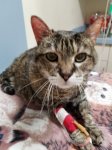
Our vet is the same way and I don't like it, although they did let me inside to show me how to give fluids.
The home treatment is generally this:
Once symptoms appear, so not drinking, not eating, nauseous (often looking like they want to eat but can't/won't), start with pain meds and the anti-nausea (ondansetron and Cerenia, vet should advise on dose and frequency). Give the anti-nausea time to kick in, then give an appetite stimulant. Hopefully that's enough to get her to eat, but sometimes you still need to assist feed. I keep a stash of Gerber baby meat 2nd foods on hand for assist-feeding, as well as syringes.
If she's still not acting right, then it's possible you need to increase dose of anti-nausea.
Fluids are only given if dehydrated (tacky gums, scruff not bouncing back like it should). You can always try tuna water or broth added to water to entice her to drink, just make sure it doesn't have onions and stuff in it.
When it seems she's back to normal while on meds, continue meds for about a day. I personally drop pain meds first, then the appetite stimulant, then the anti-nausea. I do it slowly so I know what to add back in if he starts feeling poorly.
If you look at my spreadsheet from March 16th you can see what I gave and when. That was his most recent pancreatitis attack.
It sounds like a lot, but it really is fairly easy to manage at home. And there's really nothing the vet would do that you can't at home, unless you really can't get her to eat or administer fluids.



 .
.